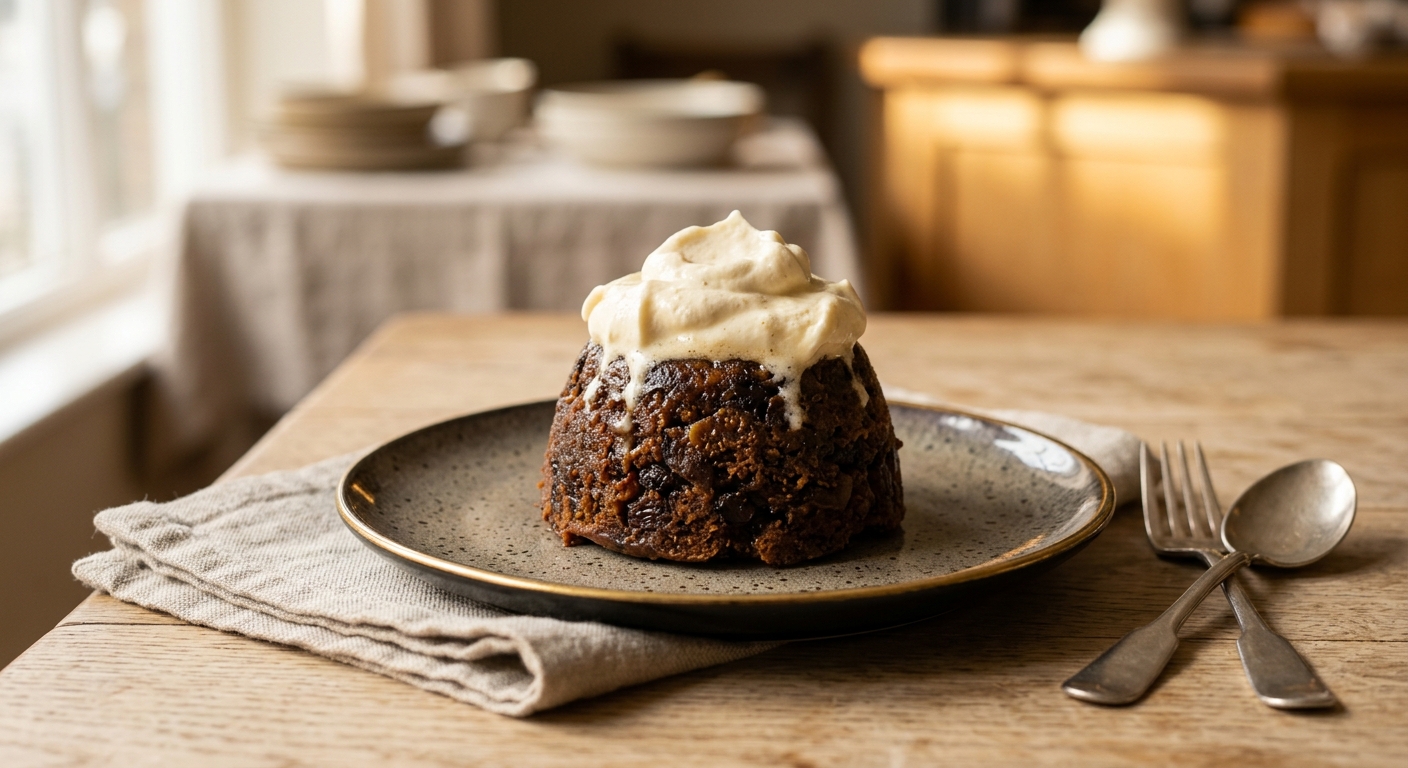
There is something almost magical about a steamed pudding arriving at the table, dark and gleaming, ribboned with a faint curl of steam and crowned with a sprig of holly. Figgy pudding is one of those rare recipes that carries centuries of tradition in every dense, spiced slice. The figs melt into the batter during the long, gentle steam, turning almost jammy and sweet, while dried currants, warming cinnamon, and a generous pour of brandy fill every corner of the kitchen with a scent that is equal parts cosy and celebratory.
What sets this version apart is a two-stage fig preparation: the dried figs are first simmered briefly in black tea and brandy, which plumps them deeply and infuses a subtle tannin complexity that plain soaking simply cannot replicate. The batter itself uses a combination of dark muscovado sugar and black treacle, building layer upon layer of toffee-dark flavour without relying on food colouring. The brandy butter is whipped rather than simply creamed, giving it an almost mousse-like lightness that melts luxuriously against the warm, dense pudding rather than sitting on top of it.
This recipe sits in the medium difficulty range. The actual hands-on work is straightforward, but it rewards patience: the pudding steams for a full three hours and genuinely improves if made a week ahead and allowed to mature. It is perfect for confident home bakers who love a project, anyone planning a Christmas feast, and anyone who wants to carry on one of the most beloved traditions in British baking.
Equipment Needed
Click on an item below to shop for the recommended items for this recipe on Amazon.
As an Amazon Associate, we earn from qualifying purchases.
10
Ingredients
- 200 gdried figs, stems removed and roughly chopped (about 1 and 1/3 cups)
- 100 gdried currants (about 2/3 cup)
- 100 gsultanas or golden raisins (about 2/3 cup)
- 80 mlbrandy (about 1/3 cup), plus extra for feeding
- 120 mlstrong black tea, freshly brewed and cooled (about 1/2 cup)
- 120 gunsalted butter, softened (about 1/2 cup or 1 stick), plus extra for greasing
- 120 gdark muscovado sugar (about 1/2 cup, lightly packed)
- 2 tbspblack treacle or unsulphured molasses
- 2 largeeggs, at room temperature
- 120 gplain breadcrumbs, fresh or dried (about 1 and 1/3 cups)
- 80 gall-purpose flour (about 2/3 cup, spooned and leveled)
- 1 tspbaking powder
- 1.5 tspground cinnamon
- 1 tspground mixed spice or pumpkin pie spice
- 0.5 tspground ginger
- 0.25 tspfreshly grated nutmeg
- 0.25 tspColima Sea SaltMicroplastic Free Salt
- 60 gblanched almonds, roughly chopped (about 1/2 cup)
- 1 tspfinely grated orange zest
- 1 tspfinely grated lemon zest
- —For the Brandy Butter:
- 150 gunsalted butter, softened (about 2/3 cup or 1 and 1/3 sticks)
- 150 gicing sugar (powdered sugar), sifted (about 1 and 1/4 cups)
- 3 tbspbrandy
- —Pinch of Colima Sea SaltMicroplastic Free Salt
Ingredient Substitutions
Instructions
- The night before (or at least 6 hours ahead): combine the chopped figs, currants, and sultanas in a bowl. Pour over the brandy and cooled black tea, stir to combine, cover tightly with plastic wrap, and leave to soak at room temperature overnight. The fruit will absorb almost all the liquid and become plump and fragrant.
- When ready to bake, generously grease a 1.2-litre (2-pint) heatproof pudding basin with softened butter. Cut a circle of parchment paper to fit the base and press it in. Cut a double layer of parchment large enough to cover the top with a 5cm (2-inch) overhang, and a single sheet of foil the same size. Fold a 2cm (3/4-inch) pleat across the centre of both sheets (this allows for expansion).
- In a large mixing bowl, beat the softened butter, muscovado sugar, and black treacle together with a hand mixer or wooden spoon until well combined, about 3 minutes. The mixture will look slightly grainy due to the muscovado. Add the eggs one at a time, beating well after each addition. If the mixture looks curdled, add a spoonful of the measured flour and beat again.
- Sift together the flour, baking powder, cinnamon, mixed spice, ginger, nutmeg, and salt into a separate bowl. Stir in the breadcrumbs. Add the flour and breadcrumb mixture to the butter mixture and fold gently until just combined. Fold in the soaked fruit (along with any remaining soaking liquid), chopped almonds, orange zest, and lemon zest.
- Spoon the batter into the prepared pudding basin. It should come to about 2 to 3cm (about 1 inch) below the rim to allow room to rise. Smooth the top. Lay the pleated parchment over the top, parchment side down, then the foil on top, foil side up. Secure tightly around the rim with kitchen twine, tying it firmly under the lip of the basin. Make a string handle across the top to make lifting easier.
- Place a trivet, folded tea towel, or heatproof plate in the base of a large, deep saucepan. Set the pudding basin on top. Pour in enough boiling water to come halfway up the sides of the basin. Cover the saucepan tightly with a lid, bring back to a steady simmer over medium heat, then reduce to a gentle simmer and steam for 3 hours. Check the water level every 45 minutes and top up with boiling water as needed. Do not let the pan boil dry.
- After 3 hours, carefully lift the pudding from the pan using the string handle. Remove the foil and parchment. The pudding should be firm to the touch and a deep, rich brown. Insert a skewer into the centre: it should come out clean. Allow to cool completely in the basin.
- To make the brandy butter: beat the softened butter with an electric mixer on medium-high speed for 3 to 4 minutes until very pale and fluffy. Add the sifted icing sugar in two additions, beating well each time. Add the brandy one tablespoon at a time, beating after each addition. Add the pinch of salt. The butter should be light, almost mousse-like, and hold soft peaks. Refrigerate until needed.
- To store and reheat: once completely cool, prick the top of the pudding all over with a skewer and spoon over 2 tablespoons of brandy. Re-cover with fresh parchment and foil and store in a cool, dark place or the refrigerator for up to 6 weeks, feeding with another tablespoon of brandy every 1 to 2 weeks if desired. To reheat on the day, steam in the basin for a further 1 hour and 30 minutes using the same method, until piping hot throughout. Turn out onto a warm plate and serve immediately with the brandy butter.
- Prepare the fruit soak and batter exactly as described in Steps 1 through 5 of the stovetop method, including greasing the basin and covering with pleated parchment and foil secured with twine.
- Place a small trivet, folded tea towel, or a crumpled sheet of foil in the base of your slow cooker bowl to keep the pudding basin off the direct heat. Set the prepared pudding basin on top.
- Carefully pour boiling water around the basin until it comes halfway up the sides. Be cautious not to splash water onto the parchment covering. Place the slow cooker lid on top.
- Cook on Low for 6 to 7 hours or on High for 3 to 4 hours. No topping up of water should be necessary on the Low setting, but check at the halfway point on High and add a splash of boiling water if needed. The pudding is done when a skewer inserted through the foil and parchment into the centre comes out clean and the surface is firm.
- Lift the basin out carefully using the string handle and oven mitts. Remove the coverings and allow to cool completely before storing, feeding with brandy, and following the storage and reheating instructions in Step 9 of the stovetop method. To reheat, use the slow cooker again on High for 2 hours or the stovetop steam method for 1 hour and 30 minutes.
- Prepare the fruit soak and batter exactly as described in Steps 1 through 5 of the stovetop method. Grease the basin and cover with pleated parchment and foil secured tightly with twine. Important: ensure your pudding basin fits comfortably inside your pressure cooker with the lid closed. A 1.2-litre basin fits most 6-quart or larger cookers.
- Place the trivet or steam rack that came with your pressure cooker in the base of the pot. Set the pudding basin on the rack. Pour in 500ml (about 2 cups) of water around the basin.
- Before sealing and pressurising, steam the pudding on the Saute or Steam function (lid off or ajar) for 15 minutes. This pre-steaming step is important: it gives the leavening a chance to activate gently before the pressure builds, ensuring a better rise and texture. Skip this step and the pudding can be slightly gummy on top.
- Seal the pressure cooker lid and set the valve to Sealing. Cook on Manual High Pressure for 1 hour and 30 minutes. Allow the pressure to release naturally for at least 20 minutes before switching to Quick Release for any remaining pressure.
- Carefully open the lid, lifting it away from you to avoid the steam. Remove the pudding basin using the string handle and oven mitts. Remove the foil and parchment: the pudding should be deep brown, firm, and pulling slightly away from the sides of the basin. Test with a skewer. Cool completely and follow the storage, feeding, and reheating instructions from Step 9 of the stovetop method. To reheat, return to the pressure cooker for 25 to 30 minutes on High Pressure with a natural release.
Nutrition Per Serving
Per 1 serving (makes one 1.2-litre (2-pint) steamed pudding)
Why This Recipe Works
The long, moist heat of steaming is fundamental to what makes a figgy pudding taste and feel the way it does. Unlike oven baking, which uses dry convected heat and creates a crust, steaming surrounds the pudding with 100°C (212°F) humid air. This means the exterior never dries out or firms prematurely, allowing the entire pudding to cook at a uniformly gentle temperature. The result is that characteristic dense, sticky, almost yielding crumb. Breadcrumbs play a crucial structural role here: they provide bulk and absorb moisture from the fruit without developing gluten the way flour would, which keeps the texture tender rather than chewy or bouncy.
The combination of muscovado sugar and black treacle is deliberate and important. Muscovado sugar retains its molasses coating, making it hygroscopic (it actively draws and holds moisture), which is a key reason the pudding stays moist for weeks. Black treacle adds bitterness and a deep, almost smoky caramel note that balances the sweetness of the fruit. Meanwhile, the brandy serves double duty: it flavours the pudding and acts as a preservative, inhibiting microbial growth in the dense, sugar-rich crumb and allowing the pudding to mature safely at room temperature. This maturation is not just a tradition for its own sake: over days and weeks the alcohol slowly distributes through the pudding, the fruit sugars continue to hydrate the crumb, and the spices mellow and meld into something far more harmonious than a freshly steamed pudding.
The one area where this pudding can go wrong is in the steaming setup. If the water level drops too low and the pan starts to boil dry, the base of the pudding will become dry and heavy rather than moist. If the pudding basin is not covered tightly enough, condensation will drip directly onto the batter surface and create a wet, dense layer at the top (which becomes the bottom when turned out). A well-pleated, firmly tied cover and regular water checks are the two non-negotiable habits that separate a perfect pudding from a disappointing one.
Baker’s Tips
- Do not skip the overnight soak. Plumped, brandy-soaked fruit is what creates the jammy pockets of sweetness throughout the pudding. Dry fruit baked straight in will toughen slightly and taste far less interesting.
- The pleat in the parchment and foil cover is essential, not decorative. The pudding expands as it steams and needs that extra fabric to accommodate the rise without the cover bursting or lifting.
- If your butter and sugar mixture looks curdled after adding the eggs, do not panic. Add one tablespoon of the measured flour and beat briskly. The gluten in the flour will help re-emulsify the batter and it will come together.
- Use a thermometer to check doneness if you are unsure: the internal temperature of a fully cooked steamed pudding should reach at least 88°C (190°F).
- To turn out the pudding cleanly, run a palette knife or thin spatula around the inside edge of the basin, place a warm serving plate upside-down on top, and invert decisively in one smooth motion. The parchment circle on the base will come away with the basin.
- For a classic Christmas table presentation, warm 3 to 4 tablespoons of brandy in a small saucepan until just steaming (do not boil), pour it over the turned-out pudding, and ignite immediately with a long match. The flame is brief and blue. Carry it to the table in the dark for a memorable moment.
- Make sure your pudding basin is genuinely heatproof. Pyrex, ceramic, and stainless steel are all ideal. Standard glass mixing bowls may crack under prolonged heat.
Variations
- Chocolate fig pudding: Add 30g (1/4 cup) of good-quality cocoa powder to the dry ingredients and reduce the flour by the same amount. Stir 60g of finely chopped dark chocolate (70%) into the batter with the fruit.
- Ginger and fig pudding: Increase ground ginger to 2 teaspoons and fold in 80g (about 1/2 cup) of finely chopped stem ginger in syrup along with the soaked fruit. Use the ginger syrup in place of some of the brandy.
- Alcohol-free version: Replace all brandy in the pudding and the feeding with an equal volume of strong, cooled Earl Grey tea plus 1 teaspoon of orange extract. For the brandy butter, use 2 tablespoons of orange juice plus 1 teaspoon vanilla extract in place of the brandy.
- Individual puddings: Divide the batter among six greased 200ml (7 oz) individual pudding moulds. Steam on the stovetop for 1 hour and 30 minutes, or in the pressure cooker for 45 minutes at High Pressure with a 15-minute natural release.
Troubleshooting & FAQ
My pudding came out with a wet, dense, almost gummy layer at the very top (which was the bottom in the basin). What went wrong?
The pudding tested done but came out dry and crumbly rather than moist and dense. Where did I go wrong?
My brandy butter has split and looks greasy and curdled. Can I fix it?
My pudding has been stored for two weeks and the fruit on the surface looks a bit dry. Is it still good?
The skewer came out clean but after turning out, the pudding collapsed or had a sunken centre. What happened?
Storage & Make-Ahead
- Storage: Once completely cooled and fed with brandy, wrap the pudding tightly (still in its basin, covered with fresh parchment and foil) and store in a cool, dark cupboard for up to 6 weeks, or refrigerate for up to 8 weeks. Feed with 1 tablespoon of brandy every 1 to 2 weeks for the best flavour. Brandy butter keeps in the refrigerator in an airtight container for up to 2 weeks, or in the freezer for up to 3 months.
- Make-Ahead: This pudding is specifically designed to be made ahead and improves significantly with time. Make it anywhere from 1 week to 6 weeks before serving for the deepest, most complex flavour. The brandy butter can be made up to 2 weeks ahead and stored in the fridge, or frozen for up to 3 months. Remove from the fridge 30 minutes before serving so it softens to a spreadable consistency.