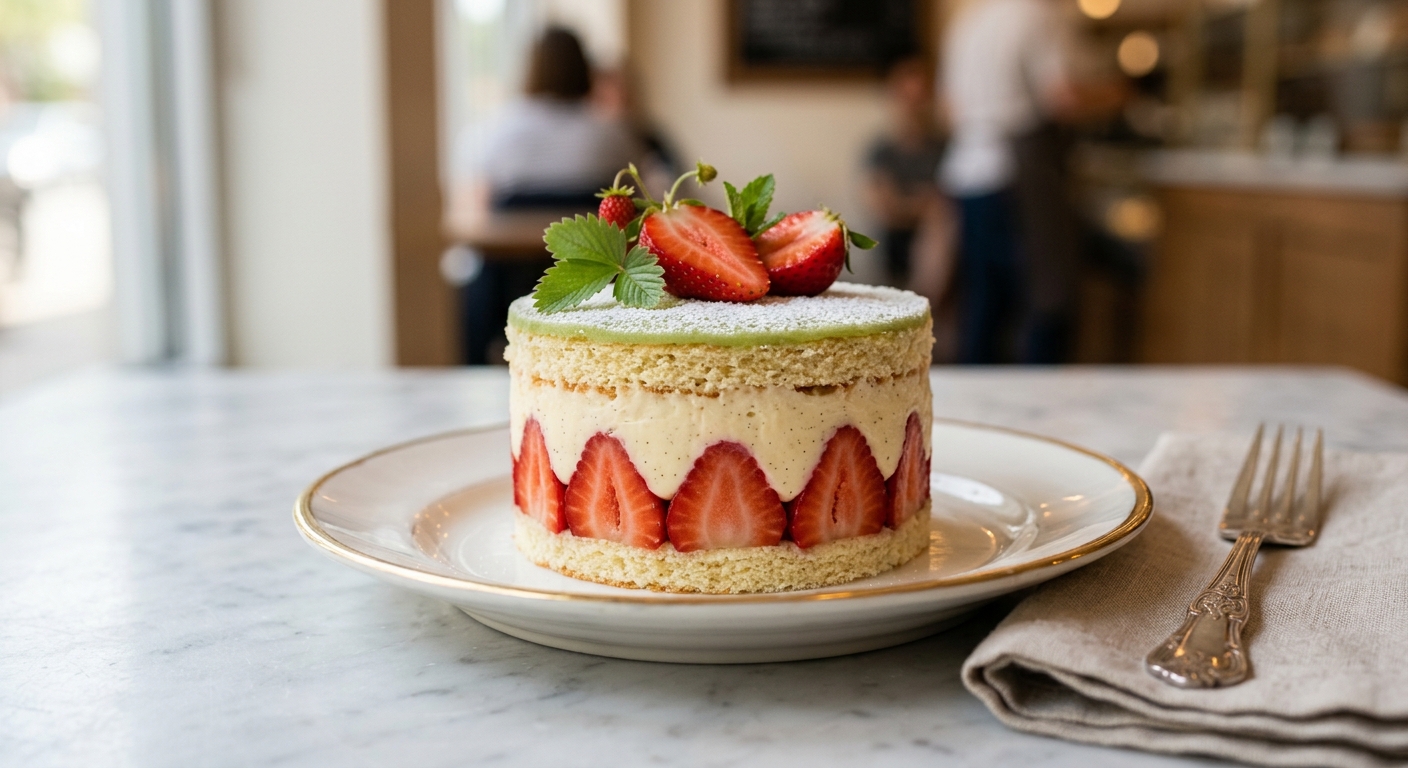
There is a moment in early summer when strawberries are so ripe, so perfectly fragrant, that they deserve something more than a bowl and a spoon. The Fraisier is that something. A jewel of French patisserie, this cake is as beautiful to look at as it is to eat: a ring of halved strawberries pressed against a thin acetate collar, their cut faces gleaming like stained glass, filled with a cloud of vanilla mousseline cream and crowned with a flush of fresh fruit. It is the kind of cake that makes people pause before they cut into it.
What sets this version apart is the mousseline cream itself. A classic creme mousseline is a pastry cream enriched with softened butter beaten in at the end, creating something richer and more stable than whipped cream but lighter and more luscious than buttercream. We use real vanilla bean paste for depth, and a touch of kirsch brushed onto the genoise layers to keep them tender and to echo the sweetness of the strawberries. The technique of pressing the strawberries flat against the ring mold is a small step that transforms a homemade cake into something that looks genuinely professional.
This recipe sits firmly in the medium to advanced category. It involves several components made across two days, but none of them is difficult on its own. If you can make a pastry cream and bake a sponge, you can make a Fraisier. It is the perfect project for a confident weekend baker who wants to stretch their skills, and it is ideal for birthdays, anniversaries, or any occasion where you want to make someone feel truly celebrated.
Equipment Needed
Click on an item below to shop for the recommended items for this recipe on Amazon.
As an Amazon Associate, we earn from qualifying purchases.
10
Ingredients
- Mousseline (about 1 Cup Plus 2 Tbsp)
- 4 largeeggs, at room temperature
- 120 gcaster sugar (about 1/2 cup plus 1 tbsp)
- 120 gall-purpose flour, sifted (about 1 cup, spooned and leveled)
- 30 gunsalted butter, melted and cooled (about 2 tbsp)
- —Pinch of Colima Sea SaltMicroplastic Free Salt
- 500 mlwhole milk (about 2 cups plus 2 tbsp)
- 1 tspvanilla bean paste (or seeds of 1 vanilla pod)
- 6 largeegg yolks
- 130 gcaster sugar for pastry cream (about 1/2 cup plus 2 tbsp)
- 50 gcornstarch (about 1/3 cup)
- 250 gunsalted butter, very soft and at room temperature
- Soaking Syrup
- 800 gfresh strawberries (about 1.75 lbs), hulled and wiped clean
- 80 mlwater (about 1/3 cup)
- 60 gcaster sugar for soaking syrup (about 1/4 cup)
- 30 mlkirsch or framboise liqueur (about 2 tbsp), optional
- 150 gmarzipan or white fondant, for the top layer (about 5 oz), optional
- —Extra fresh strawberries and edible flowers to decorate, as desired
Ingredient Substitutions
Instructions
- Make the pastry cream one day ahead if possible. Heat the milk and vanilla bean paste in a medium saucepan over medium heat until it just begins to steam. Do not let it boil. Meanwhile, whisk the egg yolks and 130g sugar in a bowl until pale and slightly thickened, about 2 minutes. Whisk in the cornstarch until no lumps remain.
- Pour about one third of the hot milk into the yolk mixture, whisking constantly to temper the eggs. Pour this mixture back into the saucepan with the remaining milk and cook over medium heat, whisking vigorously and continuously, until the cream thickens and large bubbles begin to plop on the surface, about 2 to 3 minutes. The cream must boil briefly to cook out the cornstarch. Remove from heat.
- Pour the hot pastry cream into a clean shallow container. Press a sheet of plastic wrap directly onto the surface to prevent a skin forming. Refrigerate until completely cold, at least 2 hours or overnight. The cream will become very firm.
- Bake the genoise. Preheat your oven to 350°F (175°C). Grease one 8-inch round cake pan and line the bottom with parchment paper. In a large heatproof bowl set over a saucepan of barely simmering water (the bowl should not touch the water), combine the 4 whole eggs and 120g sugar. Whisk constantly until the mixture is warm to the touch and the sugar has dissolved, about 4 to 5 minutes.
- Remove the bowl from the heat and beat with a hand mixer or stand mixer on high speed until the mixture has tripled in volume, is very pale and thick, and falls in a thick ribbon from the whisk that holds its shape for a few seconds (the ribbon stage), about 8 to 10 minutes. Sift the flour and pinch of salt over the batter in three additions, folding gently with a large rubber spatula using a wide sweeping motion from the bottom of the bowl. Stop as soon as no dry streaks remain. Pour the melted, cooled butter down the side of the bowl and fold in just until combined. Do not overmix.
- Pour the batter into the prepared pan and bake for 20 to 22 minutes, until the sponge is golden, has pulled away slightly from the edges, and a toothpick inserted in the center comes out clean. Let cool in the pan for 5 minutes, then turn out onto a cooling rack and cool completely.
- Make the soaking syrup. Combine the 80ml water and 60g sugar in a small saucepan and heat over medium heat, stirring, until the sugar dissolves. Remove from heat and stir in the kirsch if using. Set aside to cool.
- Finish the mousseline cream. Remove the cold pastry cream from the refrigerator and beat it vigorously with a hand mixer until it is smooth and lump-free, about 2 minutes. It is very important that the pastry cream is at the same temperature as the butter before you begin combining them. Let the pastry cream sit at room temperature for 20 minutes if needed. Beat the 250g soft butter in a separate large bowl until it is pale, very fluffy, and almost white, about 4 to 5 minutes. Add the beaten pastry cream to the butter in three additions, beating well after each addition. The finished mousseline should be smooth, glossy, and hold soft peaks. If it looks curdled or greasy, the temperatures were mismatched. Warm the bowl briefly over a hot water bath and beat again.
- Assemble the Fraisier. Slice the cooled genoise horizontally into two even layers. Line the sides of your 8-inch cake ring or springform pan with an acetate collar (this is key for the clean reveal). Place the bottom genoise layer inside the ring. Brush generously with soaking syrup. Select the most uniformly sized strawberries, halve them, and press them cut-side-out all around the inside of the ring, standing them upright against the acetate.
- Transfer about half the mousseline cream into a piping bag. Pipe cream into the gaps between the strawberries along the edge, pressing gently to ensure no air pockets. Spread a generous layer of mousseline in the center of the sponge. Hull and halve the remaining strawberries and scatter them over the cream layer in an even layer. Cover with more mousseline, smoothing it level. Place the second sponge layer on top, pressing gently. Brush with the remaining soaking syrup. Spread a final thin layer of mousseline over the top, smoothing with an offset spatula.
- If using a marzipan top, roll the marzipan on a surface lightly dusted with icing sugar to a circle just under 8 inches in diameter and lay it over the top of the cake. Refrigerate the assembled cake for a minimum of 3 hours, or overnight, until fully set. To serve, remove the ring and peel away the acetate collar carefully. Decorate the top with fresh strawberries and edible flowers.
- Day 1, morning: Make the pastry cream following Steps 1 to 3 from the Oven method. Cover and refrigerate overnight. The cream will be very thick and cold, which is exactly what you want for beating into mousseline the next day.
- Day 1, afternoon: Bake the genoise following Steps 4 to 6 from the Oven method. Once completely cool, wrap the whole un-sliced sponge tightly in plastic wrap and store at room temperature overnight. Wrapping it whole rather than sliced prevents it from drying out.
- Day 1, evening or Day 2, morning: Make the soaking syrup. Let it cool to room temperature and store in a small jar in the refrigerator. The kirsch will keep the syrup fresh and fragrant.
- Day 2, morning: Remove the pastry cream from the refrigerator 30 minutes before finishing the mousseline, so it can soften slightly to room temperature. Prepare the butter as described in Step 8 of the Oven method. Finish the mousseline cream. This step requires both components to be at cool room temperature (around 65 to 68°F / 18 to 20°C) for a smooth emulsification. If the pastry cream is still very cold and firm, the mousseline may break. If this happens, warm the bowl briefly in a hot water bath and beat again.
- Day 2, assembly: Unwrap the sponge and slice it into two layers. Assemble the Fraisier following Steps 9 to 11 of the Oven method. Refrigerate for a minimum of 4 hours, ideally until the following morning. An overnight set gives the cleanest slices and the most polished look when you remove the ring.
- To serve: Remove the cake from the refrigerator 20 to 30 minutes before serving so the mousseline softens slightly. Cold mousseline can be a little firm and waxy straight from the fridge. Remove the ring and acetate collar, decorate, and serve.
Nutrition Per Serving
Per 1 serving (makes one 8-inch round layer cake (approximately 10 slices))
Why This Recipe Works
The magic of mousseline cream lies in emulsification. Pastry cream on its own is a starch-thickened custard, stable and set but not particularly light. Beating softened butter into it forces fat globules to coat the starch networks, creating a cream that is simultaneously richer and airier than either component alone. The critical variable is temperature: both the pastry cream and the butter must be at a compatible cool room temperature, around 65 to 68°F (18 to 20°C). If the pastry cream is too cold and firm, it will not incorporate smoothly and the mousseline will split into greasy curds. If the butter is too warm and soft, the fat will melt rather than emulsify, and the cream will be loose and greasy. This is why the two-day method is so useful: you can control both components precisely.
The genoise sponge is leavened entirely by air beaten into the whole eggs and sugar over gentle heat. Warming the eggs before whipping serves two purposes: it partially denatures the egg proteins, which allows them to stretch further and hold more air bubbles, and it dissolves the sugar completely, which contributes to a stable foam. The result is a batter capable of holding a tremendous amount of air, producing a fine, even crumb. The folding step is critical: overmixing deflates those precious bubbles and produces a flat, rubbery sponge. Stop as soon as the flour is just incorporated.
The soaking syrup is not merely optional moisture: it serves as a flavour bridge between the neutral sponge and the bright, acidic strawberries. Kirsch, distilled from cherries, has a remarkable affinity for both strawberries and vanilla, amplifying both without tasting of cherry itself. If you find the cake is dry after a few days in the refrigerator, it is almost always because the syrup was applied too sparingly. The sponge should feel noticeably moist, almost wet, after brushing. It will absorb fully as it chills and will not be soggy in the finished cake.
Baker’s Tips
- Use the ripest, most fragrant strawberries you can find. Because the strawberries are essentially uncooked and front-and-center in every bite, their quality makes an enormous difference. Avoid refrigerated supermarket berries if possible. Farmers market strawberries in peak season will transform this cake.
- An acetate collar is not optional for a clean finish. Without it, the mousseline will stick to the pan and tear when you unmold. Acetate strips are inexpensive and widely available online. Cut them to the height of your pan.
- When selecting strawberries for the border ring, choose ones that are as close to the same height as the depth of your ring. Halve them and check they fit standing upright before pressing them in. A clean, even border is the hallmark of a well-made Fraisier.
- Beat the butter for the mousseline for longer than you think necessary. It should be almost white, extremely fluffy, and very light before you add the pastry cream. Under-beaten butter leads to a denser, heavier cream.
- When slicing the genoise, use a long serrated bread knife and a gentle sawing motion with almost no downward pressure. Mark the midpoint of the cake all the way around with toothpicks first as a guide, then slice through using the toothpicks as a level reference.
- Let the assembled cake sit at room temperature for 20 to 30 minutes before serving. Cold mousseline has a slightly waxy texture, but at cool room temperature it becomes silky and melts on the tongue exactly as it should.
- To get clean, restaurant-quality slices, dip your knife in hot water and wipe it dry between every single cut. This prevents the mousseline from dragging and keeps the strawberry border perfectly visible in each slice.
Variations
- Fraisier Pistache: Replace 20g of the flour in the genoise with finely ground pistachios, and stir 40g of good-quality pistachio paste into the finished mousseline for a nutty, fragrant variation. Top with a pale green marzipan disk and whole pistachios.
- White Chocolate Mousseline: Melt 80g good-quality white chocolate and let it cool to room temperature. Beat it into the finished mousseline for a sweeter, richer cream with a subtle ivory colour.
- Individual Fraisiers: Use 8cm (3-inch) individual entremet rings lined with acetate strips. Divide the components evenly across 6 to 8 individual cakes. Chill as directed. These make an impressive plated dessert for a dinner party.
- Raspberry Fraisier (Framboisier): Replace all the strawberries with fresh raspberries. The more tart flavour pairs beautifully with the rich mousseline. Swap the kirsch for chambord or elderflower cordial in the soaking syrup.
Troubleshooting & FAQ
My mousseline cream looks curdled and greasy. What went wrong?
My genoise sponge came out flat and dense. Where did I go wrong?
The strawberry border slipped and is no longer standing upright after unmolding. How do I prevent this?
The pastry cream has lumps in it. Can I still use it for mousseline?
My finished cake is weeping liquid after a day in the fridge. Is it ruined?
Storage & Make-Ahead
- Storage: Store the assembled Fraisier covered in the refrigerator for up to 3 days. The strawberries will gradually release juice, so the cake is at its absolute best on day 1 or 2. Do not freeze the assembled cake, as the mousseline cream and fresh strawberries do not freeze well. Individual components (baked sponge, finished mousseline) can be frozen separately for up to 1 month.
- Make-Ahead: The pastry cream can be made up to 3 days ahead and refrigerated. The genoise sponge can be baked up to 2 days ahead, wrapped, and stored at room temperature, or frozen for up to 1 month. The soaking syrup keeps in the refrigerator for up to 2 weeks. The fully assembled cake can be made the day before serving, refrigerated overnight, and decorated just before serving.