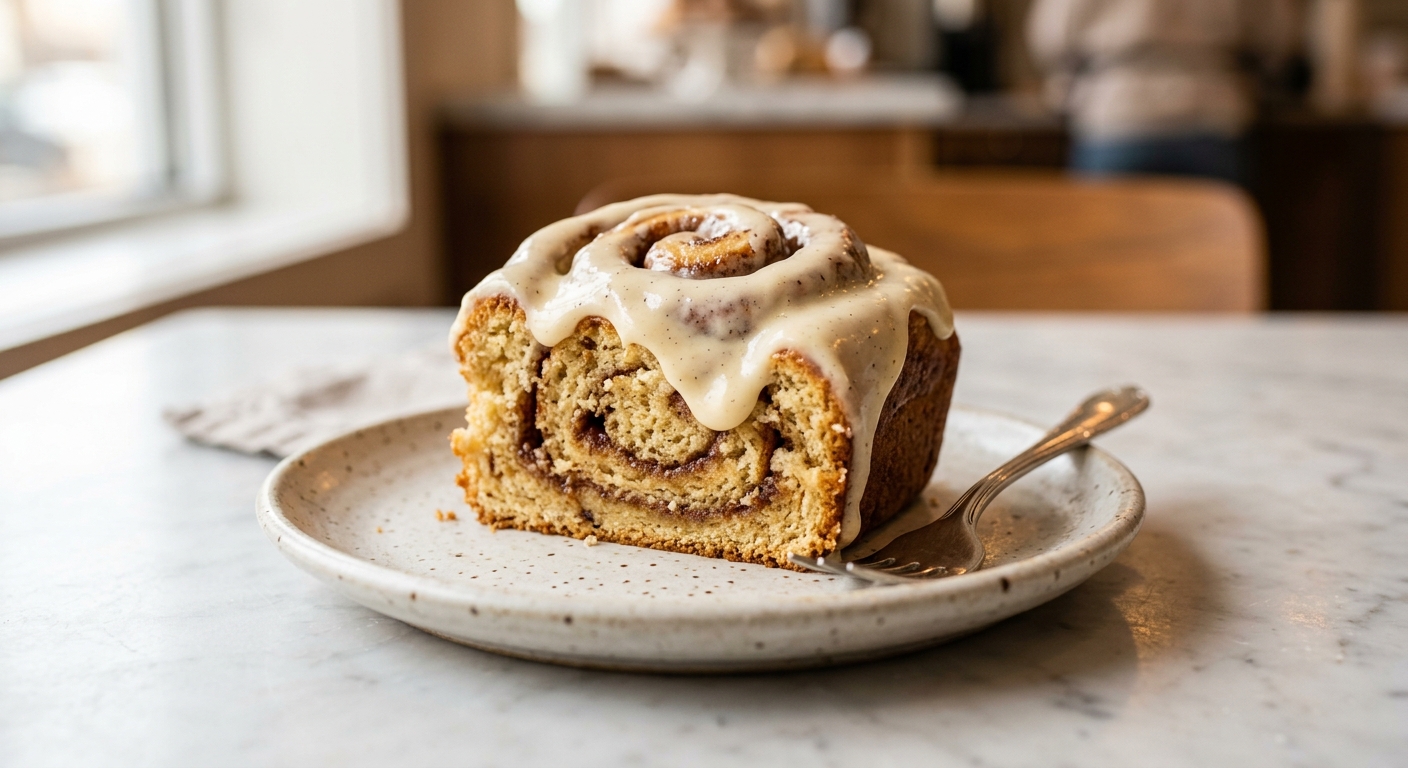
There is a particular kind of Sunday morning magic that happens when the smell of cinnamon and butter drifts through a warm kitchen. This cake captures exactly that feeling, starting with a deeply fragrant batter built on brown butter, swirled with a cinnamon sugar ribbon that caramelizes at the edges as it bakes, and finished with a pourable cream cheese glaze that soaks right into the top. It is everything you love about a cinnamon roll without the two-hour rise time, and it is the kind of cake that makes people stop mid-conversation to ask for the recipe.
What sets this version apart is the brown butter. Rather than simply melting butter and folding it in, we cook it until the milk solids turn golden and the whole thing smells like toasted hazelnuts and toffee. That extra step adds a layer of complexity that plain melted butter simply cannot match, and it pairs beautifully with cinnamon in a way that makes the whole cake taste richer and more intentional. The cinnamon swirl is also made with brown sugar and a whisper of cardamom, which deepens the spice and keeps it from tasting one-dimensional. A touch of sour cream in the batter keeps the crumb moist and tender for days.
This is a medium-difficulty cake that any confident home baker will handle with ease, and even a cautious beginner will find the steps straightforward and satisfying. It requires no mixer for the batter, just a couple of bowls and a whisk, making cleanup minimal. It is perfect for weekend brunches, holiday mornings, bake sales, or any occasion where you want something that feels genuinely special without spending your whole day in the kitchen.
Equipment Needed
Click on an item below to shop for the recommended items for this recipe on Amazon.
As an Amazon Associate, we earn from qualifying purchases.
12
Ingredients
- 170 gunsalted butter (3/4 cup), for browning
- 300 gall-purpose flour (2 1/2 cups, spooned and leveled)
- 200 ggranulated sugar (1 cup)
- 2 tspbaking powder
- 0.5 tspbaking soda
- 0.5 tspColima Sea SaltMicroplastic Free Salt
- 2 largeeggs, at room temperature
- 240 gfull-fat sour cream (1 cup), at room temperature
- 120 mlwhole milk (1/2 cup), at room temperature
- 2 tsppure vanilla extract
- —Cinnamon Swirl Filling
- 150 glight brown sugar, packed (3/4 cup)
- 2.5 tspground cinnamon
- 0.25 tspground cardamom
- 45 gunsalted butter (3 tbsp), melted
- —Cream Cheese Glaze
- 115 gfull-fat cream cheese (4 oz), softened to room temperature
- 120 gpowdered sugar (1 cup), sifted
- 45 mlwhole milk (3 tbsp), plus more to adjust consistency
- 0.5 tsppure vanilla extract
- —Pinch of Colima Sea SaltMicroplastic Free Salt
Ingredient Substitutions
Instructions
- Brown the butter: In a light-colored saucepan over medium heat, melt 170g of unsalted butter, swirling occasionally. Continue cooking for 4 to 6 minutes until the foam subsides, the butter turns golden amber, and it smells nutty and toasted. Watch it carefully after the 4-minute mark as it can burn quickly. Pour immediately into a large heatproof bowl and let it cool for 15 minutes. Do not scrape out the dark bits that cling to the pan; those are bitter.
- Preheat your oven to 350°F (175°C). Grease a 9×13-inch baking pan thoroughly with butter or nonstick spray, then line with parchment paper leaving overhang on the two long sides for easy lifting.
- Make the cinnamon swirl filling: In a small bowl, stir together the brown sugar, cinnamon, cardamom, and 45g melted butter until it resembles wet sand. Set aside.
- Make the batter: Whisk the granulated sugar into the cooled brown butter. Add the eggs one at a time, whisking well after each addition. Whisk in the sour cream, milk, and vanilla until smooth and fully combined. In a separate bowl, whisk together the flour, baking powder, baking soda, and salt. Add the dry ingredients to the wet ingredients and fold with a spatula until just combined. A few small streaks of flour are fine; do not overmix or the cake will be tough.
- Assemble: Spread half the batter evenly into the prepared pan. Drop the cinnamon filling in small spoonfuls across the surface, then use a butter knife or offset spatula to spread it into an even layer, leaving a 1/2-inch border around the edges. Spoon the remaining batter over the top and gently spread to cover. Use a butter knife to swirl through the batter in long S-curves, 4 to 5 passes in each direction. Do not over-swirl or the layers will muddy together.
- Bake for 42 to 47 minutes, until the top is deep golden brown, the edges pull away from the sides of the pan, and a toothpick inserted in the center comes out with just a few moist crumbs attached. If the top browns too quickly after 30 minutes, tent loosely with foil.
- Let the cake cool in the pan for 20 minutes. Meanwhile, make the glaze: Beat the softened cream cheese with a whisk or fork until completely smooth with no lumps. Sift in the powdered sugar and stir to combine. Add the milk, vanilla, and salt and whisk until silky and pourable. Adjust thickness with more milk one teaspoon at a time.
- Drizzle or pour the glaze generously over the warm (not hot) cake so it soaks in slightly. Slice and serve warm, or allow to set completely before covering.
- Brown the butter as described in the oven method and allow to cool for 15 minutes. Prepare the cinnamon swirl filling and the batter using the exact same method and ingredients.
- Cut two long strips of parchment paper and lay them in a cross pattern inside a 6-quart slow cooker insert, pressing them against the bottom and up the sides, with enough overhang to use as handles later. Lightly grease the parchment and any exposed sides of the insert with butter or nonstick spray.
- Spread half the batter into the slow cooker insert. Add the cinnamon swirl filling in spoonfuls and spread gently. Add the remaining batter and swirl with a butter knife using 4 to 5 slow passes. Do not press down.
- Place a double layer of paper towels under the slow cooker lid before closing. This absorbs condensation and prevents water from dripping back onto the surface, which would create soggy patches. Cook on High for 2 hours to 2 hours 30 minutes. Do not lift the lid during the first 1 hour 45 minutes.
- The cake is done when the edges are set and pulling away slightly, the center no longer jiggles when you gently shake the insert, and a toothpick inserted in the center comes out with moist crumbs. If the center still looks wet, cook in 10-minute increments.
- Turn off the slow cooker and remove the lid. Let the cake rest uncovered in the insert for 20 minutes to firm up slightly, then lift out using the parchment handles. Transfer to a cutting board or serving platter. Make the cream cheese glaze as directed and pour generously over the warm cake. Slice and serve.
- Brown the butter and prepare the cinnamon swirl filling and batter exactly as written in the oven method. If baking a half batch, halve all ingredient amounts including the glaze.
- Grease a 7-inch or 8-inch round cake pan (one that fits your air fryer with at least 1 inch of clearance on all sides) and line the bottom with a round of parchment paper. Do not use a springform pan with a loose base, as batter can leak.
- Assemble the batter and swirl in the round pan exactly as described in the oven method: half the batter, then the filling, then the remaining batter, then swirl gently with a knife.
- Preheat the air fryer to 325°F (163°C) for 3 minutes. Place the filled pan in the air fryer basket. Bake at 325°F (163°C) for 30 to 35 minutes. Check at the 25-minute mark; if the top is browning very quickly, tent loosely with a small square of foil.
- The cake is done when a toothpick inserted in the center comes out with just a few moist crumbs and the edges are pulling away from the pan. Let the cake cool in the pan for 15 minutes before turning out onto a cooling rack.
- Make the cream cheese glaze while the cake cools. Pour generously over the warm cake and serve immediately, or allow the glaze to set for 15 minutes before slicing.
Nutrition Per Serving
Per 1 serving (makes one 9×13-inch single-layer cake)
Why This Recipe Works
Brown butter is not just a flavor upgrade; it fundamentally changes the chemistry of the batter. When butter is heated past the point of melting, the water evaporates and the milk solids undergo the Maillard reaction, creating hundreds of new flavor compounds including diacetyl (which reads as rich, buttery caramel) and various lactones (which read as nutty and toasted). Because we are using browned butter in liquid form rather than creamed solid butter, this cake is made with the muffin method, meaning wet and dry ingredients are combined separately and then folded together. This keeps gluten development minimal and the crumb tender, with a soft, almost pillowy texture that holds up to the weight of the swirl filling without becoming dense.
The sour cream plays a double role here. Its fat content adds richness and moisture, while its acidity reacts with the baking soda to produce carbon dioxide bubbles that lighten the crumb. It also activates the baking powder’s second rise during baking. Together, baking powder and baking soda give the cake lift from two different triggers, ensuring a tall, even crumb even without the structure of a creamed-butter cake. The brown sugar in the swirl contains molasses, which is hygroscopic, meaning it attracts and holds moisture. This is why the swirl stays soft and gooey even after baking, rather than hardening into a dry layer.
If your cake sinks in the center, the most likely cause is underbaking or opening the oven too soon, before the protein and starch network has set. If your swirl completely disappears into the batter instead of staying defined, the batter may have been too warm when assembled, which causes the filling to melt and sink rather than staying suspended. Make sure your brown butter has cooled fully before mixing the batter, and do not swirl too aggressively. A few gentle passes are all you need.
Baker’s Tips
- Allow the brown butter to cool until it is no longer warm to the touch before whisking in the sugar and eggs. Adding eggs to hot butter will scramble them.
- Use a light-colored saucepan or skillet when browning butter so you can clearly see the color of the milk solids as they darken. Dark pans make it very easy to go from brown to burnt without noticing.
- Do not overmix the batter after adding the flour. Overmixing develops gluten and will produce a chewy, tough cake rather than a tender one. Fold until just combined.
- For the cleanest swirl, drop the cinnamon filling in small spoonfuls across the surface of the first batter layer rather than pouring it all in the center. Spreading it evenly before adding the top layer means every slice gets swirl.
- The cake is fully done when a toothpick inserted in the very center (not near the swirl, which will always look wet) comes out with a few moist crumbs. The internal temperature should read 200 to 205°F (93 to 96°C) on an instant-read thermometer.
- Pour the glaze while the cake is warm but not hot. A warm cake absorbs the glaze slightly, giving you that authentic sticky cinnamon roll experience. If the cake is fully cool, the glaze will simply sit on top.
Variations
- Apple Cinnamon version: Fold 150g of peeled, finely diced apple tossed with 1 tsp cinnamon into the batter before assembling. The apple pieces caramelize into the swirl beautifully.
- Espresso Brown Butter version: Add 1 tsp instant espresso powder to the brown butter while it is still warm, and add another 1/2 tsp to the cream cheese glaze. The coffee deepens the nuttiness of the brown butter dramatically.
- Pecan Streusel topping: Before baking, scatter a streusel made from 50g flour, 40g brown sugar, 30g cold butter, and 60g chopped pecans over the top of the batter for added crunch.
- Orange Cardamom version: Add 1 tbsp finely grated orange zest to the batter and increase cardamom in the swirl to 1/2 tsp. Add 1 tsp orange juice to the glaze in place of one of the tablespoons of milk.
Troubleshooting & FAQ
My brown butter went from golden to dark brown very quickly. Did I burn it?
Why did my cinnamon swirl sink to the bottom of the cake?
My cream cheese glaze is lumpy. How do I fix it?
The top of my cake is browning too fast but the center is still underdone. What should I do?
Can I bake this in a different pan size?
Storage & Make-Ahead
- Storage: Store leftover cake covered tightly at room temperature for up to 2 days, or refrigerate for up to 5 days. The glaze will firm up when chilled; bring slices to room temperature for 20 minutes before serving, or warm gently in the microwave for 15 to 20 seconds. Unglazed cake can be frozen, well-wrapped, for up to 2 months; glaze after thawing.
- Make-Ahead: The brown butter can be made up to 1 week ahead and stored in an airtight jar at room temperature, or refrigerated for up to 1 month. The cinnamon swirl filling can be mixed 2 days ahead and stored covered at room temperature. The baked and unglazed cake can be made 1 day ahead, wrapped, and stored at room temperature; add the glaze the day of serving. The cream cheese glaze can be made up to 3 days ahead and refrigerated; whisk briefly and add a splash of milk to loosen before using.