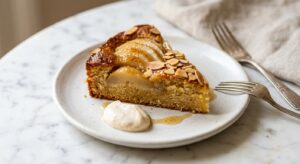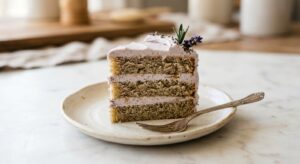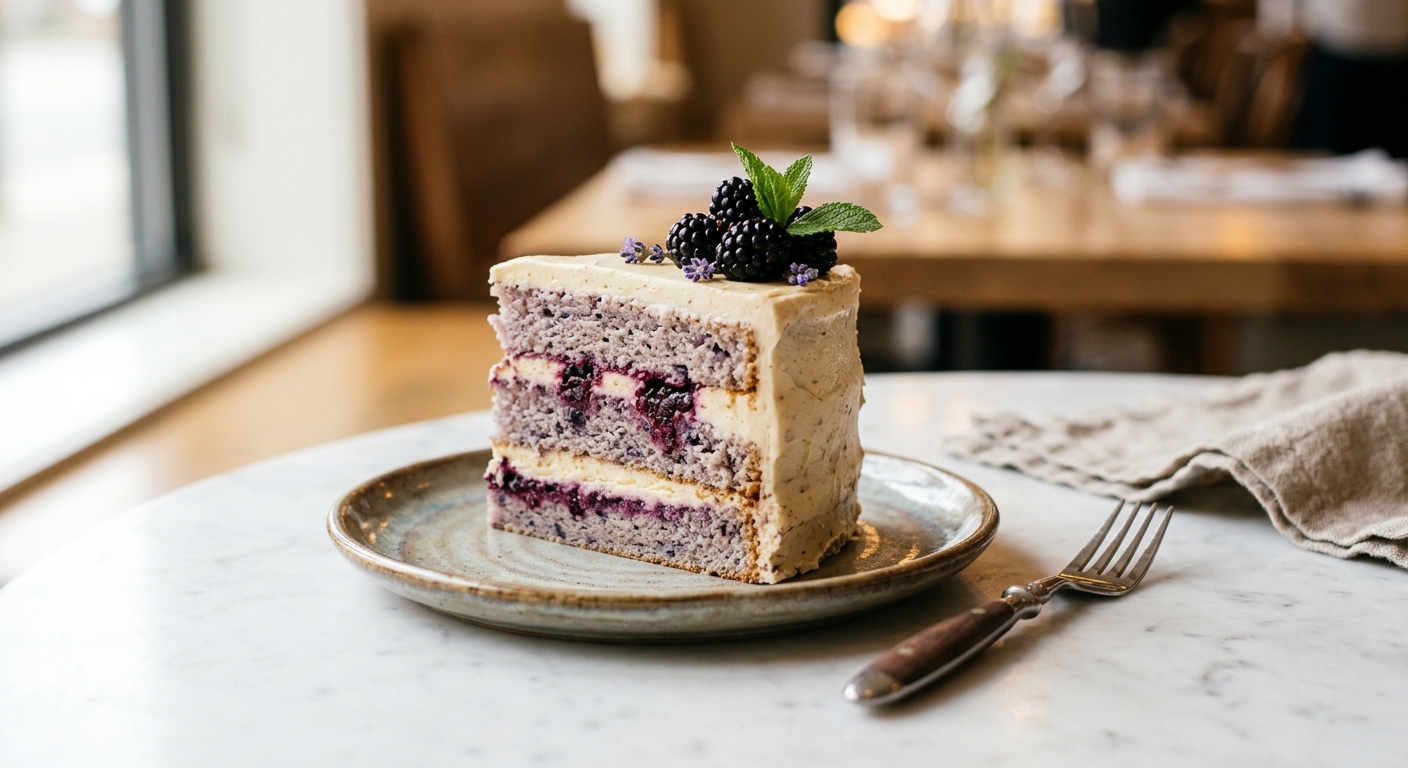
There is something almost magical about the pairing of blackberries and lavender. Both carry a gentle wildness to them, a whisper of summer meadows and hedgerows heavy with fruit. This cake captures exactly that feeling: layers of soft, lavender-scented vanilla sponge, each one split and filled with a glossy blackberry compote that bursts with jammy, slightly tart intensity, all brought together under a cloud of honey mascarpone frosting that is rich without being heavy. Finished with a cascade of fresh blackberries and a scatter of dried lavender buds, it is as beautiful to look at as it is to eat.
What sets this version apart is a two-part approach to lavender flavour. The dried lavender buds are steeped directly in warm whole milk before being added to the batter, which coaxes out their floral, herbaceous oils gently and evenly, without any soapy bitterness. A second hit of lavender comes from a simple lavender sugar made by blitzing buds with granulated sugar, which is creamed into the butter for the base of the cake. This layered flavouring technique means the lavender is present but never overwhelming, fragrant but always balanced by the deep berry fruit and the mild sweetness of the honey frosting.
This cake sits firmly in the medium difficulty range. There are a few components, the sponge layers, the compote, and the frosting, but each one is genuinely straightforward, and all three can be made ahead and assembled when you are ready. It is ideal for a weekend bake when you want to make something genuinely impressive for a birthday, a garden party, or simply because the blackberries at the market looked too good to resist.
Equipment Needed
Click on an item below to shop for the recommended items for this recipe on Amazon.
As an Amazon Associate, we earn from qualifying purchases.
12
Ingredients
- Compote
- 240 mlwhole milk (1 cup)
- 2 tspdried culinary lavender buds, divided
- 300 ggranulated sugar (1 1/2 cups), divided
- 300 gall-purpose flour (2 1/2 cups, spooned and leveled)
- 2.5 tspbaking powder
- 0.5 tspbaking soda
- 0.75 tspColima Sea SaltMicroplastic Free Salt
- 170 gunsalted butter, at room temperature (3/4 cup, 1.5 sticks)
- 3 largeeggs, at room temperature
- 2 tsppure vanilla extract
- 120 gsour cream, at room temperature (1/2 cup)
- 340 gfresh or frozen blackberries (about 12 oz)
- 75 ggranulated sugar (6 tbsp)
- 1 tbspfresh lemon juice
- 1 tbspcornstarch mixed with 1 tbsp cold water (slurry)
- Frosting
- 500 gmascarpone cheese, cold (about 2 1/4 cups)
- 360 mlheavy whipping cream, cold (1 1/2 cups)
- 60 gpowdered sugar, sifted (1/2 cup)
- 3 tbspgood-quality honey
- 1 tsppure vanilla extract
- —Fresh blackberries and dried lavender buds, to decorate
Ingredient Substitutions
Instructions
- Make the lavender milk: Warm the whole milk in a small saucepan over low heat until steaming, about 2 to 3 minutes. Do not let it boil. Remove from heat, stir in 1 1/2 teaspoons of the dried lavender buds, and let steep for 15 minutes. Strain through a fine-mesh sieve, pressing gently on the buds. Discard the buds and let the milk cool to room temperature.
- Make the lavender sugar: Place the remaining 1/2 teaspoon of dried lavender buds in a small food processor or spice grinder with 2 tablespoons of the measured granulated sugar. Blitz for 20 to 30 seconds until the lavender is finely ground into the sugar. Set aside.
- Prep and preheat: Preheat your oven to 350°F (175°C). Grease three 8-inch round cake pans with butter, line the bottoms with parchment paper circles, and lightly flour the sides, tapping out any excess.
- Mix the dry ingredients: In a medium bowl, whisk together the flour, baking powder, baking soda, and salt. Set aside.
- Cream butter and sugars: In the bowl of a stand mixer fitted with the paddle attachment (or using a hand mixer), beat the room-temperature butter with the lavender sugar and the remaining granulated sugar on medium-high speed for 4 to 5 full minutes, until the mixture is very pale, fluffy, and almost doubled in volume. Do not rush this step as it builds the cake’s structure.
- Add eggs and vanilla: With the mixer on medium speed, add the eggs one at a time, beating for 30 seconds after each addition and scraping down the bowl. Add the vanilla extract and beat to combine. The mixture may look slightly curdled at this point, which is normal.
- Alternate wet and dry: Reduce the mixer to low. Add the flour mixture in three additions, alternating with the lavender milk and sour cream (add them together as one combined wet addition) in two additions, beginning and ending with flour. Mix just until each addition is incorporated. Do not overmix. Finish folding the batter with a spatula to ensure no pockets of flour remain.
- Bake: Divide the batter evenly between the three prepared pans (a kitchen scale makes this easy, about 420g per pan). Smooth the tops with an offset spatula. Bake for 28 to 32 minutes, rotating the pans halfway through, until the tops are golden and a toothpick inserted in the centre comes out with just a few moist crumbs. The edges will just begin to pull away from the sides of the pan.
- Cool: Let the cakes cool in their pans on a wire rack for 15 minutes, then run a thin knife around the edges and turn out onto the rack. Peel off the parchment and let cool completely before frosting, at least 1 hour. Do not rush this step as warm layers will melt the frosting.
- Make the blackberry compote: Combine the blackberries, 75g sugar, and lemon juice in a small saucepan over medium heat. Cook, stirring and gently mashing the berries, for 8 to 10 minutes until the mixture is jammy and bubbling. Stir in the cornstarch slurry and cook for 1 minute more until thickened. Transfer to a bowl and refrigerate until completely cold, at least 30 minutes.
- Make the honey mascarpone frosting: In a large bowl using a hand mixer (or stand mixer with the whisk attachment), beat the cold mascarpone on medium speed for 1 minute to loosen it. Add the cold heavy cream, powdered sugar, honey, and vanilla. Start on low speed to avoid splashing, then increase to medium-high and whip until the frosting holds firm, billowy peaks, about 3 to 4 minutes. Be careful not to overwhip as mascarpone frosting can break if beaten too aggressively. Refrigerate until ready to use.
- Assemble: Place the first cake layer on a serving plate or cake board. Spread a thin, even layer of frosting over the top, then spoon half the cold blackberry compote in the centre and spread to within half an inch of the edge (the weight of the next layer will push it to the edge). Repeat with the second layer. Place the third layer on top. Apply a thin crumb coat of frosting all over the cake and refrigerate for 20 minutes to set. Then apply the final layer of frosting, swirling as you like. Decorate with fresh blackberries and a light scatter of dried lavender buds. Refrigerate for at least 30 minutes before slicing.
- Prepare the lavender milk and lavender sugar exactly as described in the oven method steps 1 and 2. Preheat your oven to 350°F (175°C). Grease a 9×13-inch (23x33cm) baking pan with butter and line with parchment paper, leaving an overhang on the long sides to lift the cake out easily.
- Make the batter following the same method: cream butter and sugars, add eggs and vanilla, then alternate dry ingredients with the lavender milk and sour cream mixture. The batter will be the same as the layer cake version.
- Pour all of the batter into the prepared pan and smooth into an even layer with an offset spatula. Tap the pan gently on the counter once or twice to release any air bubbles.
- Bake for 35 to 40 minutes, rotating halfway through, until the top is golden and a toothpick inserted in the centre comes out with just a few moist crumbs. The longer bake time is needed due to the greater depth of batter in a single pan. Let cool completely in the pan on a wire rack, at least 1 hour.
- While the cake cools, make the blackberry compote and honey mascarpone frosting as directed. Keep both refrigerated until the cake is completely cool.
- Once the cake is cool, use the parchment overhang to lift it onto a serving board, or frost it directly in the pan for an even easier serve. Spread the cold blackberry compote in an even layer over the top of the cake, leaving a half-inch border. Spoon the mascarpone frosting over the compote and gently swirl the two together with the back of a spoon for a marbled effect, or keep them in distinct layers. Garnish with fresh blackberries and dried lavender buds. Refrigerate for 20 minutes before cutting. Serves 15 to 18 from this pan.
Nutrition Per Serving
Per 1 serving (makes one 8-inch three-layer cake)
Why This Recipe Works
The double lavender technique, steeping in warm milk and grinding into sugar, is the heart of what makes this cake taste genuinely floral rather than faintly scented. Heat causes the cell walls of the dried lavender buds to release their essential oils, primarily linalool and linalyl acetate, into the fat-containing milk, which are both fat-soluble and water-soluble flavour compounds. Grinding the buds with sugar breaks open the plant cells entirely and distributes the aromatic oils directly throughout the sugar crystals, which are then creamed into the butter and dispersed uniformly through every bite of the batter. Using both methods gives complexity and balance: the milk-steeped lavender is softer and more floral, while the ground lavender sugar adds a slightly more assertive herbal note.
Sour cream is the secret to the cake’s exceptionally tender, close crumb. It does two important things: its fat content adds richness and coats the flour proteins, inhibiting too much gluten development, and its acidity reacts with the baking soda to provide a gentle lift that is different from the carbon dioxide produced by baking powder alone. Using both leaveners in combination means the cake rises well and bakes up level, reducing the need for trimming. The alternating wet-dry mixing method, which is a classic emulsification technique, ensures the batter stays smooth and fully homogenised without overworking the gluten. Always begin and end with the dry ingredients to keep the structure intact.
For the mascarpone frosting, keeping both the mascarpone and the heavy cream cold before whipping is non-negotiable. Mascarpone is an extremely high-fat soft cheese (around 75% fat), and like butter, it becomes soft and unstable when warm. Cold fat whips into a stable foam that traps air efficiently. If the mixture becomes grainy or begins to look separated during whipping, stop immediately. It has been overworked and the fat is beginning to curdle. You can sometimes rescue it by very gently folding in a tablespoon or two of cold heavy cream with a spatula, but prevention is far better: watch it closely and stop the moment you see firm, billowy peaks.
Baker’s Tips
- Use culinary-grade lavender only. Lavender sold for crafts or potpourri may have been treated with chemicals not intended for consumption. Look for it at specialty food stores or reputable online spice retailers.
- Do not be tempted to add more lavender than specified. One teaspoon too many and the cake will taste floral in an overpowering, soapy way. The recipe is calibrated for a gentle, balanced flavour.
- Weigh your batter when dividing between pans. Even layers bake evenly and make for a much neater, more stable assembled cake. Aim for about 420g per 8-inch pan.
- Make sure your blackberry compote is fully cold before using it as a filling. Warm compote will melt the mascarpone frosting and cause the layers to slip.
- When applying the crumb coat, use a very small amount of frosting and do not worry about it looking neat. Its only job is to seal in the crumbs. Refrigerating it for 20 minutes before the final coat is what gives you a clean, professional finish.
- Bring refrigerated cake slices to room temperature for 20 minutes before serving. Cold mascarpone frosting mutes the flavour and the texture of the sponge is noticeably better at room temperature.
- A turntable and an offset spatula make frosting the assembled cake significantly easier, but neither is strictly necessary. A flat plate and the back of a large spoon can achieve a beautiful rustic finish.
Variations
- Lemon Blackberry version: Omit the lavender entirely and add the zest of 2 lemons to the batter and 1 tablespoon of lemon juice to the frosting for a bright, citrusy variation.
- Chocolate base: Replace 30g of the flour with Dutch-process cocoa powder. The slight bitterness of the chocolate plays beautifully against the sweet blackberry compote and floral frosting.
- Vegan adaptation: Replace butter with vegan stick butter, eggs with 3 flax eggs (1 tbsp ground flaxseed mixed with 3 tbsp water each, rested 5 minutes), and use full-fat coconut milk steeped with lavender in place of whole milk. For the frosting, use a block-style vegan cream cheese whipped with full-fat coconut cream, powdered sugar, and honey (or maple syrup for fully vegan).
- Mini layer cakes: Divide batter among 12 jumbo muffin cups lined with parchment strips and bake for 18 to 22 minutes. Use a sharp knife to split each in half horizontally and fill like miniature layer cakes, perfect for individual plated desserts.
Troubleshooting & FAQ
My cake layers domed in the centre and are very uneven. How do I prevent this?
My mascarpone frosting turned grainy and lumpy while I was whipping it. What went wrong?
The lavender flavour in my cake is barely noticeable. What can I do?
My cake layers are sliding around when I try to assemble and frost the cake. How do I stabilise them?
Can I use fresh lavender from my garden instead of dried?
Storage & Make-Ahead
- Storage: Store the assembled cake loosely covered in the refrigerator for up to 4 days. Because of the mascarpone frosting, it must be kept chilled. Remove from the fridge 20 to 30 minutes before serving to take the chill off for the best flavour and texture. Unfrosted cake layers can be wrapped tightly in plastic wrap and stored at room temperature for 1 day, or refrigerated for 3 days.
- Make-Ahead: The cake layers can be baked up to 2 days ahead, wrapped tightly in plastic wrap, and stored at room temperature. For longer storage, wrap in plastic then foil and freeze for up to 2 months; thaw at room temperature still wrapped. The blackberry compote can be made up to 5 days ahead and stored in an airtight container in the refrigerator. The mascarpone frosting is best made on the day of assembly, but can be made up to 1 day ahead and kept refrigerated; re-whisk briefly with a spatula before using.