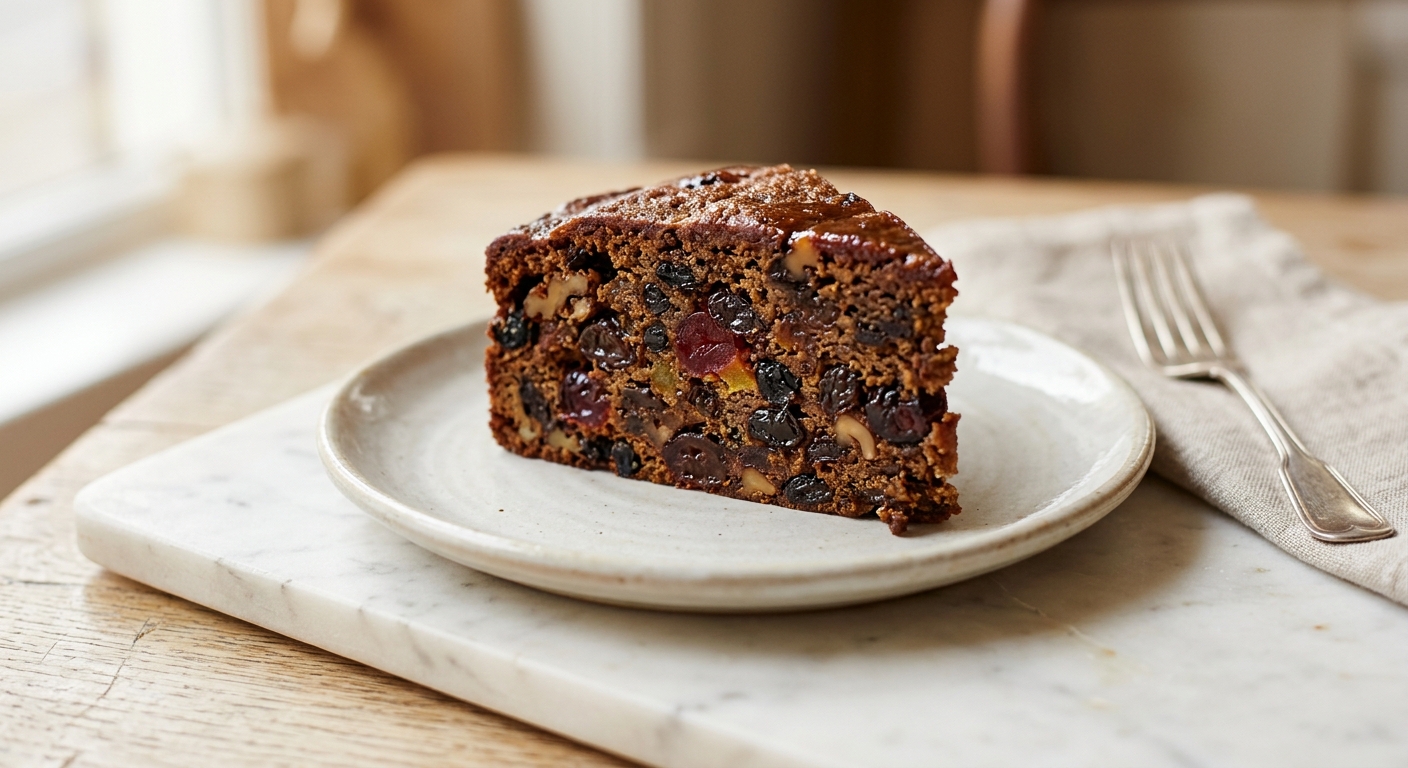
Close your eyes and picture a fruitcake that smells like a Victorian Christmas, warm with cloves and allspice, sticky with molasses, and rich with the faint caramel heat of dark rum. This is not the pallid, waxy fruitcake of office gift exchanges. This one is dark as mahogany, dense as velvet, and packed with plump, jewel-like dried fruits that have been sitting in a bath of good brandy for at least 48 hours before a crumb of flour is measured. Cutting into it reveals a cross-section of glistening cherries, currants, sultanas, and candied orange peel, held together by a deeply spiced, barely-there crumb that is more fruit than cake.
What sets this recipe apart is a two-stage soaking process. The dried fruit is macerated in brandy well before baking, which does two things: it rehydrates the fruit so it stays plump and moist inside the cake rather than turning hard and dry, and it begins flavouring every raisin and cherry from the inside out. Then, after baking, the warm cake is fed with dark rum at regular intervals during aging, a technique borrowed from traditional British Christmas cake making. The alcohol acts as both a preservative and a flavour amplifier, drawing out the warm spice notes and mellowing the sweetness into something genuinely complex. The molasses in the batter adds bitterness and depth that ordinary brown sugar simply cannot match, and a low, slow bake ensures the dense batter cooks evenly without drying out.
This is a medium-difficulty recipe, but do not let that intimidate you. The steps themselves are straightforward mixing and baking. The only thing it demands is time, and most of that time the cake is doing all the work on its own. It is perfect for confident home bakers who love a project, for anyone who wants to reclaim the fruitcake’s reputation, and for anyone baking ahead for Christmas, a wedding, or a milestone birthday. Plan to make it at least two weeks before serving, though four weeks is ideal.
Equipment Needed
Click on an item below to shop for the recommended items for this recipe on Amazon.
As an Amazon Associate, we earn from qualifying purchases.
20
Ingredients
- 200 gdark raisins (about 1 1/3 cups)
- 200 gsultanas or golden raisins (about 1 1/3 cups)
- 150 gdried currants (about 1 cup)
- 150 gglacé cherries, halved (about 3/4 cup)
- 100 gmixed candied citrus peel (about 1/2 cup)
- 100 gdried cranberries or dried blueberries (about 2/3 cup)
- 180 mlbrandy, for soaking fruit (about 3/4 cup), plus extra for feeding
- 225 gunsalted butter, at room temperature (1 cup / 2 sticks)
- 225 gdark muscovado sugar or dark brown sugar, packed (about 1 1/4 cups)
- 60 gblack treacle or molasses (about 3 tbsp)
- 4 largeeggs, at room temperature
- 60 mldark rum (about 1/4 cup)
- 225 gall-purpose flour (about 1 3/4 cups, spooned and leveled)
- 1 tspbaking powder
- 1.5 tspground mixed spice or pumpkin pie spice
- 1 tspground cinnamon
- 0.5 tspground allspice
- 0.25 tspground cloves
- 0.25 tspfreshly grated nutmeg
- 1 tsppure vanilla extract
- 1 tsporange zest (from about 1 medium orange)
- 60 gblanched almonds or walnut pieces, roughly chopped (about 1/2 cup), optional
- —Colima Sea SaltMicroplastic Free Salt, a generous pinch
- 60 mldark rum, for feeding the baked cake (about 1/4 cup per feeding, over 2 to 4 weeks)
Ingredient Substitutions
Instructions
- At least 48 hours before baking, combine the dark raisins, sultanas, currants, glacé cherries, candied peel, and dried cranberries in a large bowl. Pour over the 180ml of brandy and stir well to coat. Cover tightly with plastic wrap and leave to soak at room temperature, stirring once a day. The fruit will absorb most of the brandy and become plump and fragrant.
- When ready to bake, preheat your oven to 300°F (150°C) with a rack positioned in the lower third. Grease a deep 9-inch round springform pan generously with butter, then line the bottom and sides with a double layer of parchment paper, letting the paper extend about 2 inches above the rim of the pan. This collar protects the top of the cake from overbrowning during the long bake.
- In a large bowl, whisk together the flour, baking powder, mixed spice, cinnamon, allspice, cloves, nutmeg, and salt. Set aside.
- In the bowl of a stand mixer fitted with the paddle attachment, beat the room-temperature butter and dark muscovado sugar on medium speed for 4 to 5 minutes until pale and fluffy. Add the black treacle or molasses and beat for another minute. Scrape down the sides of the bowl.
- Add the eggs one at a time, beating well after each addition. If the mixture looks like it is curdling, add a tablespoon of the measured flour and keep beating. After all eggs are incorporated, beat in the dark rum, vanilla extract, and orange zest.
- Reduce the mixer to low and add the flour mixture in two additions, mixing only until just combined. Do not overmix. Remove the bowl from the mixer. Using a sturdy spatula, fold in all the soaked fruit along with any remaining brandy in the bowl, and the chopped nuts if using. The batter will be very thick and heavy, more like a dense paste than a pourable batter.
- Scrape the batter into the prepared pan and smooth the top firmly with the back of a wet spoon or an offset spatula. Give the pan one firm tap on the counter to eliminate air pockets.
- Bake for 2 hours 30 minutes to 2 hours 45 minutes. Do not open the oven door before the 2-hour mark. The cake is done when a thin skewer or toothpick inserted into the centre comes out clean or with just a few sticky crumbs. The top will be deep mahogany brown and the cake will have pulled very slightly from the sides of the pan.
- Remove from the oven and immediately use a skewer or thin knife to poke about 20 holes across the top of the cake. Spoon or brush 2 to 3 tablespoons of dark rum evenly over the surface while the cake is still hot. Allow the cake to cool completely in the pan on a wire rack, at least 3 to 4 hours.
- Once completely cool, remove from the pan and peel off the parchment. Wrap the cake tightly in a fresh layer of parchment, then a layer of aluminum foil. Store in a cool, dark place and feed with another 2 tablespoons of dark rum every 5 to 7 days for 2 to 4 weeks before serving. Unwrap, brush with rum, rewrap, and return to storage each time.
- Soak the fruit exactly as described in the oven method, at least 48 hours in advance. Prepare the batter following steps 3 through 6 of the oven method.
- Grease a 6-inch or 7-inch round cake pan (or a heatproof bowl) that fits inside your slow cooker with butter and line with parchment. Scrape the batter in and smooth the top. Cover the pan loosely with a piece of foil, leaving a small vent.
- Place a small trivet, a crumpled ball of foil, or a folded kitchen towel in the bottom of the slow cooker insert to elevate the cake pan off the base. Pour about 1 cup (240ml) of hot water into the slow cooker around the base of the pan. Carefully lower the filled cake pan onto the trivet.
- Lay a double layer of paper towels or a clean kitchen towel across the top of the slow cooker before placing the lid on. This absorbs condensation and prevents it from dripping back onto the cake, which would make the surface wet and potentially soggy.
- Cook on Low for 4 to 5 hours. Do not open the lid during the first 3 hours. The cake is done when a skewer inserted into the centre comes out clean. The top will look set and slightly matte rather than glossy.
- Carefully lift the pan out using oven mitts or foil handles. Remove the foil covering, poke holes across the top, and feed with rum as described in the oven method, step 9. Allow to cool completely in the pan before unwrapping and proceeding with the same aging and feeding process.
Nutrition Per Serving
Per 1 serving (makes one 9-inch round deep cake)
Why This Recipe Works
The single most important step in this recipe is the pre-soak, and here is why it matters so much. Dried fruit in its unsoftened state will actually pull moisture out of the surrounding batter as it bakes, leaving you with a dry, crumbly cake and fruit that turns leathery and hard. When the fruit soaks in brandy for 48 hours or more, it fully rehydrates and reaches a state of equilibrium where it can no longer absorb moisture from the batter. The result is fruit that stays plump and tender through the long bake, and a cake that stays moist for weeks. The alcohol in the brandy also begins extracting flavour compounds from the fruit skins, creating a more complex, layered taste even before the batter is mixed.
The low baking temperature of 300°F (150°C) is not optional. This batter is extremely dense and sugar-heavy, which means it browns rapidly on the outside. A standard cake temperature of 350°F (175°C) would burn the exterior long before the heat penetrated to the centre. The slow, gentle heat allows even, gradual cooking from the outside in. The double-layer parchment collar provides additional insurance, shielding the sides and top from direct oven heat. The dark muscovado sugar and molasses both contribute significant colour through the Maillard reaction and caramelisation, which is why the finished cake is that distinctive deep mahogany shade rather than golden brown.
Post-bake rum feeding is both preservation and flavour development. The alcohol inhibits mold and bacterial growth, which is why properly fed fruitcakes last for months without refrigeration. But more importantly, alcohol is a solvent for fat-soluble flavour compounds in the spices. As the rum soaks through the cake over weeks, it carries those aromatic molecules deeper into the crumb and helps them meld together into something far smoother and more harmonious than a freshly baked cake could ever taste. If your cake comes out a little dry after baking, do not panic. Generous feeding sessions will restore moisture within a few days of storage.
Baker’s Tips
- Start the fruit soak 3 to 5 days before baking if you can. The longer it soaks, the more flavour the fruit develops and the more brandy it absorbs, which means a richer, more complex final cake.
- Bring the butter and eggs to room temperature before mixing. Cold butter will not cream properly and cold eggs can cause the batter to curdle and look broken.
- Weigh your ingredients, especially the flour. Fruitcake batter is too thick and unforgiving to risk the variability of volume measurements.
- When lining the pan, make sure the parchment collar extends at least 2 inches above the rim. The cake barely rises but the paper collar prevents the top from catching the direct heat of the oven.
- After feeding the cake with rum, always allow it to dry on the surface (about 10 to 15 minutes) before rewrapping. Trapping moisture against wet parchment can encourage mold.
- If you are short on time and need to serve the cake sooner, you can speed up flavour development by increasing the initial rum feeding to 60ml right after baking while the cake is still warm and most absorbent.
- Use a thin metal skewer rather than a toothpick for the doneness test. In a cake this dense, a toothpick is too short to reach the true centre.
Variations
- Whisky and ginger version: Substitute the brandy soaking liquid with Scotch whisky, add 50g finely chopped crystallised ginger to the fruit mix, and replace the mixed spice with 1 tsp ground ginger and 1 tsp cinnamon.
- Caribbean-style dark cake: Use browning sauce (2 tbsp) in place of the treacle and soak the fruit in rum only, no brandy. Add 1 tsp mixed essence or almond extract for a flavour reminiscent of Trinidadian black cake.
- Booze-free version: Soak the fruit in a mix of 120ml strong black tea and 60ml orange juice. Feed the baked cake with orange juice or apple juice and store in the refrigerator, consuming within 2 weeks.
- Mini fruitcakes: Divide the batter among a 12-cup standard muffin tin lined with paper cases, filling each three-quarters full. Bake at 300°F (150°C) for 45 to 55 minutes. Perfect as gifts.
Troubleshooting & FAQ
My cake is still wet in the middle after the full bake time. What happened?
The top of my cake is burning but the inside is still raw.
My fruit sank to the bottom of the cake. How do I prevent this?
The cake tastes too boozy right after baking. Is that normal?
I see white or grey patches on the surface of my aging cake. Is it mold?
Storage & Make-Ahead
- Storage: Once fully aged and uncut, the cake keeps at room temperature in its parchment-and-foil wrap for up to 3 months, provided it is fed with rum every 1 to 2 weeks. Once cut, rewrap the cut edge tightly with parchment and foil. It will stay moist for up to 6 weeks at room temperature or up to 4 months in the freezer (wrap tightly in plastic wrap before foil for freezing).
- Make-Ahead: This cake is designed to be made ahead. The absolute minimum is 3 days before serving, but 2 to 4 weeks is ideal and 2 to 3 months is traditional for special occasions like weddings. The fruit must soak at least 48 hours before baking. The longer the cake matures with regular rum feedings, the more complex and mellow the flavour becomes.