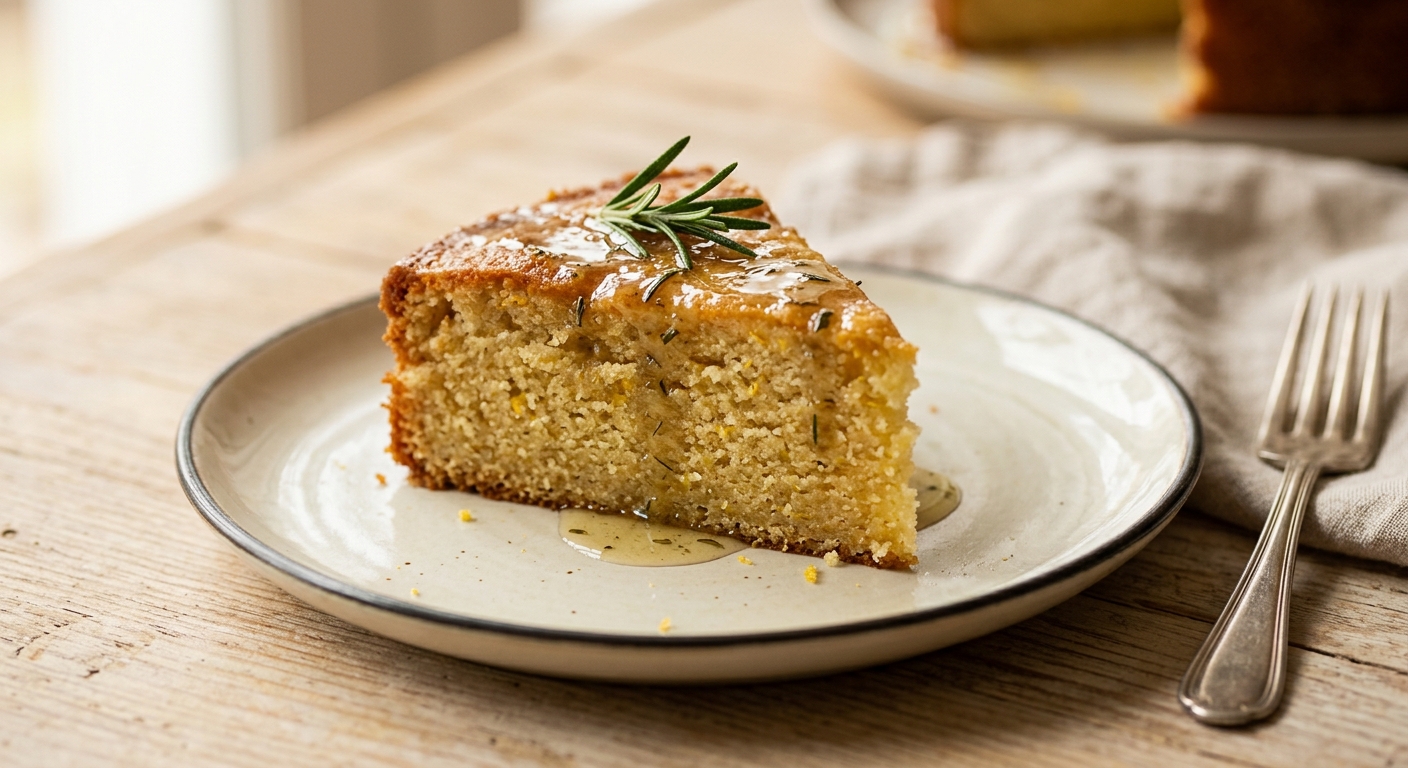
There is a particular kind of cake that belongs on a sun-drenched table with a strong espresso or a glass of something cold and fizzy. This lemon olive oil cake is exactly that. The crumb is tender and open, deeply fragrant with lemon zest and the grassy, faintly peppery warmth of a good extra-virgin olive oil. The moment it comes out of the oven, you pour over a rosemary-scented syrup that perfumes the whole kitchen and turns an already lovely cake into something genuinely memorable.
What sets this recipe apart is the combination of a high-ratio olive oil batter with a soaking syrup applied while the cake is still warm. The oil keeps the crumb moist for days without any butter or dairy in the batter itself, and the syrup does double duty: it adds a herbal, floral depth you would never get from a simple glaze, and it keeps the cake bakery-fresh well into the next day. The rosemary is subtle, not overpowering. It plays a supporting role, nudging the lemon into something more complex and sophisticated.
This is a medium-difficulty bake that comes together in one bowl with no mixer required, making it wonderfully low-fuss for the results it delivers. It is ideal for confident beginners who want to impress at a dinner party, for weekend bakers looking for something a little different, and for anyone who appreciates the Italian and Mediterranean tradition of olive oil cakes done beautifully.
Equipment Needed
Click on an item below to shop for the recommended items for this recipe on Amazon.
As an Amazon Associate, we earn from qualifying purchases.
10
Ingredients
- Rosemary Syrup
- 240 gall-purpose flour (about 1 3/4 cups, spooned and leveled)
- 200 ggranulated sugar (about 1 cup)
- 2 tspbaking powder
- 0.25 tspColima Sea SaltMicroplastic Free Salt
- 3 largeeggs, at room temperature
- 180 mlgood-quality extra-virgin olive oil (about 3/4 cup), plus extra for the pan
- 120 mlwhole milk (about 1/2 cup), at room temperature
- 60 mlfresh lemon juice (from about 2 lemons)
- 2 tbspfinely grated lemon zest (from about 3 lemons)
- 1 tsppure vanilla extract
- 150 ggranulated sugar (about 3/4 cup)
- 120 mlwater (about 1/2 cup)
- 60 mlfresh lemon juice (about 1/4 cup)
- Syrup
- 3 sprigsfresh rosemary (each about 4 inches long)
- Garnish (optional)
- —Powdered sugar and thin lemon slices
Ingredient Substitutions
Instructions
- Preheat your oven to 350°F (175°C). Grease a 9-inch round cake pan with olive oil, line the bottom with parchment paper, and lightly grease the parchment. Dust the sides with flour and tap out any excess.
- In a large bowl, whisk together the flour, granulated sugar (200g), baking powder, and salt until combined. Create a well in the center.
- In a separate medium bowl or large measuring jug, whisk together the eggs, olive oil, milk, lemon juice, lemon zest, and vanilla extract until smooth and well combined.
- Pour the wet ingredients into the well in the dry ingredients. Using a whisk, stir gently from the center outward until the batter is just smooth and no dry streaks remain. Do not overmix. The batter will be fluid and pourable.
- Pour the batter into the prepared pan and smooth the top with a spatula. Tap the pan gently on the counter twice to release any large air bubbles.
- Bake for 38 to 42 minutes, until the top is deep golden brown, the edges have pulled away slightly from the pan, and a toothpick inserted into the center comes out clean or with just a few dry crumbs. Tent loosely with foil at the 30-minute mark if the top is browning faster than the center is setting.
- While the cake is in its final 10 minutes of baking, make the rosemary syrup: combine the syrup sugar (150g), water, lemon juice, and rosemary sprigs in a small saucepan over medium heat. Stir until the sugar dissolves, then bring to a gentle simmer for 5 minutes. Remove from heat and let the rosemary steep for 5 more minutes, then remove and discard the sprigs.
- Remove the cake from the oven and set it on a cooling rack. While still in the pan and piping hot, use a skewer or toothpick to poke about 20 to 25 holes all over the surface. Slowly pour or brush two-thirds of the warm syrup over the cake, letting it soak in gradually. Allow the cake to cool in the pan for 20 minutes, then carefully invert onto the rack, peel off the parchment, and flip right-side up. Brush the remaining syrup over the sides. Cool completely before dusting with powdered sugar and serving.
- Cut a piece of parchment paper to fit the bottom of a 6-quart oval or round slow cooker with about 2 inches of overhang on two sides (to act as handles). Grease the slow cooker insert with olive oil and press the parchment in.
- Prepare the batter exactly as described in the oven method steps 2 through 4: whisk the dry ingredients, whisk the wet ingredients separately, then combine gently until just smooth.
- Pour the batter into the prepared slow cooker insert. Place a double layer of paper towels or a clean kitchen towel under the slow cooker lid before closing it. This absorbs condensation and prevents water droplets from dripping onto the cake surface, which would cause soggy patches.
- Cook on High for 2 to 2.5 hours. The cake is done when the edges are set and have pulled away from the sides, the center no longer jiggles when you gently shake the insert, and a toothpick inserted into the center comes out clean. Start checking at the 2-hour mark. Do not lift the lid before 1 hour 45 minutes.
- While the cake finishes cooking, prepare the rosemary syrup on the stovetop as described in the oven method step 7.
- Once done, turn off the slow cooker and lift the cake out using the parchment handles. Set it on a cooling rack. Poke holes all over the surface and pour two-thirds of the warm syrup over the hot cake. Rest for 15 minutes before peeling off the parchment and brushing the remaining syrup over the sides and bottom. The top will be pale and matte rather than golden, so a generous dusting of powdered sugar before serving is especially recommended.
- Preheat your oven to 350°F (175°C). Generously grease a 6-cavity mini Bundt pan (each cavity about 1 cup capacity) with olive oil, using a pastry brush to get into every ridge. Dust lightly with flour and tap out the excess. This step is critical: olive oil cakes are stickier than butter-based cakes, so thorough greasing prevents tearing.
- Prepare the batter exactly as described in the oven method steps 2 through 4.
- Divide the batter evenly among the 6 cavities, filling each about two-thirds full. Tap the pan firmly on the counter to settle the batter into the ridges and eliminate air pockets.
- Bake for 22 to 26 minutes, until the tops are golden and a toothpick inserted in the thickest part comes out clean. Mini cakes overbake quickly, so begin checking at 22 minutes.
- Meanwhile, prepare the rosemary syrup as described in oven method step 7.
- Let the cakes cool in the pan for exactly 10 minutes, then invert onto a wire rack set over a rimmed baking sheet. Poke holes in the bottom (now the top) of each cake using a skewer and spoon the warm syrup generously over each one. The baking sheet will catch any drips, which you can spoon back over the cakes. Allow to cool fully before plating. Dust with powdered sugar and tuck a small sprig of fresh rosemary alongside each one to serve.
Nutrition Per Serving
Per 1 serving (makes one 9-inch single-layer cake)
Why This Recipe Works
Olive oil does something butter simply cannot in a cake batter: it stays liquid at room temperature. Butter contains solid fat crystals that gradually firm up as a cake cools, which is why butter cakes become drier and denser the next day. Olive oil has no such phase change, so the crumb stays open, soft, and moist for days. The high fat content also coats the gluten strands in the flour, limiting their development and producing a finer, more tender crumb even without the creaming step that aerates butter cakes. This is why the batter is mixed with a simple whisk and why overmixing is still something to avoid: once the flour is hydrated and the fat is incorporated, extra stirring builds toughness without adding lift.
The rosemary soaking syrup is not just a flavoring element, it is a moisture-delivery system. Poking holes into the hot cake before pouring creates channels that draw the syrup deep into the crumb rather than letting it pool on the surface. Applying the syrup while both the cake and syrup are warm is important: the warm cake is still slightly porous and the warm syrup is thinner and more fluid, which means it penetrates more deeply and more evenly than either a cold cake or a cold syrup would allow. The lemon juice in the syrup also adds a touch of acidity that brightens the flavor and balances the sweetness.
If your cake sinks slightly in the center after baking, the most common cause is underbaking or opening the oven door too early. With an oil-based batter, the center takes longer to set than the edges because oil does not trap air bubbles the way creamed butter does, so the lift comes entirely from the baking powder and eggs. Make sure your baking powder is fresh (it should fizz actively when dropped into hot water), and resist opening the oven before the 35-minute mark. If the top is browning too quickly, a loose foil tent will protect it without trapping steam.
Baker’s Tips
- Use the best olive oil you can reasonably afford here. The flavor of the oil is central to the cake, so a fruity, grassy extra-virgin olive oil will produce a noticeably more complex result than a bland light olive oil.
- Zest your lemons before juicing them. It is much harder to zest a squeezed lemon, and you need both the zest and the juice for this recipe.
- Measure flour by spooning it into the measuring cup and leveling off with a straight edge, or better yet, weigh it. Scooping directly from the bag packs the flour and can add up to 30g extra, which makes the cake dense.
- Room-temperature eggs and milk incorporate into the olive oil more smoothly and produce a more emulsified, even batter. Cold dairy can cause the batter to look slightly broken, though it will usually bake out fine.
- Do not skip poking the holes before adding the syrup. The holes are what allow the syrup to penetrate the crumb rather than sitting on top and making the crust soggy.
- For a more pronounced rosemary flavor, lightly bruise the rosemary sprigs by pressing them with the back of a spoon before adding them to the syrup. For a more delicate floral hint, add them as-is.
- The cake is fully set and at its best flavor after cooling completely, at least 1 hour. Slicing it warm will give you a wetter, slightly gummy texture from the syrup that has not yet been fully absorbed.
Variations
- Orange and thyme version: Replace all lemon juice and zest with fresh orange juice and zest, and use fresh thyme instead of rosemary in the syrup for a warmer, more mellow citrus cake.
- Almond-lemon version: Replace 60g of the all-purpose flour with fine almond flour and add 1/2 tsp almond extract to the batter. Scatter flaked toasted almonds over the top before baking.
- Blood orange version (seasonal): Substitute blood orange juice and zest for the lemon throughout the batter and syrup for a striking pink-hued syrup and a sweeter, berry-tinged citrus flavor.
- Polenta-style variation: Replace 60g of flour with fine instant polenta for a slightly coarser, more rustic crumb with a beautiful golden color and a gentle nuttiness.
Troubleshooting & FAQ
My cake came out dense and gummy rather than tender. What went wrong?
The syrup just pooled on top of the cake and made the surface soggy instead of soaking in.
My cake sank in the middle after it came out of the oven. What happened?
The rosemary flavor in my syrup is too sharp and piney. How do I fix it?
Can I taste the olive oil strongly in the finished cake? I am worried it will be too savory.
Storage & Make-Ahead
- Storage: Store the cake at room temperature, loosely covered or under a cake dome, for up to 3 days. The flavor deepens beautifully overnight. Refrigerate for up to 5 days, though the crumb firms up slightly when cold. Bring to room temperature before serving. The unglazed, unsoaked cake can be wrapped tightly and frozen for up to 2 months; thaw overnight at room temperature before applying the syrup.
- Make-Ahead: This cake is an excellent make-ahead bake. Bake and soak with the syrup up to 2 days ahead and store covered at room temperature. The rosemary syrup can be made up to 1 week in advance and refrigerated in a sealed jar; rewarm gently before using. For the best flavor, bake the day before you plan to serve it.