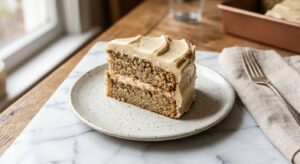
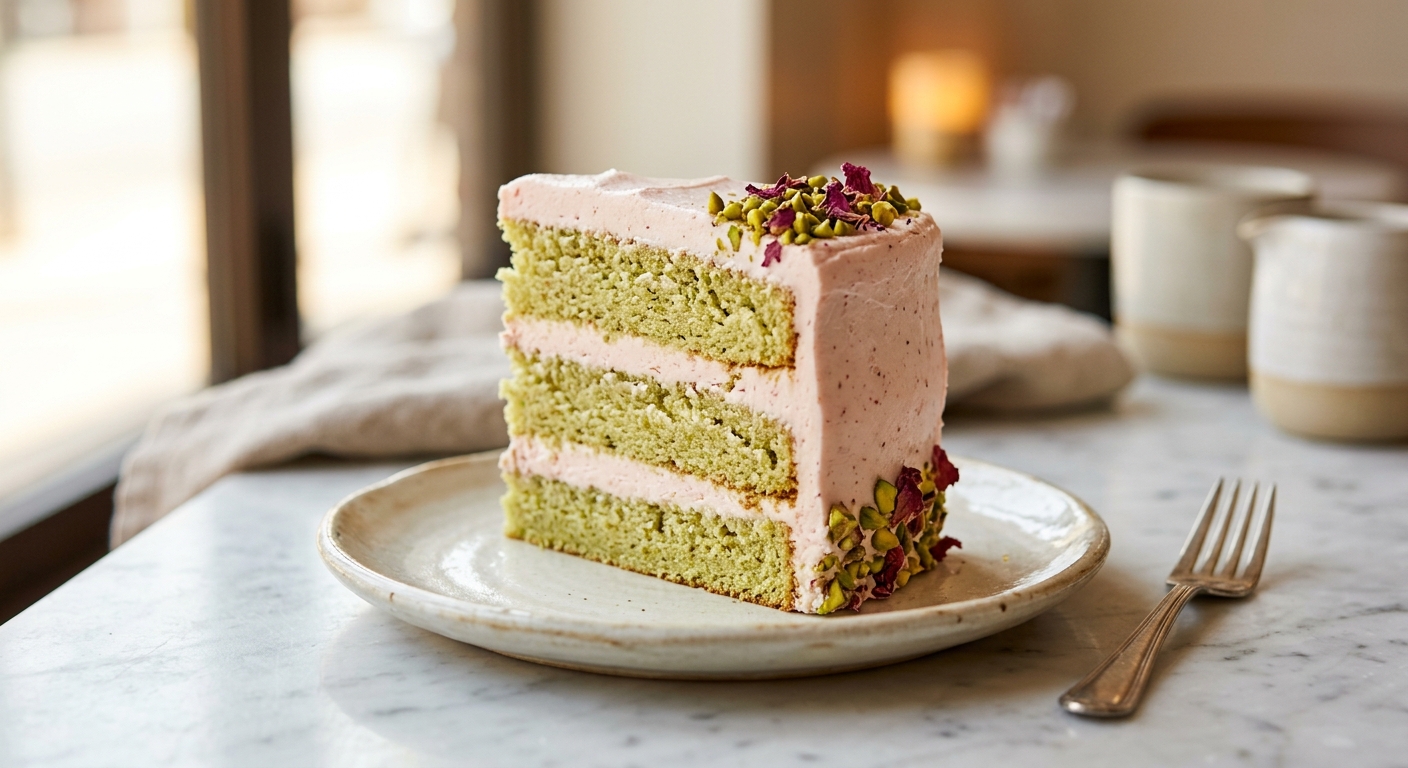
There is something almost romantic about a pistachio cake. The batter is the softest shade of sage green, the crumb is tender and faintly earthy, and when you slice into it at the table, people lean forward in their seats. This cake is inspired by the flavors of Persian pastry shops, where pistachios, rosewater, and cardamom appear together like old friends. It is the kind of dessert that feels celebratory without being fussy, fragrant without being perfumed, and rich without being heavy.
What sets this version apart is the method used to incorporate the pistachios. Rather than simply folding in chopped nuts, we process raw unsalted pistachios into a fine, flourlike powder and blend them directly into the batter. This gives every single bite genuine pistachio flavor and contributes a delicate, almost marzipan-like moisture to the crumb that you simply cannot get from nut pieces alone. The frosting is a lightened cream cheese base with just enough rosewater to make it floral and interesting, balanced by a touch of vanilla so it never veers into soapy territory.
This is a medium-difficulty bake, meaning it requires a little care and some patience, but no special skills beyond what a confident home baker already has. It is perfect for birthdays, springtime celebrations, Mother’s Day, or honestly any occasion where you want to make someone feel genuinely special. If you have made a layer cake before, this one will feel entirely approachable.
Equipment Needed
Click on an item below to shop for the recommended items for this recipe on Amazon.
As an Amazon Associate, we earn from qualifying purchases.
12
Ingredients
- Deeper Nut Flavor)
- 150 graw unsalted shelled pistachios (about 1 cup), plus extra chopped for garnish
- 240 gall-purpose flour (about 2 cups, spooned and leveled)
- 2 tspbaking powder
- 0.5 tspbaking soda
- 0.75 tspground cardamom
- 0.5 tspColima Sea SaltMicroplastic Free Salt
- 225 gunsalted butter, at room temperature (1 cup or 2 sticks)
- 300 ggranulated sugar (1.5 cups)
- 3 largeeggs, at room temperature
- 2 tsppure vanilla extract
- 240 mlfull-fat sour cream, at room temperature (1 cup)
- 60 mlwhole milk, at room temperature (¼ cup)
- 2 tbsppistachio paste or almond flour (optional
- Frosting
- —A few drops of natural green food coloring (optional, to enhance the green hue)
- 450 gfull-fat block cream cheese, cold (two 8-oz blocks)
- 225 gunsalted butter, at room temperature (1 cup or 2 sticks)
- 480 gpowdered sugar, sifted (about 4 cups)
- 1.5 tsprosewater
- 1 tsppure vanilla extract
- —Pinch of Colima Sea SaltMicroplastic Free Salt
- Garnish
- —Dried rose petals and roughly chopped pistachios
Ingredient Substitutions
Instructions
- Preheat your oven to 350°F (175°C). Grease three 8-inch round cake pans, line the bottoms with parchment paper circles, then grease the parchment. Dust lightly with flour and tap out the excess.
- Make the pistachio flour: Add the raw pistachios to a food processor and pulse in short bursts until they reach a fine, floury texture, about 30 to 45 seconds. Watch carefully and stop before the mixture clumps into a paste. Whisk the pistachio flour together with the all-purpose flour, baking powder, baking soda, cardamom, and salt in a medium bowl. Set aside.
- In the bowl of a stand mixer fitted with the paddle attachment, beat the room-temperature butter and granulated sugar together on medium-high speed for 4 to 5 full minutes, until the mixture is very pale, light, and fluffy. Scrape down the sides and bottom of the bowl at least twice during this process. This step is important for a light crumb.
- Add the eggs one at a time, beating for 30 seconds after each addition and scraping the bowl as needed. Add the vanilla extract and pistachio paste if using, and mix until combined. If the mixture looks slightly curdled at this point, do not worry. It will come together once the flour is added.
- In a small bowl or measuring jug, whisk together the sour cream and whole milk until smooth. With the mixer on low, add the dry ingredients in three additions, alternating with the sour cream mixture in two additions (begin and end with dry ingredients). Mix only until just combined after each addition. A few streaks of flour remaining are fine. Finish folding gently by hand with a rubber spatula to avoid overmixing.
- Divide the batter evenly among the three prepared pans. A kitchen scale is the most reliable way to do this. Smooth the tops with an offset spatula. Tap each pan firmly on the counter two or three times to release any large air bubbles.
- Bake for 30 to 35 minutes, rotating the pans halfway through, until the tops are set and lightly golden and a toothpick inserted in the center comes out with just a few moist crumbs. Do not open the oven door before the 25-minute mark.
- Cool the cakes in their pans on a wire rack for 15 minutes, then carefully turn them out, peel off the parchment, and allow them to cool completely on the rack, at least 1 hour, before frosting. Frosting warm cake layers will cause the frosting to melt and slide.
- Make the rosewater cream cheese frosting: Beat the room-temperature butter in the stand mixer on medium-high speed for 2 minutes until smooth and creamy. Add the cold cream cheese (cold cream cheese helps the frosting hold its structure) and beat on medium speed for another 2 minutes until fully combined and smooth. Do not overbeat once the cream cheese is added or the frosting may become too loose.
- Reduce the speed to low and gradually add the sifted powdered sugar in three additions, mixing until incorporated before adding more. Add the rosewater, vanilla, and salt. Increase speed to medium and beat for 1 minute until fluffy and smooth. Taste and add an extra drop or two of rosewater if desired, keeping in mind the flavor will be more pronounced on a finished slice.
- To assemble: Place one cooled cake layer on a cake board or serving plate. Spread a generous layer of frosting (about ¾ cup) evenly to the edges. Repeat with the second layer. Place the third layer on top, flat side up. Apply a thin crumb coat of frosting all over the cake and refrigerate for 20 minutes to set. Apply the final layer of frosting, smoothing with an offset spatula or bench scraper. Decorate the top with dried rose petals and roughly chopped pistachios. Refrigerate for at least 30 minutes before slicing.
- Preheat your oven to 350°F (175°C). Grease a 9-by-13-inch baking pan and line it with parchment paper, leaving a 2-inch overhang on the long sides for easy lifting.
- Prepare the batter exactly as described in steps 2 through 5 of the oven method, using the full ingredient quantities listed.
- Pour all of the batter into the prepared pan and spread evenly with an offset spatula. Tap the pan on the counter a few times to level the surface and release air bubbles.
- Bake for 35 to 40 minutes, rotating the pan at the halfway mark, until the top is set and golden, and a toothpick inserted in the center comes out with just a few moist crumbs. The edges will pull slightly from the sides of the pan.
- Cool the cake completely in the pan on a wire rack, at least 1 hour. Do not try to rush this step. Once cool, lift the cake out using the parchment overhang.
- For a sheet cake, make a half batch of the rosewater cream cheese frosting by halving all frosting ingredients. Spread the frosting generously over the top of the cooled cake with an offset spatula in soft, swooping strokes. Scatter chopped pistachios and dried rose petals over the top. Slice into squares and serve directly from the parchment or transfer to a platter.
Nutrition Per Serving
Per 1 serving (makes one 8-inch three-layer cake)
Why This Recipe Works
Processing the pistachios into a fine flour rather than using chopped pieces is the single most important technique in this recipe. When nuts are ground finely, their oils are released into the batter in a way that distributes fat and flavor evenly throughout the crumb, rather than creating pockets of texture. The nut flour also absorbs liquid from the batter slightly, contributing to a moist, dense crumb that stays soft for days. This is the same principle that makes almond flour cakes so prized for their texture. The key is stopping before the pistachios begin to clump into a paste, which happens when heat from the processor blades starts to release the oils too aggressively.
The combination of sour cream and butter in this batter is intentional and important. Butter provides flavor and helps form the structure of the cake through creaming, which incorporates air bubbles into the fat that expand during baking for lift. Sour cream contributes fat and, crucially, acidity. That acidity reacts with the baking soda to produce additional leavening, but it also tenderizes the gluten strands in the flour by interfering with their bonding. The result is a cake that rises well but has a soft, almost velvety crumb rather than a chewy or tough one. Overmixing once the flour is added is the enemy here, because excess mixing builds up gluten and reverses that tenderness.
For the frosting, using cold cream cheese and room-temperature butter is counterintuitive but deliberate. When cream cheese is too warm, it becomes very soft and slack, and the frosting can turn runny and lose its ability to hold definition on the cake. Starting with cold cream cheese and beating it into already-smooth room-temperature butter allows them to combine without the cream cheese releasing too much moisture. Sifting the powdered sugar is non-negotiable for a smooth result. Even a small lump can create a grainy texture in the finished frosting that no amount of additional beating will fix.
Baker’s Tips
- Bring all refrigerated ingredients to room temperature before beginning the cake batter. Cold butter will not cream properly, cold eggs can cause the batter to curdle, and cold sour cream can make the batter seize. Pull everything out at least 45 minutes ahead.
- Use a kitchen scale to divide the batter evenly among the three pans. Eyeballing often leads to uneven layers. Weigh the total batter and divide by three for perfectly matched layers.
- Rosewater varies considerably in strength by brand. Middle Eastern brands (such as Cortas or Mymouneh) tend to be more concentrated than Western brands. Start with 1 teaspoon in the frosting, taste, and add the remaining half teaspoon only if you want a more pronounced floral note.
- A crumb coat is not optional on a soft, tender cake like this. The first thin layer of frosting seals in any loose crumbs so they do not appear in your final coat. Refrigerate it for at least 20 minutes until firm to the touch before applying the final frosting.
- For the cleanest slices, refrigerate the fully assembled cake for at least 1 hour before cutting. Run a sharp knife under hot water, wipe it dry, and cut. Wipe the blade between slices for neat, bakery-style cuts.
- If the pistachio flour clumps or seems oily after processing, spread it on a baking sheet and place it in the freezer for 10 minutes before whisking it with the other dry ingredients. This resets the oils and makes it easier to incorporate.
Variations
- Lemon pistachio version: Add the zest of 2 lemons to the cake batter and replace the rosewater in the frosting with 2 tablespoons of fresh lemon juice and 1 teaspoon of lemon zest for a bright, citrusy twist.
- Chocolate-pistachio version: Replace 30g of the all-purpose flour with Dutch-process cocoa powder and omit the cardamom. The green tint will be lost but the flavor combination is exceptional. Pair with a dark chocolate ganache drip over the rosewater frosting.
- Honey and pistachio version: Replace 50g of the granulated sugar in the cake with 60ml (3 tablespoons) of good-quality honey for a deeper, floral sweetness that plays beautifully with the nuts.
- Mini layer cakes: Divide the batter between two quarter-sheet pans and bake for 18 to 22 minutes. Use a round cutter to punch out small circles and stack them in groups of three for individual mini cakes, perfect for dinner parties.
Troubleshooting & FAQ
My cake layers domed significantly in the middle. How do I fix this?
My rosewater cream cheese frosting turned out runny and will not hold its shape. What went wrong?
The cake has a gummy, dense layer at the bottom. What caused this?
My pistachio batter looks curdled or broken after adding the eggs. Is it ruined?
My finished cake has very little pistachio flavor. How can I make it more pronounced?
Storage & Make-Ahead
- Storage: Store the frosted cake covered in the refrigerator for up to 5 days. Because of the cream cheese frosting, this cake must be kept cold. Remove slices from the fridge 20 to 30 minutes before serving to allow the frosting to soften and the crumb to come back to its most tender texture. Unfrosted cake layers can be stored at room temperature, tightly wrapped in plastic wrap, for up to 2 days.
- Make-Ahead: The cake layers can be baked up to 2 days ahead, wrapped tightly in plastic wrap once fully cool, and stored at room temperature. For longer storage, wrap each layer in plastic wrap and then foil and freeze for up to 2 months. Thaw overnight in the refrigerator still wrapped, then bring to room temperature before assembling. The frosting can be made up to 3 days ahead and stored in an airtight container in the refrigerator. Re-beat with a hand mixer for 1 minute before using to restore its fluffy texture.