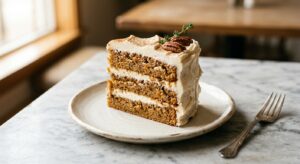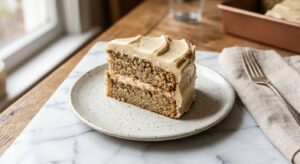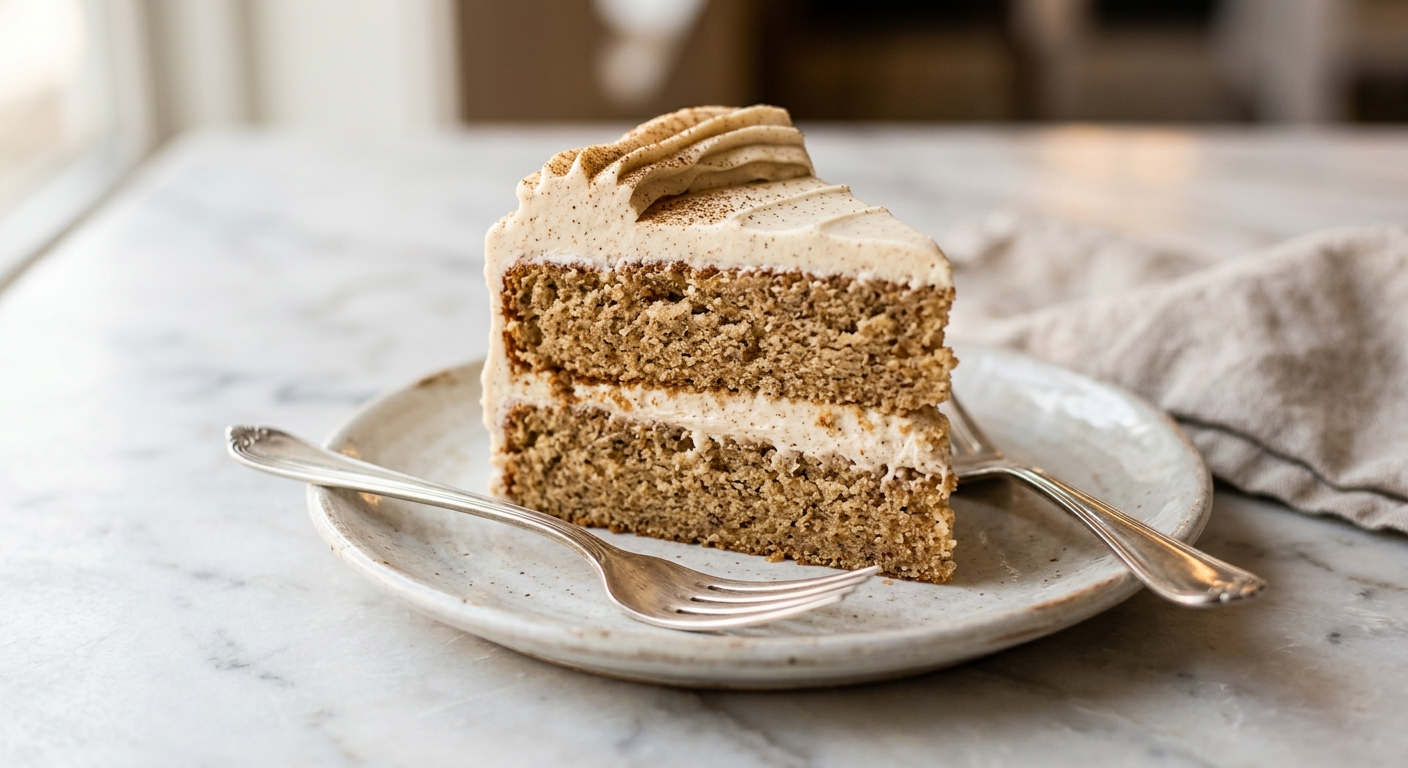
Close your eyes and imagine the first sip of a properly brewed masala chai on a cold morning, that bloom of cardamom, the gentle heat of ginger, the sweetness of cinnamon, and the deep earthiness of black tea all swirling together in one perfect cup. Now imagine all of that translated into a cake. Layers of golden, pillowy sponge spiced with cardamom, ginger, cinnamon, clove, and black pepper, sandwiched and frosted with a buttercream made from actual brewed chai concentrate. This is not a vaguely spiced vanilla cake with a chai label. This is the real thing.
What sets this recipe apart is the double-steeping technique used for the buttercream. Rather than simply adding spices to the frosting, you brew a strong masala chai concentrate directly into the cream and butter base, extracting deep, layered flavor that no spice blend alone can replicate. The cake itself relies on a combination of brown butter and neutral oil, which gives you both the nutty richness of browned milk solids and the lasting moisture that only liquid fat can provide. The result is a crumb that stays tender for days without refrigeration.
This is a medium-difficulty bake, well within reach for anyone who has made a layer cake before. The extra step of browning butter and brewing the chai concentrate adds maybe 20 minutes to your process but pays back tenfold in flavor. It is perfect for autumn and winter gatherings, birthday celebrations, or any occasion that deserves something genuinely special but still deeply comforting.
Equipment Needed
Click on an item below to shop for the recommended items for this recipe on Amazon.
As an Amazon Associate, we earn from qualifying purchases.
12
Ingredients
- Browning
- 115 gunsalted butter (1/2 cup)
- Dusting (optional)
- 60 mlAvocado Oil100% Pure Avocado Oil such as sunflower or grapeseed (1/4 cup)
- 300 gall-purpose flour (2 1/2 cups, spooned and leveled)
- 2 tspbaking powder
- 0.5 tspbaking soda
- 0.5 tspColima Sea SaltMicroplastic Free Salt
- 2.5 tspground cardamom
- 2 tspground cinnamon
- 1.5 tspground ginger
- 0.5 tspground cloves
- 0.25 tspfreshly ground black pepper
- 250 ggranulated sugar (1 1/4 cups)
- 100 glight brown sugar, packed (1/2 cup)
- 3 largeeggs, at room temperature
- 1 tsppure vanilla extract
- 240 mlwhole milk, at room temperature (1 cup)
- 60 mlsour cream or full-fat plain yogurt, at room temperature (1/4 cup)
- —For the Masala Chai Concentrate (makes enough for the buttercream and a little extra):
- 240 mlwhole milk (1 cup)
- 120 mlwater (1/2 cup)
- 3 tbsploose-leaf Assam or Darjeeling black tea (or 4 strong black tea bags)
- 4 wholegreen cardamom pods, lightly crushed
- 3 wholecloves
- 1 1-inchpiece fresh ginger, sliced
- 1 piececinnamon stick
- 0.25 tspwhole black peppercorns
- —For the Masala Chai Buttercream:
- 340 gunsalted butter (1 1/2 cups), softened to room temperature
- 560 gpowdered sugar, sifted (4 1/2 cups)
- 60 mlchai concentrate (from above), cooled completely (1/4 cup)
- 1 tsppure vanilla extract
- —Pinch of Colima Sea SaltMicroplastic Free Salt
- 1 tspground cinnamon
- Garnish (optional)
- 3 wholecinnamon sticks
- 1 tbsppearl sugar or coarse gold sanding sugar
Ingredient Substitutions
Instructions
- Make the chai concentrate first so it has time to chill. Combine the milk, water, crushed cardamom pods, cloves, sliced ginger, cinnamon stick, and black peppercorns in a small saucepan over medium heat. Bring to a gentle simmer, then add the loose-leaf tea or tea bags. Reduce heat to low and steep for 8 minutes, stirring occasionally. Do not let it boil hard, which can make the tea bitter. Strain through a fine-mesh sieve, pressing to extract all liquid. You should have about 200ml. Let cool completely, then refrigerate until cold. (This can be done up to 3 days ahead.)
- Preheat your oven to 350°F (175°C). Grease three 8-inch round cake pans, line the bottoms with parchment paper, and grease the parchment. Set aside.
- Brown the butter for the cake. Place the 115g butter in a light-colored saucepan over medium heat. Swirl occasionally and cook until the butter foams, then the foam subsides, and golden-brown specks form on the bottom with a nutty aroma, about 6 to 8 minutes. Immediately pour into a large mixing bowl and let cool until no longer hot but still fluid, about 15 minutes. Whisk in the neutral oil.
- In a medium bowl, whisk together the flour, baking powder, baking soda, salt, cardamom, cinnamon, ground ginger, cloves, and black pepper. Set aside.
- Add both sugars to the brown butter and oil mixture and whisk vigorously for 2 minutes until the mixture lightens slightly. Add the eggs one at a time, whisking well after each addition. Add the vanilla extract. In a small measuring cup, combine the milk and sour cream and whisk until smooth.
- Add one third of the flour mixture to the butter mixture and fold with a rubber spatula until just combined. Add half the milk mixture and fold again. Repeat with another third of flour, the remaining milk, then the final third of flour. Stop mixing as soon as no dry streaks remain. Do not overmix, as this develops gluten and toughens the crumb.
- Divide the batter evenly among the three prepared pans (about 380g per pan if you want to weigh for accuracy). Smooth the tops with an offset spatula. Bake for 30 to 34 minutes, until the tops are golden, the edges have pulled slightly away from the pan, and a toothpick inserted in the center comes out with just a few moist crumbs. Begin checking at 28 minutes.
- Cool the cakes in their pans on a wire rack for 15 minutes, then turn out, peel off the parchment, and cool completely on the rack before frosting, at least 1 hour. Do not frost warm layers, as the buttercream will melt.
- Make the buttercream. Beat the softened butter in the bowl of a stand mixer fitted with the paddle attachment (or with a hand mixer) on medium-high speed for 4 to 5 minutes until very pale and fluffy. Scrape down the bowl. Add the sifted powdered sugar in three additions, beating on low after each addition until incorporated, then increasing to medium for 30 seconds. Add the chilled chai concentrate, vanilla, and salt. Beat on medium-high for 3 minutes until the buttercream is smooth, silky, and holds soft peaks. If it seems too stiff, add 1 to 2 tsp more chai concentrate. If too soft, refrigerate for 15 minutes and beat again.
- Assemble the cake. Place the first layer on a cake board or serving plate. Spread about 190g (roughly 3/4 cup) of buttercream evenly to the edges. Place the second layer on top and repeat. Add the third layer, then apply a thin crumb coat of buttercream over the top and sides. Refrigerate for 20 minutes to set the crumb coat, then apply the final smooth or swirled layer of frosting. Decorate with a dusting of cinnamon, cinnamon sticks, or pearl sugar if desired.
- Prepare the chai concentrate as directed in step 1 of the oven method and refrigerate until cold.
- Preheat your oven to 350°F (175°C). Grease a 9×13-inch (23x33cm) metal baking pan and line with parchment paper, leaving a 2-inch overhang on the long sides for easy lifting. Grease the parchment.
- Prepare the brown butter and make the batter exactly as directed in steps 3 through 6 of the oven method. Pour all the batter into the prepared pan and spread to an even layer.
- Bake for 35 to 40 minutes, until the top is deep golden, the center springs back when lightly pressed, and a toothpick inserted in the thickest part comes out clean or with a few moist crumbs. The longer bake time compared to the layers is normal because the batter is deeper. Begin checking at 33 minutes.
- Let the cake cool completely in the pan on a wire rack, at least 1 hour and 15 minutes. A sheet cake retains heat longer than thin layers. Do not frost until fully cool.
- Make the buttercream as directed in step 9 of the oven method. Because this is a single layer, you will have extra buttercream. Spread a generous layer over the top of the cooled cake, creating swoops and peaks with the back of a spoon or an offset spatula. Dust with cinnamon and garnish as desired. Slice directly from the pan.
- Prepare the chai concentrate as directed in step 1 of the oven method and refrigerate until cold.
- Preheat your oven to 350°F (175°C). Line two standard 12-cup muffin tins with paper liners. This batter tends to rise well and dome nicely, so fill each liner two thirds full for the best shape.
- Prepare the brown butter and make the batter as directed in steps 3 through 6 of the oven method. Fill the cupcake liners using a large cookie scoop (about 60ml per cup) for uniform sizing. Do not overfill, as the batter rises significantly.
- Bake one tin at a time on the center rack for 18 to 22 minutes, until the tops are golden, spring back when lightly pressed, and a toothpick inserted in the center comes out with just a few moist crumbs. Cupcakes bake faster than layers, so begin checking at 17 minutes.
- Remove from the tin immediately and cool completely on a wire rack before frosting, about 45 minutes. Cupcakes can trap steam and become soggy if left in the hot tin.
- Make the buttercream as directed in step 9 of the oven method. Transfer to a large piping bag fitted with a large open star tip (such as a Wilton 1M). Pipe a tall swirl on each cooled cupcake, starting from the outer edge and spiraling inward and upward. Dust with a pinch of cinnamon and add a small cinnamon stick as a garnish for a beautiful finishing touch.
Nutrition Per Serving
Per 1 serving (makes one 8-inch three-layer cake)
Why This Recipe Works
Browning the butter before adding it to the batter is one of the most impactful flavor upgrades you can make to any cake. When butter is heated past the point of melting, the water evaporates and the milk solids undergo the Maillard reaction, creating hundreds of new flavor compounds including nutteranes and furanones that taste nutty, caramel-like, and complex. These toasty notes harmonize perfectly with the warm spice profile of masala chai and deepen the overall flavor of the cake in a way that plain melted butter simply cannot. Combining browned butter with a neutral liquid oil gives you the flavor of butter with the moisture retention of oil, since liquid fat coats gluten strands and interferes with starch retrogradation more effectively than solid fat, keeping the cake moist for longer.
The chai concentrate in the buttercream works because fat is an excellent carrier of fat-soluble flavor compounds. By steeping spices in a milk-and-water mixture, you extract both the water-soluble tannins from the tea and the fat-soluble aromatic compounds from the spices into a single liquid that integrates seamlessly into a butter-based frosting. This produces a frosting where the chai flavor is present in every molecule rather than sitting on top as a spice powder would. The black pepper in both the cake and the concentrate is not about heat; the piperine it contains actually enhances the bioavailability and perception of other spice compounds, making the whole blend taste more vibrant and complete.
Using a combination of baking powder and baking soda gives the cake both an immediate lift (from the double-acting baking powder, which releases gas twice, once when wet and once when heated) and a boost of browning through alkaline chemistry. The sour cream contributes acidity that activates the baking soda for additional leavening, while its fat content and thick texture add richness and keep the crumb from becoming too open or coarse. If your cake layers dome excessively in the center, your oven is likely running hot. Use an oven thermometer to verify the temperature, and if needed, use baking strips around the pans to encourage even rising.
Baker’s Tips
- Bring all refrigerated ingredients, including eggs, milk, sour cream, and butter, to room temperature before starting. Cold ingredients can cause the brown butter to seize and the batter to look curdled, resulting in an uneven crumb.
- Use a light-colored saucepan when browning butter so you can clearly see the color of the milk solids. Dark pans make it easy to burn the butter before you notice.
- Steep the chai concentrate low and slow. A hard boil makes the tea tannic and bitter. Aim for a gentle simmer with small bubbles around the edges.
- Weigh the batter into the pans for perfectly even layers. Uneven layers make assembly frustrating and the final cake lopsided.
- If your buttercream looks greasy or broken, the butter was likely too warm. Refrigerate the bowl for 10 to 15 minutes and beat again. If it looks curdled, the chai concentrate may have been too cold. Let it sit at room temperature and beat on medium speed for a few more minutes.
- Toast your whole spices (cardamom pods, cloves, peppercorns) in a dry pan for 1 to 2 minutes before adding them to the concentrate. This extra step wakes up the volatile aromatics and makes the finished flavor noticeably brighter.
- Do not skip the crumb coat. That thin initial layer of frosting traps crumbs so your final layer stays pristine. Twenty minutes in the refrigerator is all it takes to set.
Variations
- Chocolate Chai version: Replace 30g of flour with Dutch-process cocoa powder and add 1 tsp espresso powder to the dry ingredients. The chocolate and chai spices complement each other beautifully.
- Earl Grey and Cardamom: Swap the black tea in the concentrate for Earl Grey tea and reduce the spices to just cardamom and a pinch of clove. The bergamot creates a floral, sophisticated flavor profile.
- Honey Chai Cake: Replace the granulated sugar in the cake with 200g of honey and reduce the milk by 2 tbsp to compensate for the extra moisture. Add a honey drizzle between the layers alongside the buttercream.
- Chai Naked Cake: Apply the buttercream only between the layers and on the top, leaving the sides exposed for a rustic look. Garnish with candied ginger, star anise, and a dusting of mixed spice.
Troubleshooting & FAQ
My cake layers baked unevenly, with domed tops and a dense center. What happened?
My buttercream is too sweet and I can taste the powdered sugar graininess. How do I fix it?
I cannot taste the chai spices strongly in the finished cake. What went wrong?
The cake layers are sticking to the pans and tearing when I try to remove them. How do I prevent this?
My browned butter smells burnt and the milk solids look very dark brown or black. Can I still use it?
Storage & Make-Ahead
- Storage: Store the frosted cake covered at room temperature for up to 2 days, or refrigerate for up to 5 days. Bring refrigerated slices to room temperature for 30 to 45 minutes before serving, as cold buttercream is stiff and the cake flavor blooms at room temperature. Unfrosted cake layers can be stored wrapped tightly in plastic wrap at room temperature for 2 days or frozen for up to 3 months.
- Make-Ahead: The chai concentrate can be made up to 3 days ahead and refrigerated. The cake layers can be baked up to 2 days ahead, cooled completely, wrapped tightly in plastic wrap, and stored at room temperature. The buttercream can be made up to 4 days ahead, stored in an airtight container in the refrigerator, then brought to room temperature and re-beaten for 3 minutes before using. The fully assembled and frosted cake can be refrigerated up to 2 days ahead.