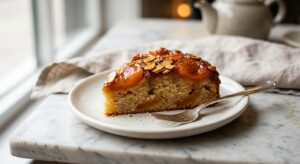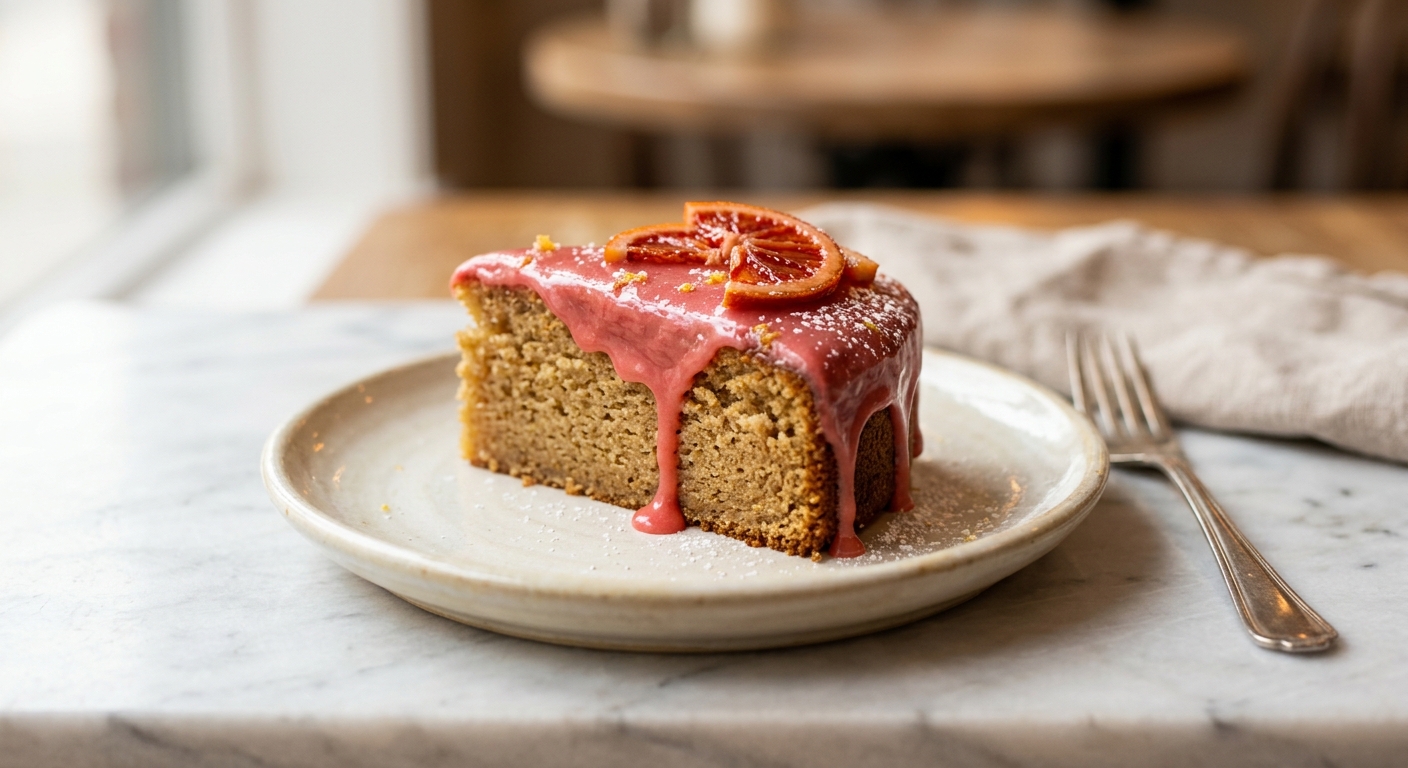
There is a particular kind of cake that does not announce itself loudly. It sits quietly on a cake stand, its golden crumb slightly domed, the deep crimson glaze catching the light like stained glass. You slice into it and the interior is impossibly moist, almost custardy at the center, with a fragrance that is equal parts citrus grove and warm Mediterranean kitchen. This is that cake. It is the kind of thing you would find at a Sunday lunch in Sicily, served with strong coffee and absolutely no apology for its simplicity.
What sets this version apart is the generous use of good extra-virgin olive oil in place of butter. Olive oil does something butter simply cannot: it coats the gluten strands in the flour differently, producing a crumb that stays moist and tender for days without any dryness creeping in. The blood orange glaze is not an afterthought. Freshly squeezed blood orange juice is reduced with powdered sugar into a glossy, tangy icing that stains a breathtaking shade of deep rose to ruby red, depending on the season and ripeness of your fruit. A generous pour over the warm cake lets it soak into the surface just slightly before setting into a translucent finish.
This cake sits firmly in the easy-to-medium range and is genuinely perfect for beginner bakers who want an impressive result without complicated technique. No creaming, no folding of egg whites, no fuss. It is equally at home as a weeknight dessert, a Sunday brunch centerpiece, or a gift brought to a friend wrapped in parchment. If blood oranges are out of season, navel oranges or cara cara oranges work beautifully, though you will lose some of that dramatic color.
Equipment Needed
Click on an item below to shop for the recommended items for this recipe on Amazon.
As an Amazon Associate, we earn from qualifying purchases.
10
Ingredients
- 240 gall-purpose flour (about 2 cups, spooned and leveled)
- 200 ggranulated sugar (1 cup)
- 1.5 tspbaking powder
- 0.25 tspbaking soda
- 0.5 tspColima Sea SaltMicroplastic Free Salt
- 3 largeeggs, at room temperature
- 180 mlgood-quality extra-virgin olive oil (3/4 cup), fruity and mild rather than intensely peppery
- 180 mlwhole milk, at room temperature (3/4 cup)
- 60 mlfreshly squeezed blood orange juice (1/4 cup), from about 1 large blood orange
- 2 tspfinely grated blood orange zest (from about 2 blood oranges)
- 1 tsppure vanilla extract
- 1 tbspGrand Marnier or Cointreau (optional but lovely)
- —For the Blood Orange Glaze:
- 150 gpowdered sugar, sifted (1.25 cups)
- 45 mlfreshly squeezed blood orange juice (3 tbsp), strained of pulp
- 1 tspfinely grated blood orange zest
- —Pinch of Colima Sea SaltMicroplastic Free Salt
Ingredient Substitutions
Instructions
- Preheat your oven to 350°F (175°C). Grease a 9-inch round cake pan thoroughly with olive oil, then line the bottom with a circle of parchment paper and grease the parchment too. Dust the sides lightly with flour, tapping out any excess. This cake has a sticky, tender crumb so do not skip the parchment.
- In a large bowl, whisk together the flour, granulated sugar, baking powder, baking soda, and salt until evenly combined. Make a well in the center.
- In a separate medium bowl or large measuring jug, whisk together the eggs, olive oil, whole milk, blood orange juice, blood orange zest, vanilla extract, and Grand Marnier if using. Whisk until the mixture is fully combined and slightly emulsified, about 30 seconds.
- Pour the wet ingredients into the well in the dry ingredients. Using a large whisk or spatula, stir gently until just combined and no dry flour streaks remain. Do not overmix: a few small lumps are perfectly fine. Overmixing develops gluten and will make the crumb tough.
- Pour the batter into the prepared pan. It will be fairly fluid. Gently tap the pan on the counter twice to release any large air bubbles. Bake on the center rack for 40 to 45 minutes, until the top is deep golden brown and a toothpick inserted in the center comes out with just a few moist crumbs attached. The edges will have pulled slightly away from the sides of the pan.
- Let the cake cool in the pan on a wire rack for 15 minutes, then run a thin knife around the edge and invert onto the rack. Peel off the parchment, then flip the cake right-side up so the domed top is facing upward.
- Make the glaze while the cake is still warm but not hot. Whisk together the sifted powdered sugar, strained blood orange juice, blood orange zest, and pinch of salt until smooth and pourable. The glaze should fall off the whisk in a thick ribbon. If too thick, add juice half a teaspoon at a time. If too thin, add powdered sugar a tablespoon at a time.
- Pour the glaze over the center of the warm cake and use the back of a spoon or an offset spatula to nudge it gently to the edges, allowing some to drip naturally down the sides. Let the glaze set at room temperature for at least 20 minutes before slicing.
- Prepare a 7-inch round cake pan by greasing it well with olive oil, lining the bottom with parchment, and greasing the parchment. Do not use a springform pan in an air fryer as the loose base can allow batter to drip.
- Mix the batter exactly as described in the oven method, steps 2 through 4, using the full ingredient quantities. Pour batter into the prepared 7-inch pan until it comes no more than two-thirds of the way up the sides. If you have extra batter, it bakes beautifully as a small ramekin cake alongside.
- Preheat your air fryer to 320°F (160°C) for 3 minutes. Place the pan in the air fryer basket. If your air fryer has a strong top heating element, lay a small piece of foil loosely over the top of the pan for the first 20 minutes to prevent the surface from over-browning before the center is set.
- Air fry for 30 to 35 minutes total. Remove the foil for the final 10 minutes to allow the top to develop a golden color. Check doneness with a toothpick at 30 minutes: it should come out with a few moist crumbs. Because air fryers vary significantly in power, begin checking at 28 minutes.
- Remove the pan carefully using tongs and oven mitts. Cool in the pan on a wire rack for 15 minutes before turning out. Glaze as described in the oven method steps 7 and 8, adjusting glaze quantity slightly downward to match the smaller surface area.
- Line the bottom and sides of a 6-quart oval or round slow cooker with a double layer of parchment paper, leaving enough overhang to lift the cake out easily. Grease the parchment lightly with olive oil. Do not attempt this without the parchment sling as the cake will be difficult to remove.
- Mix the batter exactly as described in the oven method, steps 2 through 4, using the full ingredient quantities. Pour the batter into the lined slow cooker and smooth the top gently.
- Place two layers of paper towels or a clean folded kitchen towel under the slow cooker lid before closing. This absorbs condensation that would otherwise drip back onto the cake and create a wet, gummy surface. The towels must be fully inside the lid, not hanging over the sides near the heating element.
- Cook on High for 2 to 2.5 hours. Do not lift the lid before the 2-hour mark. The cake is done when the edges are set and pulling away from the sides, the center has no visible liquid jiggle when gently nudged, and a toothpick inserted in the center comes out with moist crumbs. The top will remain pale and slightly tacky.
- Turn off the slow cooker and leave the lid ajar for 15 minutes to let steam escape. Then lift the cake out using the parchment sling and transfer to a wire rack. Peel back the sides of the parchment but leave the bottom in place until the cake has cooled for 20 minutes.
- Make and apply the glaze as described in the oven method steps 7 and 8. The glaze is especially important in this method as it adds the color, shine, and caramelized citrus flavor that the pale, uncrusted top cannot provide on its own.
Nutrition Per Serving
Per 1 serving (makes one 9-inch round single-layer cake)
Why This Recipe Works
The reason olive oil cakes stay moist for days when butter cakes go stale has everything to do with the difference between solid and liquid fats. Butter is roughly 80 percent fat and 20 percent water, and the solid fat crystals it forms at room temperature contribute to that familiar tight, sturdy crumb. As butter cakes cool and the fat solidifies, moisture is gradually expelled and the crumb firms up. Olive oil, being a liquid fat at room temperature, never solidifies in the same way. It coats the gluten and starch granules in the flour continuously, keeping the crumb lubricated and tender far longer. This is why an olive oil cake you bake on Friday still has a silky, moist interior on Sunday.
The combination of baking powder and a small amount of baking soda is deliberate. The baking powder provides the primary lift through a double-action release of carbon dioxide, first when it contacts liquid and again in the heat of the oven. The baking soda is there not for extra lift but for browning: it raises the pH of the batter slightly, which accelerates the Maillard reaction and gives the cake its deep, even golden crust even with a relatively modest amount of sugar. Blood orange juice is mildly acidic, which is part of why just a small amount of baking soda reacts with it to enhance color without creating a metallic aftertaste.
If your cake sinks in the center, the most common culprit is underbaking: the liquid batter at the center has not yet set when the structure collapses. Always test with a toothpick and trust it over a timer, since ovens vary. If your glaze turns an underwhelming pale pink rather than deep ruby, your blood oranges were either under-ripe or it is late in their season. Reduce the strained juice in a small saucepan over low heat by about a third before mixing the glaze to concentrate both the color and the flavor significantly.
Baker’s Tips
- Use a kitchen scale rather than cups if possible, especially for the flour. Scooping flour directly from the bag compacts it and can add 20 to 30 percent more flour than intended, leading to a dry, dense cake.
- Bring your eggs and milk to room temperature before mixing. Cold eggs and cold milk added to room-temperature olive oil can cause the emulsion to look broken and slightly curdled. It will usually bake out fine, but a smooth emulsion gives a more even crumb.
- Choose a mild, fruity extra-virgin olive oil rather than a robust, peppery one. Strong olive oil can dominate the delicate citrus flavor. A Spanish Arbequina or a mild Italian variety works beautifully here.
- Strain the blood orange juice for the glaze through a fine-mesh sieve to remove pulp and any stray seeds. Pulp in the glaze creates an uneven, grainy texture that does not set as smoothly.
- Pour the glaze when the cake is warm, not hot and not fully cool. Warm cake absorbs a thin layer of glaze into the surface, anchoring it, while cool cake lets the glaze pool and slide. About 20 to 25 minutes out of the oven is ideal.
- Blood orange season runs roughly from December through March in the Northern Hemisphere. For the deepest color, look for Moro blood oranges, which have the most intensely pigmented flesh and juice.
Variations
- Rosemary and blood orange: Add 1.5 teaspoons of very finely minced fresh rosemary to the batter along with the zest. The herbal, resinous note plays beautifully against the citrus and olive oil.
- Almond version: Replace 60g of the all-purpose flour with 60g of fine almond flour for a nuttier, slightly denser crumb with more richness. Reduce bake time by 3 to 5 minutes and watch the edges closely.
- Cardamom and orange: Add 1 teaspoon of ground cardamom to the dry ingredients and swap half the vanilla for a few drops of rose water. The result is perfumed and festive, wonderful for the holiday table.
- Polenta version: Replace 60g of the flour with 60g of fine-ground polenta (cornmeal) for a pleasantly gritty, rustic texture with gorgeous golden color. Particularly traditional in Italian olive oil cakes.
- Lemon version: Substitute all blood orange juice and zest with lemon in both the cake and glaze for a brighter, sharper flavor profile with a pale golden glaze.
Troubleshooting & FAQ
My cake sank in the middle after I took it out of the oven. What went wrong?
My glaze is barely pink, not the beautiful deep red I was expecting. How can I fix it?
The cake has a slightly bitter or medicinal aftertaste. What caused that?
My batter looks broken or curdled when I mix the wet and dry ingredients. Is it ruined?
The cake stuck to the pan and broke apart when I tried to remove it. How do I prevent this?
Storage & Make-Ahead
- Storage: Store the glazed cake loosely covered at room temperature for up to 3 days. The olive oil keeps the crumb moist and it genuinely improves on day two. For longer storage, refrigerate for up to 5 days, but bring to room temperature before serving as the cold dulls the olive oil flavor. Freeze the unglazed cake, well wrapped, for up to 2 months. Thaw overnight at room temperature and glaze fresh before serving.
- Make-Ahead: The cake can be baked up to 2 days ahead, wrapped tightly in plastic wrap, and stored at room temperature. Add the glaze within a few hours of serving for the best appearance. The glaze can be made up to 1 day ahead, stored covered in the refrigerator, and brought to room temperature and whisked briefly before using.