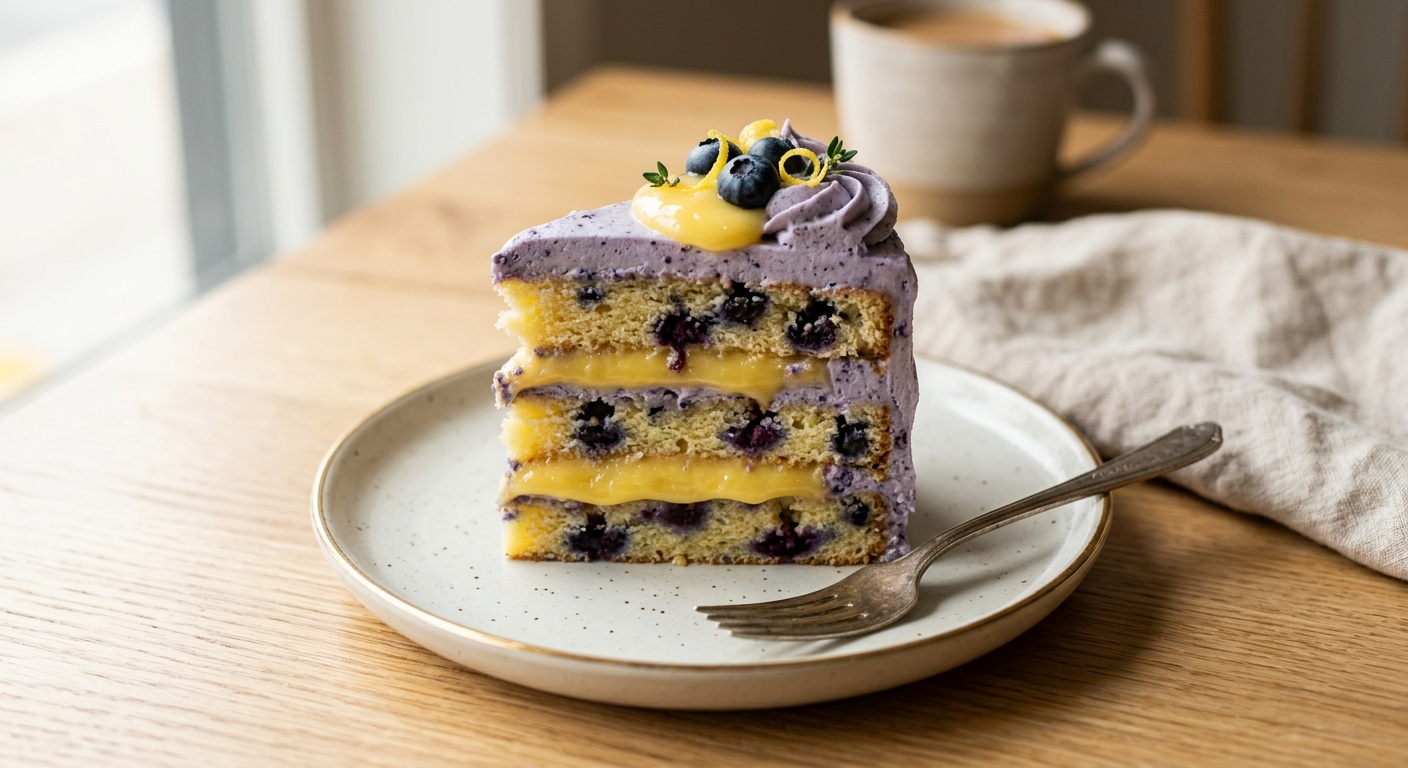
There is a particular kind of happiness that comes from a slice of lemon cake on a warm afternoon, and this one captures it completely. Picture two pale golden sponge layers, fragrant with lemon zest and vanilla, split open to reveal ribbons of glossy lemon curd, bursts of fresh blueberries, and a generous swoop of lemon cream cheese frosting. It is sunshine on a cake stand, elegant enough for a celebration but approachable enough to bake on a quiet weekend just because you feel like it.
What sets this cake apart from a standard lemon layer cake is the homemade lemon curd used two ways: as a filling between the layers and folded directly into the frosting, so every single bite carries that unmistakable citrus brightness. The sponge itself is built with a combination of butter and sour cream, giving it a fine, tender crumb that stays moist for days. Fresh blueberries scattered over the curd add little pockets of jammy sweetness that balance the tartness beautifully, while their purple-blue hue peeks through the sides of the frosting for a naturally stunning look.
This is a medium-difficulty bake that is completely manageable if you work in stages. The lemon curd can be made days ahead, and the cake layers freeze beautifully. It is ideal for confident home bakers who want a showstopper dessert for a birthday, spring celebration, Easter table, or any occasion that deserves something truly special.
Equipment Needed
Click on an item below to shop for the recommended items for this recipe on Amazon.
As an Amazon Associate, we earn from qualifying purchases.
12
Ingredients
- Lemon Curd
- 3 tbspfresh lemon zest (from about 3 large lemons), divided
- 120 mlfresh lemon juice (from about 3 to 4 lemons), divided
- 4 largeeggs, divided (2 whole eggs plus 2 yolks for the curd, 3 whole eggs for the cake)
- 200 ggranulated sugar, divided (100g for curd, 100g added to cake below)
- 85 gunsalted butter, cold and cut into cubes
- Cake Batter)
- 280 gall-purpose flour (about 2 1/4 cups, spooned and leveled)
- 250 ggranulated sugar (about 1 1/4 cups
- Cake)
- 2 tspbaking powder
- 0.5 tspbaking soda
- 0.5 tspColima Sea SaltMicroplastic Free Salt
- 115 gunsalted butter, softened to room temperature (about 1/2 cup
- Cake Batter
- 60 mlAvocado Oil100% Pure Avocado Oil (about 1/4 cup)
- 3 largeeggs, room temperature
- Frosting)
- 120 gfull-fat sour cream, room temperature (about 1/2 cup)
- 120 mlwhole milk, room temperature (about 1/2 cup)
- 1 tsppure vanilla extract
- 150 gfresh blueberries (about 1 cup), plus extra to decorate
- 1 tspall-purpose flour (to toss with blueberries)
- 450 gfull-fat cream cheese, softened to room temperature (about 2 cups)
- 115 gunsalted butter, softened to room temperature (about 1/2 cup
- Frosting
- 420 gpowdered sugar, sifted (about 3 1/2 cups)
- 80 mlprepared lemon curd (from the recipe above)
- —Pinch of Colima Sea SaltMicroplastic Free Salt
Ingredient Substitutions
Instructions
- Make the lemon curd first so it has time to cool completely. In a small heatproof bowl, whisk together 2 whole eggs, 2 egg yolks, 100g granulated sugar, 80ml (about 1/3 cup) of the lemon juice, and 1 tbsp of the lemon zest. Set the bowl over a saucepan of barely simmering water (do not let the bowl touch the water). Cook, stirring constantly with a heatproof spatula, for 8 to 12 minutes until the curd thickens enough to coat the back of a spoon and reaches 170°F (77°C) on an instant-read thermometer. Remove from heat and whisk in the cold cubed butter, one or two pieces at a time, until fully melted and smooth. Strain through a fine-mesh sieve into a clean jar or bowl. Press plastic wrap directly onto the surface and refrigerate for at least 2 hours, or until completely cold and set.
- Preheat your oven to 350°F (175°C). Grease two 8-inch round cake pans thoroughly with butter or nonstick spray, then line the bottoms with parchment paper circles. Grease the parchment as well.
- In a medium bowl, whisk together the flour, 250g granulated sugar, baking powder, baking soda, and salt. Set aside. In a small bowl, toss the fresh blueberries with 1 tsp flour to coat them and prevent sinking. Set aside.
- In the bowl of a stand mixer fitted with the paddle attachment (or in a large bowl with a hand mixer), beat the softened butter on medium speed for 2 minutes until light and fluffy. Add the oil and beat for another 1 minute. Add the 3 room-temperature eggs one at a time, beating well after each addition and scraping down the bowl. Beat in the remaining 2 tbsp lemon zest and the vanilla extract.
- With the mixer on low, add the flour mixture in three additions, alternating with two additions of the combined sour cream and milk (beginning and ending with flour). Mix just until each addition disappears into the batter. Do not overmix. Fold in the flour-coated blueberries by hand using a rubber spatula, with just a few gentle strokes.
- Divide the batter evenly between the two prepared pans (a kitchen scale is useful here). Smooth the tops with an offset spatula. Bake for 28 to 32 minutes, until a toothpick inserted into the center comes out with just a few moist crumbs and the edges have begun to pull away from the sides of the pan. Rotate the pans halfway through baking. Cool in the pans on a wire rack for 15 minutes, then turn out onto the rack, peel off the parchment, and cool completely before frosting.
- Make the frosting: Beat the softened cream cheese and butter together on medium-high speed for 3 minutes until completely smooth and fluffy. Reduce speed to low and add the sifted powdered sugar in two additions, then add the pinch of salt. Once incorporated, increase speed to medium-high and beat for 2 minutes more. Add the 80ml of cooled lemon curd and beat on medium until just combined. The frosting should be thick and spreadable. If it seems too soft, refrigerate for 20 minutes before using.
- Assemble the cake: Place one cake layer on a cake board or serving plate. Pipe or spread a border of frosting around the top edge to create a dam, then fill the center with a generous layer of the remaining cold lemon curd (about half the leftover curd). Scatter a handful of fresh blueberries over the curd. Place the second cake layer on top and press gently. Apply a thin crumb coat of frosting over the entire cake and refrigerate for 30 minutes. Apply the final layer of frosting, smooth with an offset spatula, and decorate with fresh blueberries and a few thin lemon slices. Serve any extra lemon curd alongside.
- In a large microwave-safe bowl (the curd bubbles up so use a bowl with plenty of headroom), whisk together 2 whole eggs, 2 egg yolks, 100g granulated sugar, 80ml fresh lemon juice, and 1 tbsp lemon zest until smooth.
- Microwave on 50% power (medium) for 1 minute. Remove and whisk thoroughly. Return to the microwave and continue cooking in 45-second intervals at 50% power, whisking vigorously between each interval. The curd is ready when it has thickened to a consistency similar to a light pudding and coats the back of a spoon. This typically takes 4 to 6 minutes of total microwave time. Do not rush it by using full power as the eggs will scramble.
- Immediately whisk in the cold cubed butter, a few pieces at a time, until completely melted and incorporated. The heat from the curd will melt the butter smoothly. Strain through a fine-mesh sieve into a clean container, pressing gently with a spatula. Discard any solids in the sieve.
- Press plastic wrap directly onto the surface of the curd to prevent a skin forming. Refrigerate for at least 2 hours until fully set and cold. Proceed with the oven cake method above using this curd for the filling and frosting.
- Prepare the lemon curd using either the stovetop or microwave method above. Cool completely in the refrigerator. Prepare the cake batter exactly as described in the oven method steps 3 through 5.
- Preheat your oven to 350°F (175°C). Line a standard 12-cup muffin tin with paper liners and lightly spray the insides with nonstick spray. Fill each cup about two-thirds full with batter. Bake for 18 to 22 minutes until a toothpick comes out with just a few moist crumbs. Cool completely on a wire rack.
- Once cooled, use a serrated knife to trim the domed tops off each cupcake so you have flat, even rounds. Then slice each round in half horizontally to create two thin discs. This gives you a bottom layer and a top layer for each jar.
- Make the frosting as directed in the oven method step 7. Transfer to a piping bag fitted with a large round tip (or use a zip-lock bag with one corner snipped off).
- To assemble: Place one cake disc in the bottom of each wide-mouth mason jar. Spoon 1 to 2 tbsp of lemon curd over the top and scatter a few fresh blueberries. Pipe a layer of frosting over the blueberries. Add the second cake disc, pressing gently. Pipe another rosette of frosting on top and garnish with 3 to 4 fresh blueberries and a small pinch of lemon zest. Secure lids and refrigerate until serving. The assembled jars keep refrigerated for up to 2 days.
Nutrition Per Serving
Per 1 serving (makes one 8-inch two-layer cake, serving 12)
Why This Recipe Works
The combination of butter and neutral oil in the sponge is deliberate and important. Butter contributes flavor and that classic tender crumb, but it is solid at room temperature, which means a butter-only cake can firm up noticeably when refrigerated. Oil stays liquid at any temperature, keeping the crumb moist and soft even after a night in the fridge, which matters a great deal for a cake meant to be made ahead. The sour cream adds both fat and a gentle acidity, which tenderizes the gluten in the flour and gives the cake a slightly richer, more velvety texture than milk alone could achieve.
Tossing the blueberries in flour before folding them in is a technique that genuinely works: the light coating of starch helps the berries grip the surrounding batter and resist sinking to the bottom during baking. It does not waterproof them entirely, but it gives them enough resistance to stay suspended throughout the crumb. Using room-temperature dairy and eggs is equally important: cold ingredients cause the butter in the batter to seize and curdle, creating a lumpy, broken batter that bakes into an uneven, coarser crumb. Room-temperature ingredients emulsify smoothly, trapping air pockets for a finer rise.
The lemon curd thickens because egg proteins gently coagulate when heated to around 160 to 175°F (71 to 79°C). Cooking the curd too quickly or over direct high heat pushes the temperature too far too fast, resulting in scrambled eggs. The cold butter added at the end does two things: it immediately drops the temperature of the curd, stopping the cooking process, and it enriches the texture through an emulsification process that gives the curd its characteristic glossy, silky consistency. The frosting dam technique around the edge of each layer is not just for looks: it acts as a retaining wall that keeps the soft curd filling from squeezing out the sides when the layers are stacked, ensuring clean, beautiful slices every time.
Baker’s Tips
- Bring all refrigerated ingredients (eggs, butter, sour cream, milk, cream cheese) to room temperature at least 1 hour before you begin. This one step makes the biggest difference to a smooth batter and lump-free frosting.
- Zest your lemons before you juice them. It is much easier to zest a whole lemon than a squeezed one. A microplane grater gives the finest, most fragrant zest.
- Use a kitchen scale to divide the batter equally between the two pans. Even layers bake more uniformly and make for a more professional-looking finished cake.
- When making the curd, stir constantly and do not walk away. The difference between perfectly thickened curd and curdled eggs is only a matter of a minute or two. If you see any lumps forming, immediately remove the bowl from the heat and whisk rapidly.
- The frosting dam is essential: pipe a thick ring of frosting around the outer edge of the bottom layer before spooning in the curd. Without this dam, the curd will push out the sides and make the cake unstable.
- A crumb coat (a thin first layer of frosting that traps loose crumbs) refrigerated for 30 minutes before the final frosting coat is the secret to a clean, professional finish. Do not skip it.
- Serve the cake at room temperature. Cold cream cheese frosting can taste dense and slightly pasty. Thirty minutes on the counter transforms the texture and allows the lemon flavors to fully bloom.
Variations
- Lemon and Raspberry version: Replace the blueberries with fresh raspberries throughout. Fold a spoonful of raspberry jam into the curd filling layer for extra depth.
- Elderflower twist: Add 2 tbsp of elderflower cordial to the cake batter in place of 2 tbsp of the milk, and stir another tablespoon into the lemon curd while it is still warm for a floral, summery note.
- Gluten-free option: Substitute the all-purpose flour with a 1:1 gluten-free baking flour blend (such as Bob’s Red Mill 1-to-1). Add 1/4 tsp xanthan gum if your blend does not already contain it. The crumb will be slightly more delicate.
- Lemon Poppy Seed version: Add 2 tbsp of poppy seeds to the dry ingredients for a classic pairing that adds a subtle nutty crunch.
Troubleshooting & FAQ
My lemon curd curdled and has lumps of cooked egg in it. Can I fix it?
My cake layers domed a lot in the center and are uneven. What happened?
My cream cheese frosting is too runny and will not hold its shape.
All my blueberries sank to the bottom of the cake layers. How do I prevent that next time?
The curd filling is oozing out from between the layers when I cut the cake.
Storage & Make-Ahead
- Storage: Store the assembled cake covered in the refrigerator for up to 4 days. Bring slices to room temperature for 20 to 30 minutes before serving for the best texture and flavor. The lemon curd on its own keeps refrigerated in an airtight jar for up to 2 weeks. Unfrosted cake layers can be wrapped tightly in plastic wrap and refrigerated for 3 days or frozen for up to 3 months.
- Make-Ahead: The lemon curd can be made up to 2 weeks ahead and kept refrigerated. The cake layers can be baked, cooled, wrapped tightly, and frozen for up to 3 months (thaw overnight in the refrigerator still wrapped). The frosting can be made up to 3 days ahead and refrigerated in an airtight container. Re-whip briefly before using. The fully assembled cake can be built the day before serving and refrigerated overnight.