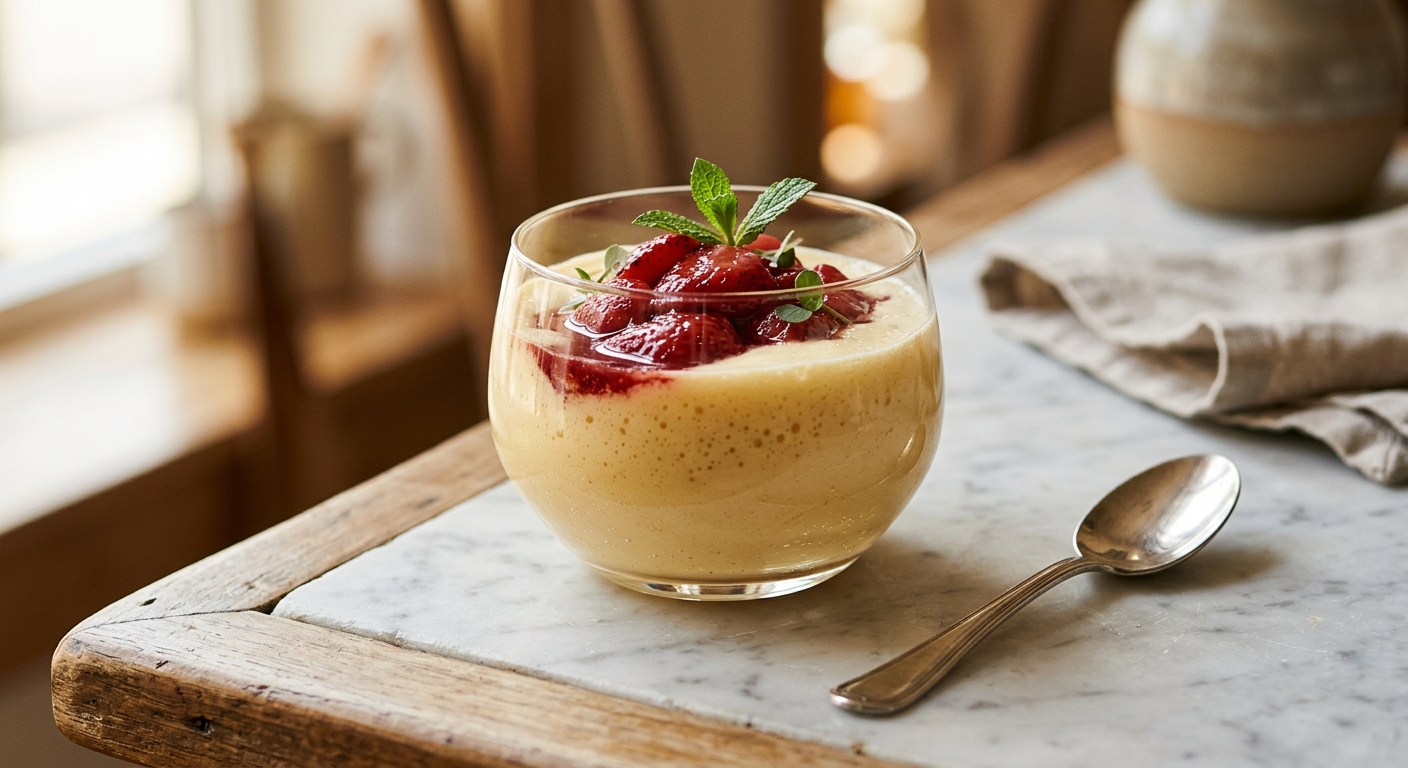
There is a kind of kitchen magic in watching egg yolks and wine transform over a pot of simmering water into something pale, voluminous, and impossibly silky. Champagne sabayon, known in Italy as zabaione, is that magic in a bowl. It arrives at the table still warm and trembling, draped over strawberries that have been quietly macerating in sugar and a splash of citrus, their juices pooling at the bottom of the glass like a pink syrup waiting to be discovered. Every spoonful is a little cloud of something celebratory.
What sets this version apart is the ratio of Champagne to egg yolks, which leans generously toward the wine, giving the finished sabayon a bright, slightly tart lift that keeps it from tasting heavy or overly rich. A small addition of finely grated lemon zest and a whisper of vanilla are stirred in just before serving, rounding out the flavor without masking the Champagne’s delicate bubbles. The technique here is patient and deliberate: constant whisking over gentle heat builds the emulsion slowly so the custard is thick, stable, and full of tiny air bubbles rather than scrambled and grainy.
This recipe sits at a medium difficulty level, mainly because the stovetop method requires your full attention and a confident hand with a whisk. It is an ideal weekend bake for anyone who wants to impress guests with a French bistro classic, a romantic dinner dessert, or a New Year’s Eve showstopper. If you have made hollandaise or lemon curd before, you will feel right at home here. If you have not, this is a beautiful place to start learning the art of egg-and-heat emulsions.
Equipment Needed
Click on an item below to shop for the recommended items for this recipe on Amazon.
As an Amazon Associate, we earn from qualifying purchases.
4
Ingredients
- Sabayon
- 500 gfresh strawberries (about 3 cups), hulled and halved or quartered if large
- 2 tbspgranulated sugar (for macerating the strawberries)
- 1 tspfresh lemon juice
- 6 largeegg yolks, at room temperature
- 80 ggranulated sugar (about 6 tbsp)
- 180 mldry Champagne or dry sparkling wine such as Prosecco or Cava (about 3/4 cup), at room temperature
- 1 tspfinely grated lemon zest
- 0.5 tsppure vanilla extract
- —Pinch of Colima Sea SaltMicroplastic Free Salt
- Garnish (optional)
- —Fresh mint leaves or extra strawberry slices
Ingredient Substitutions
Instructions
- Macerate the strawberries first: Toss the hulled, halved strawberries with 2 tablespoons of granulated sugar and 1 teaspoon of lemon juice in a bowl. Stir gently, then set aside at room temperature for at least 20 minutes. The sugar will draw out their juices and deepen their flavor.
- Set up your double boiler: Fill a medium saucepan with 5cm (2 inches) of water and bring it to a gentle simmer over medium heat. You want steam, not a rolling boil. Have ready a large heatproof bowl (stainless steel or glass) that sits snugly over the pan without touching the water.
- Combine the sabayon base: In the heatproof bowl, off the heat, whisk together the 6 egg yolks and 80g of granulated sugar vigorously for about 1 minute until the mixture is slightly pale and the sugar has begun to dissolve. Pour in the Champagne and add the pinch of salt. Whisk briefly to combine.
- Cook the sabayon: Set the bowl over the simmering water and whisk constantly and energetically, making sure to reach the sides and bottom of the bowl to prevent the eggs from scrambling. After 8 to 12 minutes, the mixture will triple in volume, become very pale and creamy, and leave a thick ribbon on the surface when you lift the whisk. It should register 70 to 75 degrees Celsius (158 to 167 degrees Fahrenheit) on an instant-read thermometer. Remove from heat immediately.
- Finish and serve: Stir in the lemon zest and vanilla extract. Divide the macerated strawberries and their juices among 4 glasses or shallow bowls. Spoon the warm sabayon generously over the top. Garnish with a mint leaf if desired and serve immediately while the sabayon is still warm and airy.
- Macerate the strawberries: Toss the hulled strawberries with 2 tablespoons of sugar and the lemon juice. Set aside for at least 20 minutes at room temperature.
- Warm the egg mixture: Combine the egg yolks, 80g of sugar, Champagne, and a pinch of salt in the bowl of a stand mixer. Place the bowl over a saucepan of simmering water (the same double boiler setup as the classic method) and whisk by hand continuously for about 3 to 4 minutes, until the mixture is warm to the touch and slightly foamy and the sugar has fully dissolved. Do not let it cook all the way through here; you are just warming it to help it whip properly.
- Transfer to the stand mixer: Carefully attach the warm bowl to the stand mixer fitted with the whisk attachment. Whip on high speed for 6 to 10 minutes until the mixture is tripled in volume, very pale, thick, and holds a slowly dissolving ribbon when the whisk is lifted. The outside of the bowl should feel cool to the touch, which tells you the sabayon has fully stabilized.
- Finish: Fold in the lemon zest and vanilla extract with a spatula using gentle strokes to avoid deflating the foam.
- Assemble and serve: Spoon the macerated strawberries and juices into glasses. Top with the sabayon and serve. If made slightly ahead (up to 30 minutes), cover the sabayon loosely and keep at room temperature. Give it a gentle fold before serving if any liquid has separated at the base.
- Macerate the strawberries as directed: toss with sugar and lemon juice and refrigerate, covered, for up to 4 hours.
- Make the sabayon using either the stovetop double boiler or the stand mixer method above. Once it is finished and thick, set the bowl over a larger bowl of ice water and continue whisking gently for 2 to 3 minutes until the sabayon has cooled to room temperature. This stops the cooking and helps it hold its structure.
- Whip the cream: In a separate chilled bowl, whip 120ml (1/2 cup) of cold heavy cream to soft peaks. Do not over-whip.
- Fold together: Using a large spatula, gently fold the whipped cream into the cooled sabayon in two additions, using slow, deliberate strokes to preserve as much air as possible. The mixture will be pale, billowy, and very light.
- Chill and assemble: Spoon the chilled strawberries into serving glasses. Top with the sabayon cream and refrigerate, uncovered, for at least 2 hours or up to 4 hours. The sabayon will firm up slightly into a soft, spoonable mousse. Garnish just before serving.
Nutrition Per Serving
Per 1 serving (makes 4 individual dessert glasses or shallow bowls)
Why This Recipe Works
Sabayon is a foam-based emulsion, and understanding that fact makes the whole process much less mysterious. Egg yolks contain lecithin, a natural emulsifier that coats tiny air bubbles and holds them stable. When you whisk yolks with sugar and wine over gentle heat, two things happen simultaneously: the heat partially coagulates the egg proteins, giving the custard structure and body, while the constant mechanical action of the whisk incorporates air and keeps the foam expanding. The sugar both stabilizes the foam (by increasing the viscosity of the liquid phase) and raises the temperature at which the eggs would overcook, giving you a wider window of safety. This is why you must not rush the heat: too high and the proteins seize into scrambled curds before the foam can fully develop.
The Champagne is not just there for flavor. Its acidity lowers the pH of the mixture, which actually helps the egg proteins set at a slightly lower temperature and contributes to a more stable, less likely to weep foam. The alcohol also plays a role, loosening the protein network so the sabayon stays light rather than turning rubbery. This is why swapping to a non-alcoholic base (like grape juice) produces a slightly less stable result that needs to be consumed quickly. The ribbon stage, when a thick stream of sabayon falls back on itself and holds for several seconds before dissolving, tells you the proteins have coagulated sufficiently and enough air has been incorporated. At that point, the internal temperature should read between 70 and 75 degrees Celsius, which is also the food-safe threshold for egg yolks.
If your sabayon looks grainy or curdled, it means the heat was too high and the proteins coagulated unevenly before the foam could form. Unfortunately, a fully curdled sabayon cannot be rescued, but a slightly grainy one can sometimes be saved by immediately removing the bowl from heat, placing it over ice water, and whisking vigorously to cool it down fast. Going forward, keep the water at a gentle simmer rather than a boil, and make sure the bowl is not touching the water directly. A wider, shallower bowl also helps because it gives the foam more room to expand and allows heat to distribute more evenly.
Baker’s Tips
- Use a large, wide bowl for the double boiler setup. More surface area means more even heat distribution and more room for the sabayon to grow as you whisk.
- Bring your egg yolks to room temperature before starting. Cold yolks take longer to warm through and can lead to uneven cooking at the edges of the bowl.
- Keep a close eye on the water in your saucepan. It should be at a steady, gentle simmer with small bubbles, not a rolling boil. If the steam becomes too aggressive, lift the bowl off the heat for a few seconds and reduce the temperature.
- Taste the Champagne you use for the sabayon. If you would not drink it happily in a glass, do not cook with it. A dry, crisp sparkling wine gives the most elegant result. Avoid very sweet or very cheap sparkling wines as the off-flavors concentrate with heat.
- For the cleanest presentation, strain the macerated strawberry juices and drizzle them around the sabayon just before serving rather than spooning them up from the bottom of the bowl.
- Warm your serving glasses briefly in a low oven (or rinse with hot water and dry) before plating the classic hot sabayon. A cold glass causes the custard to deflate faster.
Variations
- Limoncello Sabayon: Replace the Champagne with 120ml dry white wine and 60ml limoncello for a vibrant, citrus-forward version. Serve over fresh raspberries and blueberries.
- Spiced Sabayon: Add 1/4 teaspoon ground cardamom and a tiny pinch of black pepper to the egg-sugar mixture before cooking. Wonderful over roasted stone fruits like peaches or apricots.
- Vegan Coconut Sabayon: Whisk together 200ml full-fat coconut cream, 80g sugar, 2 tablespoons cornstarch, and 180ml Prosecco over a double boiler, stirring constantly until thick and smooth, about 10 to 12 minutes. The texture is different, creamier rather than airy, but the flavor is delicious.
- Brown Sugar and Bourbon Sabayon: Substitute the Champagne with 120ml dry white wine plus 60ml good bourbon, and use light brown sugar in place of granulated. Serve over sliced bananas and toasted pecans for a Southern-inspired twist.
Troubleshooting & FAQ
My sabayon curdled and looks scrambled. What went wrong?
My sabayon is not thickening or tripling in volume. How long should this actually take?
My sabayon deflated quickly after I took it off the heat. Can I fix it?
The strawberries released too much liquid and everything looks watery. What should I do?
Can I make sabayon without a thermometer? How do I know it is done?
Storage & Make-Ahead
- Storage: Sabayon is best served immediately after making. If using the chilled version, store covered in the refrigerator for up to 4 hours. Do not freeze sabayon, as it will separate on thawing. Macerated strawberries can be stored separately in the refrigerator for up to 2 days.
- Make-Ahead: For the best make-ahead experience, use the chilled sabayon method: prepare the sabayon with folded whipped cream up to 4 hours ahead and refrigerate. Macerate the strawberries up to 4 hours ahead and store separately. Assemble up to 2 hours before serving. The classic warm sabayon cannot be made ahead and must be served immediately.