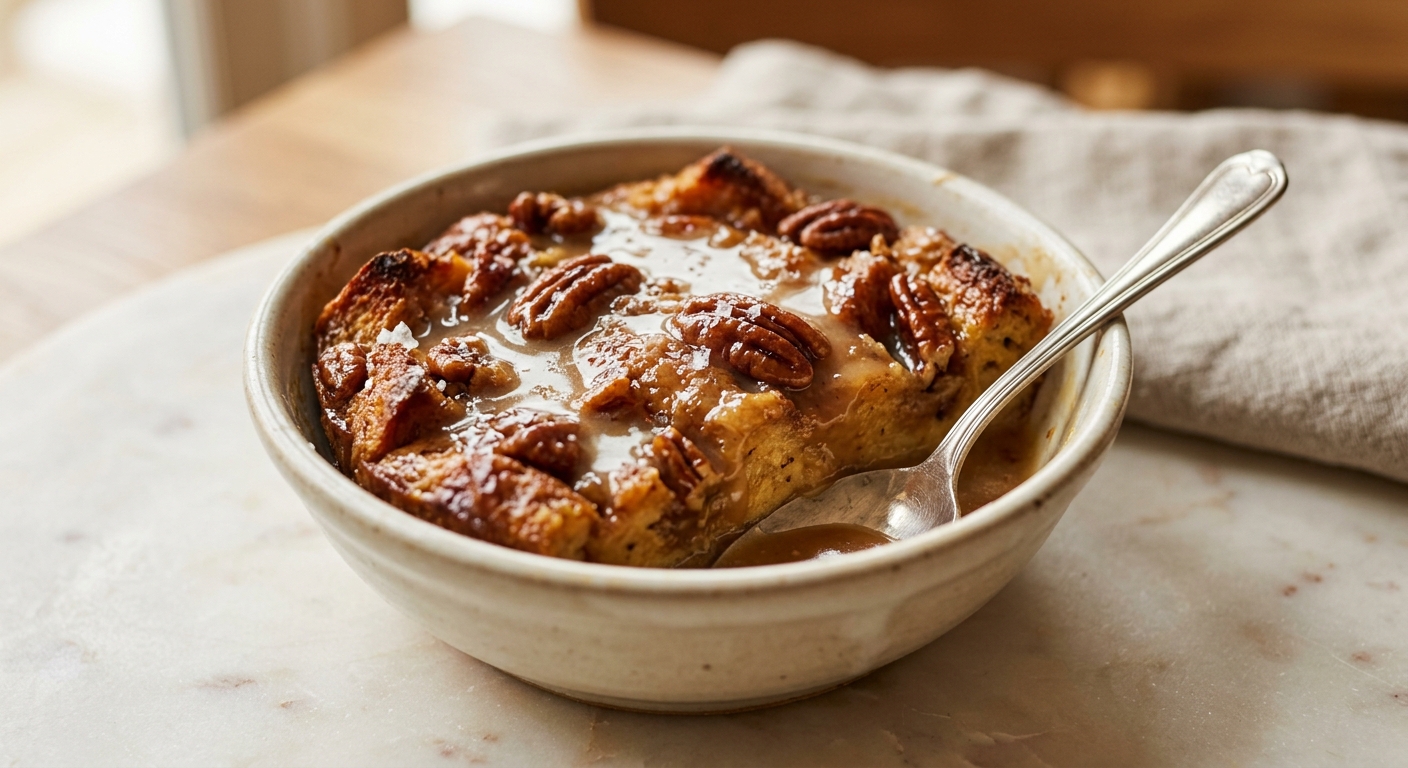
There is a moment, somewhere between pulling this pudding from the oven and pouring the warm maple cream sauce over the top, when the whole kitchen smells like a Vermont sugarhouse in October. The brioche, soaked overnight in a custard rich with eggs, heavy cream, and real Grade A dark maple syrup, puffs and turns golden in the oven while the pecans on top toast to a deep, crackling crunch. It is the kind of dessert that makes people go quiet at the table, focused entirely on what is in front of them.
What sets this bread pudding apart from the average version is a combination of three deliberate choices. First, brioche: its high butter content means the bread absorbs the custard without turning gluey, giving you a texture that is silky and rich rather than heavy or dense. Second, the custard uses a higher ratio of yolks to whole eggs, which creates a noticeably more luxurious, creme brulee-like interior. Third, and perhaps most importantly, flaky sea salt is scattered over the top before baking and again just before serving, cutting through the sweetness of the maple in a way that makes the whole dessert taste more complex and alive.
This recipe sits firmly in the medium difficulty range, but most of that work is hands-off soaking time. It is perfect for anyone who wants a showstopping dessert for a dinner party or a holiday table without spending hours in the kitchen. If you have made French toast, you already understand the technique. This is just French toast taken to its most glorious extreme.
Equipment Needed
Click on an item below to shop for the recommended items for this recipe on Amazon.
As an Amazon Associate, we earn from qualifying purchases.
10
Ingredients
- 700 gday-old brioche bread, cut into 1.5-inch cubes (about 10 to 11 cups), see note on substitutions
- 6 largeegg yolks
- 3 largewhole eggs
- 480 mlheavy cream (2 cups)
- 360 mlwhole milk (1.5 cups)
- 180 mlpure maple syrup, Grade A Dark (Robust Taste), about 3/4 cup, plus more for serving
- 100 glight brown sugar, packed (about 1/2 cup)
- 2 tsppure vanilla extract
- 1 tspground cinnamon
- 0.25 tspground nutmeg, freshly grated if possible
- 1.5 tspColima Sea SaltMicroplastic Free Salt (such as Maldon), divided, plus extra for finishing
- 150 graw pecan halves (about 1.5 cups)
- 30 gunsalted butter, melted (2 tbsp), for the pan and topping
- —For the Salted Maple Cream Sauce:
- 240 mlheavy cream (1 cup)
- 80 mlpure maple syrup (1/3 cup)
- 30 gunsalted butter (2 tbsp)
- 0.5 tspColima Sea SaltMicroplastic Free Salt, or to taste
- 0.5 tsppure vanilla extract
Ingredient Substitutions
Instructions
- If your brioche is fresh, spread the cubes on a large baking sheet and bake at 300°F (150°C) for 15 minutes to dry them out slightly. This step is crucial: stale or dried bread absorbs custard much better than soft fresh bread, giving you a cohesive pudding rather than a soggy one. Let the cubes cool completely before proceeding.
- Spread the pecan halves on the same baking sheet and toast at 325°F (163°C) for 8 to 10 minutes, stirring once, until they are fragrant and one shade darker. Watch carefully as they go from toasted to burnt quickly. Set aside to cool.
- In a large bowl, whisk together the egg yolks and whole eggs until smooth. Add the heavy cream, whole milk, maple syrup, brown sugar, vanilla, cinnamon, nutmeg, and 1 teaspoon of the flaky sea salt. Whisk until the sugar is fully dissolved and the custard is uniform. Taste it: it should be sweet, warmly spiced, and have a noticeable maple depth.
- Brush a 9×13-inch baking dish generously with the melted butter. Add the dried brioche cubes to the dish. Pour the custard mixture evenly over the bread, pressing down gently with a spatula to encourage every cube to make contact with the liquid. Scatter two-thirds of the toasted pecans over the top, pressing some lightly into the gaps. Cover the dish tightly with plastic wrap and refrigerate for at least 2 hours, or ideally overnight. The bread should absorb nearly all of the custard.
- When ready to bake, remove the dish from the refrigerator and let it sit at room temperature for 30 minutes. Preheat your oven to 325°F (163°C). Scatter the remaining pecans over the top and sprinkle with the remaining 0.5 teaspoon of flaky sea salt. Drizzle very lightly with a little extra maple syrup if you like.
- Place the baking dish in a larger roasting pan and pour hot water into the roasting pan until it comes 1 inch up the sides of the baking dish. This water bath (bain-marie) regulates the temperature around the custard, preventing the edges from overcooking before the center sets. Bake for 50 to 55 minutes, until the top is deep golden brown, the pecans are crisp, and the center jiggles only slightly when you gently shake the pan (like a set gelatin rather than liquid).
- Carefully remove the baking dish from the water bath. Let the pudding rest for at least 15 minutes before serving; this allows the custard to fully set and makes slicing much cleaner. Meanwhile, make the maple cream sauce: combine the cream, maple syrup, and butter in a small saucepan over medium heat. Bring to a gentle simmer and cook, stirring occasionally, for 5 to 7 minutes until the sauce has thickened slightly and coats the back of a spoon. Remove from heat, stir in the vanilla and flaky sea salt. Taste and adjust salt. Serve the pudding warm, with the sauce poured over each portion and an extra pinch of flaky sea salt on top.
- Dry the brioche cubes as described in the oven method (using your oven or leaving them out uncovered on a rack overnight). Toast the pecans in a dry skillet over medium heat for 4 to 5 minutes, tossing frequently, until fragrant. This step is not optional in the slow cooker method since the pecans will not crisp in the moist environment: toasting them beforehand is the only way to build their flavor and crunch.
- Whisk together all custard ingredients (egg yolks, whole eggs, cream, milk, maple syrup, brown sugar, vanilla, cinnamon, nutmeg, and 1 teaspoon salt) in a large bowl until the sugar is dissolved. Combine the dried brioche cubes with two-thirds of the toasted pecans and fold them into the custard. Let this mixture soak for at least 30 minutes at room temperature, pressing the bread down occasionally.
- Butter the insert of a 6-quart slow cooker generously. Line the bottom and sides with a single sheet of parchment paper, leaving overhang at the top (this makes lifting the pudding out much easier). Transfer the soaked bread and custard mixture into the insert, spreading it evenly. Scatter the remaining pecans over the top and sprinkle with the remaining 0.5 teaspoon of flaky sea salt.
- Lay two layers of paper towels across the top of the slow cooker insert before placing the lid on. The paper towels absorb condensation that would otherwise drip back onto the pudding and make the surface soggy. This is the single most important tip for slow cooker custards and puddings.
- Cook on High for 2.5 to 3 hours, until the center is just set (it will still be slightly soft but not liquid). Do not lift the lid before the 2-hour mark. Once set, turn off the slow cooker and let the pudding rest uncovered for 20 minutes before serving. While resting, prepare the maple cream sauce on the stovetop as described in the oven method. Use the parchment overhang to lift portions out cleanly, or serve directly from the insert. Finish each serving with a drizzle of warm maple cream sauce and a pinch of flaky sea salt.
Nutrition Per Serving
Per 1 serving (makes one 9×13-inch pudding, about 10 generous servings)
Why This Recipe Works
The custard ratio in this recipe is calculated specifically for brioche. Because brioche is already an enriched bread, high in fat and egg from its original baking, it needs a thinner custard than a leaner baguette would. Using a combination of cream and whole milk (rather than all cream) gives the custard enough body to set without making the finished pudding feel heavy or greasy. The higher ratio of yolks to whole eggs is the real key: yolks are rich in fat and emulsifying lecithin, which produces a smoother, more cohesive custard gel. Whole egg whites, while they help the custard set, can make it slightly rubbery if overused. More yolks means a silkier, more creme-brulee-like interior, which is exactly the texture we are chasing here.
The water bath (bain-marie) in the oven method is not optional for the best results. Custards cook by gentle, even heat; direct oven heat at the edges of the pan causes the proteins in the eggs to overcook and tighten before the center has had a chance to set, resulting in a rubbery or curdled edge. Water can only ever reach 212°F (100°C) no matter how hot the oven is, so it acts as a thermal buffer that keeps the sides of the pudding cooking at the same gentle pace as the center. If your pudding ever comes out with a rubbery or scrambled texture around the edges, a bain-marie will solve it.
Dark Grade A (Robust Taste) maple syrup, rather than the lighter amber variety, is called for deliberately. The darker grade contains more of the Maillard reaction compounds developed during the sap reduction process, giving it a deeper, almost caramel-like flavor that does not get lost in a rich custard the way a delicate light syrup would. Light maple syrup is beautiful on pancakes where subtlety is noticed; in a baked custard surrounded by cream, butter, and pecans, you need the darker, bolder version to register clearly in every bite.
Baker’s Tips
- Day-old or stale bread is genuinely important here. Fresh soft brioche will partially dissolve into the custard, making the pudding gummy in the center. If your bread is fresh, the 15-minute drying step in the oven is not optional.
- Do not skip the overnight (or minimum 2-hour) soak. This is when the bread absorbs the custard fully and the flavors meld. A pudding baked immediately after assembly will have uneven texture with wet pockets and dry spots.
- Use real, pure maple syrup, not pancake syrup or maple-flavored syrup. Imitation maple flavor bakes out almost completely and you will be left with an oddly sweet but flavor-less pudding. Grade A Dark (formerly Grade B) is the best choice for baking.
- Let the pudding rest for at least 15 minutes before cutting. Like any custard, it continues to set as it cools slightly. Cutting it straight from the oven gives you a loose, soupy slice; waiting gives you a clean, cohesive square.
- The maple cream sauce can be made richer by letting it reduce for a full 10 minutes rather than 5 to 7. For a thinner, pourable consistency (better for serving a crowd straight from a jug), stop at 5 minutes.
- If your pecans sink to the bottom during soaking, scatter a fresh handful over the top just before baking. You want visible, toasty pecans on the surface for both texture and presentation.
- Taste your maple syrup before using it. Genuine maple syrup varies enormously in flavor intensity from brand to brand. If yours tastes mild, you can increase the amount by up to 60ml (1/4 cup), reducing the milk by the same amount to keep the custard ratio balanced.
Variations
- Bourbon Maple version: Add 2 tablespoons of good bourbon to the custard and another tablespoon to the cream sauce. The vanilla notes in the bourbon amplify the maple beautifully.
- Apple and Maple: Fold in 1 large apple (peeled, finely diced, and briefly sauteed in butter and cinnamon) with the bread cubes before soaking. A fall variation that tastes like a cross between bread pudding and apple pie.
- Chocolate Pecan: Add 100g of roughly chopped dark chocolate (70%) to the bread cubes before adding the custard, and replace the cinnamon and nutmeg with a teaspoon of espresso powder. The maple and dark chocolate combination is extraordinary.
- Dairy-free: Replace the heavy cream with full-fat coconut cream and the whole milk with oat milk. Use dairy-free butter throughout. The coconut flavor is subtle but present and pairs well with the maple.
Troubleshooting & FAQ
My bread pudding is still liquid or very wobbly in the center after the full bake time. What went wrong?
The edges of my pudding are rubbery and overcooked but the center seems fine. How do I prevent this?
My maple flavor is barely noticeable in the finished pudding. What happened?
My pecans are soft and chewy rather than crunchy on top. How do I get them properly crisp?
My cream sauce is too thin and runny. How do I fix it?
Storage & Make-Ahead
- Storage: Cover the cooled bread pudding tightly and refrigerate for up to 4 days. Store the maple cream sauce separately in a jar in the refrigerator for up to 1 week; rewarm gently in a small saucepan over low heat or in 20-second microwave bursts, stirring between each. The bread pudding itself can be frozen (without sauce) for up to 2 months; thaw overnight in the refrigerator and reheat covered with foil at 325°F (163°C) for 20 minutes.
- Make-Ahead: This recipe is ideal for making ahead. Assemble the unbaked pudding up to 24 hours in advance, cover tightly, and refrigerate. Pull it out 30 minutes before baking to take the chill off. The maple cream sauce can also be made up to 5 days ahead and refrigerated. This makes it an excellent choice for Thanksgiving, Christmas, or any dinner party.