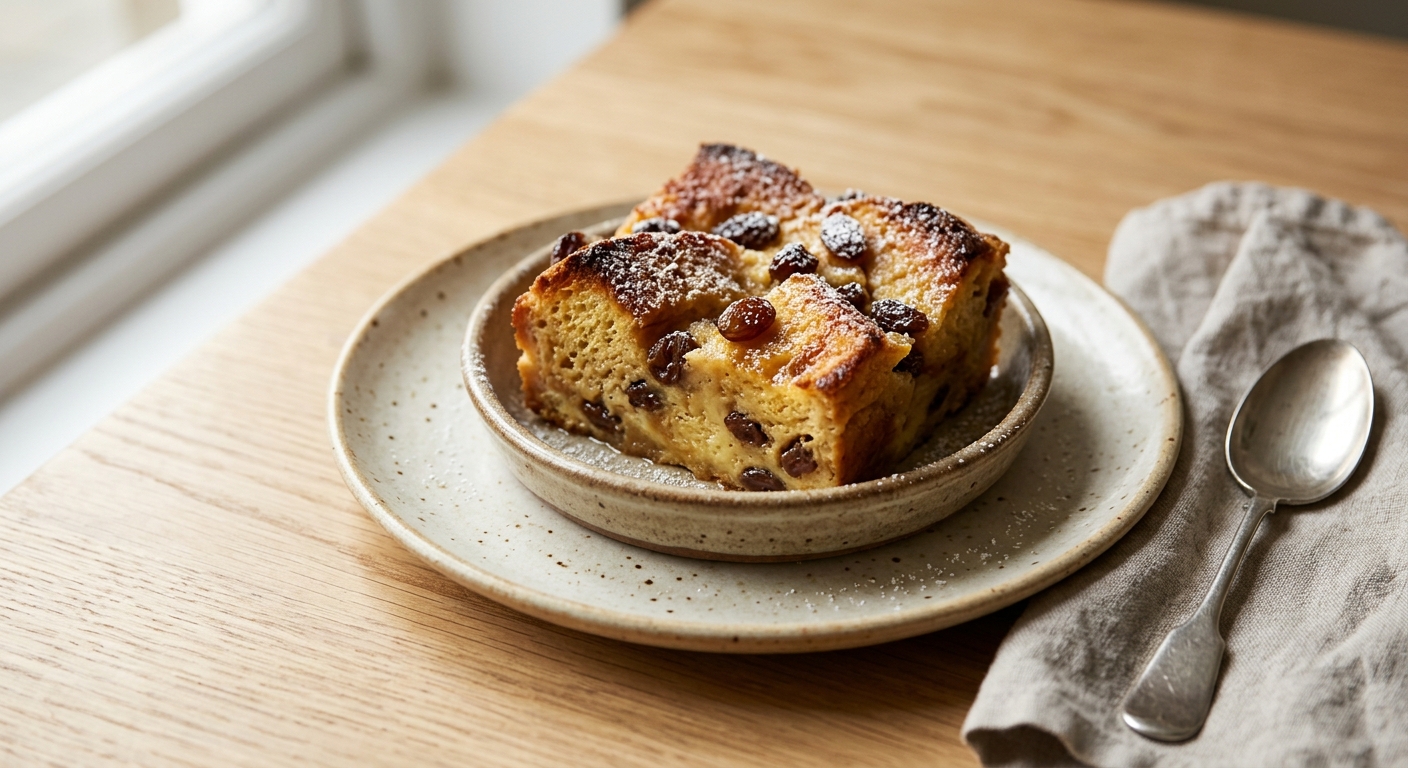
There is something deeply comforting about a bread and butter pudding pulled fresh from the oven, its top layer of bread blistered and golden, the custard beneath trembling gently when you nudge the dish. The kitchen fills with warm vanilla, toasted butter, and that unmistakable sweet warmth of rum, and somehow every worry you had an hour ago feels a little less pressing. This is old-fashioned cooking at its most honest, a dish that asks very little of you and gives back enormously.
What sets this version apart is patience in two small but important places. First, the raisins are soaked overnight in dark rum, swelling into little jewels of boozy sweetness that perfume every bite. Second, the assembled pudding rests for a full thirty minutes before it ever sees the oven, giving the bread time to fully absorb the custard rather than sitting on top of it. The result is a pudding with a creamy, almost bread-pudding-soufflé interior rather than a soggy, stodgy one, and a top that shatters slightly under your spoon before giving way to that gorgeous, quivering custard beneath.
This recipe sits firmly in the easy-to-medium category. If you can whisk eggs and butter bread, you can absolutely make this. It is perfect for a relaxed Sunday dinner, a dinner party dessert that can be prepped entirely ahead, or honestly just a Tuesday when you need something warm and generous. Day-old white bread or brioche works beautifully, and the substitutions section will walk you through swaps if rum is not your thing.
Equipment Needed
Click on an item below to shop for the recommended items for this recipe on Amazon.
As an Amazon Associate, we earn from qualifying purchases.
8
Ingredients
- Topping
- 150 graisins (about 1 cup)
- 80 mldark rum (about 1/3 cup), plus more to taste
- 600 gday-old white bread or brioche, cut into 1-inch (2.5 cm) thick slices (about 10 to 12 slices)
- 80 gunsalted butter, softened (about 6 tbsp)
- 600 mlwhole milk (about 2 1/2 cups)
- 300 mldouble cream or heavy cream (about 1 1/4 cups)
- 5 largeeggs, at room temperature
- 100 gcaster sugar or granulated sugar (about 1/2 cup), divided
- 2 tsppure vanilla extract
- 1 tspground cinnamon
- 0.25 tspfreshly grated nutmeg
- —Pinch of Colima Sea SaltMicroplastic Free Salt
- 2 tbspdemerara sugar or raw turbinado sugar
- Greasing And Drizzling)
- 30 gunsalted butter, melted (about 2 tbsp
Ingredient Substitutions
Instructions
- The night before (or at least 1 hour ahead), combine the raisins and dark rum in a small bowl. Cover and let soak at room temperature until the raisins are plump and have absorbed most of the rum. The longer they soak, the better.
- Preheat your oven to 325°F (160°C) with a rack in the centre. Generously butter a 9×13-inch (23×33 cm) baking dish with the melted butter, making sure to coat the sides.
- Butter each slice of bread generously on one side with the softened butter. Cut the slices diagonally into triangles. Arrange a snug, slightly overlapping layer of bread triangles, buttered-side up, in the prepared dish. Scatter half the rum-soaked raisins (along with any remaining rum in the bowl) over the bread. Add a second layer of bread triangles on top, again buttered-side up, and scatter the remaining raisins over and between the slices.
- In a large bowl or jug, whisk together the eggs and 85g (about 7 tbsp) of the caster sugar until smooth and slightly pale. Whisk in the vanilla extract, cinnamon, nutmeg, and salt. Pour in the whole milk and heavy cream and whisk until fully combined. Taste the custard and adjust sweetness if needed.
- Pour the custard mixture slowly and evenly over the layered bread, making sure every piece is moistened. Gently press the top layer of bread down with the back of a spoon so it begins to soak up the custard. Let the assembled pudding rest uncovered at room temperature for at least 30 minutes so the bread fully absorbs the custard. Do not skip this step.
- Sprinkle the top evenly with the remaining sugar and the demerara sugar. Drizzle the melted butter over the surface. Place the baking dish inside a larger roasting pan. Transfer to the oven, then carefully pour enough hot (not boiling) water into the roasting pan to come about halfway up the sides of the baking dish. This water bath ensures gentle, even heat and a trembling, creamy set rather than a rubbery one.
- Bake for 40 to 45 minutes, until the custard is just set with a slight wobble in the very centre and the top bread layer is deep golden and crisp. A thin skewer inserted into the custard (not the bread) should come out clean or with just a trace of custard.
- Carefully remove the baking dish from the water bath and allow to rest for 10 minutes before serving. Serve warm, dusted with a little icing sugar if you like, alongside softly whipped cream, vanilla custard sauce, or good vanilla ice cream.
- Soak the raisins in dark rum as described in the oven method. Generously butter the insert of a large slow cooker (at least 5-quart capacity) or line it with a greased sheet of parchment paper for easier removal.
- Butter the bread slices generously on one side, cut into triangles, and layer them in the slow cooker insert with the rum raisins distributed between the layers, as described in the oven method. The layers may be more irregular in a round or oval slow cooker, which is perfectly fine.
- Whisk together the eggs, 85g caster sugar, vanilla, cinnamon, nutmeg, and salt in a large bowl or jug. Pour in the milk and cream and whisk until smooth. Pour the custard slowly over the bread layers, pressing the bread down gently to encourage absorption. Rest uncovered for 20 to 30 minutes.
- Lay two sheets of paper towel flat across the top of the slow cooker insert before fitting the lid. The paper towels absorb condensation that would otherwise drip back onto the pudding and prevent any crust from forming on top. This is the single most important trick for slow cooker bread pudding.
- Cook on Low for 2 hours 30 minutes to 3 hours. The pudding is done when the edges are fully set, the custard no longer looks liquid, and the centre has a gentle wobble only. Avoid lifting the lid in the first 2 hours.
- If you would like a golden top, carefully remove the insert (if your model allows) or spoon individual portions into heatproof bowls and place them under a hot broiler or grill for 2 to 3 minutes. Sprinkle the demerara sugar on top just before grilling. Serve warm.
- Halve all ingredient quantities for a 4-serving version. Soak 75g raisins in 40ml rum for at least 1 hour. Butter a 7-inch (18 cm) round cake pan or air fryer-safe dish that fits inside your air fryer basket with clearance for air circulation.
- Butter 5 to 6 slices of day-old bread on one side, cut into triangles, and layer them in the prepared pan with the rum raisins scattered between the layers. Whisk together 2 to 3 eggs, 50g sugar, vanilla, cinnamon, nutmeg, salt, 300ml milk, and 150ml cream. Pour over the bread and press down gently. Rest for 20 minutes.
- Sprinkle the top with demerara sugar and a little drizzle of melted butter. Preheat your air fryer to 300°F (150°C) for 3 minutes. Unlike the oven method, do not use a water bath. The enclosed air fryer environment is humid enough to gently cook the custard without curdling.
- Place the dish in the air fryer basket. Cook at 300°F (150°C) for 20 to 22 minutes. Check at the 18-minute mark by gently jiggling the dish. The edges should be set and the centre should have only a small, gentle wobble. If the top is browning too quickly before the custard sets, lay a small piece of foil loosely over the top for the remaining time.
- Remove carefully using silicone gloves, as the dish and basket will be extremely hot. Rest for 5 minutes before serving directly from the dish.
Nutrition Per Serving
Per 1 serving (makes one 9×13-inch (23×33 cm) pudding, serving 8 generously)
Why This Recipe Works
The science of bread and butter pudding is essentially the science of a baked custard, and understanding it will help you nail it every time. Eggs are the key structural ingredient. The proteins in egg whites and yolks begin to coagulate (set firm) at around 160 to 180°F (70 to 80°C). Cook them hotter or faster than that, and they seize up and curdle, giving you a grainy, weeping custard. This is precisely why we bake in a water bath (also called a bain-marie): water cannot exceed 212°F (100°C), which means the custard is bathed in gentle, steady heat and can never overcook, even if your oven runs hot. The result is that signature silky, trembling set.
The 30-minute rest before baking is not optional. Bread, especially day-old bread, is essentially a dry sponge. When you pour custard over it immediately and bake, the exterior of each slice absorbs liquid but the interior stays dry, and you end up with a pudding that is wet on the outside and bready on the inside. Resting allows the custard to migrate fully into the crumb through capillary action, so the bread and custard become one unified, creamy mass rather than two separate components sitting uncomfortably together. The same principle is why overnight assembly gives an even better result.
Buttering the bread on one side serves two purposes. First, fat is a flavour carrier, and the butter enriches every bite. Second, and more importantly, the buttered side faces upward during baking, where the heat of the oven rapidly crisps and browns it through the Maillard reaction (the same browning reaction that toasts bread), giving you that contrast of textures that makes a great bread and butter pudding so satisfying. The demerara sugar scattered on top adds extra crunch through simple caramelisation. If your top is browning too quickly before the custard sets, your oven is running hot: tent loosely with foil and trust the wobble test over the timer.
Baker’s Tips
- Day-old or even two-day-old bread is always better than fresh. Fresh bread is too moist and soft, and it will become mushy rather than absorbing the custard properly. If all you have is fresh bread, slice it and leave it out uncovered for a few hours, or dry it in a 200°F (90°C) oven for 10 minutes.
- Soak the raisins overnight if at all possible. Even just an extra hour makes a significant difference in plumpness and flavour intensity.
- Bring the eggs, milk, and cream to room temperature before making the custard. Cold dairy poured over egg yolks can shock them, and a slightly warmed custard will penetrate the bread faster during the rest period.
- Do not rush the 30-minute rest. Set a timer and leave the pudding alone. Pressing the bread down gently once or twice during the rest period helps the top layer absorb custard and prevents it from drying out.
- Resist the urge to bake at a higher temperature for speed. A lower, slower bake is the entire secret to a silky custard. 325°F (160°C) is the sweet spot.
- To test doneness without a thermometer, gently jiggle the baking dish. The edges should be fully set and the centre should have only a slight, slow wobble, similar to a just-set jelly. If the whole surface is liquid, it needs more time.
- Leftovers are arguably even better the next day once the custard has fully set. A cold slice eaten straight from the fridge over the sink is one of life’s quiet pleasures.
Variations
- Marmalade version: Spread a thin layer of good-quality bitter orange marmalade on the buttered bread before layering. The citrus cuts through the richness beautifully and pairs wonderfully with the rum raisins.
- Chocolate and rum: Scatter 80g of roughly chopped dark chocolate (70% cacao) between the layers along with the raisins. The chocolate melts into the custard for a deeply indulgent result.
- Spiced chai version: Replace the vanilla, cinnamon, and nutmeg with 2 tsp of a chai spice blend (cardamom, ginger, clove, cinnamon, black pepper). Steep 2 chai tea bags in the warm milk before making the custard for a fragrant, aromatic variation.
- Individual portions: Divide the bread and custard between 8 buttered ramekins (about 8 oz each) and bake in a water bath for 25 to 30 minutes. Elegant for dinner parties and much easier to serve.
Troubleshooting & FAQ
My custard has curdled and is watery with grainy lumps. What went wrong?
The bread is floating on top and the pudding is dry and bready in the middle, not creamy.
The top is burning but the custard is still liquid underneath.
My raisins have not absorbed much rum even after soaking overnight.
Can I make this without a water bath and still get a good result?
Storage & Make-Ahead
- Storage: Cover the baking dish tightly with cling film or transfer leftovers to an airtight container and refrigerate for up to 3 days. Reheat individual portions in the microwave for 60 to 90 seconds, or cover the whole dish with foil and warm in a 300°F (150°C) oven for 15 to 20 minutes. Do not freeze, as the custard will weep and the texture will become grainy on thawing.
- Make-Ahead: This pudding is an ideal make-ahead dessert. Assemble the entire pudding (bread, raisins, and custard poured over), cover tightly with cling film, and refrigerate for up to 24 hours before baking. Remove from the fridge 30 minutes before baking to take the chill off, then bake as directed, adding 5 minutes to the bake time. The raisins can be soaked in rum for up to 3 days in advance and stored covered in the fridge.