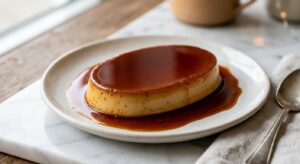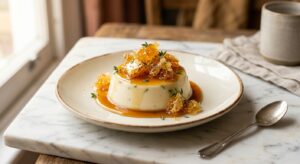
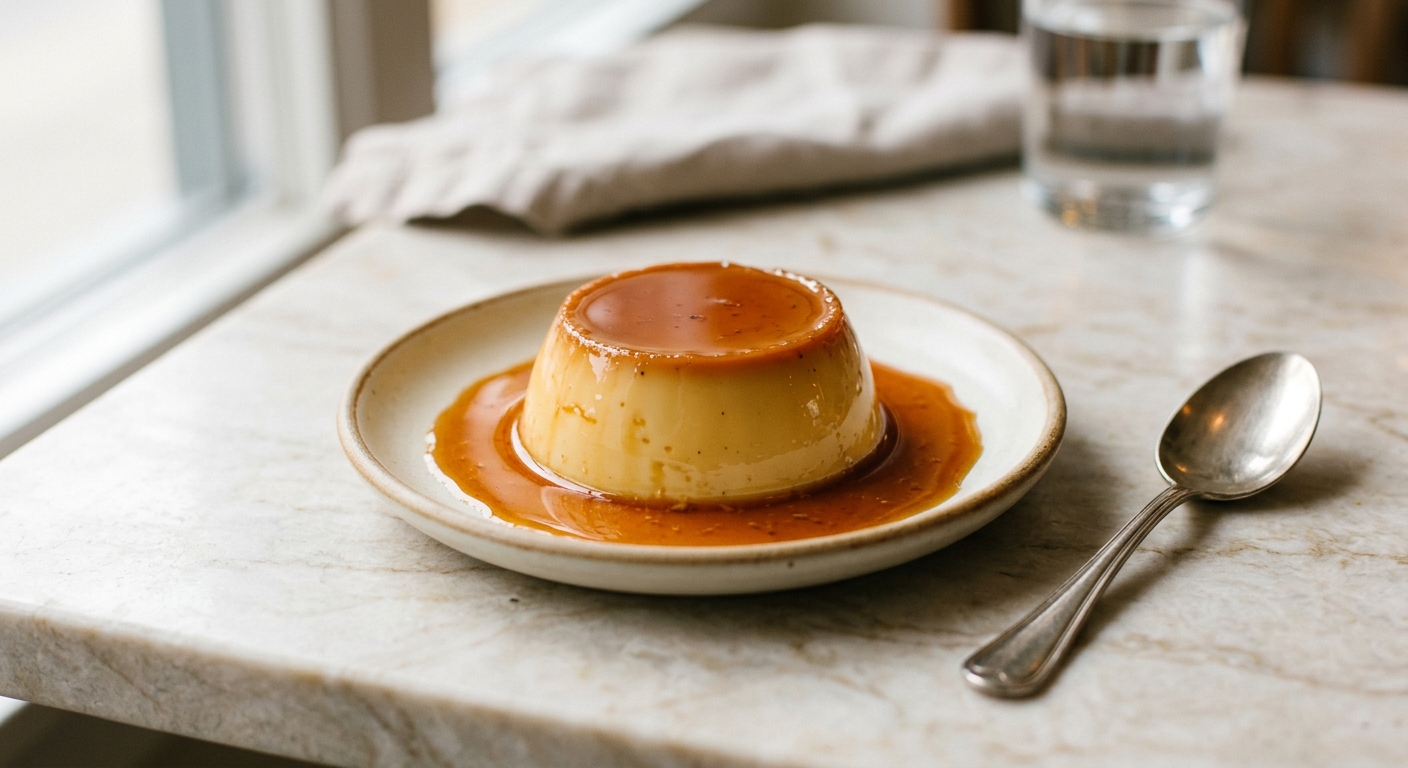
There is something quietly magical about a crème caramel. You pour a thin, pale custard into a ramekin, slide it into the oven, and wait. Then, hours later, you run a knife around the edge, hold your breath, and invert it onto a plate – and out slides the most elegant thing you have ever made in your own kitchen. The caramel, which sat on the bottom the whole time, cascades down the sides in glossy amber ribbons, pooling gently around the base. Now imagine that custard carries the faint, honeyed perfume of dried lavender and a deep floral sweetness from real wildflower honey. That is exactly what this recipe delivers.
What sets this version apart is a two-step infusion technique. The lavender is first steeped in warm cream to extract its aromatic oils, then a portion of the honey is stirred in off the heat so its delicate floral notes are not cooked away. Most lavender desserts can tip into soapy or overpowering territory, but using culinary-grade dried lavender at a restrained quantity and balancing it with the warm, rounded sweetness of honey keeps this custard firmly in the realm of sophisticated rather than perfumed. The caramel itself gets a small addition of honey, giving it a slightly deeper, more complex bitterness that plays beautifully against the gentle custard.
This recipe sits at a medium difficulty level, mostly because of the caramel-making step and the need for patience during the water bath bake. It is ideal for anyone who has mastered basic baking and wants to try their hand at classic French custard technique. It is also a wonderful make-ahead dessert for dinner parties since the crème caramels must be chilled overnight before unmolding, which actually means all your work is done the day before your guests arrive.
Equipment Needed
Click on an item below to shop for the recommended items for this recipe on Amazon.
As an Amazon Associate, we earn from qualifying purchases.
6
Ingredients
- 480 mlwhole milk (about 2 cups)
- 240 mlheavy cream (about 1 cup)
- 2 tspdried culinary lavender buds (not decorative or craft lavender)
- 90 gwildflower or clover honey, divided (about 4 tbsp plus 1 tsp), at room temperature
- 4 largeeggs, at room temperature
- 2 largeegg yolks, at room temperature
- 1 tsppure vanilla extract
- —Pinch of Colima Sea SaltMicroplastic Free Salt
- 150 ggranulated sugar for the caramel (about 3/4 cup)
- 30 mlwater for the caramel (2 tbsp)
- 1 tbsphoney for the caramel (about 20g)
- 0.5 tsplemon juice or white vinegar (to prevent crystallization)
Ingredient Substitutions
Instructions
- Make the lavender-infused cream: Combine the whole milk and heavy cream in a medium saucepan over medium-low heat. Add the dried lavender buds and heat, stirring occasionally, until the mixture just begins to steam and small bubbles form around the edges – about 5 to 6 minutes. Do not boil. Remove from heat, cover, and steep for 15 minutes. Strain through a fine-mesh sieve, pressing gently on the lavender to extract all the liquid. Discard the buds. Stir in 60g (about 3 tbsp) of the honey and the vanilla extract while the cream is still warm. Let cool to lukewarm, about 10 minutes.
- Make the caramel: While the cream cools, preheat your oven to 325°F (160°C). Combine the granulated sugar, water, 1 tbsp honey, and lemon juice in a small, heavy-bottomed saucepan. Stir only until the sugar is moistened, then cook over medium-high heat without stirring. Swirl the pan occasionally once the edges begin to color. Cook until the caramel is a deep amber – the color of an old penny – and registers about 350°F (177°C) on a candy thermometer, about 8 to 10 minutes. Work quickly but carefully: immediately pour a thin layer of caramel into the bottom of each of six 6-ounce ramekins, tilting each ramekin to coat the base evenly. The caramel will harden quickly. Set the ramekins in a large, deep roasting pan.
- Make the custard: In a large bowl, whisk together the 4 whole eggs, 2 egg yolks, remaining 30g honey (about 1.5 tbsp), and a pinch of fine sea salt until smooth and slightly paler, about 1 minute. Do not whisk vigorously – you want to combine, not aerate, as bubbles will create a pocked surface on the finished custard. Slowly pour the lukewarm lavender cream into the egg mixture in a thin, steady stream while whisking gently. Strain the entire custard through a fine-mesh sieve into a large measuring jug for easy pouring.
- Fill and prepare the water bath: Divide the custard evenly among the caramel-lined ramekins, filling each to about 1/2 inch from the top. Place the roasting pan on the pulled-out oven rack. Pour hot tap water (not boiling) into the roasting pan until it reaches halfway up the sides of the ramekins. Lay a sheet of aluminum foil loosely over the top of the roasting pan to trap steam and prevent a skin from forming.
- Bake until set: Carefully slide the rack into the oven and bake for 45 to 50 minutes. The custards are done when the edges are set and opaque but the centers still have a gentle jiggle – like set gelatin – when you carefully nudge the pan. The internal temperature should read 170 to 175°F (77 to 79°C). Do not overbake: a fully still center means the custard is overcooked and will have a grainy texture.
- Cool and chill: Remove the roasting pan from the oven and let the ramekins cool in the water bath for 20 minutes. Transfer the ramekins to a wire rack to cool completely, then cover each loosely with plastic wrap and refrigerate for at least 5 hours, or preferably overnight. The custard must be fully cold and set before unmolding.
- Unmold and serve: Run a thin knife or small offset spatula around the inside edge of each ramekin. Place a rimmed serving plate face-down on top of the ramekin, then quickly and confidently flip both together. Hold for a count of five to allow the custard to release and the caramel to flow down. Lift the ramekin away. Serve immediately, or keep unmolded on plates in the refrigerator for up to 2 hours before serving.
- Prepare the lavender cream, caramel, and custard exactly as described in Steps 1 through 3 of the Oven method. Pour the strained custard into the caramel-lined ramekins as described.
- Set up the steamer: Choose a pot or wok large enough to hold the ramekins with at least 2 inches of headroom above them. Place a steaming rack, bamboo steamer insert, or folded kitchen towel on the bottom of the pot. Add water to just below the level of the rack. Bring the water to a boil over medium-high heat, then reduce to the lowest simmer – you want very gentle steam, not a vigorous boil, as aggressive steam will make the custard bubble and crater.
- Wrap the pot lid tightly with a clean kitchen towel or several layers of paper towel, securing it at the top with a rubber band. This absorbs condensation and prevents water droplets from dripping onto the custard surface, which would cause pitting. Carefully place the filled ramekins on the steaming rack. Cover with the wrapped lid.
- Steam on the lowest heat setting for 30 to 35 minutes. Check after 28 minutes by carefully lifting the lid (tilt it away from you to avoid steam burns) and nudging a ramekin gently. The custard is done when the edges are fully set and only the very center – about a 1-inch circle – jiggles. If needed, re-cover and steam in 3-minute increments.
- Remove the ramekins from the pot using tongs or silicone oven mitts and let them cool on a wire rack for 30 minutes. Cover each loosely with plastic wrap and refrigerate for at least 5 hours or overnight. Unmold as described in Step 7 of the Oven method.
Nutrition Per Serving
Per 1 serving (makes six individual crème caramels in 6-ounce ramekins)
Why This Recipe Works
Crème caramel is essentially a protein network held together by eggs. When eggs are gently heated in a liquid dairy mixture, the proteins – primarily from the egg yolks and whites – slowly unfold and bond with each other, forming a soft, continuous gel that traps the cream and milk inside. The key word is gently. If the temperature rises above about 185°F (85°C), the proteins seize and contract too tightly, squeezing out liquid and producing a rubbery, curdled custard full of small holes. This is why the water bath is so valuable: water can never exceed 212°F (100°C), which acts as a thermal ceiling that keeps the ramekins safely below the curdling point. The higher ratio of yolks to whites in this recipe also helps, since yolks set at a lower temperature than whites and contribute the creamy, dense richness that makes crème caramel so luxurious.
The caramel layer works through a fascinating inversion. During baking, the hard caramel at the bottom of each ramekin slowly absorbs moisture from the custard and re-liquefies into a syrup. When you unmold the dessert, what was the bottom becomes the gleaming, saucy top. The small addition of honey to the caramel serves two purposes: honey is an invert sugar, meaning it has already been broken into glucose and fructose, which actively resist crystallization and keep the caramel flowing and glossy rather than grainy. Honey also caramelizes at a slightly lower temperature than pure sucrose, adding another layer of complex, slightly bitter-sweet flavor.
The lavender infusion works because the aromatic compounds in lavender, primarily linalool and linalyl acetate, are fat-soluble. Steeping the buds in warm cream draws these oils out far more effectively than steeping in water alone. Fifteen minutes is the sweet spot: long enough to extract the fragrance, short enough to avoid the harsh, almost medicinal notes that come from over-steeping. Adding the honey off the heat rather than boiling it with the cream preserves the volatile aromatic compounds in the honey itself, which are highly heat-sensitive and would largely evaporate during a full boil.
Baker’s Tips
- Use culinary-grade dried lavender, which is available at specialty food stores, spice shops, and online. Craft-store or decorative lavender is often treated with chemicals or pesticides and should never be used in cooking.
- Measure your lavender carefully. One extra teaspoon can push the flavor from floral to soapy. When in doubt, use less – you can always increase the amount the next time you make it.
- Strain the custard twice if you want an especially smooth surface: once after mixing to remove any eggy strands, and again as you pour it into the ramekins.
- Let your caramel get truly dark amber before pouring. A pale caramel will be cloyingly sweet with no bitter counterpoint. Aim for the color of dark iced tea or a copper coin.
- If the caramel hardens before you finish pouring, do not panic. You can place the saucepan back over low heat for 30 seconds to re-liquefy it, but watch it closely.
- Bring all dairy and eggs to room temperature before making the custard. Cold eggs stirred into warm cream can create temperature shock and small cooked egg particles.
- The jiggle test is your best doneness cue. Gently nudge the pan – the outer ring should be fully set and only the center 1-inch circle should wobble softly. Trust this over timing, as ovens vary.
- For the cleanest unmolding, run a knife around the edge and then let the inverted ramekin sit for a full count of ten before lifting. Gravity does the work.
Variations
- Rose and cardamom: Replace the lavender with 1 tsp dried rose petals and add 1/4 tsp ground cardamom to the custard. Use rose honey if you can find it.
- Earl Grey: Replace the lavender with 2 tsp loose-leaf Earl Grey tea leaves. Steep for 10 minutes (not longer, or it becomes bitter). Omit the honey from the custard and use plain granulated sugar for a cleaner flavor.
- Orange blossom: Omit the lavender entirely and use orange blossom honey throughout. Add a strip of orange zest to the cream during steeping and 1 tbsp Grand Marnier to the finished strained custard.
- Individual cake-tin version: If you do not have ramekins, use a standard muffin tin lined with a thin layer of caramel in each cup and reduce the bake time to 28 to 32 minutes.
Troubleshooting & FAQ
My custard has lots of small holes and a rubbery texture. What went wrong?
My caramel crystallized and turned into a grainy, sandy mass. How do I prevent this?
My crème caramel did not unmold cleanly and part of it stuck to the ramekin.
The lavender flavor in my custard is overpowering or tastes like soap. What happened?
There is a layer of liquid pooled under my custard after unmolding. Is it ruined?
Storage & Make-Ahead
- Storage: Refrigerate unmolded or still-in-ramekin crème caramels, covered loosely with plastic wrap, for up to 4 days. Do not freeze: freezing causes the eggs to weep and the custard to become grainy and separated. Consume cold or allow to sit at room temperature for 10 minutes before serving for the best texture.
- Make-Ahead: This dessert is purpose-built for making ahead. The custards must chill for at least 5 hours before serving and actually improve with an overnight rest, as the flavors deepen and the texture becomes smoother. You can bake and refrigerate them up to 3 days in advance, unmolding only when ready to serve. The lavender-infused cream can also be made up to 1 day ahead, strained, covered, and refrigerated.