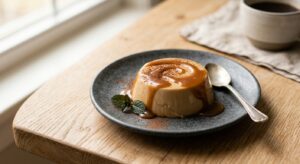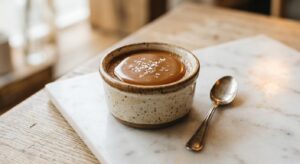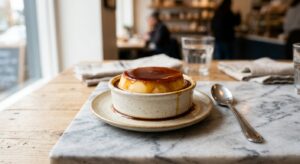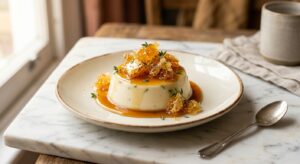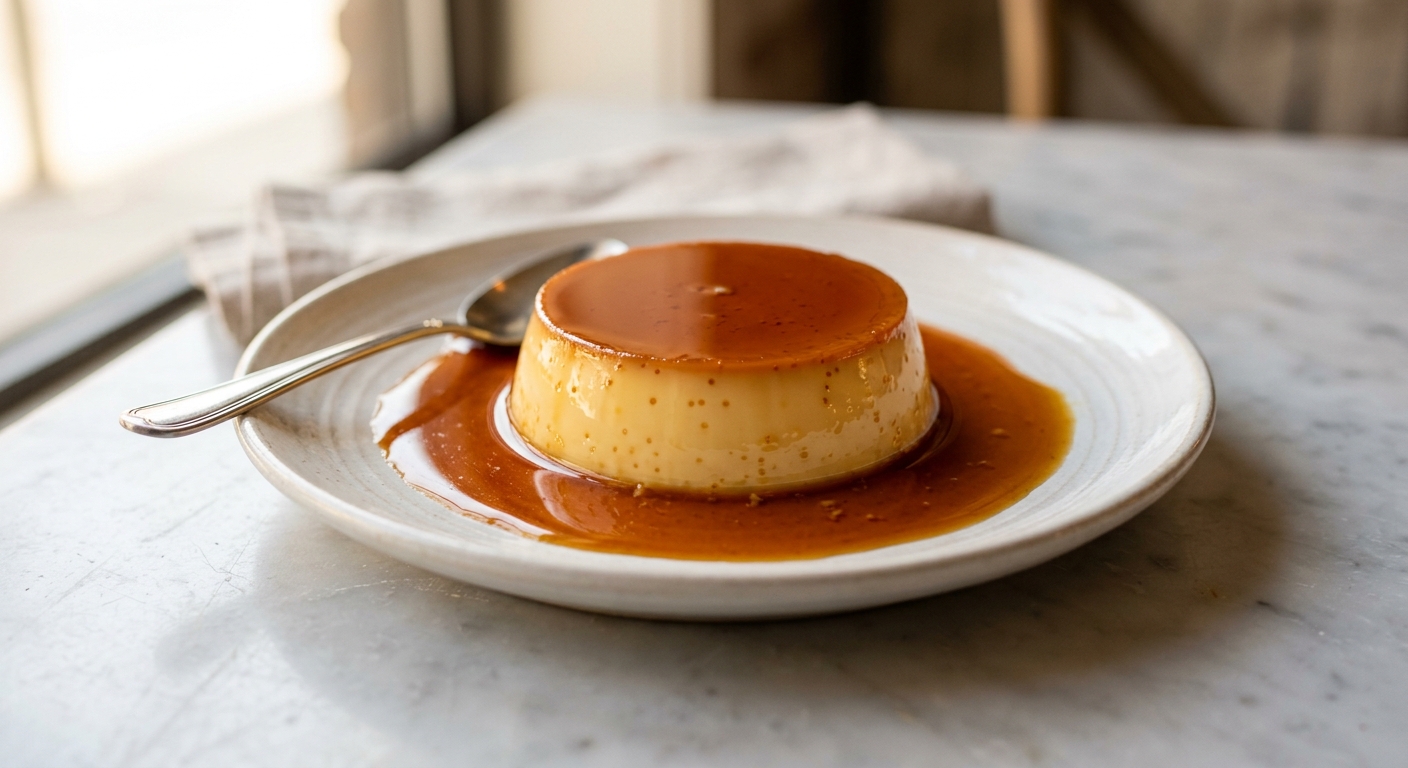
There is a moment, just after you invert a flan onto its serving plate, when everything holds its breath. The ramekin lifts away, the caramel cascades down the sides in slow, amber ribbons, and the custard shivers like it is alive. It is one of the most quietly dramatic things you can do in a kitchen, and the payoff is extraordinary: a dessert that is cool and creamy, faintly eggy in the best possible way, with a caramel that carries just enough bitterness to keep every bite interesting.
What sets this version apart is attention to the two moments that make or break a flan. First, the caramel is cooked to a true amber, around 375°F (190°C), deep enough to develop complex, slightly bitter notes that balance the sweet custard beneath. A pale caramel tastes like candy; an amber one tastes like something far more sophisticated. Second, the custard is strained through a fine-mesh sieve and baked in a water bath at a low temperature, which eliminates bubbles and prevents the proteins in the eggs from seizing up and turning grainy or pockmarked. The result is a surface as smooth as polished glass.
This recipe sits firmly in the medium difficulty range. The caramel requires confidence and your full attention for about five minutes, and the bake needs patience, but neither step is beyond a home baker who has made a custard before. It is a perfect weekend project, equally at home on a casual family table or the end of a dinner party where you want something elegant without spending all day in the kitchen.
Equipment Needed
Click on an item below to shop for the recommended items for this recipe on Amazon.
As an Amazon Associate, we earn from qualifying purchases.
8
Ingredients
- Caramel
- 200 ggranulated white sugar (1 cup)
- 60 mlwater (1/4 cup)
- 4 large whole eggs, at room temperature
- 4 large egg yolks, at room temperature
- 400 mlwhole milk (1 2/3 cups)
- 400 mlheavy cream (1 2/3 cups)
- Custard
- 150 ggranulated white sugar (3/4 cup)
- 2 tsppure vanilla extract
- —Pinch of Colima Sea SaltMicroplastic Free Salt
Ingredient Substitutions
Instructions
- Make the caramel: Combine 200g sugar and 60ml water in a medium heavy-bottomed saucepan over medium heat. Stir gently just until the sugar dissolves, then stop stirring entirely. Let the mixture cook undisturbed, swirling the pan occasionally if needed, until it reaches a deep amber colour, about 8 to 10 minutes. It should smell like burnt toffee and register around 375°F (190°C) on a candy thermometer. Working quickly and carefully (the caramel is extremely hot), pour it into a 9-inch round cake pan or divide evenly among 8 ramekins. Tilt the pan or each ramekin to coat the bottom in a thin, even layer. Set aside to harden completely, about 10 minutes.
- Preheat your oven to 325°F (160°C). Place a folded kitchen towel in the bottom of a large roasting pan (this prevents the custard from getting too much bottom heat and keeps the ramekins or pan from sliding). Set your caramel-lined pan or ramekins on top of the towel.
- Make the custard: Combine the whole milk and heavy cream in a medium saucepan over medium-low heat. Warm until steaming and just beginning to simmer around the edges, about 5 minutes. Do not boil. Remove from heat and stir in the vanilla extract and salt.
- In a large bowl, whisk together the 4 whole eggs, 4 egg yolks, and 150g sugar until smooth and pale, about 1 minute. Do not whisk vigorously or you will create too many bubbles. Very slowly pour the warm cream mixture into the egg mixture, a thin stream at a time, whisking gently and constantly. This is called tempering and prevents the eggs from scrambling.
- Strain the custard through a fine-mesh sieve into a large measuring jug (the spout makes pouring easy). Skim off any foam from the surface with a spoon. Pour the custard slowly over the hardened caramel in your pan or ramekins, filling them about three-quarters full.
- Place the roasting pan in the oven. Carefully pour enough hot (not boiling) tap water into the roasting pan to come halfway up the sides of the custard vessel. Slide the oven rack in gently to avoid splashing.
- Bake until the edges are set but the centre still wobbles like Jell-O when you gently shake the pan, about 45 to 55 minutes for a large flan, or 35 to 40 minutes for individual ramekins. A knife inserted 1 inch from the edge should come out clean; the very centre will finish cooking from residual heat.
- Carefully remove the custard from the water bath and let cool on a wire rack to room temperature, about 1 hour. Cover tightly with plastic wrap and refrigerate for at least 4 hours, ideally overnight. To unmold, run a thin knife around the edge, place a rimmed serving plate on top, and flip in one confident motion.
- Make the caramel exactly as described in the oven method. Pour into 6 individual 6-ounce ramekins that you know will fit inside your slow cooker. Allow the caramel to harden completely, about 10 minutes.
- Make the custard: Warm the milk and cream in a saucepan over medium-low heat until steaming. Remove from heat and add vanilla and salt. Whisk eggs, yolks, and sugar in a bowl until smooth, then slowly stream in the warm milk mixture while whisking gently. Strain through a fine-mesh sieve and skim off any foam.
- Pour the strained custard into the caramel-lined ramekins, filling each about three-quarters full. Cover each ramekin tightly with a small square of aluminium foil. This step is essential in a slow cooker: condensation drips from the lid and will ruin the smooth surface of the custard if the ramekins are uncovered.
- Place a small folded kitchen towel in the bottom of the slow cooker insert. Arrange the foil-covered ramekins on top. Pour enough hot tap water into the slow cooker to come halfway up the sides of the ramekins.
- Place a double layer of paper towels under the slow cooker lid before closing it. The paper towels absorb condensation that would otherwise drip back onto the foil. Cook on High for 2 to 2.5 hours. Begin checking at the 2-hour mark: the custard is done when the edges are set and the centre has a gentle wobble.
- Carefully remove the ramekins from the slow cooker, discard the foil, and allow to cool on a wire rack for 1 hour. Cover with plastic wrap and refrigerate for at least 4 hours before unmolding and serving.
Nutrition Per Serving
Per 1 serving (makes one 9-inch round flan or 8 individual 6-ounce ramekins)
Why This Recipe Works
The silky texture of a perfect flan comes down to controlled protein coagulation. Egg proteins begin to set at around 160°F (71°C) and become rubbery and curdled if pushed much higher. The water bath, or bain-marie, insulates the custard from the direct heat of the oven and keeps the temperature of the mixture hovering right around that gentle setting point. Without it, the edges cook far faster than the centre, producing a tough, pockmarked, or weeping custard. The low oven temperature of 325°F (160°C) reinforces this gentle approach. Straining the custard removes any chalazae (the white cords attached to the yolk), undissolved sugar, and air bubbles introduced during whisking, all of which would create an uneven texture or a foamy surface on the finished flan.
The caramel stage is a lesson in dry-heat chemistry. When sucrose is heated beyond its melting point, it undergoes pyrolysis, breaking down into hundreds of new flavour compounds including diacetyl (buttery), furans (nutty), and various acids (slightly sharp). A pale gold caramel has just begun this process; a deep amber one has developed far more complexity. The small amount of water added at the start dissolves the sugar evenly and slows the initial cooking, giving you more control. Once the water evaporates and the sugar begins to colour, the transformation accelerates quickly, which is why it requires your full attention. The finished caramel also serves a functional purpose: as the flan chills overnight, the moisture in the custard slowly dissolves the hardened caramel from below, creating the liquid sauce that pours dramatically from the mold.
Tempering is the technique of slowly introducing a hot liquid to eggs to raise their temperature gradually before combining them fully. If you pour hot cream directly onto cold eggs, the proteins on the surface of the eggs will cook instantly and scramble. By adding the hot cream in a slow, thin stream while whisking, you raise the egg temperature incrementally, allowing everything to combine smoothly into a homogeneous liquid that bakes evenly. If your custard mixture does show small cooked egg bits despite tempering, do not worry: that is exactly why we strain it.
Baker’s Tips
- Use a heavy-bottomed, light-coloured saucepan for the caramel so you can accurately judge the colour as it develops. A dark pan makes it nearly impossible to see when the caramel has reached amber.
- Have your pan or ramekins ready and nearby before you start the caramel. Once it is ready, you have only about 30 seconds to pour it before it begins to harden in the pot.
- If your caramel seizes into a lumpy mass when you add the water at the start, do not panic. Keep it over medium heat and stir gently. The lumps will dissolve as the temperature rises.
- Room temperature eggs temper more easily and evenly than cold eggs straight from the refrigerator. Set them out at least 30 minutes before starting.
- For the smoothest possible surface, skim foam off the top of the strained custard with a spoon and let the mixture rest for 5 minutes before pouring into the ramekins. Any remaining bubbles will rise and can be popped with the tip of a knife.
- The water bath water should be hot but not boiling when it goes into the roasting pan. Boiling water creates steam that can cause the top of the flan to puff and crack.
- To test doneness without a thermometer, gently shake the pan. The outer 1 inch of the custard should be completely still while the centre jiggles as one cohesive mass. If it ripples like water, it needs more time.
Variations
- Orange Flan: Add 2 teaspoons of finely grated orange zest to the warm cream and milk while steeping. The citrus cuts through the richness beautifully.
- Coffee Flan: Dissolve 2 teaspoons of good-quality instant espresso powder into the warm cream before tempering the eggs. The result is a mocha-toned custard with a gentle bitterness that pairs perfectly with the caramel.
- Coconut Flan (Flan de Coco): Replace the heavy cream with full-fat coconut cream and add 30g (1/4 cup) of sweetened shredded coconut, toasted and sprinkled into the caramel-lined ramekins before pouring in the custard.
- Cream Cheese Flan (Flan de Queso): Blend 200g (7 oz) of softened full-fat cream cheese into the egg and sugar mixture before adding the warm milk. This produces a denser, richer flan with a cheesecake-like quality that is enormously popular throughout Latin America.
Troubleshooting & FAQ
My caramel turned from pale gold to black almost instantly. What happened?
My flan has lots of tiny holes and a porous, almost spongy texture. Where did I go wrong?
My flan will not unmold cleanly. Part of it stuck to the pan.
The surface of my flan looks bubbly and pitted, not smooth and glossy.
There is watery liquid weeping out from my flan. Is it ruined?
Storage & Make-Ahead
- Storage: Cover individual flans with plastic wrap or store in an airtight container in the refrigerator for up to 4 days. Flan does not freeze well once baked, as the custard becomes watery and grainy upon thawing. For best texture and flavour, unmold just before serving.
- Make-Ahead: Flan is an ideal make-ahead dessert. Bake the day before, cool completely, and refrigerate overnight in the pan or ramekins. The extra chilling time actually improves the flavour and makes unmolding easier, as the caramel has more time to liquefy slightly around the edges. Do not unmold until ready to serve.