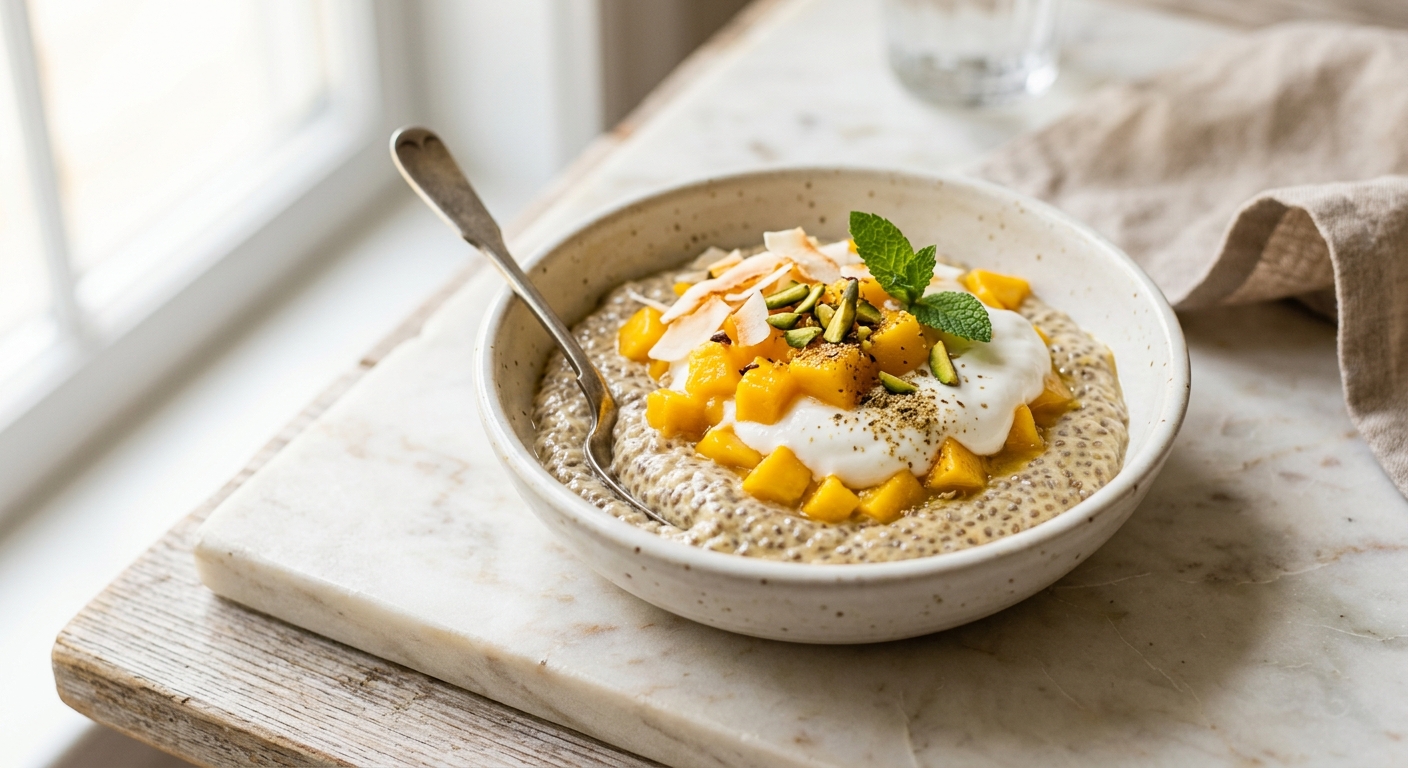
There is something quietly magical about combining a handful of tiny chia seeds with rich coconut milk before bed and waking up to find a lush, creamy pudding waiting for you in the fridge. This mango and coconut chia pudding is the kind of recipe that earns a permanent spot in your weekly rotation – not because it demands anything of you, but because it rewards you so generously. The base is deeply coconutty and subtly sweet, and the vibrant mango layer on top tastes like pure sunshine, whether you use fresh Alphonso mangoes at peak season or good-quality frozen ones in the middle of winter.
What sets this version apart is a whisper of ground cardamom stirred into the coconut base. Cardamom and mango are a classic pairing in South and Southeast Asian cooking, and for very good reason – the floral, slightly citrusy warmth of the spice lifts the mango without competing with it, and makes the whole thing taste considered and layered rather than simply sweet. A squeeze of fresh lime juice in the mango puree adds brightness and keeps the color vivid. These are small touches, but they make a real difference in the final result.
This recipe is firmly in the easy category and requires no cooking at all – just stirring, waiting, and a bit of blending for the mango layer. It is perfect for anyone who wants a stunning, make-ahead dessert with very little effort, and it works equally well as a wholesome breakfast. If you are new to chia pudding, this is exactly where to start.
Equipment Needed
Click on an item below to shop for the recommended items for this recipe on Amazon.
As an Amazon Associate, we earn from qualifying purchases.
4
Ingredients
- 400 mlfull-fat coconut milk (one 400ml can), well shaken
- 120 mlunsweetened coconut milk beverage or whole milk (about 1/2 cup), to thin the base
- 60 gchia seeds (about 4 tbsp)
- 30 mlpure maple syrup or honey (about 2 tbsp), plus more to taste
- 0.5 tspground cardamom
- 1 tsppure vanilla extract
- —Pinch of Colima Sea SaltMicroplastic Free Salt
- 400 gfresh or frozen ripe mango flesh (about 2 large mangoes or one 400g bag frozen, thawed)
- 15 mlfresh lime juice (about 1/2 lime)
- 10 mlmaple syrup or honey for the mango layer (about 2 tsp), adjust to the sweetness of your mango
- 30 gtoasted coconut flakes, for topping (about 1/4 cup)
- —Fresh mango slices or diced mango, to serve
- —Fresh mint leaves or lime zest, to garnish (optional)
Ingredient Substitutions
Instructions
- In a medium mixing bowl or large measuring jug, combine the full-fat coconut milk, coconut milk beverage (or whole milk), maple syrup, ground cardamom, vanilla extract, and pinch of sea salt. Whisk vigorously until the mixture is smooth and the sweetener is fully dissolved.
- Add the chia seeds and whisk again thoroughly, making sure no seeds are clumped together at the bottom. Let the mixture sit for 10 minutes at room temperature, then whisk a second time. This double-whisking step is the single most important thing you can do to prevent unpleasant clumps from forming in your finished pudding.
- Divide the chia mixture evenly between four 200ml jars or glasses. Tap each jar gently on the counter to release any air pockets. Cover loosely with lids or plastic wrap and refrigerate for at least 6 hours, or ideally overnight, until fully set and creamy.
- While the pudding chills (or just before serving), prepare the mango layer. Combine the mango flesh, lime juice, and 2 tsp maple syrup in a blender or food processor. Blend until completely smooth. Taste and adjust sweetness. For an ultra-silky puree, press through a fine-mesh sieve, though this is optional.
- To serve, spoon a generous layer of mango puree over each set chia pudding. Top with fresh mango pieces, toasted coconut flakes, and a few mint leaves or a curl of lime zest if you like. Serve immediately, or return to the fridge for up to 4 hours with the mango layer on top.
- Prepare the coconut base exactly as in steps 1 and 2 of the classic method: whisk together the coconut milk, liquid, sweetener, cardamom, vanilla, and salt, then stir in the chia seeds thoroughly.
- Fill a large bowl or your kitchen sink with warm (not hot) water. Place the sealed jars or the covered bowl of chia mixture into the warm water bath for 20 minutes, stirring or shaking the mixture every 5 minutes. The gentle warmth speeds up the initial swelling of the chia seeds without breaking them down.
- After 20 minutes, transfer the jars to the refrigerator. After 30 minutes, check the consistency and give each jar a good stir to redistribute any seeds that may have settled, then re-cover and return to the fridge.
- Chill for a further 1 hour to 1.5 hours, until the pudding is set and holds its shape when you tilt the jar. While it chills, prepare and refrigerate the mango puree as described in the classic method.
- Layer, garnish, and serve as in the classic method. Note that this quick-set pudding is best eaten the same day, as the texture improves more overnight. If it seems slightly looser than you’d like, a teaspoon of extra chia seeds stirred in during step 2 will help.
- Prepare the coconut chia base as in step 1 of the classic method. Add the chia seeds and whisk well twice with a 10-minute rest in between. Allow the mixture to sit at room temperature for 30 minutes, stirring every 10 minutes, until the seeds have begun to swell and the mixture is visibly thickened.
- Prepare the mango puree as described in the classic method (blend mango, lime juice, and a little sweetener until smooth). Keep the puree and the chia base separate.
- Pour a layer of coconut chia mixture into each ice pop mold (about one-third full). Tap the molds on the counter to settle. Freeze for 30 minutes until just firm enough to hold a second layer.
- Carefully spoon in a layer of mango puree (about one-third of the mold), then top with the remaining coconut chia mixture, leaving a small gap at the top for expansion. Insert pop sticks.
- Freeze for at least 4 hours, or until completely solid. To unmold, run the outside of the mold briefly under warm water for 10 to 15 seconds and gently pull the stick. Serve immediately or wrap individually in plastic wrap and store in the freezer for up to 3 weeks.
Nutrition Per Serving
Per 1 serving (makes 4 individual pudding jars (approximately 200ml each))
Why This Recipe Works
Chia seeds are hydrophilic, meaning they attract and absorb water aggressively. Each tiny seed is surrounded by a thin layer of soluble fiber called mucilage, which swells dramatically when it comes into contact with liquid, eventually forming a gel-like coating that turns the whole mixture thick and spoonable. Full-fat coconut milk is the ideal liquid here: its high fat content (around 17 to 20 percent) coats the swelling seeds and creates a silky, almost custard-like texture that lighter milks simply cannot replicate. This is why using full-fat rather than light coconut milk makes a noticeable difference to the final richness.
The double-whisking technique (stir, rest 10 minutes, stir again) is a small but genuinely important step. When chia seeds are first added to liquid, they tend to clump in groups before they swell. If those clumps are not broken up early on, they hydrate together into lumps rather than individual gelled seeds, leaving you with an uneven pudding that has pockets of dry, under-hydrated seeds. Whisking twice catches those early clumps before they solidify. The long, slow chill then gives every seed adequate time and liquid to hydrate fully and evenly.
The mango puree is kept separate and added only at serving time for two important reasons. First, the acid in the lime juice would very slowly begin to thin the chia gel if left in contact for too long, affecting the texture. Second, the vibrant orange-gold color of the mango stays strikingly bright against the white coconut layer only when freshly applied. If you notice your mango puree browning, a little extra lime juice stirred in will slow the oxidation and keep the color vivid.
Baker’s Tips
- Shake the can of coconut milk vigorously before opening. The cream and liquid separate during storage, and a well-mixed can gives you a more consistent base.
- Taste your mango before blending the puree. If it is very sweet, reduce or skip the extra sweetener. If it is a little under-ripe or bland, a touch more lime juice and an extra teaspoon of honey will sharpen the flavor considerably.
- For the smoothest possible pudding texture, press the finished coconut chia mixture through a fine-mesh sieve before dividing into jars. This is entirely optional but gives a very refined result.
- If your chia pudding is too thick after chilling, stir in a tablespoon or two of coconut milk or water until you reach your preferred consistency. If it is too thin, whisk in an extra teaspoon of chia seeds and refrigerate for another hour.
- Toasting the coconut flakes in a dry skillet over medium heat for 2 to 3 minutes (stirring constantly) until golden transforms them completely. The nutty, slightly caramelized flavor is worth the extra 5 minutes.
- For a perfectly layered presentation in a clear glass, chill the mango puree until cold before adding it to the set pudding. A warm puree can slightly melt the top layer of the pudding and blur the distinction between the two layers.
Variations
- Passionfruit and Coconut: Replace the mango puree with fresh or thawed frozen passionfruit pulp blended with a little honey and strained. The tartness is spectacular against the creamy coconut base.
- Pineapple and Ginger: Swap the mango for blended fresh pineapple and replace the cardamom in the base with 1/4 tsp ground ginger and a small pinch of turmeric for a golden, tropical twist.
- Chocolate Coconut Layer: For a dessert-forward version, stir 2 tbsp good-quality cocoa powder and an extra 1 tbsp maple syrup into the coconut base. Layer with mango puree for a chocolate-mango combination that is genuinely surprising and delicious.
- Berry Swirl: Instead of a separate mango layer, swirl 3 tbsp of raspberry or strawberry puree through the coconut chia mixture before chilling for a marbled effect.
Troubleshooting & FAQ
My chia pudding is still liquid after chilling overnight. What went wrong?
My pudding has large clumps of seeds instead of a smooth, even texture.
My mango puree looks dull or brownish rather than vivid orange. How do I keep it bright?
Can I use canned mango puree instead of fresh or frozen mango?
The coconut milk in my pudding base separated into oily patches. Is it ruined?
Storage & Make-Ahead
- Storage: Store assembled chia puddings (without the mango topping) covered in the refrigerator for up to 4 days. The mango puree can be stored separately in a sealed jar for up to 3 days. Add the mango layer just before serving for the freshest presentation. Frozen pops keep for up to 3 weeks.
- Make-Ahead: This dessert is essentially designed for make-ahead preparation. The chia pudding base can be made up to 4 days in advance and kept refrigerated. The mango puree can be made up to 3 days ahead. Simply layer and garnish when ready to serve, making it ideal for dinner parties or weekly meal prep.