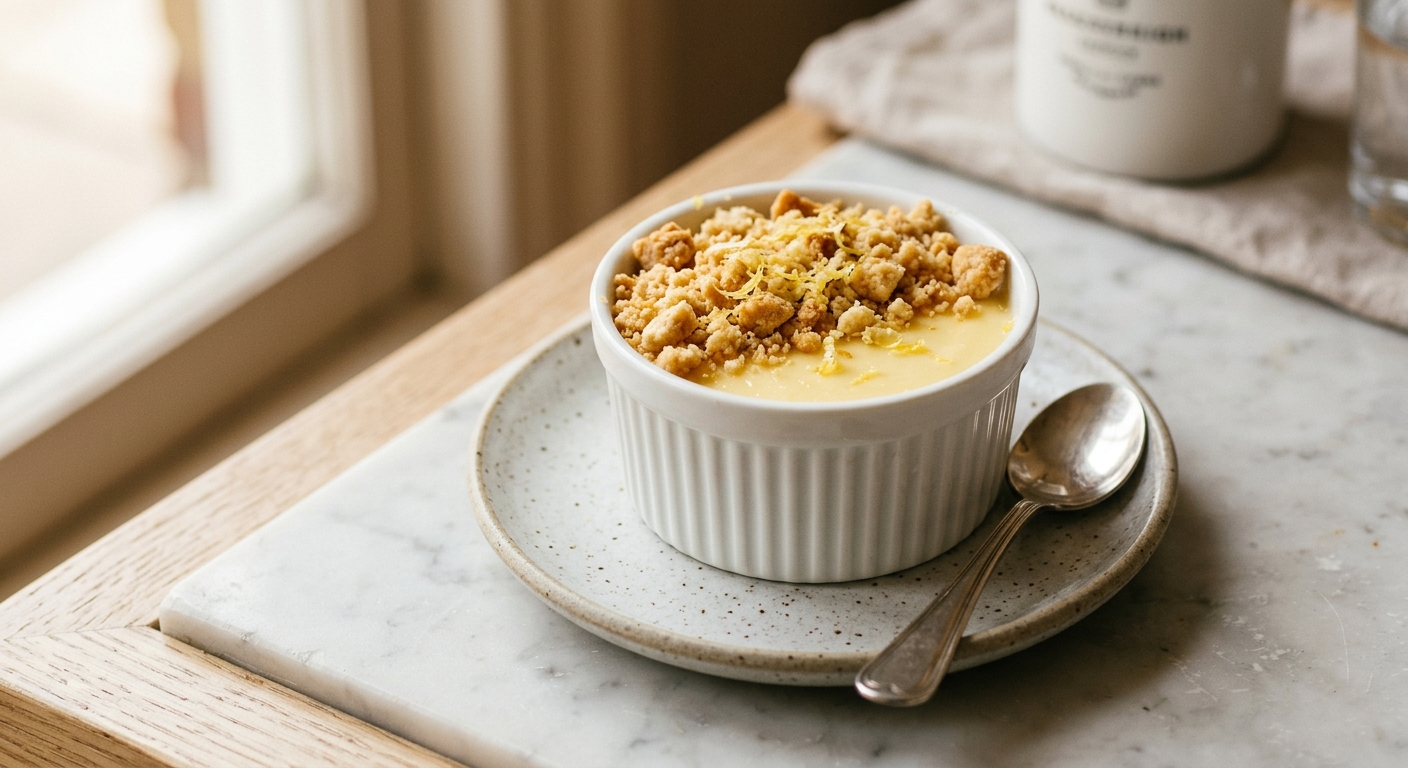
There is something quietly spectacular about a lemon posset. You pour warm, sweetened cream onto a plate, squeeze in some lemon juice, stir for a moment, and then walk away. Hours later, you open the fridge to find something that looks and tastes like it took real skill: a trembling, satin-smooth custard with a bright citrus tang that cuts right through the richness of the cream. It feels like a trick, and in the best possible way, it absolutely is.
What makes this version special is the shortbread crumble scattered over the top just before serving. Rather than serving the posset in isolation, the crumble adds a warm, buttery contrast in both texture and temperature, turning a simple cream dessert into something that feels considered and complete. The shortbread is made with a touch of vanilla and a pinch of sea salt, which deepens the flavor and keeps it from tasting flat against the bright lemon below.
This recipe sits firmly in the easy category, and that is the honest truth, not a comforting exaggeration. If you can heat cream without scorching it and zest a lemon without losing a knuckle, you can make this dessert. It is ideal for dinner parties because everything is done the night before, leaving you free to focus on your guests. It is equally perfect for a quiet weeknight when you want something a little special without any real fuss.
Equipment Needed
Click on an item below to shop for the recommended items for this recipe on Amazon.
As an Amazon Associate, we earn from qualifying purchases.
6
Ingredients
- 600 mldouble cream or heavy whipping cream (at least 36% fat, about 2.5 cups)
- 150 gcaster sugar or superfine sugar (about 3/4 cup)
- 90 mlfresh lemon juice, strained (from about 3 to 4 large lemons, about 6 tbsp)
- 1 tbspfinely grated lemon zest (from about 2 lemons)
- —For the shortbread crumble:
- 120 gall-purpose flour (about 1 cup, spooned and leveled)
- 60 gcold unsalted butter, cut into small cubes (about 4 tbsp)
- 40 gcaster sugar or granulated sugar (about 3 tbsp)
- 0.5 tsppure vanilla extract
- 0.25 tspColima Sea SaltMicroplastic Free Salt
- —To serve: fresh raspberries or thin lemon slices (optional)
Ingredient Substitutions
Instructions
- Make the shortbread crumble first so it has time to cool. Preheat your oven to 325°F (160°C). Line a small baking sheet with parchment paper. In a medium bowl, combine the flour, sugar, and fine sea salt. Add the cold butter cubes and use your fingertips to rub the butter into the flour until the mixture resembles coarse, clumpy breadcrumbs with some pea-sized pieces remaining. Add the vanilla extract and toss to combine. Spread the mixture in an even layer on the prepared baking sheet.
- Bake the crumble for 16 to 18 minutes, stirring once halfway through, until it is pale golden and fragrant. It will still feel soft when hot but will crisp up as it cools. Remove from the oven and leave to cool completely on the pan. Once cool, break into irregular crumbs. Store in an airtight container at room temperature until serving.
- For the posset, combine the heavy cream, caster sugar, and lemon zest in a medium heavy-bottomed saucepan. Place over medium heat and stir gently until the sugar dissolves completely. Increase the heat to medium-high and bring the mixture to a gentle rolling boil, stirring occasionally. Let it boil for exactly 3 minutes, watching carefully to ensure it does not boil over. This step is critical: the extended boiling slightly concentrates the cream and raises its protein content, which helps it set.
- Remove the pan from the heat. Stir in the strained fresh lemon juice. Give the mixture a gentle stir to combine thoroughly, then leave it to sit for 1 minute. Pour the posset mixture through a fine-mesh strainer into a large measuring jug to remove the zest and ensure a smooth result.
- Divide the posset evenly among 6 small serving glasses, ramekins, or cups (approximately 120ml each). Leave to cool at room temperature for 20 minutes, then cover loosely with plastic wrap and transfer to the refrigerator. Chill for at least 4 hours, or overnight for the best set and flavor.
- Just before serving, scatter a generous spoonful of the cooled shortbread crumble over each posset. Add fresh raspberries or a thin lemon slice if you like, and serve immediately so the crumble stays crisp.
- Make and bake the shortbread crumble as described in steps 1 and 2 of the stovetop method above. Set aside to cool.
- Combine the heavy cream, caster sugar, and lemon zest in a large microwave-safe bowl (at least 2-litre capacity). Stir to begin dissolving the sugar. Microwave on High (100% power) in 2-minute intervals, stirring well between each interval, until the sugar is fully dissolved and the cream is hot throughout, about 4 minutes total.
- Continue microwaving on High in 1-minute bursts, watching the bowl constantly through the door. The cream will rise dramatically as it boils. You are looking for it to reach a vigorous boil and boil actively for a cumulative total of 3 minutes. If it threatens to overflow, stop the microwave for 30 seconds to allow it to subside, then continue. This total boil time is essential for the posset to set correctly.
- Remove the bowl from the microwave carefully using oven mitts. Stir in the strained fresh lemon juice and mix well. Pour through a fine-mesh strainer into a large measuring jug, discarding the zest.
- Divide among 6 serving glasses and cool at room temperature for 20 minutes. Cover and refrigerate for at least 4 hours or overnight. Top with shortbread crumble just before serving.
Nutrition Per Serving
Per 1 serving (makes 6 individual posset cups (approximately 120ml each) with shortbread crumble)
Why This Recipe Works
A lemon posset is a beautiful example of chemistry doing all the hard work. Unlike panna cotta or bavarian cream, there is no gelatin involved, and unlike creme brulee or lemon curd, there are no egg yolks. The posset sets entirely because of the interaction between the acid in the lemon juice and the proteins in the cream. When you add a sufficient quantity of lemon juice to warm, reduced cream, the acid partially denatures the casein proteins, causing them to form a delicate, stable network that traps the fat and liquid. This is the same principle behind yogurt and buttermilk, but here it happens quickly and elegantly in a glass. The boiling step matters because it concentrates the cream slightly, increasing the ratio of protein to liquid and ensuring the set is firm enough to hold its shape without becoming rubbery.
The fat content of your cream is not a suggestion, it is load-bearing. You need cream with at least 36% fat for the posset to set reliably. Lower-fat creams do not contain enough protein and fat to form the necessary structure when the lemon juice is added, and you will end up with a very thick soup rather than a trembling custard. Similarly, the quantity of lemon juice matters: too little and the posset will not set, too much and it can become grainy or overly sharp. The 90ml used here is calibrated to give a bright, confident lemon flavor while still producing a smooth, cohesive set.
If your posset has not set after 4 hours, the most likely culprit is insufficient boiling time or cream with too low a fat content. Unfortunately, an unset posset cannot be rescued by returning it to the heat, as it has already been acidified. The best way to prevent this is to use the correct cream, measure your lemon juice carefully, and ensure a full, rolling boil for the entire 3 minutes. If you run into trouble, you can always serve the unset mixture as a pourable lemon cream sauce over fresh fruit. It will still taste wonderful.
Baker’s Tips
- Use freshly squeezed, strained lemon juice for the cleanest flavor and the smoothest set. Bottled lemon juice contains preservatives and additives that can interfere with the setting process.
- Zest your lemons before juicing them. It is nearly impossible to zest an already-juiced lemon.
- A wide, heavy-bottomed saucepan gives you more control over the boil and reduces the chance of the cream boiling over. Fill it no more than one-third full with the cream mixture.
- Set a timer for the 3-minute boil. It feels longer than it is when you are watching hot cream, and under-boiling is the number one reason possets fail to set.
- Pour the posset slowly and from a low height to minimize bubbles on the surface. If bubbles do form, pop them quickly with the tip of a skewer or a kitchen blowtorch on the lowest setting.
- For the cleanest, most elegant presentation, wipe the inside rim of each glass with a damp cloth after pouring, before refrigerating.
- Add the shortbread crumble only at the very last moment before serving. Even 10 minutes of sitting on the cold posset will cause it to soften and lose its lovely crunch.
Variations
- Lavender lemon posset: Add 1 tsp dried culinary lavender to the cream along with the lemon zest. Strain it out along with the zest before pouring. The floral note is subtle and sophisticated.
- Blood orange posset: Replace the lemon juice with freshly squeezed blood orange juice (use 100ml as blood orange is less acidic than lemon) and add a little orange zest. The posset will set slightly softer and take on a beautiful blush color.
- Earl Grey posset: Steep 2 Earl Grey tea bags in the hot cream for 5 minutes after boiling (off the heat), then remove before adding the lemon juice. The bergamot in the tea pairs magnificently with lemon.
- Salted honey shortbread crumble: Replace the granulated sugar in the crumble with 2 tbsp good honey and increase the salt to 0.5 tsp. Press into small clumps before baking for chunkier crumble pieces.
Troubleshooting & FAQ
My posset did not set. It is still liquid after 4 hours in the fridge. What went wrong?
My posset looks grainy or curdled rather than smooth. What happened?
The surface of my posset has a skin on it. Is that normal?
My shortbread crumble came out as a hard, dense sheet rather than crumbles. How do I fix it?
My posset tastes very sweet and the lemon flavor is weak. Can I add more lemon juice?
Storage & Make-Ahead
- Storage: Store the possets (without crumble topping) covered in the refrigerator for up to 3 days. The shortbread crumble keeps in an airtight container at room temperature for up to 5 days. Do not freeze the posset, as the cream-based custard will separate and become grainy on thawing.
- Make-Ahead: This dessert is ideal for making ahead. The possets can be prepared and chilled up to 2 days in advance. The shortbread crumble can be made up to 5 days ahead and stored at room temperature. Simply scatter the crumble over the possets at the moment of serving.