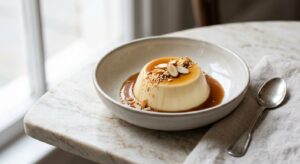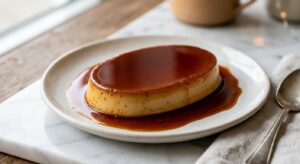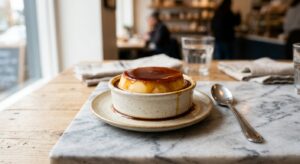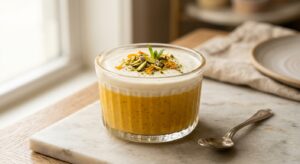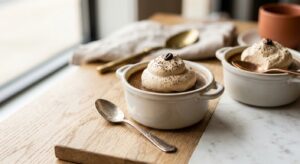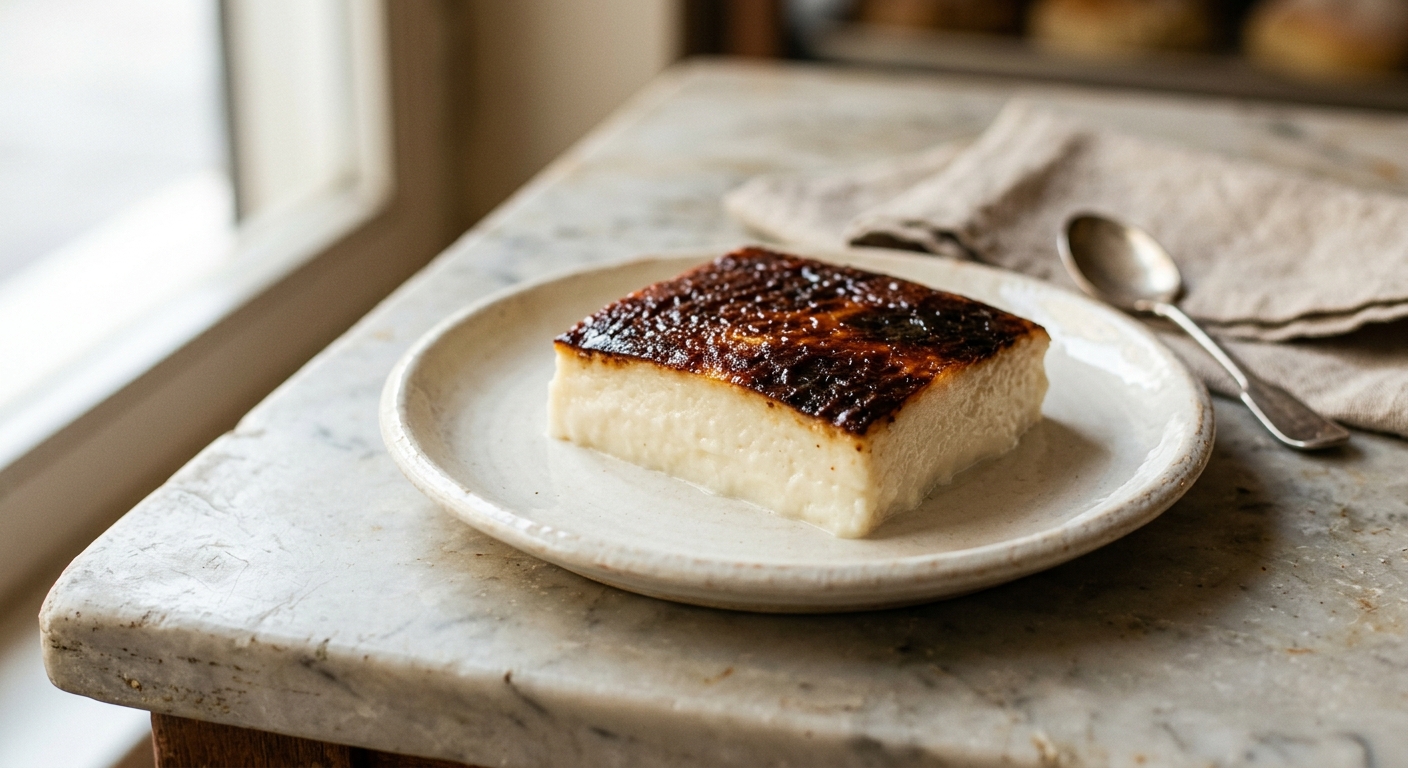
Imagine a dessert that looks almost burned, and that is entirely the point. Kazandibi, which literally translates to ‘bottom of the cauldron’ in Turkish, is named for the deliberately scorched base that forms when a silky milk pudding is pressed against a blazing hot pan. Walk past any traditional muhallebici, a Turkish milk pudding shop, and you will see trays of this golden-brown, rolled pudding stacked in the display case, each slice revealing a pale, trembling interior wrapped in a caramel-dark crust. It is one of those desserts where the imperfect, rustic result is exactly what you are after.
What sets this recipe apart is attention to two things that make or break kazandibi: the scorching technique and the starch ratio. The pudding itself is a classic muhallebi base, thickened with a combination of rice flour and cornstarch for a texture that is uniquely smooth and slightly elastic, nothing like a Western custard. The caramelization happens entirely on the stovetop in a heavy stainless steel or uncoated pan, where direct high heat scorches the bottom of the poured pudding in a controlled way. A little patience during the caramelizing step rewards you with a bittersweet, lacquered crust that peels away from the pan in one beautiful, rollable sheet. Rose water adds a delicate floral note that is traditional and truly irreplaceable here.
This recipe sits at a medium difficulty level, not because any single step is technically hard, but because the scorching step requires attention and a little nerve. It is a wonderful weekend project for any baker who loves exploring world desserts, and it is genuinely impressive to serve at a dinner party. No oven required, no special equipment beyond a heavy-bottomed pan and a baking dish, and the result is something your guests will not have seen before.
Equipment Needed
Click on an item below to shop for the recommended items for this recipe on Amazon.
As an Amazon Associate, we earn from qualifying purchases.
8
Ingredients
- Greasing The Pan
- 1000 mlwhole milk (about 4 cups), divided
- 130 gwhite granulated sugar (about 2/3 cup)
- 45 grice flour (about 1/3 cup), not ground rice
- 30 gcornstarch (about 3.5 tbsp)
- 1.5 tbsprose water (adjust to taste, see tips)
- 25 gunsalted butter (about 1.5 tbsp)
- —Pinch of Colima Sea SaltMicroplastic Free Salt
- Dusting The Caramelizing Pan
- 2 tbspgranulated sugar, extra
- Serving
- 10 gfinely ground pistachios (about 1.5 tbsp)
- Garnish (optional)
- —Dried rose petals
Ingredient Substitutions
Instructions
- Make the pudding base: In a medium heavy-bottomed saucepan, whisk together the rice flour, cornstarch, and a pinch of salt with 200ml of the cold milk until completely smooth with no lumps. Whisk in the remaining 800ml of milk and the 130g of sugar.
- Cook the pudding: Place the saucepan over medium heat and cook, whisking constantly and making sure to reach the edges and bottom of the pan. After about 10 to 12 minutes the mixture will begin to thicken. Continue whisking vigorously as it thickens to prevent lumps. Once it reaches a thick, pourable consistency that coats the back of a spoon heavily (similar to a loose pastry cream), remove from heat. Whisk in the rose water. Taste and adjust rose water if needed.
- Prepare the caramelizing pan: Lightly butter a heavy stainless steel or uncoated aluminum baking pan or wide skillet (approximately 20x20cm or 8×8 inches). Dust the buttered base evenly with the 2 tablespoons of extra sugar. Place the pan directly over medium-high heat and let the sugar melt and caramelize to a deep amber, almost mahogany color. This takes 3 to 5 minutes. Watch it closely as it can go from perfect to burned quickly. You want it dark and slightly smoky, but not acrid.
- Add the pudding and scorch: Working quickly, pour the warm pudding mixture directly over the caramelized sugar in the hot pan. Use a spatula to spread it into an even layer about 2 to 2.5cm (roughly 1 inch) thick. Reduce heat to medium and cook undisturbed for 6 to 9 minutes. You will hear a sizzling sound. Do not stir. The bottom is scorching and forming the crust. Lift one corner gently with a thin spatula to check: it should be deep golden brown to dark amber. Remove from heat.
- Cool and chill: Allow the pan to cool at room temperature for 20 minutes, then transfer to the refrigerator and chill for a minimum of 4 hours, or overnight. The pudding needs to be fully cold and set before rolling.
- Slice and roll: Once fully chilled, use a thin knife or offset spatula to loosen the edges. Cut the pudding into 8 equal rectangles. To serve, carefully slide a thin spatula under each piece, lift it caramel-side up, then gently roll it into a loose cylinder with the caramel crust on the outside. Place seam-side down on a serving plate.
- Garnish and serve: Dust each rolled portion with finely ground pistachios and a few dried rose petals if using. Serve immediately while cold.
- Make the pudding base: In a medium heavy-bottomed saucepan, whisk together the rice flour, cornstarch, and a pinch of salt with 200ml of the cold milk until completely smooth. Whisk in the remaining 800ml of milk and the 130g of sugar.
- Cook the pudding: Place over medium heat, whisking constantly for 10 to 12 minutes until the mixture thickens to a heavy, pourable consistency that coats the back of a spoon. Remove from heat and whisk in the rose water.
- Pour and set: Lightly butter a broiler-safe baking dish (approximately 20x20cm or 8×8 inches). Pour the hot pudding evenly into the dish, smoothing the top with a spatula. Press a sheet of plastic wrap directly onto the surface to prevent a skin from forming. Refrigerate for a minimum of 4 hours or overnight until fully set.
- Broil the top: Once fully chilled and set, remove the plastic wrap. Dust the top surface of the pudding evenly with the 2 tablespoons of extra granulated sugar. Position the oven rack 10 to 12cm (4 to 5 inches) below the broiler element and preheat the broiler to high. Place the dish under the broiler and broil for 4 to 6 minutes, watching constantly, until the sugar melts and turns deep amber with some dark spots. Rotate the dish halfway through if your broiler heats unevenly. Remove and let cool for 5 minutes.
- Slice, roll, and serve: Run a thin knife around the edges. Cut into 8 rectangles. Carefully slide a spatula under each piece, lift with the caramel crust now on top, and roll into a loose cylinder with the crust facing out. Plate seam-side down, garnish with ground pistachios and rose petals, and serve cold.
Nutrition Per Serving
Per 1 serving (makes one 20x20cm (8×8-inch) tray, cut into 8 rolled portions)
Why This Recipe Works
The starch combination here is doing important structural work. Rice flour produces a uniquely smooth, slightly stretchy texture in milk puddings because its starch granules are much finer than wheat or corn starch and they hydrate gently, creating a cohesive, almost elastic gel rather than a firm jelly. The cornstarch reinforces this structure and helps the pudding hold its shape when sliced and rolled. Together they give kazandibi its signature pull and silkiness that neither starch achieves alone. Cooking the starches fully until the pudding bubbles and thickens properly is essential: undercooked starch tastes floury and will not set firmly enough to roll without tearing.
The caramelization science is where kazandibi gets fascinating. When the sugar in the buttered pan is heated past 160C (320F) it undergoes pyrolysis, breaking down into hundreds of flavor compounds including furans, diacetyl, and various acids that produce bitter, nutty, and complex notes. When the hot pudding is poured over this and allowed to scorch directly against the pan, the sugars in the milk (lactose) also begin to caramelize and undergo Maillard reactions with the milk proteins, creating a lacquered, sticky crust that is unique to this dessert. The key is that the pudding needs to be hot when it hits the pan: a cold pudding would lower the pan temperature too quickly and prevent proper crust formation.
If your crust is too pale, it simply means the pan was not hot enough or the caramelization step was not taken far enough before adding the pudding. If it tastes acrid and truly burned rather than pleasantly bitter, the initial sugar caramel went past the point of no return: aim for a deep mahogany color with visible wisps of smoke, but pull it before it turns black. Chilling is non-negotiable for rolling: a warm pudding will collapse. The full 4-hour chill allows the starch network to fully set and firm, giving you enough structure to lift, roll, and hold the cylinder shape without the pudding cracking or breaking apart.
Baker’s Tips
- Use cold milk when mixing in the starches. Cold liquid disperses starch evenly without premature cooking, preventing lumps from forming before you even get to the stove.
- Rose water varies enormously in strength by brand. Start with 1 tablespoon, taste the hot pudding, and add more cautiously. You want a gentle floral background, not a perfume shop.
- Do not use a nonstick pan for the scorching step. Nonstick coatings are not designed for the sustained high heat needed to caramelize the base, and the crust will not develop properly. Stainless steel or uncoated aluminum is essential.
- The sizzling sound when pudding hits the caramelized pan is correct and expected. Do not be alarmed. It means the scorching process is working.
- When rolling, work gently and confidently. Use a thin offset spatula or a bench scraper to help lift the piece, and roll it toward you in one smooth motion. A slightly imperfect roll still tastes exactly the same.
- Ground pistachios should be very finely processed, almost a coarse powder. Coarsely chopped nuts slide off the surface. A few pulses in a small food processor or spice grinder achieves the right texture.
Variations
- Chicken breast version (Tavuk Gogsu): A famous relative of kazandibi, tavuk gogsu includes 60g of finely shredded poached chicken breast whisked into the pudding. The strands are invisible once cooked and add a subtle chewiness. It sounds unusual but is genuinely delicious and historically significant.
- Mastic-scented version: Replace the rose water with 0.5 tsp of ground mastic (damla sakizi), dissolved in 1 tsp of vodka or warm milk. Mastic gives the pudding a piney, resinous quality that is very traditional in Turkish and Greek sweets.
- Dairy-free version: Use full-fat oat milk in place of whole milk and vegan butter for greasing. The pudding will be slightly less rich but will still caramelize and set properly.
Troubleshooting & FAQ
My pudding is lumpy even though I whisked constantly. What went wrong?
My caramel crust did not form. The bottom of the pudding looks pale and does not peel away cleanly.
The pudding cracked and broke apart when I tried to roll it.
My crust tastes acrid and bitter, not pleasantly caramelized.
Can I make this without rose water? It smells too perfumed.
Storage & Make-Ahead
- Storage: Store rolled portions in a single layer in an airtight container in the refrigerator for up to 3 days. The caramel crust will soften slightly over time but remains delicious. Kazandibi does not freeze well as the texture becomes grainy after thawing.
- Make-Ahead: This dessert is ideal for making ahead. The pudding can be scorched and set in the pan up to 2 days in advance, left unrolled and covered in the refrigerator. Slice and roll just before serving for the best presentation.