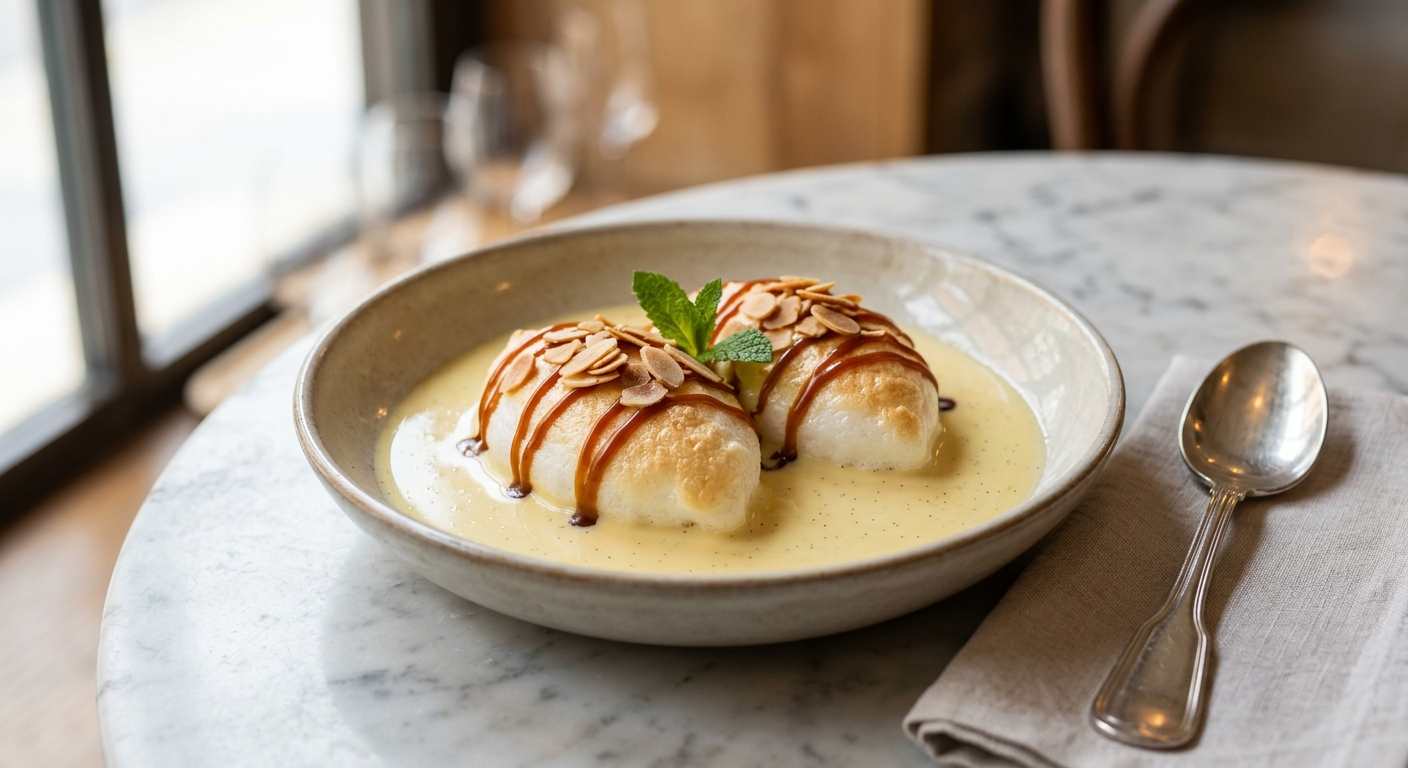
There is something quietly magical about a bowl of floating islands. The meringues arrive like soft white clouds resting on a pool of pale golden custard, a single thread of caramel draped over the top, and the whole thing trembles delicately when you set it on the table. It is one of those desserts that makes guests go quiet for a moment before they reach for their spoons. The French call it oeufs à la neige, eggs in snow, and the name could not be more fitting. Every bite is cool, airy, lightly sweet, and deeply satisfying in a way that only the most elegant simple things can be.
What sets this version apart is attention to the custard. The crème anglaise here is made the slow, careful way, cooked gently over a bain-marie rather than direct heat, which gives you total control and a sauce so silky it coats the back of a spoon like poured cream. The meringues are poached in barely simmering sweetened milk, which keeps them impossibly tender and adds a faint richness that water-poaching simply cannot match. The finishing caramel is cooked dry, no water added, for a deeper, more complex bittersweet flavour that cuts through the sweetness of the meringue beautifully.
This recipe sits comfortably in the medium difficulty range. Nothing here is technically demanding, but it does ask for your patience and attention at the stove. It is perfect for anyone who wants to expand their classic French repertoire, impress dinner party guests without spending hours in the kitchen, or simply treat themselves to something genuinely beautiful on a quiet evening. The components can all be made ahead and assembled just before serving, which makes it one of the most stress-free elegant desserts you will ever add to your rotation.
Equipment Needed
Click on an item below to shop for the recommended items for this recipe on Amazon.
As an Amazon Associate, we earn from qualifying purchases.
6
Ingredients
- Poaching And The Custard Base
- 1000 mlwhole milk (about 4 cups)
- 1 wholevanilla bean, split and seeds scraped (or 2 tsp pure vanilla extract)
- 6 largeeggs, separated at room temperature
- 200 gcaster sugar (about 1 cup), divided
- 0.25 tspcream of tartar
- —Pinch of Colima Sea SaltMicroplastic Free Salt
- Dry Caramel
- 150 gcaster sugar (about 3/4 cup)
- Loosening The Caramel (optional)
- 30 mlheavy cream (2 tbsp), warmed
Ingredient Substitutions
Instructions
- Infuse the milk: Combine the milk, vanilla bean, and scraped seeds in a wide, shallow saucepan. Warm over medium-low heat until steaming and just below a simmer (about 180°F / 82°C). Do not boil. Remove the vanilla pod and set aside.
- Make the meringue: In a spotlessly clean bowl, beat the 6 egg whites with the cream of tartar and a pinch of salt on medium speed until foamy. Gradually add 100g (1/2 cup) of the caster sugar, one tablespoon at a time, increasing to medium-high speed. Continue beating until the meringue holds stiff, glossy peaks and the sugar is fully dissolved (rub a little between your fingers – it should feel smooth, not gritty).
- Poach the meringues: Keep the milk at a bare simmer (small bubbles only, no rolling boil). Using two large spoons or an ice cream scoop, shape portions of meringue into oval quenelles and gently lower them into the hot milk, 3 to 4 at a time depending on your pan size. Poach for 2 minutes, then gently flip each one using a slotted spoon and poach for a further 2 minutes. The meringues will puff up considerably. Transfer to a plate lined with a clean kitchen towel. Repeat with the remaining meringue. Reserve the poaching milk.
- Make the crème anglaise: Strain the reserved poaching milk back into a clean saucepan and top up to 750ml (3 cups) if needed. In a heatproof bowl, whisk together the 6 egg yolks and the remaining 100g (1/2 cup) of caster sugar until the mixture is pale, thick, and falls in a ribbon from the whisk, about 2 to 3 minutes. Slowly pour the hot milk into the yolk mixture, whisking constantly, to temper the eggs.
- Cook the custard: Set the bowl over a saucepan of barely simmering water (bain-marie), making sure the base of the bowl does not touch the water. Stir constantly with a heatproof spatula, scraping the sides and bottom of the bowl, until the custard thickens enough to coat the back of a spoon and holds a clear line when you draw your finger across it (170 to 175°F / 77 to 79°C). This takes 10 to 15 minutes. Do not rush with higher heat – the eggs will scramble. Immediately strain through a fine-mesh sieve into a clean bowl set over an ice bath. Stir until cooled. Refrigerate for at least 1 hour.
- Make the dry caramel: Place the 150g of caster sugar in a light-coloured saucepan over medium heat. Without stirring, let the sugar melt around the edges, then gently swirl the pan occasionally until all the sugar has melted and turned a deep amber (about 355°F / 180°C). If using, carefully stir in the warmed heavy cream – it will bubble vigorously. Work quickly as caramel sets fast. Transfer to a heatproof jug.
- Assemble: Pour a generous pool of chilled crème anglaise into each bowl. Float 2 to 3 meringue islands on top. Drizzle the caramel over each island in thin threads using the tines of a fork or a spoon. Serve immediately.
- Make the crème anglaise first: Warm 750ml (3 cups) whole milk with the vanilla bean in a saucepan until steaming. Whisk 6 egg yolks with 100g (1/2 cup) caster sugar until pale and thick. Temper the hot milk slowly into the yolks, then cook in a bain-marie, stirring constantly, until the custard coats a spoon (170 to 175°F / 77 to 79°C). Strain into a bowl set over ice, cool completely, and refrigerate for at least 1 hour.
- Make the meringue: Beat the 6 egg whites with cream of tartar and a pinch of salt until foamy. Gradually add 100g (1/2 cup) caster sugar and beat to stiff, glossy peaks.
- Shape and microwave the meringues: Line a large microwave-safe plate with parchment paper. Shape the meringue into 12 to 18 oval portions using two large spoons and arrange them with space between each. Microwave on Medium power (50%) in 20-second bursts, checking after each, until the meringues are just set and spring back lightly when touched. This usually takes 40 to 60 seconds total depending on your microwave wattage. They should look slightly matte on the outside. Work in two or three batches.
- Rest the meringues: Allow the meringues to cool on the plate for 5 minutes. They will firm up slightly as they rest. Handle gently as they are very soft.
- Make the caramel: Cook 150g caster sugar in a light-coloured saucepan over medium heat without stirring until deep amber. Stir in the warmed cream if using, and transfer to a heatproof jug to cool slightly.
- Assemble: Spoon cold crème anglaise into bowls, float the microwaved meringues on top, and drizzle with caramel threads. Serve within 20 minutes as the meringues soften quickly.
Nutrition Per Serving
Per 1 serving (makes 6 individual dessert bowls, 2 to 3 meringue islands each)
Why This Recipe Works
The crème anglaise is a stirred custard, meaning it is thickened entirely by the proteins in egg yolks rather than any starch. As the yolks are heated gently between 170°F and 180°F (77°C and 82°C), their proteins begin to unfold and link loosely together, creating a sauce with body and flow rather than a set gel. The key is staying in that narrow temperature window: below 170°F the custard remains watery, but above 185°F the proteins tighten too fast and the sauce breaks into sweet scrambled eggs. Cooking in a bain-marie slows the heat transfer, making it far easier to stay in the safe zone. Tempering the eggs by slowly adding hot milk before they go near the heat is equally important, as it gradually raises their temperature without shocking them into scrambling.
The meringue clouds work because of what happens when you whip egg whites. Vigorous beating incorporates air bubbles and causes the proteins in the whites, primarily ovalbumin and ovomucin, to denature and form a stabilising network around each bubble. Cream of tartar lowers the pH of the whites, which strengthens this protein network, making the foam more stable and resilient and helping the meringue hold its peaks without deflating as you work. The sugar dissolves into the thin liquid film between bubbles, further reinforcing the structure and adding enough moisture retention that the meringues stay soft rather than drying into a crunchy shell. Poaching rather than baking keeps the interior tender by surrounding the meringue with gentle, moist heat that sets the exterior without dehydrating the centre.
The dry caramel technique (melting sugar without any added water) is used here because it is faster and produces a slightly more complex flavour. When sugar melts and reaches around 355°F (180°C), hundreds of new flavour compounds are created through a process called pyrolysis, producing the characteristic bittersweet, nutty, slightly smoky notes that define a great caramel. If your caramel starts to smoke heavily or smells burnt, it has gone too far and will taste bitter rather than complex. Pull it off the heat at a rich amber and trust that it will continue to darken slightly in the pan from residual heat.
Baker’s Tips
- Fat is the enemy of meringue. Make sure your bowl and whisk are completely clean and grease-free before you start beating. A quick wipe with a paper towel dampened with white vinegar will eliminate any residual fat.
- Separate your eggs while cold from the fridge, as cold yolks are firmer and less likely to break. But let the whites come to room temperature before beating for maximum volume.
- When poaching the meringues, keep the milk at the gentlest possible simmer. An aggressive boil will cause them to fall apart before they set. If in doubt, turn the heat lower.
- To test your crème anglaise without a thermometer, dip a wooden spoon into the custard, then draw your finger across the back. If the line stays clean and the custard does not run back into it, it is ready.
- The caramel will continue to cook from residual heat even after you remove it from the stove. Pull it off the heat just before it reaches your target amber colour.
- If your crème anglaise shows any signs of scrambling (small lumps forming at the edges), immediately remove it from the heat, strain it through a fine-mesh sieve, and blend it briefly with an immersion blender to rescue the texture.
- Serve the assembled dessert within a few minutes of plating. Meringues absorb moisture from the custard over time and will slowly deflate and dissolve if left to sit.
Variations
- Raspberry crème anglaise: Stir 3 tablespoons of strained raspberry puree into the finished custard for a blush-coloured sauce with a bright, fruity contrast to the meringue.
- Coffee caramel: Add 1 teaspoon of instant espresso powder to the caramel just before it sets for a mocha note that pairs wonderfully with the vanilla custard.
- Praline topping: Instead of caramel drizzle, scatter crushed almond praline over the islands for a crunchy textural contrast.
- Orange blossom: Add 1 teaspoon of orange blossom water to the finished crème anglaise and a strip of orange zest to the poaching milk for a fragrant, floral twist.
Troubleshooting & FAQ
My crème anglaise curdled and turned grainy. Is it ruined?
My meringues collapsed and flattened out in the poaching liquid. What went wrong?
My caramel crystallised and turned grainy instead of melting smoothly. What happened?
My meringues are weeping and releasing liquid after sitting in the fridge overnight. Is this normal?
My finished crème anglaise is too thin and pours like milk. Did I undercook it?
Storage & Make-Ahead
- Storage: The crème anglaise can be stored in an airtight container in the refrigerator for up to 3 days. The poached meringues can be stored on a plate loosely covered with plastic wrap in the refrigerator for up to 24 hours, though they will weep slightly over time. The caramel is best made fresh but can be stored in a heatproof jar at room temperature for up to 2 days and gently rewarmed before serving. Do not freeze assembled floating islands.
- Make-Ahead: This dessert is beautifully suited to being made in stages. The crème anglaise can be made up to 3 days ahead and refrigerated. The meringues are best made the day of serving but can be prepared up to 12 hours in advance and stored uncovered in the refrigerator on a parchment-lined tray. The caramel should be made within a few hours of serving and kept at room temperature. Assemble individual bowls just before bringing them to the table.