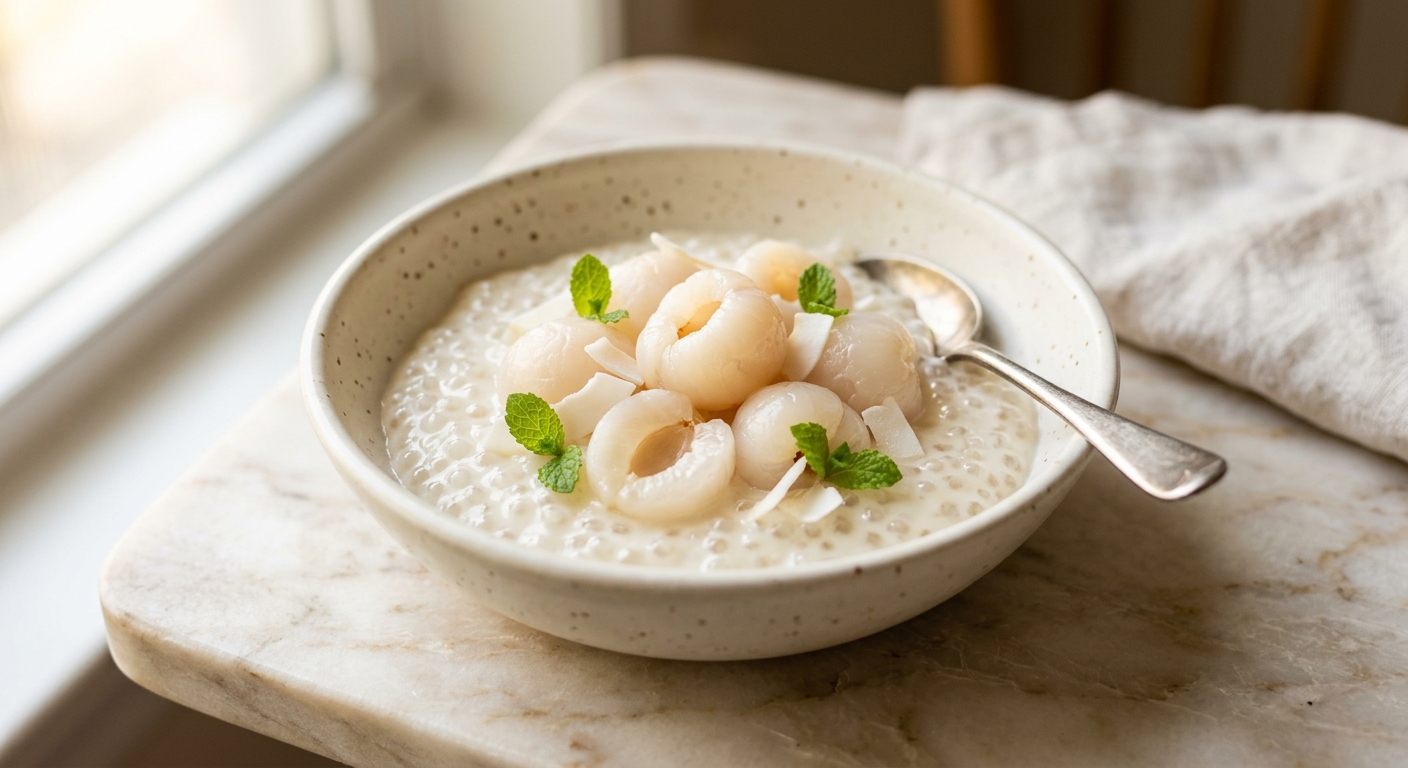
There is something almost meditative about stirring a pot of tapioca pudding. The tiny pearls bloom slowly, turning from chalky white to translucent, and the kitchen fills with the warm, tropical perfume of coconut milk. Add a handful of fresh lychee – peeled, jewel-like, and impossibly fragrant – and you have a dessert that feels like it belongs on a warm evening somewhere beautiful. This is comfort food with a sense of occasion.
What makes this version stand out is the use of full-fat coconut milk as the sole cooking liquid, rather than diluting it with water or dairy milk. That decision gives every spoonful a genuinely rich, velvety body. A pinch of salt and a split vanilla pod coaxed into the milk as it heats draw out the coconut’s natural sweetness and give the pudding a depth that coconut extract simply cannot replicate. The lychee is added fresh at the very end, so its delicate floral perfume stays bright and uncooked against the warm pudding.
This recipe sits comfortably at the easy end of the difficulty scale, though it does ask for your attention at the stove. It is ideal for anyone who wants to make something genuinely impressive with very little fuss, whether you are cooking for a dinner party or simply treating yourself on a Sunday afternoon. No special equipment is needed, and the pudding can be made ahead and chilled, making it as practical as it is beautiful.
Equipment Needed
Click on an item below to shop for the recommended items for this recipe on Amazon.
As an Amazon Associate, we earn from qualifying purchases.
6
Ingredients
- 150 gsmall pearl tapioca (about 3/4 cup, not instant tapioca)
- 800 mlfull-fat coconut milk (two 400ml cans), well stirred
- 120 mlwater (1/2 cup, for soaking)
- 80 gwhite granulated sugar (about 6 tbsp), plus more to taste
- 1 wholevanilla bean, split lengthways and seeds scraped (or 1 tsp pure vanilla extract)
- 0.25 tspColima Sea SaltMicroplastic Free Salt
- 2 largeeggs, beaten
- 400 gfresh lychee (about 20 to 24 fruit), peeled, pitted, and halved (or one 565g can, drained and patted dry)
- 1 tbspfresh lime juice
- —Fresh mint leaves or a light dusting of toasted coconut flakes, to serve (optional)
Ingredient Substitutions
Instructions
- Place the tapioca pearls in a medium bowl and cover with the 120ml of cold water. Let them soak for 30 minutes. They will absorb the water and swell slightly. Do not drain them – add the pearls and any remaining soaking water directly to the pot in the next step.
- Pour the coconut milk into a medium, heavy-bottomed saucepan. Add the sugar, salt, and the vanilla bean pod and seeds (or extract added later). Stir to combine. Add the soaked tapioca pearls and their soaking water. Bring the mixture to a gentle simmer over medium heat, stirring frequently to prevent the pearls from clumping or sticking to the bottom.
- Once simmering, reduce the heat to low. Cook, stirring almost constantly, for 15 to 18 minutes, until the pearls are almost fully translucent with just a tiny opaque dot at their very centre. The mixture will thicken noticeably. Patience here is key – do not rush this on higher heat or the eggs added next will scramble.
- Remove the pan from the heat. Beat the eggs in a small bowl. Slowly ladle about 60ml of the hot tapioca mixture into the eggs while whisking constantly – this tempering step gradually raises the egg temperature so they blend smoothly into the pudding rather than curdling. Pour the tempered egg mixture back into the saucepan, stirring constantly.
- Return the pan to low heat and cook, stirring continuously, for 3 to 4 more minutes until the pudding is thick, glossy, and coats the back of a spoon. The pearls should now be fully translucent. Remove the vanilla pod. If using vanilla extract, stir it in now.
- Taste and adjust sugar if needed. Remove from heat. Toss the halved lychee in the lime juice in a small bowl. Spoon the warm pudding into serving glasses or bowls, then top generously with the lime-kissed lychee. Alternatively, let the pudding cool to room temperature, press a piece of plastic wrap directly onto the surface to prevent a skin from forming, and refrigerate for at least 1 hour before serving cold, topped with lychee just before serving.
- Soak the tapioca pearls in the 120ml cold water for 30 minutes as directed. Meanwhile, lightly grease the insert of a 4 to 6-quart slow cooker with a thin film of coconut oil or neutral cooking spray to minimise sticking.
- Add the soaked tapioca pearls and their soaking water, the coconut milk, sugar, salt, and vanilla pod and seeds directly to the slow cooker insert. Stir well to combine. Do not add the eggs yet.
- Cook on High for 1 hour 45 minutes, stirring once or twice during cooking if you are nearby. The mixture should be thickened and the pearls mostly translucent. If your slow cooker runs cool, it may need up to 2 hours.
- Beat the eggs in a small bowl. Ladle about 60ml of the hot tapioca liquid from the slow cooker into the eggs while whisking constantly to temper them. Pour the tempered eggs back into the slow cooker, stirring thoroughly. Replace the lid and cook on High for a further 15 minutes, then stir once more. The pudding will thicken further as it cools.
- Remove the vanilla pod. Stir in vanilla extract now if using. Transfer the pudding to a bowl or individual glasses. Press plastic wrap directly onto the surface and refrigerate for at least 1 hour. Top with lime-tossed lychee just before serving.
- Soak the tapioca pearls in 120ml cold water for 30 minutes. Combine the soaked pearls and their liquid, coconut milk, sugar, salt, and vanilla pod or extract in a very large microwave-safe bowl (at least 2.5-litre capacity). Stir well.
- Microwave on High (100% power) for 4 minutes. Remove and stir thoroughly, making sure to scrape the bottom and edges of the bowl where the mixture thickens first. The pearls may clump initially – stir firmly to separate them.
- Continue microwaving in 3-minute intervals, stirring well after each, for a total of 12 to 16 minutes of cooking time. After about 10 minutes the mixture should be visibly thickened and the pearls mostly translucent. Stop when the mixture coats the back of a spoon thickly.
- Temper the beaten eggs: ladle 60ml of the hot pudding into the eggs while whisking, then stir the egg mixture back into the bowl. Microwave on Medium power (50%) for 2 minutes, stir, then microwave for 1 minute more on Medium until the pudding is thick and glossy. Remove the vanilla pod if using.
- Taste for sweetness, then spoon into serving glasses. Cool slightly, cover with plastic wrap pressed onto the surface, and chill for at least 1 hour. Toss lychee in lime juice and spoon over the chilled pudding just before serving.
Nutrition Per Serving
Per 1 serving (makes 6 individual dessert portions (about 150ml each))
Why This Recipe Works
Tapioca pearls are made from cassava starch, and their remarkable transformation during cooking is a perfect illustration of starch gelatinisation. When the dry pearls hit the hot coconut milk, the starch granules absorb liquid and swell dramatically. As the temperature climbs toward 75 to 85°C (167 to 185°F), the granule walls break down and the starch begins to form a continuous, thickened gel around each pearl. This is why constant stirring matters so much at this stage: without it, the pearls sink to the bottom of the pan and weld themselves together into clumps, and the base of the pudding scorches before the top has a chance to thicken. The 30-minute soak before cooking gives the outer layers of each pearl a head start on hydration, which means a more even, thorough cook and fewer unpleasantly chewy or white-centred pearls in the finished pudding.
The egg tempering step is where this recipe moves from tapioca-thickened milk to something genuinely custardy and rich. Eggs set between approximately 65 and 75°C (149 and 167°F). If you pour cold beaten egg directly into a 90°C pudding, the proteins seize almost instantly and you get scrambled egg flecks suspended in tapioca, which is no one’s ideal outcome. Tempering solves this elegantly: by slowly adding a small amount of hot liquid to the eggs first, you raise their temperature gradually to a point where they can be introduced into the hot pudding safely. The result is a silky, cohesive gel in which the egg proteins add body and a gentle richness without any eggy flavour or grainy texture.
Using full-fat coconut milk rather than a diluted version is not mere indulgence – it is functional. The high fat content of coconut cream (which makes up a large portion of a well-stirred can of full-fat coconut milk) acts as an emulsifier and tenderiser, coating the starch granules and giving the pudding a smoother, more yielding mouthfeel than a water-based tapioca would achieve. If your pudding looks too thick on reheating or after chilling, do not panic: simply stir in a splash of coconut milk and gently warm it through. The starch gel is reversible with gentle heat and added liquid, and it will smooth right out.
Baker’s Tips
- Do not substitute instant tapioca or tapioca flour for the small pearl tapioca. They behave completely differently and will produce a gluey paste rather than the distinct, jewel-like pearls that make this dessert special.
- Stir frequently and never walk away during the stovetop cook. Tapioca loves to stick to the bottom of the pan and scorch – a heavy-bottomed saucepan and a silicone spatula that reaches the corners of the pan will protect you.
- The pudding thickens considerably as it cools. If it looks slightly thinner than you expect while still warm, trust the process and allow it to chill before assessing the texture.
- Always add the lychee just before serving. Their delicate floral juice will bleed into the pudding and dilute the top layer if left to sit for more than 30 minutes.
- For the cleanest, most elegant presentation, serve in clear glasses so the translucent pearls are visible through the sides.
- If using canned lychee, taste the pudding before adding the full amount of sugar, as the canning syrup can make the fruit considerably sweeter than fresh fruit.
Variations
- Pandan coconut tapioca: Add 2 fresh pandan leaves (tied into a knot) to the coconut milk as it heats, and remove before serving. This adds a fragrant, grassy, vanilla-like aroma that is traditional across Southeast Asian desserts.
- Mango and coconut version: Replace the lychee with 2 ripe mangoes, diced, and add a pinch of chilli powder and a squeeze of lime to the fruit for a sweet-heat contrast.
- Rose and lychee: Add 1 tsp of rose water to the pudding along with the vanilla for a perfumed, floral combination that makes the lychee flavour even more pronounced. Use sparingly as rose water can easily overpower.
- Black tapioca pearl version: Substitute black tapioca pearls for the white ones (widely available in Asian grocery stores). The cook time is similar, but the dramatic dark colour against the pale coconut milk makes a striking presentation.
Troubleshooting & FAQ
My tapioca pearls are still white and hard in the centre after the recommended cooking time. What went wrong?
My pudding looks thin right after cooking. Will it thicken up?
I see white stringy bits in my pudding after adding the eggs. What are they and how do I avoid it next time?
My pudding has developed a thick, rubbery skin on top after chilling. How do I prevent it?
Can I reheat leftover tapioca pudding, and why does it look stiff and separated from the fridge?
Storage & Make-Ahead
- Storage: Store the pudding (without the lychee topping) in an airtight container or individual covered glasses in the refrigerator for up to 4 days. Press plastic wrap directly onto the surface before sealing to prevent a skin from forming. Add the lychee topping fresh just before serving. This pudding does not freeze well, as freezing causes the tapioca pearls to become hard and the texture to break apart on thawing.
- Make-Ahead: The tapioca pudding can be made up to 2 days ahead and kept refrigerated, covered tightly. If using fresh lychee, peel, pit, and halve them up to 24 hours ahead and store in a covered bowl with the lime juice in the refrigerator. Assemble just before serving for the best presentation and freshest flavour.