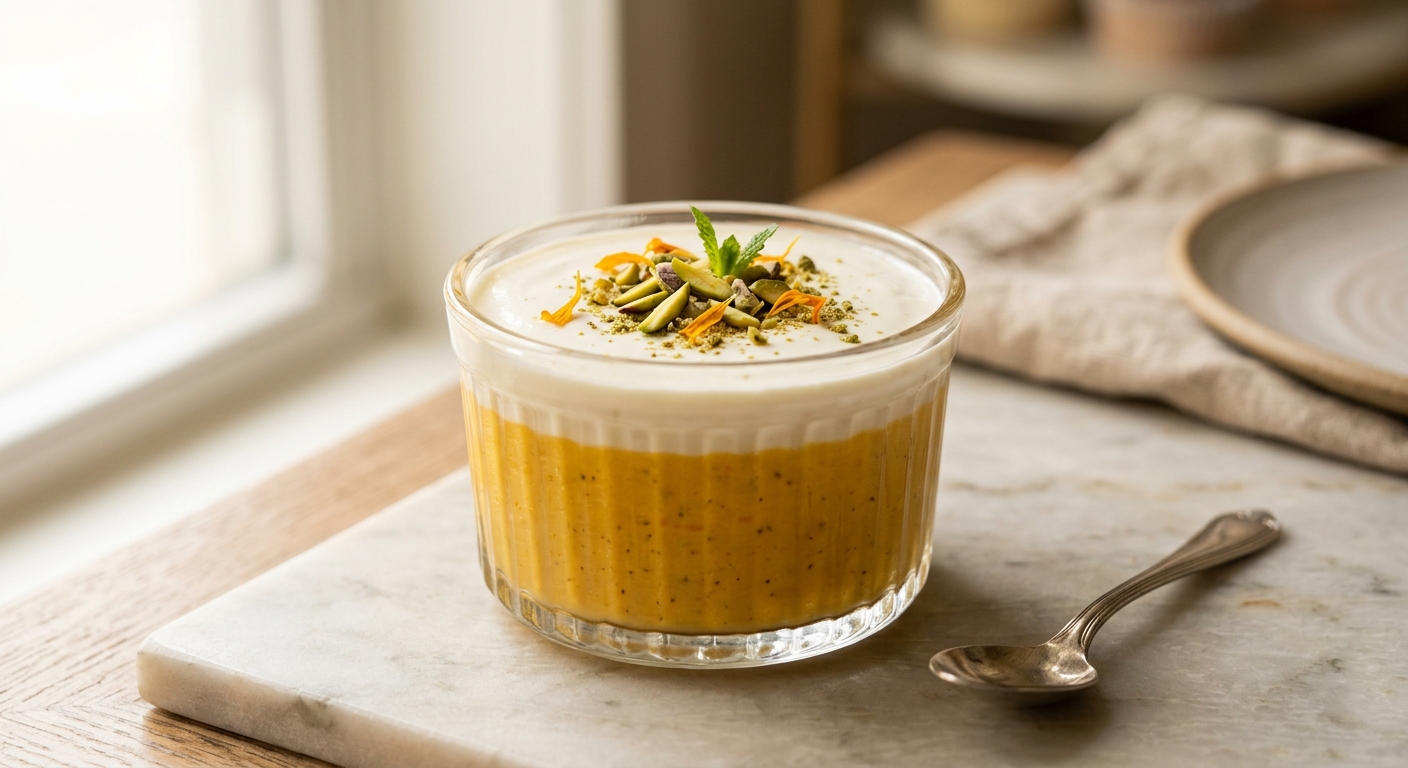
There is a moment, usually in the peak of summer, when a cold glass of mango lassi feels like the most perfect thing in the world. The thick, tangy yogurt, the floral sweetness of ripe mango, the faint warmth of cardamom lingering at the back of your throat. This pudding was born from that exact craving, on a day when I wanted something you could eat with a spoon, tuck into a pretty glass, and bring to the table with a little flourish. It is cooling, fragrant, and deeply satisfying in a way that feels both familiar and quietly extraordinary.
What sets this pudding apart from a standard mango custard is the use of full-fat Greek yogurt stirred in off the heat, which gives it that signature lassi tang and an almost mousse-like lightness once chilled. The base is thickened with cornstarch rather than eggs alone, which means a shorter cook time, no risk of scrambled eggs, and a texture that holds beautifully in individual glasses without being stiff or gluey. Fresh or frozen Alphonso or Ataulfo mangoes are ideal here for their low-fiber, intensely sweet flesh, but a good-quality store-bought mango puree works wonderfully and makes this recipe truly effortless year-round.
This is a medium-difficulty recipe in terms of technique, but it is genuinely forgiving once you understand the simple stovetop custard method. It is perfect for anyone who loves make-ahead desserts, since it needs at least three hours to chill and is actually better the next day. Serve it at a dinner party, a summer gathering, or honestly just for yourself on a Tuesday when you need something beautiful to look forward to.
Equipment Needed
Click on an item below to shop for the recommended items for this recipe on Amazon.
As an Amazon Associate, we earn from qualifying purchases.
6
Ingredients
- Garnish
- 400 gripe mango flesh, fresh or thawed frozen (about 2 large Ataulfo or Alphonso mangoes, or 1.5 cups puree)
- 500 mlwhole milk (2 cups plus 2 tbsp)
- 200 gfull-fat Greek yogurt (about 3/4 cup plus 2 tbsp), at room temperature
- 80 ggranulated sugar (6 tbsp plus 1 tsp), divided
- 45 gcornstarch (5 tbsp), sifted
- 1 tspground cardamom, divided (plus a pinch extra for the cream)
- 0.5 tsppure rose water (optional but recommended)
- 1 pinchColima Sea SaltMicroplastic Free Salt
- 240 mlheavy whipping cream (1 cup), cold
- 15 gpowdered sugar (2 tbsp) for the cardamom cream
- —Toasted pistachios, roughly chopped
- —Thin slices of fresh mango or dried mango strips
- Garnish (optional)
- —Edible dried rose petals
Ingredient Substitutions
Instructions
- Blend the mango flesh in a blender or with an immersion blender until completely smooth. Pass it through a fine-mesh sieve into a bowl, pressing with a spatula to remove any fibrous bits. You need 350ml of smooth puree. Set aside.
- In a medium heavy-bottomed saucepan, whisk together the cornstarch and 60g of the granulated sugar until combined. Gradually pour in the whole milk, whisking constantly to prevent lumps. Add 3/4 tsp of the ground cardamom, the pinch of fine sea salt, and all but 3 tablespoons of the mango puree (reserve those 3 tbsp for swirling in at the end for a fresh mango note).
- Set the pan over medium heat and cook, whisking constantly and scraping the bottom and corners of the pan, for 10 to 14 minutes until the mixture thickens noticeably and begins to bubble. Once you see the first big bubbles break the surface, continue cooking for exactly 2 more minutes, whisking vigorously. This step cooks out the starchy taste of the cornstarch. The pudding should be thick enough to coat the back of a spoon heavily.
- Remove the pan from the heat immediately. Let it cool for exactly 3 minutes, then add the room-temperature Greek yogurt, the remaining 20g of sugar, and the rose water if using. Whisk until completely smooth and glossy. Do not add the yogurt while the mixture is at full boil temperature or it may curdle and turn grainy.
- Divide the pudding evenly among 6 serving glasses (about 130 to 140ml per glass). Swirl a small spoonful of the reserved fresh mango puree on top of each. Cover each glass tightly with plastic wrap pressed directly onto the surface of the pudding to prevent a skin from forming. Refrigerate for at least 3 hours, or overnight.
- When ready to serve, make the cardamom cream: whip the cold heavy cream with the powdered sugar and the remaining 1/4 tsp ground cardamom plus a pinch extra using a hand mixer or stand mixer on medium-high speed until soft, billowy peaks form, about 2 to 3 minutes. Do not overwhip.
- Remove the plastic wrap from the chilled puddings. Spoon or pipe a generous dollop of cardamom cream onto each glass. Garnish with chopped toasted pistachios, a thin slice or curl of fresh mango, and a few dried rose petals if using. Serve immediately.
- Blend and strain the mango puree as directed in the stovetop method. Set aside, reserving 3 tablespoons for finishing.
- In a large microwave-safe bowl (at least 2-liter capacity to allow for bubbling), whisk together the cornstarch and 60g of granulated sugar. Gradually whisk in the whole milk until no lumps remain. Stir in the mango puree (minus the reserved 3 tbsp), 3/4 tsp cardamom, and the pinch of salt.
- Microwave on HIGH (100% power) for 2 minutes. Remove and whisk thoroughly for 30 seconds, making sure to scrape the edges and bottom of the bowl where the mixture cooks fastest. Return to the microwave and cook for another 2 minutes. Whisk again.
- Continue microwaving in 90-second intervals, whisking well after each, until the pudding is thick, glossy, and bubbling vigorously around the edges and in the center, about 3 to 4 more intervals (total cook time roughly 8 to 10 minutes depending on microwave wattage). Once it bubbles, microwave for one final 90-second interval to fully cook out the cornstarch, then whisk well.
- Allow the bowl to rest for 3 minutes, then whisk in the room-temperature Greek yogurt, remaining 20g sugar, and rose water until smooth and combined. Pour into serving glasses, swirl in the reserved mango puree, cover with plastic wrap pressed to the surface, and refrigerate for at least 3 hours.
- Make the cardamom cream and garnish exactly as described in the stovetop method steps 6 and 7.
- Bloom the gelatin: sprinkle 8g (about 2.5 tsp or roughly 1.25 standard sachets) of unflavored powdered gelatin over 3 tablespoons of cold water in a small bowl. Let it sit for 5 minutes until it swells and looks spongy.
- Warm 100ml of the whole milk in a small saucepan or in the microwave until steaming but not boiling (about 70 to 75 degrees C). Add the bloomed gelatin and stir or whisk for 1 to 2 minutes until completely dissolved with no visible granules. Do not let it boil after adding gelatin as this weakens its setting power.
- Blend the mango flesh until very smooth, then sieve as directed. Combine 300ml of the smooth mango puree in a blender with the remaining 400ml of cold whole milk, 80g of total granulated sugar, 1 tsp ground cardamom, the pinch of salt, the rose water, and the room-temperature Greek yogurt. Blend on high speed for 30 seconds until completely combined and frothy.
- With the blender running on low speed, slowly pour the warm dissolved gelatin mixture through the lid opening in a thin, steady stream. Blend for another 15 seconds. This tempers the gelatin gradually so it does not set in stringy clumps.
- Pour the mixture through a fine-mesh sieve one more time to catch any foam or unblended bits. Divide evenly among 6 serving glasses. Tap each glass gently on the counter to release air bubbles. Swirl a small spoonful of any remaining mango puree on top. Cover and refrigerate for at least 4 hours, or overnight for the firmest set.
- For a vegetarian agar-agar version: use 2 tsp of agar-agar powder instead of gelatin. Dissolve it in the 100ml of cold milk first, then bring to a gentle simmer for 2 minutes stirring constantly, as agar must be fully heated to activate. Let it cool to lukewarm before blending in.
- Make the cardamom cream and garnish as described in the stovetop method steps 6 and 7.
Nutrition Per Serving
Per 1 serving (makes 6 individual pudding glasses (approximately 150ml each))
Why This Recipe Works
The key to a silky, lump-free stovetop pudding is understanding what cornstarch needs to do its job. Cornstarch granules are tightly packed parcels of starch that must be fully hydrated in cold liquid before heat is applied, which is why we whisk it into the cold milk first rather than adding it to a hot pan. As the mixture heats and approaches 95 degrees C, the granules swell, burst, and release long starch molecules that trap water and create viscosity. This is called gelatinization. The critical step of cooking for 2 full minutes after the first bubbles appear is not optional: raw cornstarch has a faintly chalky, starchy flavor that only disappears after sustained heat has broken down those raw starch molecules. Skipping this step is the number one reason homemade puddings taste slightly off.
Adding the Greek yogurt off the heat and after a short cool-down period is equally important. Yogurt contains live cultures and proteins that behave much like egg proteins: expose them to temperatures above about 82 degrees C and they will seize and curdle, leaving you with a grainy, lumpy pudding instead of a smooth one. At around 70 to 75 degrees C, the yogurt incorporates smoothly, adding its lactic acid tang and contributing to the pudding’s characteristic lassi flavor. The lactic acid also subtly brightens the mango’s natural sweetness, which is why yogurt-based puddings tend to taste more vibrant and less flat than pure milk custards.
If your pudding turns out thinner than expected, the most likely culprits are insufficient cooking time (the mixture did not fully gelatinize), mango puree that was too watery (this dilutes the starch ratio), or measuring cornstarch by scooping directly from the bag (which can pack it and give you less than you think). Always spoon cornstarch into your measuring spoon and level it off, or weigh it on a scale. If the pudding is already poured and sets too soft after chilling, it can be scraped back into the saucepan, reheated gently while whisking, and an additional 1 teaspoon of cornstarch dissolved in 1 tablespoon of cold milk can be whisked in. Bring back to a bubble, cook 2 more minutes, cool briefly, and re-pour. It will set properly the second time.
Baker’s Tips
- Use the ripest, most fragrant mango you can find. Underripe mango will make a dull, starchy-tasting pudding. If your mangoes are not quite ripe enough, stir in an extra teaspoon of sugar and a small squeeze of lime juice to brighten the flavor.
- Bring the Greek yogurt to room temperature before adding it. Cold yogurt added to hot pudding increases the risk of curdling and can also cause the pudding to stiffen unevenly as it cools.
- Press the plastic wrap directly onto the surface of each pudding glass before refrigerating. Any air gap allows a rubbery skin to form on top as the pudding cools.
- Do not rush the chilling time. The pudding needs a full 3 hours minimum to set to a sliceable, spoonable consistency. Overnight chilling gives the best texture and allows the cardamom to bloom more fully.
- For the smoothest possible pudding, pass the final mixture through a fine-mesh sieve before pouring into glasses. This catches any small lumps or bits of un-dissolved yogurt for a restaurant-quality finish.
- Toast your pistachios in a dry skillet over medium heat for 2 to 3 minutes until fragrant before chopping. The warmth deepens their flavor dramatically and keeps them from tasting bland against the creamy pudding.
- Keep the whipping cream very cold right until the moment you whip it. Warm cream does not hold air as effectively and can quickly go from soft peaks to grainy butter with overwhipping. If your kitchen is warm, chill the bowl and whisk attachments in the freezer for 10 minutes first.
Variations
- Coconut Mango Lassi Pudding: Replace all the whole milk with full-fat coconut milk and the Greek yogurt with coconut cream. Add 1/4 tsp turmeric for a golden hue. Garnish with toasted coconut flakes instead of pistachios.
- Strawberry Lassi Pudding: Swap the mango for 400g blended and sieved ripe strawberries. Replace cardamom with 1/2 tsp vanilla extract and a pinch of black pepper. The rose water pairs beautifully here too.
- Spiced Chai Pudding Base: Omit the mango entirely and steep the milk with 2 black tea bags, 1/2 tsp cinnamon, 3 crushed cardamom pods, and a small piece of fresh ginger for 10 minutes before making the pudding base. Remove the tea bags and proceed as directed for a chai-scented pudding.
- Layered Parfait Style: Pour pudding into taller glasses in two layers with a thin layer of crushed digestive biscuits or amaretti cookies pressed between them. Chill as directed for a lassi parfait with textural contrast.
Troubleshooting & FAQ
My pudding did not set and is still liquid after chilling. What went wrong?
My pudding has a grainy or curdled texture after I added the yogurt. How do I prevent this?
There are lumps in my pudding even though I whisked constantly. What happened?
My cardamom cream deflated and turned watery by the time I served the puddings. How do I keep it stable?
The mango flavor tastes faint or flat in the finished pudding. How do I boost it?
Storage & Make-Ahead
- Storage: Store covered pudding glasses in the refrigerator for up to 4 days. Add the cardamom cream and garnishes only just before serving, as whipped cream softens and pistachios lose their crunch if left on overnight. Do not freeze the set pudding as freezing causes cornstarch-thickened custards to weep and become grainy upon thawing. The gelatin (no-cook) version can be frozen for up to 1 month and thawed overnight in the fridge, though the texture may be slightly less smooth.
- Make-Ahead: This pudding is an ideal make-ahead dessert. Cook the pudding base up to 3 days in advance and store covered in the fridge. The cardamom cream can be whipped up to 4 hours ahead and kept covered in the refrigerator. If it deflates slightly, whisk it gently for 30 seconds by hand before serving to restore its body. Garnish with pistachios and mango just before bringing to the table.