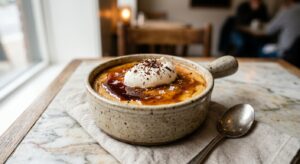
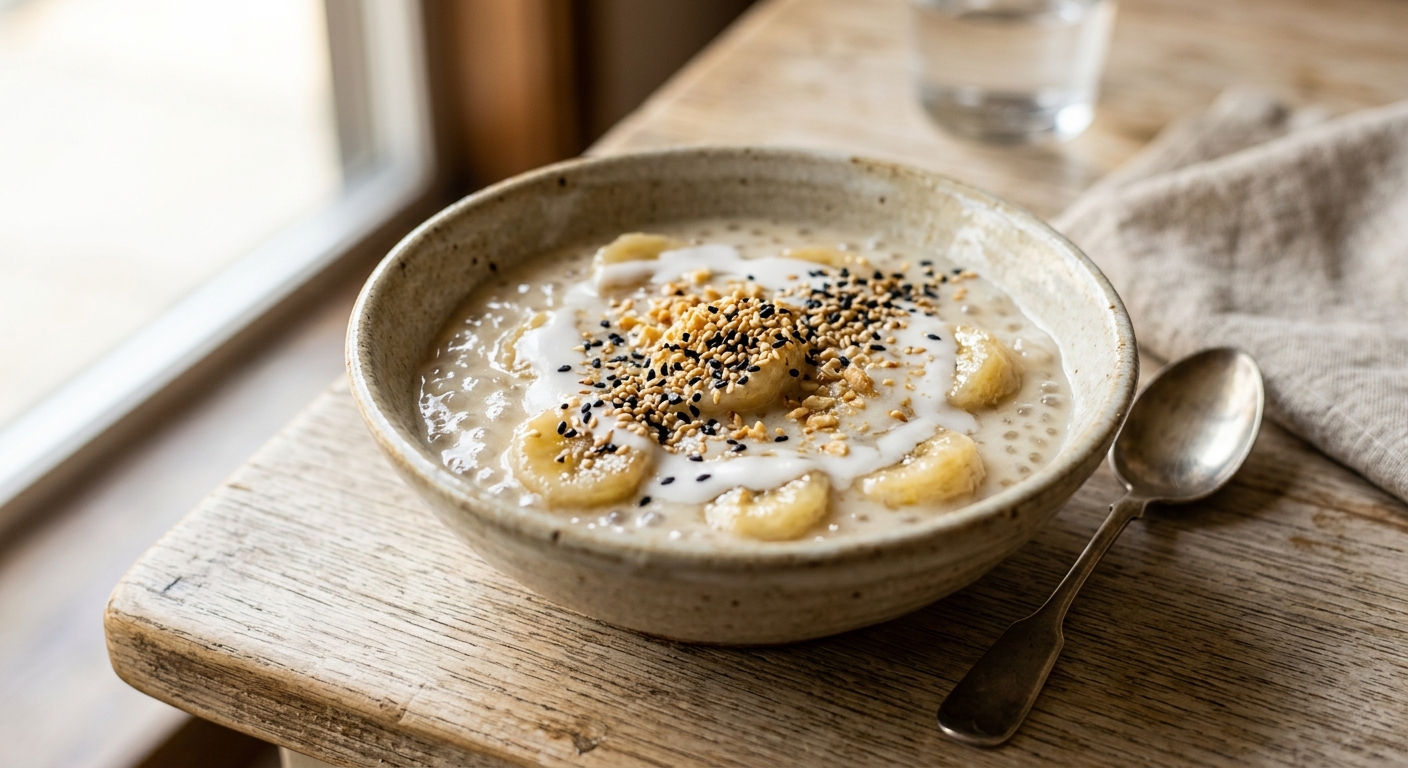
There is a particular kind of comfort in a bowl of che chuoi – warm, glossy, and smelling of coconut and ripe banana – that feels both humble and quietly luxurious. In Vietnam, this dessert is everywhere: ladled into small plastic cups by street vendors, served at the end of family meals, spooned out from big pots at temple gatherings. The base is almost laughably simple, just ripe bananas simmered in sweetened coconut milk until they turn soft and jammy, the whole thing thickened gently with tapioca pearls that turn translucent and bouncy like tiny pearls of glass. A drizzle of salted coconut cream on top ties every spoonful together with a rich, savory-sweet contrast that is genuinely addictive.
What sets this version apart is a two-part coconut approach borrowed from the most careful Vietnamese home cooks. The pudding base uses full-fat canned coconut milk for body and depth, but the topping is made with a separate, lightly salted coconut cream that is simmered with a small amount of cornstarch until it thickens into a pourable, velvety sauce. This distinction matters: pooling cold, thin coconut milk straight from the can over the top gives you something watery and flat, while this warm, thickened coconut cream sauce clings to every bite and delivers that signature layered richness you find in the best street-stall versions. Using ripe but still-firm bananas – the kind with plenty of yellow and just a few brown flecks – also keeps the fruit from dissolving into mush during cooking.
Che chuoi falls firmly in the easy category, and it is the perfect recipe for anyone who has never explored Vietnamese desserts before. You do not need any special equipment, and the ingredient list is short enough to memorize after one cook. It is equally lovely served warm on a cool evening or chilled and spooned cold straight from the fridge on a hot afternoon, making it one of the most versatile, lowest-effort puddings you will ever add to your rotation.
Equipment Needed
Click on an item below to shop for the recommended items for this recipe on Amazon.
As an Amazon Associate, we earn from qualifying purchases.
6
Ingredients
- Pudding Base
- 120 gsmall white tapioca pearls (about 1/2 cup), NOT large boba pearls
- 600 mlfull-fat coconut milk (about 2 1/2 cups), from 1 1/2 standard 400ml cans
- 240 mlwater (about 1 cup)
- 80 ggranulated white sugar (about 1/3 cup plus 1 tbsp), adjust to taste
- 1 tsppure vanilla extract
- 0.25 tspColima Sea SaltMicroplastic Free Salt
- 500 gripe but firm bananas, about 4 medium (see note on variety below)
- 160 mlfull-fat coconut cream (about 2/3 cup), from the top of a chilled can or a separate can of coconut cream
- Topping Sauce
- 10 gcornstarch (about 1 tbsp plus 1 tsp)
- Dissolving The Cornstarch
- 2 tbspwater
- Coconut Cream Topping
- 0.25 tspColima Sea SaltMicroplastic Free Salt
- 1 tspgranulated white sugar
- Serving
- 30 gwhite sesame seeds (about 3 tbsp), toasted
Ingredient Substitutions
Instructions
- Toast the sesame seeds first: Place a dry skillet over medium heat. Add the sesame seeds and shake the pan gently for 2 to 3 minutes until they are golden and fragrant. Immediately tip them onto a plate to cool – they will continue to darken if left in the hot pan. Set aside.
- Pre-soak the tapioca: Place the tapioca pearls in a small bowl, cover with cold water, and soak for 10 minutes while you prepare everything else. Drain before using. This softens the outer layer and ensures they cook evenly without turning gluey on the outside before the center is done.
- Make the coconut pudding base: In a medium saucepan, combine the 600ml coconut milk, 240ml water, 80g sugar, vanilla extract, and 1/4 tsp salt. Stir to dissolve the sugar and bring to a gentle simmer over medium heat, stirring occasionally. Do not let it come to a rolling boil, as hard boiling can cause the coconut milk to separate and turn grainy.
- Cook the tapioca: Once the coconut mixture is simmering, drain the soaked tapioca pearls and add them to the pot. Stir well and reduce the heat to medium-low. Cook for 12 to 15 minutes, stirring frequently, until the pearls are almost entirely translucent with just a tiny white dot remaining at the center. They will finish cooking in the residual heat.
- Add the bananas: Peel the bananas and cut them into coins about 1.5 cm (1/2 inch) thick. Add them to the simmering pudding and gently stir to coat. Cook for 3 to 4 minutes only, until the bananas are heated through and just beginning to soften at the edges but still holding their shape. Remove from heat immediately.
- Make the salted coconut cream topping: In a small saucepan, whisk together the 160ml coconut cream, 1 tsp sugar, and 1/4 tsp salt. In a separate small bowl, dissolve the cornstarch in 2 tbsp cold water until completely smooth, then whisk this slurry into the coconut cream. Place the saucepan over medium-low heat and cook, whisking constantly, for 2 to 3 minutes until the sauce thickens slightly and turns glossy. Remove from heat.
- Serve and garnish: Ladle the warm pudding into bowls. Spoon a generous tablespoon or two of the salted coconut cream topping over each portion, then finish with a pinch of toasted sesame seeds. Serve immediately while warm, or let cool and refrigerate for a chilled version – both are wonderful.
- Toast the sesame seeds using the stovetop method: Heat a dry skillet over medium heat, add sesame seeds, and shake for 2 to 3 minutes until golden. Tip onto a plate and set aside.
- Pre-soak the tapioca: Soak the tapioca pearls in cold water for 15 minutes (slightly longer than the stovetop method to give them a head start). Drain well.
- Combine ingredients in the slow cooker: Add the drained tapioca pearls, 600ml coconut milk, 240ml water, 80g sugar, vanilla extract, and 1/4 tsp salt to the slow cooker insert. Stir well to combine. Cover and cook on Low for 1 hour 15 minutes, stirring once halfway through if possible, until the tapioca pearls are mostly translucent.
- Add the bananas: Peel and slice the bananas into 1.5 cm coins. Stir them gently into the pudding. Replace the lid and cook on Low for a further 15 to 20 minutes, until the bananas are heated through and just tender. Switch the slow cooker to Warm if serving at a gathering.
- Make the salted coconut cream topping on the stovetop: Whisk together the coconut cream, 1 tsp sugar, and 1/4 tsp salt in a small saucepan. Dissolve the cornstarch in 2 tbsp cold water and whisk into the cream. Cook over medium-low heat, whisking constantly, for 2 to 3 minutes until thickened and glossy.
- Serve: Ladle into bowls, spoon the warm coconut cream topping over each portion, and scatter with toasted sesame seeds. The slow cooker pudding is particularly good served warm directly from the pot.
- Use quick-cook tapioca for this method: Standard small tapioca pearls do not hydrate reliably in the microwave. Use 20g (about 2 tablespoons) of quick-cook tapioca per serving. No pre-soaking is needed.
- Combine for one serving: In a large microwave-safe bowl or mug (it will bubble up), combine 100ml full-fat coconut milk, 40ml water, 1 tablespoon sugar, a tiny pinch of salt, 1/4 tsp vanilla extract, and 2 tablespoons of quick-cook tapioca. Stir well. The bowl should be at least 3 times the volume of the liquid to prevent boilovers.
- Microwave in short bursts: Microwave on Medium power (50%) for 3 minutes. Stir thoroughly. Microwave again on Medium for 2 minutes. Stir again – the tapioca should be mostly clear and the mixture should be thickening. If the center of the tapioca is still very white, microwave in 1-minute increments on Medium, stirring between each, until the pearls are nearly translucent.
- Add the banana: Slice half a ripe banana into coins and stir gently into the hot pudding. Microwave on Medium for 1 minute more, until the banana is just warmed through. Let stand for 2 minutes – the mixture will thicken further as it rests.
- Make a quick coconut cream topping: In a small microwave-safe cup, whisk together 2 tablespoons coconut cream, a tiny pinch of salt, and 1/4 tsp sugar. Microwave on High for 30 seconds, stir, and pour over the pudding. Top with a pinch of toasted sesame seeds (toast them quickly in a dry skillet or in the microwave on High for 60 to 90 seconds, watching carefully). Serve immediately.
Nutrition Per Serving
Per 1 serving (makes approximately 6 individual servings (about 3/4 cup each))
Why This Recipe Works
The magic of che chuoi lies almost entirely in understanding tapioca starch and what it does in a warm liquid. Tapioca pearls are made from cassava root starch that has been formed into small spheres. When submerged in a hot, sweetened liquid, the starch granules within each pearl absorb water and swell through a process called gelatinization. As they swell, they transition from opaque white to translucent, which is your visual cue that the starch has fully hydrated. A small white dot remaining at the center means the pearl is almost done but not quite – remove the pot from the heat at this point and the residual warmth will finish the job without overcooking. Overcooked tapioca goes from pleasantly chewy to completely dissolved and gluey, which is why careful monitoring in the last few minutes matters more than any other step here.
The choice to simmer the coconut milk rather than boil it hard is not just caution – it is chemistry. Coconut milk is an emulsion of fat, water, and proteins. When it hits a vigorous boil and stays there, the emulsion destabilizes: the fat separates out as oily yellow pools and the proteins clump into grainy white specks. A steady, gentle simmer keeps the emulsion intact, maintaining that creamy, uniform white color and smooth texture throughout. The same principle applies to the coconut cream topping: cooking it over medium-low heat with constant whisking keeps the fat and water bonded together, while the small amount of cornstarch acts as an additional stabilizer, binding water molecules and giving the sauce a satin-like, glossy body that pours beautifully rather than breaking into oil and liquid.
Adding the banana at the very end of cooking is intentional and important. Bananas contain a high proportion of pectin (a natural thickening carbohydrate in cell walls) that breaks down rapidly with heat. A ripe banana cooked for too long turns to mush that disintegrates into the pudding, making it taste more like banana-flavored starch than a dessert with distinct, tender fruit pieces. Three to four minutes of gentle simmering is enough to warm the banana through, allow the pectin at the cut surfaces to soften slightly and thicken the surrounding liquid a little, and infuse the pudding with sweet banana flavor without sacrificing texture. If your bananas are very ripe (mostly yellow with significant browning), reduce the cooking time to two minutes maximum.
Baker’s Tips
- Choose bananas that are ripe but firm for the best texture. The skin should be fully yellow with just a few brown speckles. Bananas that are mostly brown or very soft will dissolve during cooking and turn the pudding starchy and indistinct in flavor.
- Pre-soaking the tapioca pearls is a step you should not skip. Even 10 minutes of cold-water soaking softens the outer layer, which means the pearls hydrate more evenly from the inside out during cooking instead of becoming gummy on the outside before the center is done.
- Stir the pudding frequently while the tapioca is cooking. Tapioca pearls sink and stick to the bottom of the pot readily, and scorching at the base will give the whole pudding an off flavor. A silicone spatula that can scrape the bottom of the pan is your best tool here.
- The salted coconut cream topping is best made just before serving. Once it cools and is refrigerated, it thickens considerably. If reheating, add a teaspoon of water and whisk over low heat until smooth and pourable again.
- For a perfectly smooth coconut cream topping, whisk the cornstarch slurry into the cold coconut cream before applying any heat. Adding cornstarch to a hot liquid can cause it to clump instantly.
- If your pudding seems too thin after cooling, do not panic. Tapioca pudding thickens dramatically as it cools and rests. What looks almost soupy at serving temperature will be quite thick and set after an hour in the fridge. Taste and adjust sweetness before serving, as chilling mutes sweetness slightly.
Variations
- Pandan-scented version: Add 2 fresh or frozen pandan leaves (tied in a knot) to the coconut milk as it heats, and remove before adding the tapioca. This gives the pudding a floral, grassy fragrance that is quintessentially Southeast Asian and pairs beautifully with banana.
- Taro and banana combination: Replace half the banana with an equal weight of steamed taro, cut into 1.5 cm cubes. Add the taro at the same time as the banana. This is a popular Vietnamese variation called che chuoi khoai mon.
- Jackfruit variation: Add 80g of ripe jackfruit (fresh or canned and drained), torn into strips, along with the banana for a tropical, honey-like sweetness that complements the coconut beautifully.
- Warm spiced version: Add a 5 cm cinnamon stick and 2 whole star anise to the coconut milk while it heats. Remove before serving. This adds a gently warming note that makes the pudding feel especially cozy in cooler months.
Troubleshooting & FAQ
My tapioca pearls are still hard and white in the center after 15 minutes of simmering. What is wrong?
My coconut milk looks curdled and oily. Did I ruin the pudding?
My banana pieces completely fell apart and dissolved into the pudding.
The coconut cream topping went lumpy when I added the cornstarch. How do I fix it?
My pudding is much too thick after refrigerating. Can I still serve it?
Storage & Make-Ahead
- Storage: Store leftover pudding in an airtight container in the refrigerator for up to 3 days. The tapioca pearls will absorb more liquid as it sits and the pudding will thicken considerably when cold. To serve warm, reheat gently in a small saucepan over low heat with a splash of coconut milk or water stirred in to loosen it back to a pourable consistency. The coconut cream topping can be stored separately in the fridge for up to 3 days and rewarmed gently before serving.
- Make-Ahead: The pudding base (without the banana) can be made up to 1 day ahead and refrigerated. Reheat gently over medium-low heat with a splash of coconut milk, then stir in freshly sliced banana and simmer for 3 to 4 minutes just before serving. This keeps the banana from over-softening. The salted coconut cream topping keeps in the fridge for 3 days and reheats beautifully in 2 to 3 minutes on the stovetop.