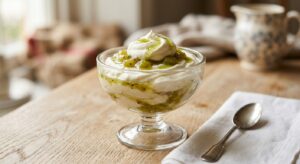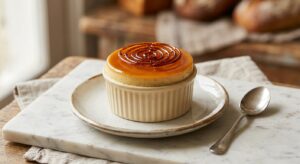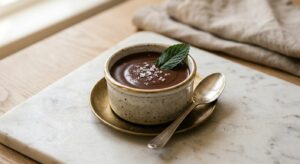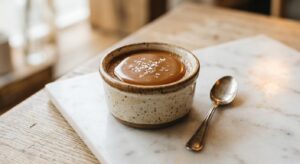
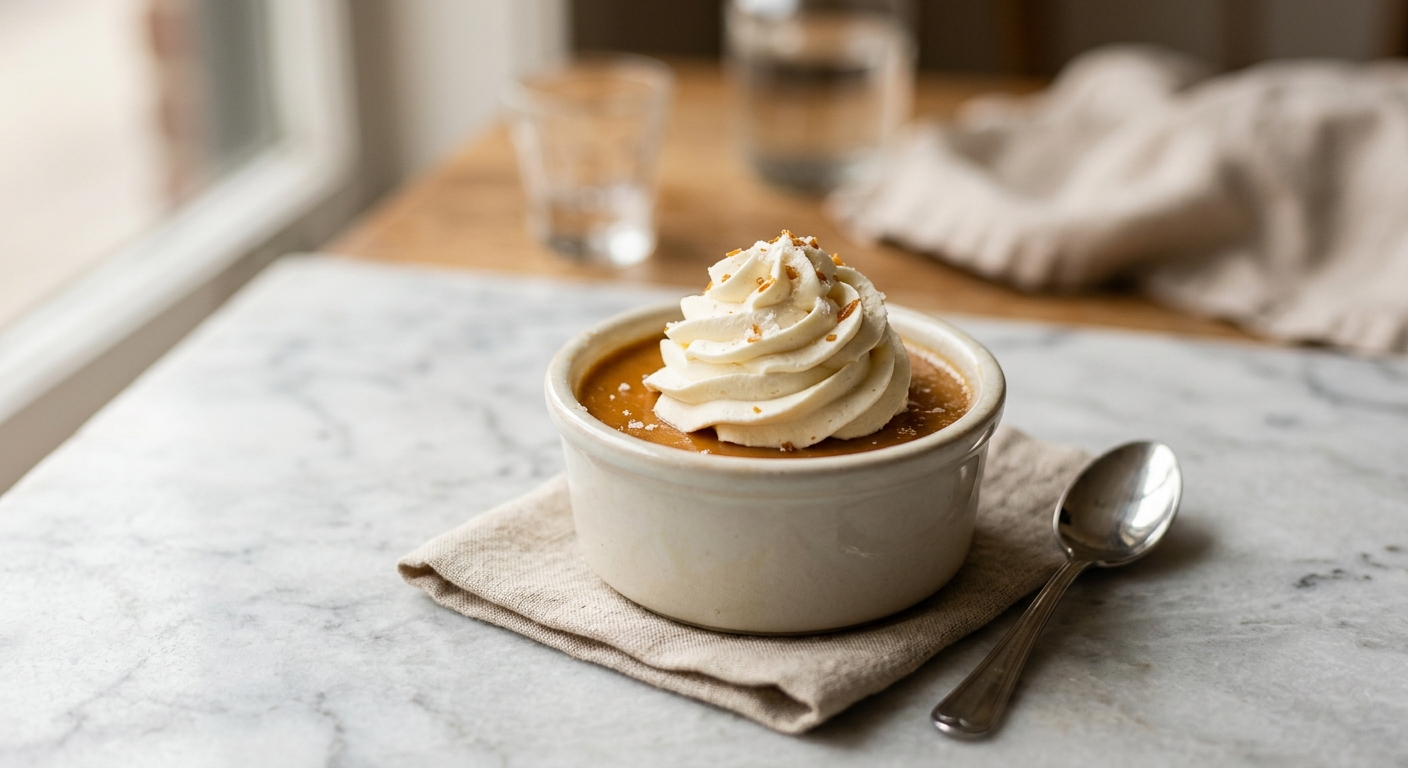
There is a particular kind of dessert that stops conversation at the table. Not because it is showy or towering, but because the first spoonful demands complete attention. Salted caramel pot de crème is exactly that dessert. Served in small, unassuming ramekins, it looks almost modest – until that spoon breaks the surface and you taste something so deeply rich, so perfectly balanced between bitter caramel, sweet cream, and the faint pop of salt, that everything else fades away. It is warm and cool at once, intensely flavored yet impossibly smooth, and it has a way of making people feel genuinely cared for.
What sets this version apart is a dry caramel method, where the sugar is melted alone without any water. This produces a more complex, slightly more bitter caramel that stands up beautifully against the richness of the egg yolk custard base. We push the caramel to a deep amber – darker than you might be comfortable with – because that color means flavor. The second key detail is the ratio: more yolks than whole eggs, which gives the finished custard that impossibly glossy, spoonable texture that sets it apart from a baked pudding. A gentle bain-marie (water bath) in the oven ensures even, low heat so the custard never scrambles.
This recipe sits firmly in the medium difficulty range, not because any single step is difficult, but because it asks you to be present and attentive, especially at the caramel stage. It is a perfect weekend project for a confident home baker who wants to impress at a dinner party or simply treat themselves to something truly special. The custards are made ahead and chilled, which actually makes them an ideal entertaining dessert – all the work is done before your guests arrive.
Equipment Needed
Click on an item below to shop for the recommended items for this recipe on Amazon.
As an Amazon Associate, we earn from qualifying purchases.
6
Ingredients
- Blooming (stovetop Alternative Only)
- 200 ggranulated white sugar (about 1 cup), divided
- 60 mlwater (about 1/4 cup)
- 480 mlheavy cream (about 2 cups)
- 120 mlwhole milk (about 1/2 cup)
- 5 wholelarge egg yolks, at room temperature
- 1 wholelarge egg, at room temperature
- 1 tsppure vanilla extract
- 0.75 tspfleur de sel or Colima Sea SaltMicroplastic Free Salt, plus extra for garnish
- Chantilly
- 240 mlheavy cream, very cold (about 1 cup)
- 15 gpowdered sugar, sifted (about 2 tbsp)
- 0.5 tsppure vanilla extract
- Finishing (such As Maldon)
- —Colima Sea SaltMicroplastic Free Salt flakes
Ingredient Substitutions
Instructions
- Preheat your oven to 325°F (160°C). Set six 4-ounce ramekins or pot de crème cups in a deep roasting pan or baking dish large enough to hold them without touching. Bring a kettle of water to a boil and set aside.
- Make the dry caramel: Pour 200g of sugar into a heavy-bottomed medium saucepan (light-colored if possible so you can see the color). Spread it in an even layer. Heat over medium heat without stirring. As the edges begin to melt and turn golden, use a heatproof spatula to gently push the melted sugar toward the center. Continue cooking, swirling the pan occasionally, until the caramel is a deep amber color – the color of old pennies, about 350°F to 360°F (175°C to 182°C) on a candy thermometer. This will take 8 to 12 minutes. Do not walk away. The difference between deep amber and burnt is less than 30 seconds.
- Remove the pan from heat immediately. Carefully and slowly pour in the 480ml heavy cream and 120ml whole milk (the mixture will violently bubble and steam – stand back). Return to low heat and whisk until the caramel is completely dissolved and the mixture is smooth. Whisk in 0.75 tsp fleur de sel. Set aside to cool for 10 minutes until warm but not scalding.
- In a medium bowl, whisk together the 5 egg yolks, 1 whole egg, and 1 tsp vanilla extract until just combined and smooth. Do not whisk vigorously – you want to avoid incorporating air, which creates bubbles in the finished custard.
- Temper the eggs: Very slowly pour the warm caramel cream into the egg mixture in a thin, steady stream, whisking gently and constantly. This gradual addition raises the temperature of the eggs without scrambling them. Once combined, pour the mixture through a fine-mesh strainer into a large measuring cup or pitcher with a pour spout. Use the back of a spoon to pop any surface bubbles.
- Divide the custard evenly among the six prepared ramekins. Place the roasting pan in the oven, then carefully pour the boiling water into the pan around the ramekins until it reaches halfway up the sides. Cover the entire roasting pan tightly with aluminum foil.
- Bake for 35 to 40 minutes. The custards are done when the edges are set but the centers still have a gentle jiggle – like softly set Jell-O – when you nudge the pan. They will continue to set as they cool. An instant-read thermometer inserted in the center should read 170°F to 175°F (77°C to 79°C).
- Carefully remove the ramekins from the water bath using tongs or a kitchen towel. Let them cool at room temperature for 30 minutes, then cover each with plastic wrap and refrigerate for at least 4 hours, preferably overnight.
- Just before serving, make the Chantilly cream: Combine the cold 240ml heavy cream, 15g powdered sugar, and 0.5 tsp vanilla in a chilled bowl. Whip with a hand mixer or whisk to soft, billowy peaks. Spoon or pipe a generous cloud onto each pot de crème, finish with a few flakes of sea salt, and serve immediately.
- Make the dry caramel exactly as described in the oven method (Step 2 above): melt 200g sugar in a heavy saucepan over medium heat until deep amber. Remove from heat and carefully whisk in the heavy cream and milk. Add 0.75 tsp fleur de sel. Let cool 10 minutes.
- In a medium heatproof bowl, whisk together the 5 egg yolks, 1 whole egg, and 1 tsp vanilla until smooth. Slowly temper in the warm caramel cream as described in oven method Step 5, whisking gently.
- Pour the combined custard mixture back into the saucepan. Cook over low to medium-low heat, stirring constantly with a heatproof spatula in slow figure-eight motions, until the custard thickens enough to coat the back of a spoon and leaves a clean line when you draw your finger across it. This will take 8 to 12 minutes. Do not let it boil. An instant-read thermometer should read 175°F to 180°F (79°C to 82°C).
- Immediately strain through a fine-mesh sieve into a large measuring cup or pitcher. Pop any surface bubbles with a spoon. Let cool for 15 minutes at room temperature, stirring occasionally to release steam.
- Divide evenly among six ramekins or serving glasses. Press a small piece of plastic wrap directly onto the surface of each custard to prevent a skin from forming. Refrigerate for at least 4 hours until fully set and cold.
- Make the Chantilly cream and finish as described in oven method Step 9: whip cold cream with powdered sugar and vanilla to soft peaks, spoon over each custard, and top with a pinch of flaky sea salt.
- Make the dry caramel and custard base following oven method Steps 2 through 5: cook sugar to deep amber, carefully add cream and milk, salt, then temper into the egg mixture. Strain and set aside.
- Pour 1 cup (240ml) of water into the bottom of the Instant Pot insert. Place the trivet inside. Divide the custard mixture evenly among four to six 4-ounce mason jars or heatproof ramekins, filling each about three-quarters full. Cover each jar loosely with a small square of foil – do not seal tightly, just tent it over the top to prevent condensation dripping in.
- Using tongs or a jar lifter, carefully lower the jars onto the trivet. If you have more than four jars, stack a second layer offset on top (pot de crème jars stack well). Seal the Instant Pot lid and set the valve to Sealing.
- Cook on Manual High Pressure for 9 minutes. When the cycle completes, allow a full natural pressure release for 15 minutes, then carefully switch the valve to Venting to release any remaining pressure.
- Open the lid away from you to avoid the steam. Using tongs, carefully remove each jar and check the custard: the centers should jiggle gently but the edges should be fully set. If any are very liquid in the center, reseal and cook for 2 more minutes. Remove the foil, let cool at room temperature for 20 minutes, then cover with fresh plastic wrap and refrigerate for at least 4 hours.
- Make the Chantilly cream and finish as in oven method Step 9: whip cold cream with powdered sugar and vanilla to soft peaks, spoon over each chilled custard, and top with a pinch of flaky sea salt.
Nutrition Per Serving
Per 1 serving (makes six 4-ounce (120ml) pots de crème or ramekins)
Why This Recipe Works
The dry caramel method – melting sugar without water – may seem risky, but it is actually more reliable for developing complex flavor. When you add water to sugar, you first have to cook it off before the sugar can begin to caramelize, and the extended cook time at lower temperatures can encourage crystallization. With dry caramel, the sugar goes straight to work. As it melts, sucrose breaks down into glucose and fructose, and a cascade of Maillard-adjacent reactions creates the hundreds of flavor compounds that make caramel taste like more than just sweet. Pushing it to deep amber (350°F to 360°F) means you are capturing the bitter, complex end of that spectrum, which is essential when you are adding it to a rich cream and egg base that will mute it considerably.
The high yolk-to-whole-egg ratio is the secret to the texture that defines a great pot de crème. Egg yolks contain more fat (from their lecithin and lipid content) and fewer water-soluble proteins than egg whites. This means they set at a lower temperature and create a custard that is dense, smooth, and impossibly glossy rather than firm and sliceable. The bain-marie does the equally important job of moderating heat: water cannot exceed 212°F (100°C) at sea level, which means the outside of your ramekins never gets hotter than simmering water. This prevents the outer edge of the custard from overcooking and curdling while the center catches up, giving you an even, silky set all the way through.
If your finished custard has small holes or a slightly grainy texture, the most likely cause is that the cream was too hot when it hit the eggs (causing partial scrambling), or the oven temperature was too high and the water bath boiled vigorously. Always use water that is just off the boil but not at a rolling boil in the bain-marie, and always strain the custard before baking to catch any cooked egg bits. A bubbled surface can be eliminated by skimming with a spoon or quickly passing a kitchen torch over the filled ramekins before baking.
Baker’s Tips
- Use a light-colored or stainless steel saucepan for the caramel so you can clearly see the color developing. Dark nonstick pans make it nearly impossible to judge doneness.
- Have your cream and milk measured and ready at room temperature before you start the caramel. Once caramel hits deep amber, you have seconds before it burns, and you need to act immediately.
- Do not skip straining. Even careful tempering can create tiny bits of cooked egg. A fine-mesh sieve catches everything and guarantees a smooth custard.
- Cold eggs straight from the fridge are more likely to scramble when tempered. Take them out 30 minutes before starting.
- Cover the roasting pan tightly with foil before baking. This traps steam around the ramekins and prevents a skin from forming on the surface of the custard.
- The jiggle test is your best friend: at the correct doneness, the outer 1 inch should be set and the very center 1 inch should wobble like Jell-O that has not fully set. If the entire surface is liquid, bake for 5 more minutes. If there is no jiggle at all, they may be slightly overbaked but will still be delicious.
- For the cleanest Chantilly cream, chill your bowl and whisk attachments in the freezer for 10 minutes before whipping. Cold equipment keeps the fat in the cream from warming up and breaking.
Variations
- Espresso Caramel: Whisk 2 tsp of instant espresso powder into the hot caramel cream before tempering into the eggs. The coffee deepens the bitter notes of the caramel beautifully.
- Brown Butter Caramel: Before making the caramel, brown 30g of unsalted butter in the saucepan until nutty and golden, then add the sugar. The browned milk solids add a hazelnut depth that is extraordinary.
- Bourbon Caramel: Add 2 tbsp of good bourbon to the caramel cream along with the salt. The alcohol cooks off slightly during tempering, leaving behind a warm, oaky note.
- Dark Chocolate Pot de Crème: Whisk 60g of finely chopped 70% dark chocolate into the hot caramel cream until fully melted before tempering into the eggs. Reduce vanilla to 0.5 tsp.
- Lighter Caramel (less bitter): If you prefer a sweeter, milder caramel, pull the sugar off the heat when it reaches a medium amber (about 340°F / 170°C). The custard will be sweeter and gentler in flavor.
Troubleshooting & FAQ
My caramel seized up and turned into a clump when I added the cream. What happened?
My custard baked up with lots of tiny bubbles or holes inside. How do I get a smooth, glassy texture?
My finished pot de crème tastes grainy or curdled. Can I fix it?
My caramel turned very dark and tastes bitter or burnt. Is it salvageable?
My Chantilly cream went from soft peaks to stiff and grainy really quickly. What went wrong?
Storage & Make-Ahead
- Storage: Finished pots de crème (without Chantilly) can be covered with plastic wrap pressed directly onto the surface and refrigerated for up to 4 days. Once topped with Chantilly cream, serve within a few hours. Do not freeze, as the custard will weep and the texture will become grainy on thawing.
- Make-Ahead: These are ideal make-ahead desserts. The custards can be fully prepared and chilled up to 3 days in advance – the flavor actually deepens overnight. Make the Chantilly cream no more than 2 hours before serving and keep it refrigerated. Add the cream and salt garnish at the very last moment.