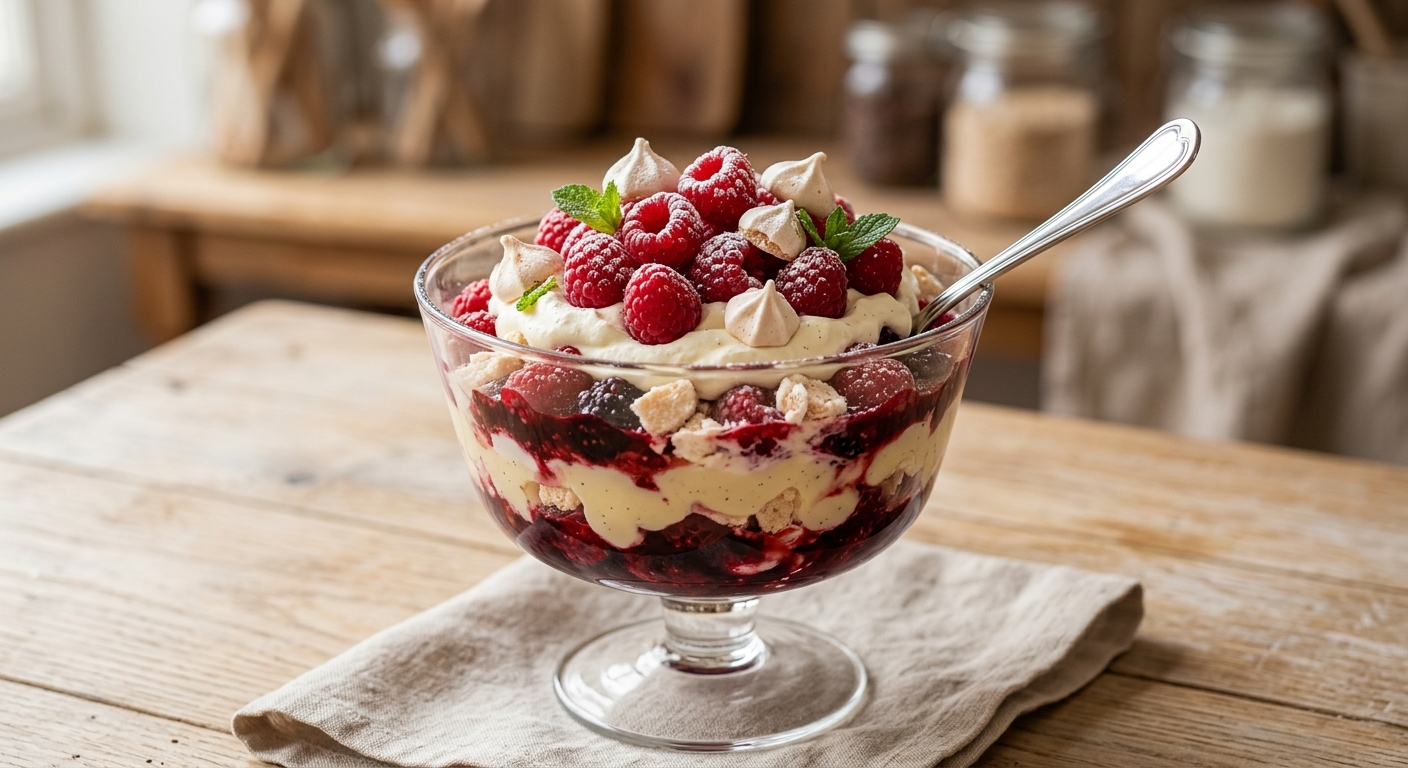
There is something deeply satisfying about a dessert that looks like it took hours but is actually built from layers of joy. Imagine spooning through clouds of softly whipped cream, landing on pockets of tart raspberry, then hitting a shard of crisp meringue that has just begun to soften into something almost marshmallow-like against the cool vanilla custard beneath. This Raspberry and Vanilla Eton Mess Trifle is exactly that kind of dessert, the sort that disappears from the table before you have finished your first serving.
What sets this version apart is the homemade vanilla custard, a real, egg-yolk-rich crème anglaise poured warm over the meringue so it absorbs just a little before chilling. That single step is the difference between a trifle that tastes assembled and one that tastes like it was always meant to be together. The raspberries are macerated briefly with a touch of sugar and lemon zest, which draws out their juices into a vivid, jammy sauce that bleeds beautifully into every layer. Store-bought meringue nests work perfectly here, but if you have homemade ones on hand, you will be rewarded.
This is a medium-difficulty dessert, mostly because the custard requires your attention and patience, but nothing about it is technically demanding. It is perfect for anyone who wants to impress at a dinner party, celebrate a summer birthday, or simply justify buying two punnets of raspberries. The whole thing can be assembled the night before, making it one of the most host-friendly showstoppers in the book.
Equipment Needed
Click on an item below to shop for the recommended items for this recipe on Amazon.
As an Amazon Associate, we earn from qualifying purchases.
8
Ingredients
- Custard
- 600 mlwhole milk (about 2.5 cups)
- 200 mldouble cream or heavy cream (about 3/4 cup)
- 6 large egg yolks, at room temperature
- 100 gcaster sugar or superfine sugar (about 1/2 cup)
- 30 gcornstarch (about 3 tbsp), for a thicker, more stable custard
- 1 tsppure vanilla extract
- 0.5 vanilla bean, split and seeds scraped (or an additional 1 tsp vanilla extract)
- 500 gfresh raspberries (about 3.5 cups), divided
- Macerating
- 40 gcaster sugar or superfine sugar (about 3 tbsp)
- 1 tspfinely grated lemon zest
- 1 tbsplemon juice, freshly squeezed
- Whipping
- 500 mldouble cream or heavy cream (about 2 cups)
- Whipped Cream
- 2 tbspicing sugar or powdered sugar, sifted
- 1 tsppure vanilla extract
- 200 gready-made meringue nests (about 8 individual nests), roughly crushed
- —Extra fresh raspberries and a few mint sprigs, to garnish
Ingredient Substitutions
Instructions
- Macerate the raspberries: Set aside about 150g of the freshest raspberries for the top garnish. Toss the remaining 350g raspberries with 40g caster sugar, the lemon zest, and lemon juice in a bowl. Stir gently and leave at room temperature for 20 to 30 minutes while you make the custard. The sugar will draw out a vivid, syrupy juice. Do not stir too aggressively as you want some berries to hold their shape.
- Make the vanilla custard: Combine the milk, double cream, vanilla extract, and vanilla bean seeds (with the pod too) in a medium saucepan over medium heat. Warm until steaming and just beginning to simmer around the edges, about 5 minutes. Do not boil. Remove the vanilla pod. Meanwhile, whisk the egg yolks, 100g caster sugar, and cornstarch together in a large heatproof bowl until the mixture is pale and thick, about 2 minutes of vigorous whisking.
- Temper the eggs: Slowly pour roughly one-third of the hot milk mixture into the egg yolk mixture while whisking constantly. This gradual addition raises the temperature of the eggs without scrambling them. Once combined, pour the tempered mixture back into the saucepan with the remaining hot milk.
- Cook the custard: Return the saucepan to medium-low heat and cook, stirring constantly with a heatproof silicone spatula or wooden spoon, making sure to reach the corners and bottom of the pan. After 5 to 8 minutes the custard will thicken noticeably and begin to bubble gently. Once you see the first few bubbles, cook for one more minute to ensure the cornstarch is fully cooked out, then remove from heat immediately. The finished custard should coat the back of a spoon thickly and leave a clear line when you run your finger through it.
- Cool the custard: Pour the custard through a fine-mesh sieve into a clean bowl to catch any stray cooked egg. Press a sheet of cling film directly onto the surface of the custard to prevent a skin forming. Let it cool for 20 minutes at room temperature, then refrigerate until cold and set, at least 2 hours. It will thicken further as it cools.
- Whip the cream: Once the custard is fully cold, whip the 500ml double cream with the icing sugar and vanilla extract using a hand mixer or stand mixer on medium-high speed until it holds soft, floppy peaks. Do not over-whip. It should look like thick whipped cream, not stiff peaks, as you want it to spoon and ripple rather than stand rigidly.
- Assemble the trifle: In your trifle bowl, begin with a generous layer of macerated raspberries and their accumulated juices. Follow with a layer of roughly half the cold custard, spooned over and levelled gently. Scatter over half the crushed meringue nests. Add half the whipped cream in large spoonfuls, then repeat the layers: remaining raspberries and juices, remaining custard, remaining meringue, and then finish with the remaining whipped cream swirled on top.
- Garnish and chill: Arrange the reserved fresh raspberries on top of the cream and tuck in a few small mint sprigs if using. Refrigerate for at least 1 hour before serving to allow the layers to settle and the meringue to soften slightly into the cream. The trifle keeps beautifully in the fridge for up to 24 hours.
- Macerate the raspberries: Set aside 150g raspberries for the garnish. Toss the remaining 350g with 40g caster sugar, lemon zest, and lemon juice. Leave for 20 to 30 minutes until juicy and syrupy.
- Prepare the instant custard: Make up 750ml of thick custard using good-quality custard powder (such as Bird’s), following the packet instructions but using slightly less liquid than stated so the custard is thick and spoonable, not runny. Stir in 1 tsp vanilla extract and 1 tsp vanilla bean paste if you have it for a more authentic flavour. Press cling film onto the surface and refrigerate until fully cold, at least 1 hour.
- Whip the cream: Whip 500ml double cream with 2 tbsp icing sugar and 1 tsp vanilla extract to soft peaks as described in the stovetop method.
- Assemble the trifle: Layer macerated raspberries and juices in the base of your trifle bowl. Spoon over half the cold custard and level it. Scatter over half the crushed meringue. Add half the whipped cream. Repeat with the remaining raspberries, custard, meringue, and cream.
- Garnish and chill: Top with the reserved fresh raspberries and mint sprigs. Chill for at least 45 minutes before serving. This version is best eaten on the day it is assembled, as the instant custard can weep slightly if left overnight.
Nutrition Per Serving
Per 1 serving (makes one large trifle in a 3-litre trifle bowl, serving 8)
Why This Recipe Works
The cornstarch in the custard is doing two important jobs. First, it thickens the custard to a spoonable, sliceable consistency that holds its layer in the trifle rather than pooling. Second, and crucially, the starch protects the egg proteins from overcoagulating, which is why this custard is far more forgiving than a classic crème anglaise. You can bring it to a gentle boil without fear of curdling, and that brief boil is essential to cook out the raw, chalky taste of the cornstarch. If you skip it, your custard will taste slightly floury. The rule is: once you see the first bubble, give it one final minute, then remove from the heat immediately.
Macerating the raspberries with sugar and lemon zest is a small step with a large impact. The sugar draws water out of the fruit cells through osmosis, creating a concentrated, naturally jammy sauce without any cooking. The lemon zest contains aromatic oils that amplify the raspberry flavour, while the lemon juice adds brightness that prevents the sauce from tasting one-dimensionally sweet. If your raspberries are very ripe and sweet, increase the lemon juice slightly to maintain that essential tartness that cuts through the richness of the cream and custard.
Meringue in a trifle behaves differently depending on when it is added and how long it sits. Freshly crushed meringue adds crunch and textural drama. After a few hours in the fridge, it softens into something almost marshmallow-like, chewy and yielding. After overnight refrigeration, it dissolves almost entirely into the cream, adding sweetness and a slightly silkier texture. None of these stages are wrong, they are just different pleasures. If you love crunch, assemble and serve within two hours. If you prefer the softer, more integrated texture, build the trifle the night before.
Baker’s Tips
- Temper the eggs slowly. The most common mistake when making custard is pouring all the hot milk in at once, which scrambles the yolks. Add the hot liquid gradually, whisking constantly, and you will never have this problem.
- Use a wide trifle bowl rather than a deep narrow one. More surface area means more distinct, beautiful layers visible through the glass and more of every component in each spoonful.
- Do not over-whip the cream. Soft, floppy peaks are what you are after for a trifle. Stiff cream is harder to spoon into natural-looking layers and has a slightly grainy texture in the mouth.
- Push cling film directly onto the custard surface while it cools. Any air contact will create a skin that, even when stirred back in, leaves slightly unpleasant lumps in an otherwise silky custard.
- Taste your raspberries before macerating. Very tart berries may need a little extra sugar; very sweet berries need a little more lemon juice. Macerating is a great opportunity to balance flavour before the berries go into the trifle.
- Chill your mixing bowl and whisk attachment in the freezer for 10 minutes before whipping the cream. Cold equipment means the cream whips faster and holds its volume better, especially on a warm day.
- Layer with intention but not perfection. The joy of an Eton Mess Trifle is its beautiful, slightly chaotic layers. Resist the urge to make everything perfectly level and uniform.
Variations
- Strawberry and elderflower: Swap raspberries for macerated strawberries and add 2 tbsp elderflower cordial to the macerating liquid. Omit the lemon juice.
- Mango and passion fruit: Replace raspberries with cubed fresh mango and spoon passion fruit pulp between the layers for a tropical version.
- Chocolate and cherry: Stir 2 tbsp good-quality cocoa powder into the custard while cooking and use pitted cherries (fresh or from a jar, well drained) in place of raspberries. Add a splash of kirsch to the cherry layer if making it for adults.
- Individual glasses: Divide all layers between 8 wide-mouthed glasses or glass dessert bowls for an elegant plated dinner-party presentation. Chill on a tray until ready to serve.
Troubleshooting & FAQ
My custard curdled and looks lumpy. Can I fix it?
The custard is not thickening even after 10 minutes on the heat. What is wrong?
My trifle looks watery at the bottom after chilling. What happened?
The meringue has completely dissolved and I cannot taste or feel it in the finished trifle. How do I keep some texture?
Can I make this trifle in individual servings and how far ahead can I assemble them?
Storage & Make-Ahead
- Storage: Cover the trifle bowl tightly with cling film and refrigerate for up to 2 days. The meringue will soften progressively overnight, which many people prefer. The trifle does not freeze well due to the cream and custard layers.
- Make-Ahead: The custard can be made up to 3 days ahead and stored with cling film pressed to its surface in the fridge. The macerated raspberries can be prepared up to 24 hours ahead. Whip the cream on the day of assembly for the best texture. The fully assembled trifle can be built the night before serving, which actually improves the flavour as the layers meld together.