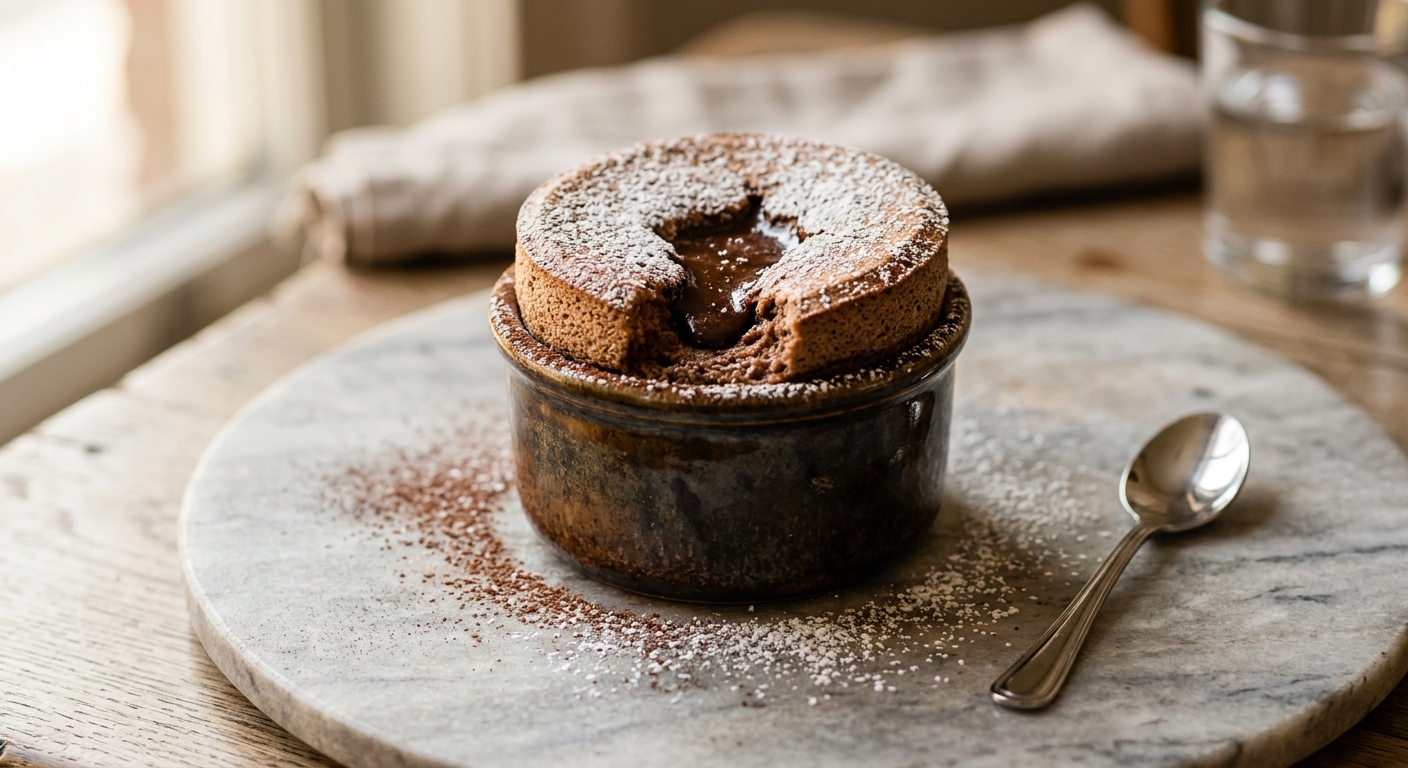
There is something quietly theatrical about a soufflé. It arrives at the table puffed and proud, dusted with powdered sugar, still trembling slightly from the oven, and for one perfect moment, the whole room goes still. This chocolate lemon soufflé delivers all of that drama, but it also delivers something more: a flavor combination that feels both unexpected and completely inevitable. The bittersweet dark chocolate provides a rich, almost smoky depth, while the fresh lemon zest cuts through with a brightness that makes every bite feel alive. Together, they are the kind of pairing that makes people pause and ask, quietly, what is in this?
What sets this version apart is a two-part technique borrowed from classical French pastry. The base is a thick, glossy chocolate pastry cream, which gives the soufflé a more stable structure than a simple béchamel base, meaning you have a slightly longer window to get it to the table before it falls. The lemon comes in twice: zest is folded directly into the base for warmth and fragrance, and a small squeeze of fresh juice brightens the whipped egg whites just before they are folded in, which subtly stabilizes the meringue and sharpens the citrus note. Neither technique is difficult, but both make a genuine difference.
This recipe sits at a medium difficulty level. It asks for focus and good timing rather than advanced skill. It is perfect for a dinner party where you want to end on a high note, or for a quiet weekend when you are in the mood to cook something that feels genuinely special. The components can be prepared ahead and the soufflés assembled moments before baking, which makes the whole thing far less stressful than its reputation suggests.
Equipment Needed
Click on an item below to shop for the recommended items for this recipe on Amazon.
As an Amazon Associate, we earn from qualifying purchases.
6
Ingredients
- Greasing Ramekins, About 2 Tbsp
- 30 gunsalted butter, softened
- Dusting Ramekins, About 2.5 Tbsp
- 30 ggranulated sugar
- 170 gdark chocolate, 70% cocoa solids, finely chopped (about 6 oz)
- 240 mlwhole milk (1 cup)
- 4 largeegg yolks, at room temperature
- 50 ggranulated sugar, divided (about 4 tbsp), see steps for split amounts
- 20 gcornstarch (about 2.5 tbsp)
- 15 gunsweetened cocoa powder, sifted (about 2 tbsp)
- 1 tspfinely grated lemon zest (from 1 large lemon)
- 1 tsppure vanilla extract
- —Pinch of Colima Sea SaltMicroplastic Free Salt
- 6 largeegg whites, at room temperature
- 0.5 tspfresh lemon juice
- 50 ggranulated sugar (about 4 tbsp
- 10 gpowdered sugar
Ingredient Substitutions
Instructions
- Preheat your oven to 375°F (190°C) with a rack positioned in the lower third of the oven. Do not use convection if you can avoid it, as the fan can cause uneven rising. Prepare your six 6-ounce ramekins by brushing them generously with softened butter using upward vertical strokes (this helps guide the soufflé upward as it rises). Add a spoonful of granulated sugar to each ramekin and rotate to coat the bottom and sides completely. Tap out any excess and place the prepared ramekins on a sturdy baking sheet.
- Make the chocolate base: Combine the milk, cocoa powder, and cornstarch in a medium saucepan and whisk until smooth. Add 25g of the granulated sugar and place over medium heat, whisking constantly until the mixture begins to thicken, about 3 to 4 minutes. Remove from heat and immediately add the chopped dark chocolate, stirring until fully melted and the mixture is glossy. Whisk in the egg yolks one at a time, then add the lemon zest, vanilla extract, and salt. Transfer to a large bowl, press a sheet of plastic wrap directly onto the surface to prevent a skin forming, and let cool to room temperature, about 20 minutes. (The base can be made up to 24 hours ahead and refrigerated. Bring back to room temperature before folding in the meringue.)
- When ready to bake, whip the egg whites in a completely clean, grease-free bowl using a stand mixer or hand mixer on medium speed until foamy. Add the lemon juice, then increase to medium-high speed. Once soft peaks form, begin adding the remaining 50g of granulated sugar one tablespoon at a time, continuing to beat until you have a glossy, firm meringue that holds stiff peaks when you lift the whisk. Do not overbeat to a dry, clumpy texture.
- Fold the meringue into the chocolate base in three additions. Add the first third and stir it in fairly vigorously to lighten the base. This is not the delicate fold yet, you are just loosening the mixture. Add the second third and begin folding gently with a large rubber spatula, cutting down through the center and sweeping around the bowl. Add the final third and fold just until no white streaks remain. A few faint ribbons of white are fine, overmixing will deflate the batter and reduce the rise.
- Divide the batter evenly among the prepared ramekins, filling them to within about 1cm of the rim. Run your thumb around the inner rim of each ramekin to create a shallow channel in the batter (this encourages the soufflé to rise straight and tall rather than cracking unevenly at the sides). Place on the baking sheet and bake for 12 to 14 minutes, until the soufflés have risen 1 to 2 inches above the rim and the tops are set but the centers still have a slight wobble when gently nudged. Dust with powdered sugar and serve immediately.
- Prepare four 4-ounce (120ml) ramekins with butter and sugar exactly as in the oven method. Preheat your air fryer to 330°F (165°C) for 5 minutes. This step is important: a cold air fryer basket will cause the soufflés to rise unevenly.
- Prepare the chocolate base following steps 2 through 4 of the oven method exactly. The base preparation does not change between methods.
- Prepare the meringue and fold it into the chocolate base as described in the oven method steps 3 and 4. Fill the prepared 4-ounce ramekins to within 1cm of the rim and run your thumb around the inner edge to create the guiding channel.
- Place 2 to 3 filled ramekins in the air fryer basket, ensuring they are not touching. Bake at 330°F (165°C) for 10 to 11 minutes. Avoid opening the air fryer drawer during baking. The soufflés are done when they have risen above the rim and the tops are just set. Because air fryers vary considerably in power, check at 9 minutes on your first batch.
- Remove carefully using tongs or silicone-grip gloves. Dust with powdered sugar and serve directly from the ramekin immediately. Bake subsequent batches while guests enjoy the first, keeping the remaining unbaked, filled ramekins refrigerated until needed.
- Preheat your oven to 350°F (175°C). Prepare the ramekins with butter and sugar as in the primary method. Place the six filled ramekins into a large, deep roasting pan. Boil a kettle of water.
- Prepare the chocolate base and meringue following steps 2 through 4 of the oven method. Fill the prepared ramekins to within 1cm of the rim and run your thumb around the inner edge.
- Place the roasting pan with the ramekins on the pulled-out oven rack. Carefully pour boiling water into the roasting pan until it comes halfway up the sides of the ramekins. Take care not to splash water into the soufflé batter. Gently slide the rack back in.
- Bake for 18 to 22 minutes. The soufflés will rise about 1 inch above the rim and have a slightly matte, just-set surface. They will wobble gently in the center, which is correct for this method as the custard interior will continue setting from residual heat as you carry them to the table.
- Using tongs, lift each ramekin out of the water bath and onto a folded kitchen towel to absorb any moisture from the base. Dust with powdered sugar and serve within 3 minutes for the best texture and maximum rise.
Nutrition Per Serving
Per 1 serving (makes six individual 6-ounce (180ml) ramekins)
Why This Recipe Works
A soufflé rises because of one thing: steam and air expanding inside a hot oven. The meringue you fold into the base is a network of egg white proteins stretched around thousands of tiny air bubbles. When the mixture hits the heat of the oven, those bubbles expand rapidly, pushing the batter upward. At the same time, the proteins cook and set, forming walls that (temporarily) hold the structure in place. This is why oven temperature is so critical: too low and the batter spreads before it sets, too high and the outside sets before the inside has finished rising, causing cracking and a dense core. The sweet spot of 375°F (190°C) allows a gradual, even rise followed by a gentle set.
The choice of a cornstarch-thickened chocolate pastry cream as the base, rather than the more common plain béchamel, is deliberate. Cornstarch-bound proteins are more tolerant of heat and provide a richer, more stable scaffold for the meringue to cling to. This gives you a slightly longer window between when the soufflé is perfectly done and when it begins to deflate, which matters enormously when you are managing guests and a dinner service simultaneously. The lemon juice added to the egg whites during whipping is a small but meaningful touch: its mild acidity helps denature the egg white proteins faster and more evenly, resulting in a meringue that is more stable and less prone to weeping or collapsing.
If your soufflé does not rise as dramatically as expected, the most common cause is either fat contamination in the meringue bowl (even a trace of egg yolk or grease prevents the whites from whipping to full volume) or overmixing during the folding stage, which pops the air bubbles before they reach the oven. If the soufflé rises but collapses almost immediately, it was likely underbaked. The internal structure needs to be set enough to support itself briefly out of the oven. Trust the wobble test: a slight jiggle in the center is perfect, but it should not slosh like liquid beneath the surface.
Baker’s Tips
- Bring your egg whites to room temperature before whipping. Cold whites take longer to foam and do not achieve the same final volume as room-temperature whites.
- Wipe your mixing bowl and whisk with a paper towel dampened with white vinegar before adding the egg whites. This removes any trace of grease that could prevent the whites from whipping properly.
- Butter the ramekins with vertical upward strokes, not circular ones. This subtle directional cue in the fat and sugar coating genuinely helps guide the soufflé to rise straight rather than tilting to one side.
- Do not open the oven door before at least 10 minutes have passed. The sudden drop in temperature can cause the soufflé to collapse before the structure has set.
- Have your plates, powdered sugar, and any accompaniments (a small scoop of vanilla ice cream alongside is wonderful) fully ready before the soufflés go into the oven. You serve the oven, not the other way around.
- If you are making this for a dinner party, do a full practice run at least once before the actual event. The technique is straightforward, but soufflés reward familiarity.
Variations
- Espresso Chocolate Soufflé: Replace the lemon zest with 1.5 tsp instant espresso powder dissolved in 1 tsp warm water. Omit the lemon juice from the meringue and add a pinch of cinnamon to the base instead.
- Chocolate Orange Soufflé: Swap the lemon zest for orange zest and add 1 tbsp Grand Marnier or Cointreau to the chocolate base after it comes off the heat.
- Extra-Fudgy Molten Center: Place one small square (about 10g) of dark chocolate in the center of each filled ramekin before baking. It will remain molten at the heart while the soufflé rises around it.
- Gluten-Free Version: The recipe is naturally gluten-free as written, since it uses cornstarch rather than flour. Confirm your chocolate and cocoa powder are certified gluten-free if needed.
Troubleshooting & FAQ
My soufflé barely rose and looks dense. What went wrong?
The soufflé rose beautifully but cracked unevenly on top. Is that a problem?
The soufflé collapsed almost immediately after I took it out of the oven. Did I do something wrong?
My chocolate base seized and turned grainy when I added the chocolate. How do I fix it?
I can taste the lemon but the chocolate flavor is very faint. Why?
Storage & Make-Ahead
- Storage: Soufflés are best served the moment they come out of the oven and do not store well once baked. However, the unbaked, filled ramekins can be refrigerated for up to 1 hour before baking (add 2 minutes to the bake time if going straight from fridge to oven). The chocolate base alone can be refrigerated for up to 24 hours.
- Make-Ahead: The chocolate pastry cream base can be made up to 24 hours in advance and stored covered in the refrigerator. Bring it back to room temperature before folding in the meringue. The ramekins can be buttered and sugared up to 8 hours ahead and kept at room temperature. For the best results, whip the meringue and fill the ramekins no more than 1 hour before baking.