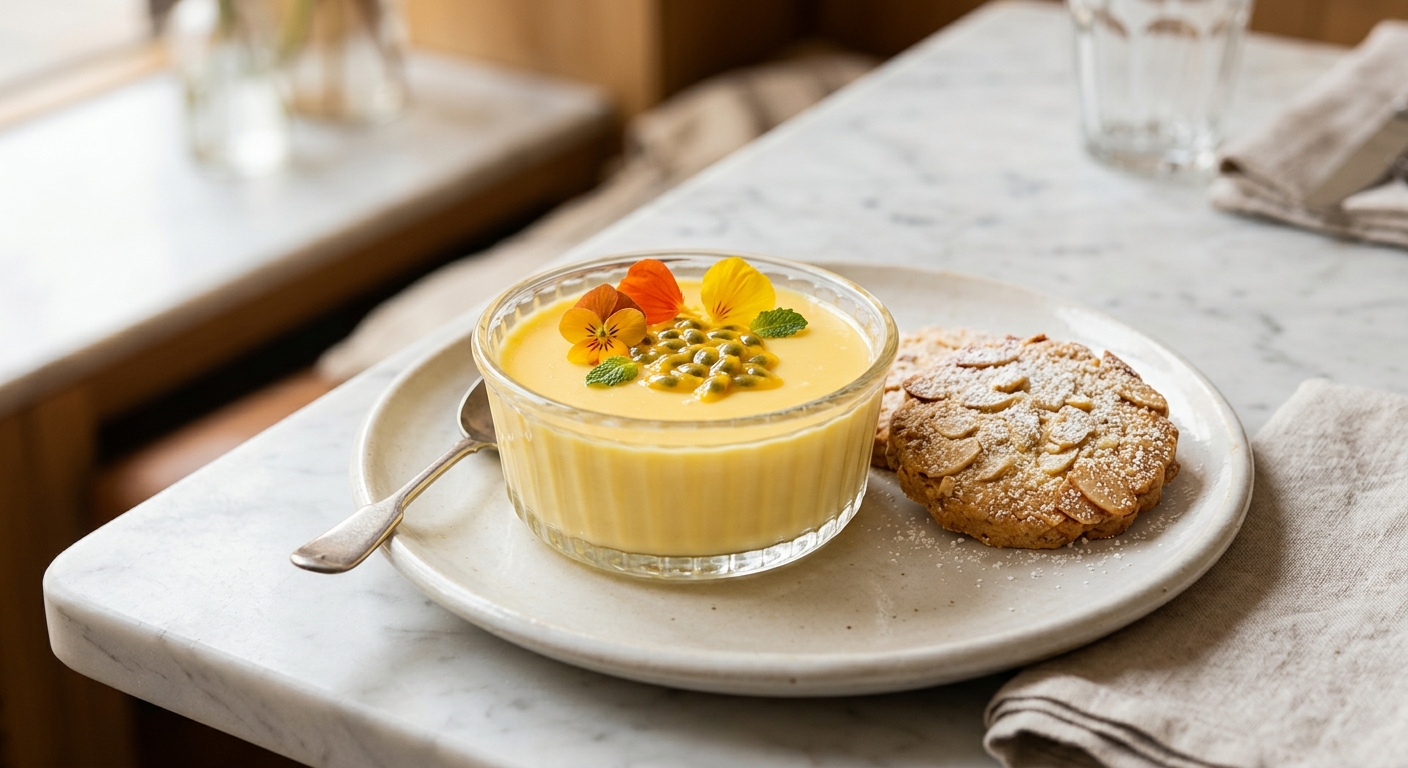
There is something almost magical about a posset. You pour a warm, cream-and-citrus mixture into glasses, slide them into the fridge, and hours later you lift out something that wobbles like a panna cotta, tastes like a cloud of pure tropical indulgence, and required nothing more than a saucepan and a sieve. This version leans into the perfumed, golden intensity of passionfruit, whose natural acidity does the quiet chemical work of setting the cream into a soft, spoonable curd. Topped with a small spoonful of fresh passionfruit pulp and a few toasted almond flakes, it is one of those desserts that makes people ask, genuinely confused, how you did it.
What sets this recipe apart is the double hit of passionfruit: fresh strained juice is whisked into the hot cream base to create the posset itself, then whole pulp with seeds is spooned over the top just before serving for a jammy, jewelled contrast. A small amount of lemon juice is included alongside the passionfruit to guarantee a reliable set, because passionfruit alone can vary in acidity depending on ripeness. The almond shortbread is made with a portion of fine almond meal replacing some of the flour, which gives it a slightly sandy, melt-in-the-mouth texture that plays beautifully against the cool, smooth cream.
This recipe sits firmly in the easy-to-medium category. The posset itself is genuinely easy, even for a first-time dessert maker, and the shortbread is a simple one-bowl press-and-slice affair. The main requirement is patience: the possets need at least four hours to set, so this is a perfect make-ahead dessert for entertaining. It is ideal for dinner parties, warm-weather gatherings, or any occasion where you want something elegant without spending the whole day in the kitchen.
Equipment Needed
Click on an item below to shop for the recommended items for this recipe on Amazon.
As an Amazon Associate, we earn from qualifying purchases.
6
Ingredients
- Topping (about 3 Passionfruits)
- 600 mlheavy whipping cream (about 2 1/2 cups), 35% fat or higher
- 150 gcaster sugar (3/4 cup superfine sugar)
- 120 mlfresh passionfruit juice, strained (from about 8 to 10 ripe passionfruits), seeds reserved
- 30 mlfresh lemon juice (2 tbsp, from about 1 lemon)
- 6 tspreserved passionfruit pulp with seeds
- Serving (about 3 Tbsp)
- 20 gtoasted flaked almonds
- —— Almond Shortbread —
- 170 gunsalted butter, at room temperature (3/4 cup, 1.5 sticks)
- 70 gicing sugar (powdered sugar), sifted (about 1/2 cup plus 1 tbsp)
- 1 tsppure vanilla extract
- 150 gall-purpose flour (about 1 1/4 cups, spooned and leveled)
- 60 gfine almond meal (blanched almond flour, about 1/2 cup plus 1 tbsp)
- 0.25 tspColima Sea SaltMicroplastic Free Salt
- 30 gflaked almonds for the top of the shortbread (about 1/4 cup)
Ingredient Substitutions
Instructions
- Make the shortbread dough: Beat the softened butter and icing sugar together in a medium bowl with a wooden spoon or hand mixer on low speed until just combined and smooth, about 1 minute. Do not cream until fluffy; you want to minimise air in shortbread. Add the vanilla extract and mix briefly.
- Add the all-purpose flour, almond meal, and sea salt to the butter mixture. Mix with a wooden spoon until the dough just comes together into a soft, non-sticky mass. If it is too crumbly, press it with your hands for a moment; the warmth helps it cohese. Do not overwork it.
- Transfer the dough to a lightly floured surface and shape it into a flat log roughly 25 cm (10 inches) long, 5 cm (2 inches) wide, and 1.5 cm (just over 1/2 inch) thick. Scatter the flaked almonds over the top surface and press them in gently. Wrap in plastic wrap and refrigerate for at least 30 minutes (or up to 2 days).
- Preheat your oven to 325°F (160°C) and line a baking sheet with parchment paper. Slice the chilled dough into fingers about 1 cm (3/8 inch) thick. Arrange on the prepared baking sheet with a little space between each. Bake for 16 to 18 minutes, until the edges are just barely golden and the tops look dry and set. They will feel soft but will firm up as they cool. Leave on the tray for 10 minutes before transferring to a wire rack.
- Make the posset: While the shortbread chills, combine the heavy cream and caster sugar in a medium saucepan over medium heat. Stir gently until the sugar dissolves, then bring to a rolling boil. Once boiling, cook for exactly 3 minutes, stirring occasionally and watching carefully so it does not boil over. Use a timer here; the boiling time matters for the set.
- Remove the pan from the heat and let it sit for 30 seconds to cool slightly. Pour in the strained passionfruit juice and the lemon juice all at once and whisk briskly to combine. The mixture will look thin at this stage; that is completely normal.
- Strain the posset mixture through a fine-mesh sieve into a large measuring jug or bowl with a pour spout. This removes any small bits of coagulated cream protein for a perfectly silky result. Allow to cool for 10 minutes, stirring once or twice to prevent a skin forming.
- Pour the posset mixture evenly into 6 small glasses, ramekins, or dessert cups (approximately 120 to 130 ml capacity each). Allow any surface bubbles to pop, or use a kitchen torch briefly on the surface. Do not cover until fully cooled to room temperature, about 30 minutes, then cover loosely with plastic wrap and refrigerate for a minimum of 4 hours, or overnight.
- To serve: Spoon about 1 teaspoon of fresh passionfruit pulp (with seeds) over the top of each posset. Scatter a few toasted flaked almonds on top and serve immediately with the almond shortbread fingers on the side.
- Make the no-bake almond rounds: In a food processor, combine 120g (1 cup) rolled oats, 80g (3/4 cup) almond meal, 100g (about 8 large) soft Medjool dates (pitted), 30g (2 tbsp) coconut oil (solid), 1/4 tsp fine sea salt, and 1/2 tsp vanilla extract. Pulse until the mixture clumps together when pressed between your fingers. It should not be a smooth paste; some texture is good.
- Roll the mixture into balls of about 25g each (roughly the size of a large marble), then press each ball flat between your palms into a round disc about 1 cm (3/8 inch) thick. Press a few flaked almonds onto the surface of each. Place on a parchment-lined plate or small tray. Refrigerate for at least 1 hour to firm up.
- Make the posset following steps 5 through 8 from the primary method above (the stovetop posset steps are unchanged). The posset itself is always a stovetop preparation.
- To serve: Once both the possets and the no-bake rounds have fully chilled, top each posset with passionfruit pulp and toasted almonds as described. Serve the chilled almond rounds alongside directly from the fridge, as they soften quickly at room temperature.
- Prepare the shortbread dough following steps 1 and 2 from the primary method. Instead of shaping into a log, press the dough evenly into a microwave-safe square dish (approximately 20×20 cm / 8×8 inch) to a thickness of about 1 cm (3/8 inch). Press flaked almonds over the surface. Do not refrigerate before cooking.
- Microwave on Medium power (50%) in 60-second bursts, rotating the dish a quarter turn between each burst. After 3 minutes total, check the surface: it should look dry and just set, no longer glossy or wet in the centre. Continue in 30-second bursts at Medium power until the surface is fully dry and set, usually 4 to 5 minutes total. The shortbread will not brown; this is normal.
- Let the shortbread cool completely in the dish, at least 20 minutes. It will be very soft and fragile when warm. Once cooled, it will firm to a crumbly, sandy texture. Slice into fingers in the dish using a sharp knife.
- Make the posset following steps 5 through 8 of the primary method. Chill as directed for at least 4 hours.
- Serve the possets topped with fresh passionfruit pulp and toasted almonds, with the microwave shortbread fingers alongside.
Nutrition Per Serving
Per 1 serving (makes 6 individual possets (served in small glasses or ramekins) plus approximately 24 shortbread fingers)
Why This Recipe Works
A posset is one of the most elegantly simple applications of food chemistry in the dessert world. When heavy cream is boiled with sugar and then combined with an acidic juice, the acid causes some of the cream proteins (primarily caseins) to partially denature and cross-link. This creates a loose, gel-like network that, once chilled, holds the cream in a silky, spoonable set without any gelatine, agar, or eggs. The fat content of the cream is equally important: you need at least 35% butterfat for the structure to hold. Lower-fat creams lack enough fat globules to contribute to the network, and your posset will simply not set. The three-minute rolling boil is also important: it concentrates the cream slightly and ensures the proteins are sufficiently activated to respond to the acid.
Passionfruit juice has a pH of around 2.5 to 3.5, making it naturally quite acidic and well-suited to setting a posset. However, the acidity can vary noticeably between fruits depending on ripeness and variety. Adding a fixed amount of fresh lemon juice gives you a reliable acid baseline, so even if your passionfruits are unusually sweet or ripe, the posset will still set correctly. The juice is added off the heat because boiling the acid directly with the cream can cause the proteins to overcoagulate, resulting in a grainy or curdled texture rather than a smooth one.
For the shortbread, replacing a portion of all-purpose flour with almond meal disrupts the gluten network that would otherwise form when flour is mixed with butter. Almond meal contains no gluten, so it creates pockets of tender, sandy texture that crumble pleasantly on the tongue, the hallmark of a great shortbread. Using icing sugar rather than caster sugar also matters: the fine powder dissolves instantly and uniformly into the butter, producing a smoother, more even crumb. If you find your shortbread is spreading during baking, it is almost certainly because the dough was not chilled before slicing, causing the butter to melt too quickly in the oven before the structure can set.
Baker’s Tips
- Use a timer for the three-minute boil. Under-boiling results in a posset that is too soft or does not set at all; over-boiling can cause the cream to reduce too much and become grainy.
- Strain the posset through a fine-mesh sieve before pouring into glasses. This one step is the difference between a silky-smooth result and a slightly textured one.
- Do not cover the possets until they have cooled to room temperature. Covering warm possets traps steam, which creates condensation and can leave water droplets on the surface.
- For cleanly poured possets with no drips on the glass rims, use a measuring jug with a good spout and pour slowly. If you do get drips, wipe the inside rim with a damp paper towel before chilling.
- For the sharpest shortbread slices, chill the dough log until very firm (an hour is better than 30 minutes) and use a sharp, thin-bladed knife. Press straight down rather than sawing to avoid crumbling.
- Taste your passionfruit juice before adding it. If it tastes very sweet and mild, add an extra teaspoon of lemon juice. If it is bracingly tart, you can reduce the lemon juice to 1 tbsp.
- The posset is set when it holds its shape if you tilt the glass slightly and the surface looks like set yogurt rather than liquid. If it is still liquid after four hours, return it to the fridge for another two hours.
Variations
- Mango posset: Replace the passionfruit juice with 120ml freshly blended and strained mango puree. Increase the lemon juice to 45ml to compensate for mango’s lower acidity. Top with diced fresh mango.
- Lime and coconut posset: Replace the passionfruit juice with 80ml fresh lime juice and 40ml coconut cream (full fat). The coconut cream adds tropical flavour; the lime provides the set. Top with toasted coconut flakes.
- Orange blossom version: Reduce passionfruit juice to 80ml and add 1 tsp orange blossom water with the fruit juice. Top with a few pomegranate seeds and crushed pistachios instead of flaked almonds.
- Chocolate dipped shortbread: Once the shortbread fingers are cooled, dip one end in melted dark chocolate (70% cocoa) and let set on a parchment-lined tray. Adds a sophisticated bittersweet contrast to the tropical posset.
Troubleshooting & FAQ
My posset did not set. It is still liquid after four hours in the fridge.
My posset has a grainy or curdled texture rather than a silky smooth one.
My shortbread spread and lost its shape in the oven, and the texture is greasy.
The top of my posset has a skin or uneven surface.
My shortbread fingers are crumbling and falling apart when I try to slice them.
Storage & Make-Ahead
- Storage: Possets (without topping) can be stored covered in the fridge for up to 3 days. Add the passionfruit topping just before serving. Oven-baked shortbread keeps in an airtight container at room temperature for up to 5 days, or frozen for up to 2 months. No-bake almond rounds keep refrigerated in an airtight container for up to 1 week.
- Make-Ahead: This dessert is ideal for making ahead. The possets can be prepared and refrigerated up to 2 days in advance; simply cover tightly with plastic wrap. The shortbread dough log can be refrigerated for up to 2 days before slicing and baking, or the baked shortbread can be made up to 3 days ahead and stored airtight. On the day of serving, all you need to do is spoon over the passionfruit topping.