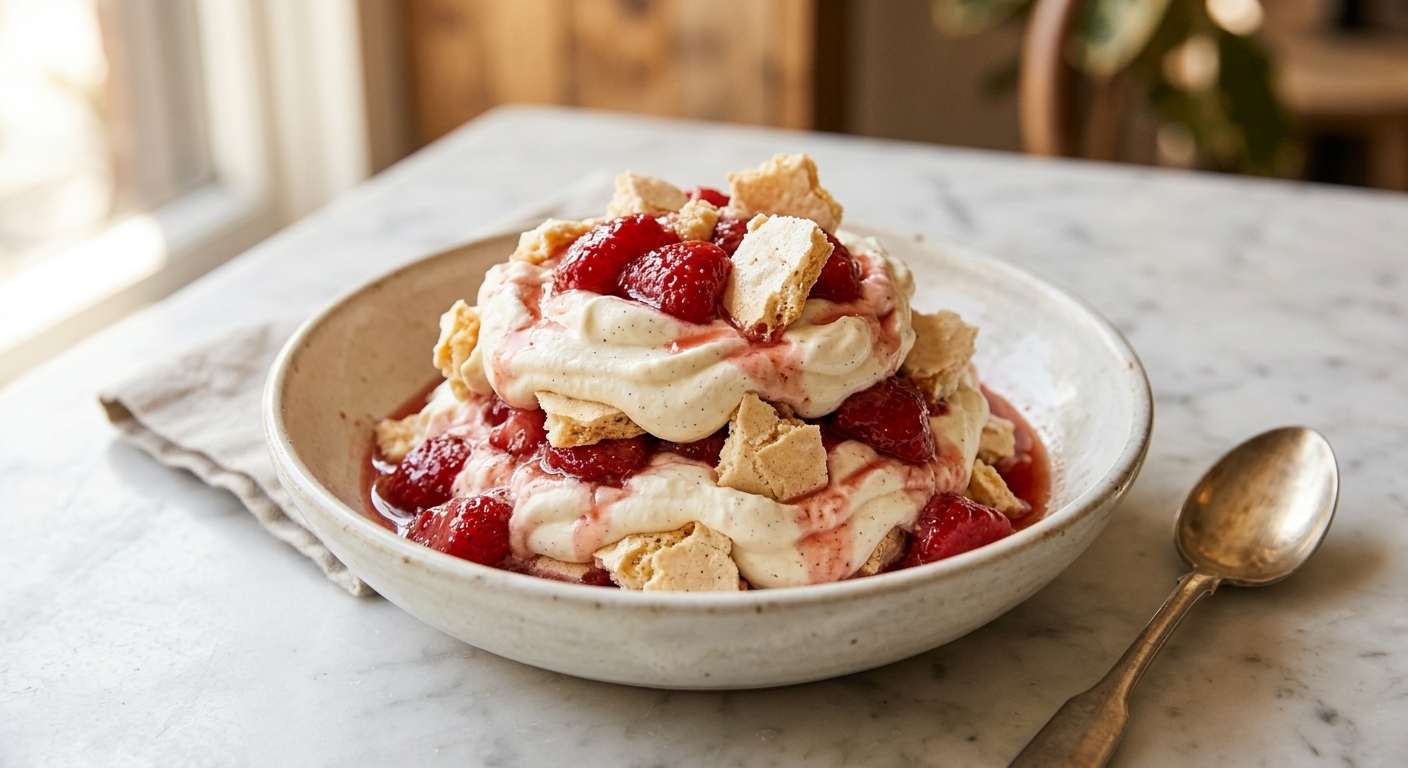
There is something deeply satisfying about a dessert that looks like beautiful chaos. Eton Mess arrives at the table in glorious disarray – crimson strawberries tumbling through pillowy cream and pale ivory meringue – and every spoonful somehow manages to hit sweet, creamy, fruity, and crunchy all at once. It has been served at Eton College’s annual cricket match since at least the 1930s, though its exact origins are cheerfully disputed. What is not disputed is that it is one of the most purely joyful desserts ever invented.
What sets this version apart is the homemade meringue, made using the French method with a touch of white wine vinegar and cornstarch worked into the batter. These two small additions create a meringue that is deeply crisp on the outside and ever so slightly chewy and marshmallow-soft within – far more interesting than the hollow, bone-dry meringues you find at the supermarket. The strawberries are macerated in sugar and a squeeze of lemon juice, which draws out their juices to create a natural syrup that bleeds into the cream in the most beautiful way. The cream itself is whipped just to soft, billowing peaks – sturdy enough to hold everything together, but still cloud-light.
Difficulty-wise, this sits firmly in the easy to medium camp. The meringues require a little patience while they dry in the oven, but the technique itself is straightforward. This recipe is perfect for anyone who wants to impress guests without spending hours in the kitchen – it is ideal for summer garden parties, casual dinner parties, or any occasion where you want something stunning with minimal stress. You can make every component ahead of time and assemble in minutes.
Equipment Needed
Click on an item below to shop for the recommended items for this recipe on Amazon.
As an Amazon Associate, we earn from qualifying purchases.
6
Ingredients
- Macerating
- 4 largeegg whites, at room temperature (approximately 120g total)
- 200 gcaster sugar (about 1 cup; superfine sugar in the US – blitz regular sugar briefly in a food processor if needed)
- 1 tspwhite wine vinegar
- 1 tspcornstarch (cornflour)
- 0.5 tspvanilla extract
- —Pinch of Colima Sea SaltMicroplastic Free Salt
- 600 gfresh strawberries (about 4 cups), hulled and quartered
- 30 gcaster or granulated sugar (about 2 tbsp)
- 1 tbspfresh lemon juice
- 480 mldouble cream or heavy whipping cream (about 2 cups, minimum 35% fat)
- 2 tbspicing sugar (powdered sugar), sifted
- Cream
- 1 tspvanilla bean paste or vanilla extract
Ingredient Substitutions
Instructions
- Preheat your oven to 225°F (110°C). Line a large baking sheet with parchment paper. If your parchment keeps sliding, dab a tiny bit of meringue mixture under each corner to anchor it.
- Macerate the strawberries: Toss the hulled, quartered strawberries with 30g caster sugar and 1 tbsp lemon juice in a bowl. Stir to coat, then cover and set aside at room temperature for at least 30 minutes (up to 2 hours). The sugar will draw out the juices to create a fragrant ruby syrup.
- Make the meringue: Ensure your bowl and whisk are completely clean and grease-free – any trace of fat will prevent the egg whites from whipping. Separate your eggs carefully. Place the 4 egg whites and a pinch of salt in the bowl of a stand mixer (or a large mixing bowl if using a hand mixer). Whip on medium speed until you reach soft, foamy peaks, about 2 to 3 minutes.
- Increase the speed to medium-high. Add the 200g caster sugar one tablespoon at a time, waiting about 10 to 15 seconds between each addition. This gradual addition is crucial – it lets the sugar dissolve into the foam without deflating it. Once all the sugar is added, continue whipping for 4 to 5 minutes until the meringue is very thick, glossy, and holds stiff peaks. When you rub a small amount between your fingers, you should feel no graininess from undissolved sugar.
- Add the vanilla extract, white wine vinegar, and cornstarch. Fold gently with a large metal spoon or spatula – just 3 to 4 folds – until combined. The vinegar and cornstarch are your insurance policy for a chewy centre and a stable structure.
- Spoon the meringue onto the prepared baking sheet in large irregular mounds – some can be roughly 3 to 4 inches across, others smaller. Eton Mess meringue is meant to be broken up, so rustic shapes are ideal and encouraged. You want a variety of sizes for textural contrast.
- Bake for 1 hour 15 minutes. The meringues should feel dry and lift cleanly from the parchment without sticking. Turn off the oven and leave the meringues inside with the door closed for a full 1 hour. This slow cooling prevents cracking from a sudden temperature change. Once cooled, they can be stored in an airtight container for up to a week.
- When ready to assemble: Whip the 480ml double cream with 2 tbsp icing sugar and 1 tsp vanilla bean paste in a cold bowl until it holds soft, billowy peaks. Do not over-whip – you want it to just hold its shape, not look grainy or stiff. Break the meringues into rough shards and chunks. Reserve about 1/4 of the strawberries and their syrup for the top. Gently fold the remaining strawberries and their juices through the cream, then fold in most of the meringue pieces. Spoon generously into glasses or a large bowl, top with the reserved strawberries and a drizzle of syrup, and add the remaining meringue shards. Serve immediately.
- Macerate the strawberries first: Toss the hulled, quartered strawberries with 30g caster sugar and 1 tbsp lemon juice. Stir, cover, and let them sit for at least 30 minutes at room temperature. The longer they sit (up to 2 hours), the more flavourful and syrupy they become.
- Source 150 to 200g of good-quality meringue nests or meringue kisses from a bakery or supermarket. Look for ones with a slightly golden tinge rather than bleach-white, which often indicates better flavour. Break them into uneven chunks just before assembling – do not break them too early or they will soften in the humidity.
- Whip the 480ml double cream with 2 tbsp icing sugar and 1 tsp vanilla bean paste in a cold bowl until it just reaches soft, floppy peaks. Cold cream whips faster and holds better, so chill your bowl in the freezer for 10 minutes beforehand if possible.
- To assemble: reserve about 1/4 of the macerated strawberries and their syrup for garnishing. Gently fold the remaining strawberries through the whipped cream. Add most of the meringue pieces and fold in 2 to 3 times – you want streaks of strawberry syrup running through the cream, not a uniform pink mixture.
- Spoon into chilled glasses or a large trifle bowl. Top with the reserved strawberries, a generous drizzle of the accumulated syrup, and scatter the remaining meringue pieces over the top for crunch. Serve within 15 minutes of assembling for maximum textural contrast.
Nutrition Per Serving
Per 1 serving (makes 6 individual dessert glasses or one large sharing bowl)
Why This Recipe Works
The science of meringue is the science of egg white foam stabilized by sugar. When you whip egg whites, you are unfolding the proteins and trapping air bubbles within a protein network. Sugar plays two essential roles: it strengthens and stabilizes that protein network, and it absorbs water from the egg whites, reducing the chance of weeping (those annoying puddles of liquid under a meringue). This is why the sugar must be added gradually – dumping it in all at once risks collapsing the foam before it has had a chance to set. The gradual, spoon-by-spoon method gives the sugar time to dissolve into the foam and form a stable syrup-protein matrix.
The white wine vinegar and cornstarch are the two ingredients that elevate a basic French meringue into something genuinely special. The acid in the vinegar lowers the pH of the egg white foam, which tightens the protein bonds and creates a more stable structure that holds up better during baking. More importantly, it is what gives the interior that beloved marshmallow chew. The cornstarch works similarly, absorbing moisture within the meringue as it bakes and helping to retain a soft, slightly gooey centre rather than drying out completely throughout. Together, they are the reason homemade meringue beats store-bought every time.
The low, slow baking temperature of 225°F (110°C) is not about cooking the meringue so much as gently drying it out. Too high a temperature causes the sugar to caramelize and the outside to brown before the interior has dried, resulting in a sticky, weeping meringue. The slow oven cooling after baking is equally important: a sudden drop in temperature causes the outer shell to contract rapidly while the interior is still warm and pliable, leading to cracking. Leaving the meringues in the switched-off oven lets everything cool at a uniform, gentle rate. If your meringues do crack, do not worry at all – they are going straight into an Eton Mess, where beautiful imperfection is entirely the point.
Baker’s Tips
- Room temperature egg whites whip to greater volume than cold ones. Take your eggs out of the fridge at least 30 minutes before you begin.
- Make sure your mixing bowl and whisk are completely clean and free of any grease or water. Even a tiny trace of egg yolk will prevent the whites from whipping properly. Wipe them down with a cut lemon or a paper towel dampened with white vinegar to be safe.
- On humid days, meringues may take longer to dry out and can absorb moisture from the air once cooled, becoming sticky. Try to make meringues on a dry day, and store them in an airtight container with a small silica gel packet or a piece of dry bread if needed.
- The macerating time for the strawberries matters. Thirty minutes is the minimum, but 1 to 2 hours produces a much more complex, deeply flavoured syrup. Taste a strawberry before assembling – if they are quite tart, add an extra teaspoon of sugar.
- Use cold cream and a cold bowl for whipping. Pop your bowl in the freezer for 10 minutes before you start. Cold fat emulsifies more readily and the cream will hold its peaks longer without weeping or turning grainy.
- Assemble directly before serving for the best textural contrast. The genius of Eton Mess is the interplay between the crisp meringue and the soft cream. Within 15 to 20 minutes of assembling, the meringue begins to soften – which some people love, but for maximum crunch, serve immediately.
- A splash of elderflower liqueur (St-Germain) or Pimm’s stirred into the macerated strawberries adds a wonderfully summery, grown-up note.
Variations
- Raspberry and rose: Replace the strawberries with fresh raspberries macerated with sugar and 1 tsp rosewater. Add a pinch of freeze-dried raspberry powder to the cream for a delicate pink colour.
- Mango and passion fruit: Replace strawberries with diced ripe mango and spoon the pulp of 3 passion fruits over the top just before serving. Skip the lemon juice in the maceration and use lime instead.
- Chocolate Eton Mess: Fold 2 tbsp sifted cocoa powder into the whipped cream and crumble dark chocolate-dipped meringue pieces through. Serve with fresh cherries instead of strawberries.
- Winter citrus version: Use segmented blood oranges and pink grapefruit with a splash of Campari in place of the strawberries. The bitter-sweet flavour against the sweet meringue is surprisingly elegant.
- Mini pavlova version: Instead of breaking the meringues, bake them as individual 4-inch nests with a shallow indent in the centre. Top each with a spoonful of cream and a pile of macerated strawberries for a more formal plating.
Troubleshooting & FAQ
My meringue is weeping – there are sticky, syrupy droplets on the surface. What went wrong?
My meringues cracked badly during baking. Can I prevent this?
My meringue mixture looks flat and runny rather than thick and glossy. What happened?
My whipped cream has turned grainy and almost butter-like. Is it salvageable?
My meringues are still soft and sticky inside after the full baking and cooling time. What went wrong?
Storage & Make-Ahead
- Storage: Eton Mess is best assembled and served immediately, as the meringue begins to soften once it contacts the cream and fruit juices. Store the three components separately: baked meringues in an airtight container at room temperature for up to 7 days, macerated strawberries covered in the fridge for up to 2 days, and whipped cream covered in the fridge for up to 24 hours (it may need a gentle re-whip). Do not freeze assembled Eton Mess.
- Make-Ahead: The meringues are excellent made 2 to 5 days ahead and stored in an airtight container at room temperature. The strawberries can be macerated up to 4 hours ahead. The cream can be whipped to soft peaks, covered, and refrigerated up to 4 hours ahead. Assemble no more than 15 minutes before serving.