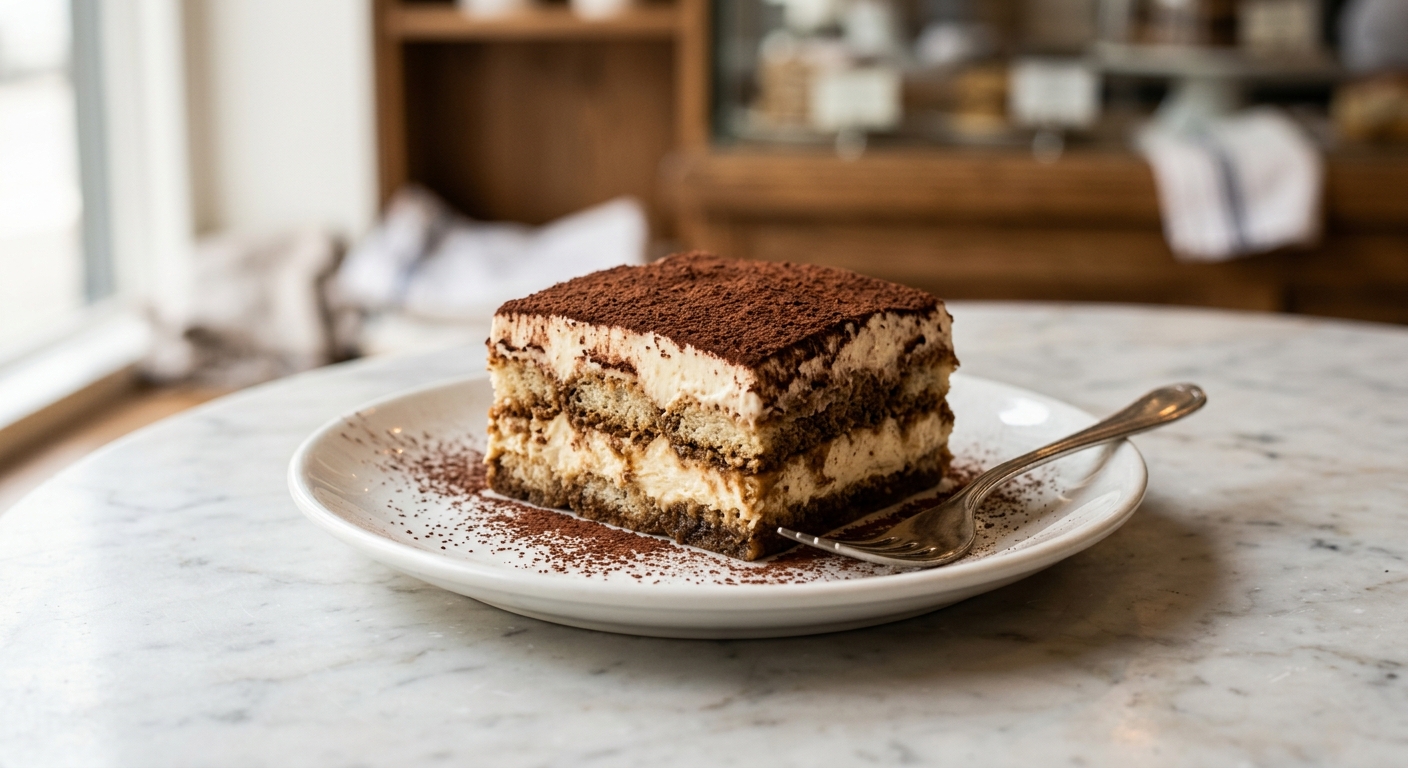
There is a reason tiramisu has never gone out of style. The moment you dip a crisp savoiardo into a shallow pool of espresso, watch it absorb just enough liquid to soften without falling apart, and then layer it beneath a billowing cream of mascarpone and egg yolks, you understand. It is deeply Italian in its restraint – no baking, no complicated technique, just honest ingredients treated with patience and care. The name means “pick me up” in Italian, and between the espresso and the whisper of dark rum, it does exactly that.
What sets this version apart is the zabaglione base. Rather than simply folding raw egg yolks into mascarpone (a shortcut that can taste flat and carries food safety concerns), we whisk the yolks with sugar over a double boiler until they reach a pale, thick, mousse-like consistency. This gentle heat pasteurises the eggs and develops a cooked-custard depth that makes the finished cream taste almost butterscotch-kissed beneath all that coffee. The mascarpone is then folded in by hand, keeping the mixture as light as possible, before being layered with stiffly whipped cream for extra lift and stability.
This recipe sits firmly in the medium difficulty category – not because the technique is complicated, but because it rewards patience. The zabaglione needs your attention at the double boiler, and the assembled tiramisu genuinely needs at least six hours in the refrigerator (overnight is far better) before it reaches its full, sliceable glory. If you have an afternoon and a dinner party tomorrow, this is exactly the dessert to make.
Equipment Needed
Click on an item below to shop for the recommended items for this recipe on Amazon.
As an Amazon Associate, we earn from qualifying purchases.
12
Ingredients
- 6 largeegg yolks, at room temperature
- 150 gcaster sugar (about 3/4 cup), divided
- 500 gmascarpone cheese, cold (about 2 cups plus 2 tbsp)
- 360 mlheavy whipping cream, cold (about 1 1/2 cups)
- 1 tsppure vanilla extract
- 360 mlstrong brewed espresso or very strong coffee, cooled to room temperature (about 1 1/2 cups, roughly 4 to 5 double shots)
- 60 mldark rum or marsala wine (about 1/4 cup), optional
- 300 gsavoiardi ladyfinger biscuits (about 36 to 40 biscuits, one standard 200g and one partial package)
- 25 ghigh-quality unsweetened cocoa powder, for dusting (about 3 tbsp)
- —Pinch of Colima Sea SaltMicroplastic Free Salt
Ingredient Substitutions
Instructions
- Brew your espresso and allow it to cool completely to room temperature. Stir in the rum or marsala wine if using. Pour into a shallow dish wide enough to dip a ladyfinger lengthways. Set aside.
- Make the zabaglione: Set a heatproof bowl over a saucepan with about 5cm (2 inches) of barely simmering water, ensuring the bottom of the bowl does not touch the water. Add the 6 egg yolks, 120g (about 3/5 cup) of the caster sugar, and a pinch of salt to the bowl. Whisk constantly for 8 to 10 minutes until the mixture triples in volume, turns pale yellow, and falls from the whisk in thick, slow ribbons. A thermometer should read 70 to 74°C (158 to 165°F) at this point – this pasteurises the eggs. Remove from heat and let cool for 15 minutes, whisking occasionally.
- Once the zabaglione is just warm (not hot), add the cold mascarpone all at once. Using a large rubber spatula, fold gently until smooth and fully combined. Do not stir vigorously – the mixture should remain thick and airy. Set aside.
- In a separate cold bowl, whip the heavy cream with the remaining 30g (about 2 tbsp) of sugar and the vanilla extract until stiff peaks form. Be careful not to over-whip.
- Fold the whipped cream into the mascarpone-zabaglione mixture in two additions, using slow, sweeping motions from the bottom of the bowl upward. Stop as soon as no white streaks remain. The cream should be voluminous and mousse-like.
- Assemble the first layer: Working quickly, dip each ladyfinger into the espresso mixture for no more than 1 to 2 seconds per side. They should be moist and flavoured but not waterlogged. Arrange them snugly in a single layer in the bottom of a 9×13-inch (23x33cm) dish, breaking pieces to fill any gaps.
- Spoon or spread half the mascarpone cream evenly over the ladyfinger layer, smoothing to the edges with an offset spatula. Repeat with a second layer of dipped ladyfingers, followed by the remaining mascarpone cream.
- Cover the dish tightly with plastic wrap and refrigerate for at least 6 hours, or ideally overnight (up to 24 hours). Just before serving, dust generously with unsweetened cocoa powder through a fine mesh sieve. Slice and serve chilled.
- Brew espresso and cool to room temperature. Stir in rum or marsala if using. Pour into a shallow dish. Prepare the zabaglione and mascarpone cream exactly as described in steps 2 through 5 of the Classic method, then transfer to a piping bag or large zip-lock bag with a corner snipped for easier layering.
- Break each ladyfinger in half crossways. Dip each half-biscuit in the espresso for 1 second per side – shorter than the large dish method because the smaller pieces absorb liquid faster. Place 2 to 3 halves (depending on glass width) flat in the bottom of each glass or cup, breaking further if needed to create an even base.
- Pipe or spoon a generous layer of mascarpone cream (about 3 to 4 tablespoons) over the biscuit layer in each glass, smoothing lightly with a small spoon.
- Add another layer of dipped biscuit halves, then finish with a second layer of mascarpone cream, domed slightly above the rim or level with the top of the glass. Repeat for all 12 servings.
- Cover each glass with plastic wrap, pressing it gently against the surface of the cream to prevent a skin from forming. Refrigerate for at least 6 hours or overnight.
- Remove from the refrigerator 10 minutes before serving. Dust each glass with cocoa powder through a fine mesh sieve, and finish with a chocolate-covered espresso bean or a curl of dark chocolate if desired. Serve immediately.
Nutrition Per Serving
Per 1 serving (makes one 9×13-inch dish, about 12 generous portions)
Why This Recipe Works
The zabaglione step is the heart of this recipe and it is worth understanding why. Whisking egg yolks with sugar over gentle heat does two things simultaneously: it pasteurises the yolks, bringing them above 70°C (158°F) and eliminating food safety concerns, and it creates a foam structure by denaturing the egg proteins while incorporating air. The sugar dissolves into the yolks and, as the mixture heats, the proteins begin to set just enough to trap the air you are whisking in. The result is a stable, mousse-like foam with a deep, almost caramel sweetness that a raw yolk mixture simply cannot replicate. This is the difference between a good tiramisu and an extraordinary one.
Mascarpone is a very high-fat, very soft Italian cream cheese made from cream coagulated with an acid rather than rennet. Its fat content (typically around 70 to 75%) is what gives tiramisu its signature richness and why it holds its shape when sliced. Because it is already so thick, it folds into the zabaglione without deflating it, provided you use a gentle hand. Adding the cold mascarpone to a warm (not hot) zabaglione is important: too hot and the mascarpone will melt and loosen the mixture; too cold and it can cause the zabaglione foam to deflate from the temperature shock.
The 1 to 2 second espresso dip is perhaps the most technical moment in the whole recipe. Savoiardi are deliberately dry and airy, designed to absorb liquid quickly. A dip that is too short leaves a dry, crunchy core that never fully hydrates even after chilling. A dip that is too long results in a waterlogged, mushy slab that cannot support the cream layers. The right dip is quick and confident, leaving the centre of the biscuit just barely moist so that the refrigerator rest completes the hydration evenly throughout. If your espresso is very hot, this process will be faster, which is another reason the coffee must be fully cooled before you begin.
Baker’s Tips
- Use the best espresso you can manage. The flavour of the coffee is the dominant note in this dessert, so a weak or bitter brew will define the finished dish. Freshly pulled espresso or a strong moka pot brew both work beautifully.
- Keep the mascarpone cold until the very moment it is needed. Warm mascarpone becomes loose and greasy and will not hold its shape in the cream.
- Whip the cream to stiff, not just firm, peaks. Under-whipped cream will make the mascarpone layer too soft to slice cleanly. Watch carefully in the final 30 seconds of whipping.
- Do not rush the chilling time. Six hours is the minimum; overnight is ideal. The layers need time to meld, the biscuits need time to fully hydrate, and the cream needs time to firm and become sliceable.
- Dust the cocoa only just before serving. Applied too early, cocoa absorbs moisture from the cream and turns dark and damp-looking rather than a pretty matte finish.
- For cleanest slices, dip a sharp knife in hot water and wipe dry between each cut.
- If your zabaglione looks like it is curdling (streaks of cooked egg appearing), your water was boiling too hard. Pull the bowl off the heat immediately and whisk vigorously – it can usually be rescued if caught early.
Variations
- Chocolate tiramisu: Stir 30g melted dark chocolate (cooled) into the zabaglione before adding the mascarpone, and use chocolate milk or hot chocolate spiked with espresso as the dipping liquid.
- Lemon and limoncello tiramisu: Replace the espresso with limoncello syrup (equal parts limoncello and water with 2 tbsp sugar, heated and cooled), swap rum for more limoncello, and add 1 tsp lemon zest to the mascarpone cream for a bright, summery variation.
- Strawberry tiramisu: Replace espresso with fresh strawberry juice or a strawberry and elderflower syrup. Layer sliced fresh strawberries between the cream layers for a fruity, lighter version perfect in summer.
- Coffee-free version: Use warm chamomile tea sweetened with honey as the dipping liquid, and omit the alcohol. The result is gentle, floral, and surprisingly elegant.
Troubleshooting & FAQ
My mascarpone cream is runny and will not hold its shape.
My ladyfingers turned into a soggy, indistinguishable mush.
The tiramisu is still soft and loose after chilling overnight.
My zabaglione looks grainy or has scrambled bits in it.
Can I make this without alcohol and will it taste good?
Storage & Make-Ahead
- Storage: Cover tightly with plastic wrap and refrigerate for up to 3 days. The texture is best between 12 and 48 hours after assembly. Not suitable for freezing once assembled, as the cream separates and the biscuits become unpleasantly mushy on thawing.
- Make-Ahead: This recipe is purpose-built for making ahead. Assemble up to 24 hours before serving and refrigerate. The mascarpone cream can be prepared up to 8 hours ahead and stored covered in the refrigerator before assembling. Do not dust with cocoa until just before serving.