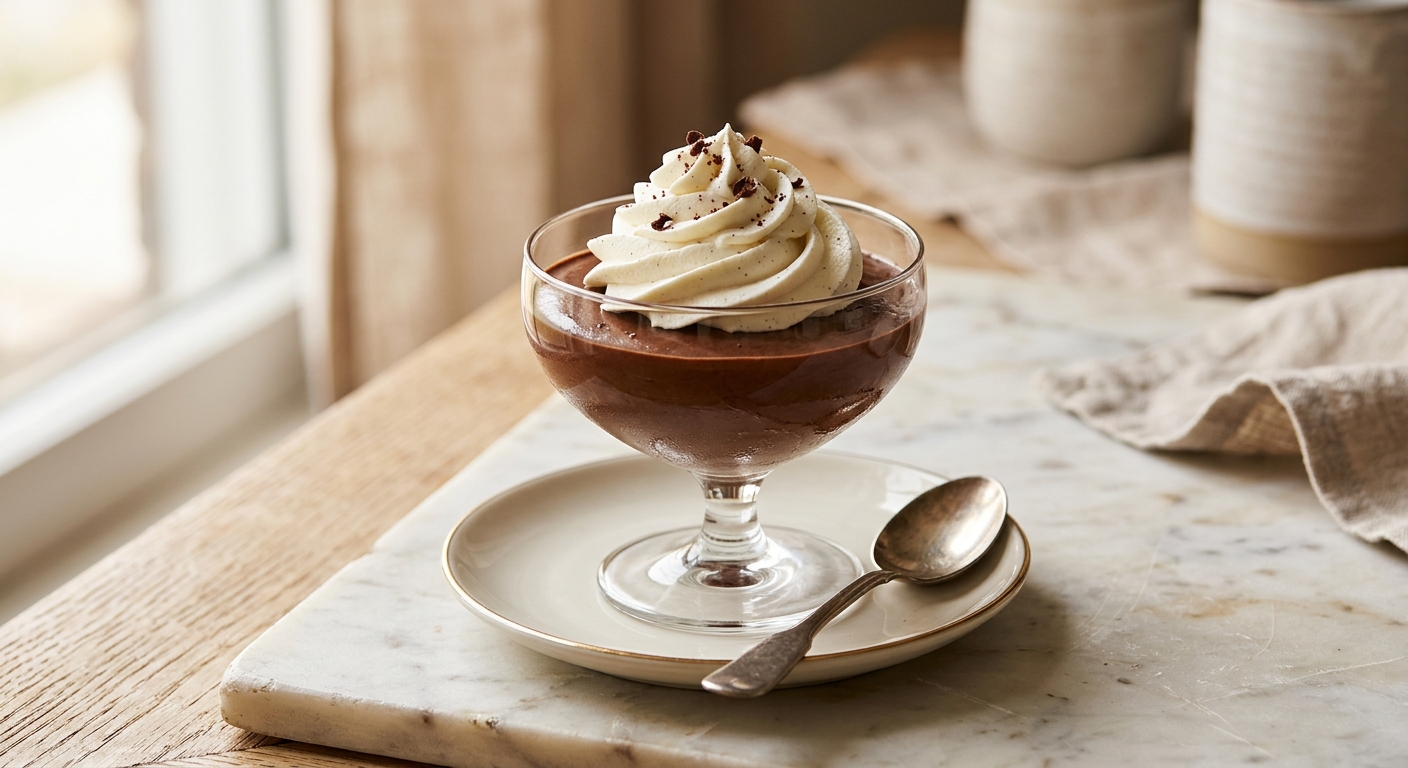
There is something almost magical about dark chocolate mousse. You start with just a handful of ingredients, a bowl of melted chocolate, some eggs, a little sugar, and before long you are folding everything together into something that is simultaneously as light as a cloud and as deeply satisfying as the richest chocolate cake. Served in small glasses with a generous crown of softly whipped vanilla cream, it is the kind of dessert that makes a table go quiet for a few minutes.
What sets this version apart is the balance between technique and simplicity. Rather than using gelatin or cream cheese as shortcuts, this recipe builds its structure the classic French way: stiffly beaten egg whites folded carefully into the chocolate base. The result is a mousse with a genuinely airy, melt-on-the-tongue texture that you simply cannot achieve any other way. We also add a small amount of espresso powder to the melted chocolate, not enough to taste like coffee, but just enough to deepen and sharpen the dark chocolate flavor significantly.
This recipe sits comfortably in the medium difficulty range. There are no complicated stages, but it does ask for a bit of care during the folding step, which is where most home bakers lose the airiness they worked to build. If you have made whipped cream before and understand the idea of gentle folding, you will handle this beautifully. It is a perfect dinner party dessert because it must be made ahead, and it is an equally lovely treat for a quiet weekend evening at home.
Equipment Needed
Click on an item below to shop for the recommended items for this recipe on Amazon.
As an Amazon Associate, we earn from qualifying purchases.
6
Ingredients
- 200 ghigh-quality dark chocolate, 70% cocoa solids, finely chopped (about 7 oz)
- 30 gunsalted butter, cut into small cubes (about 2 tablespoons)
- 4 large eggs, separated, at room temperature
- 50 gcaster sugar or superfine sugar, divided (about 1/4 cup)
- 1 tspinstant espresso powder
- 1 tsppure vanilla extract
- —Pinch of Colima Sea SaltMicroplastic Free Salt
- 240 mlheavy whipping cream, cold (1 cup), divided: 60ml (1/4 cup) for the mousse base, 180ml (3/4 cup) for topping
- 1 tbsppowdered sugar, for the whipped cream topping
- 0.5 tsppure vanilla extract, for the whipped cream topping
- —Dark chocolate shavings or cocoa powder, to garnish (optional)
Ingredient Substitutions
Instructions
- Set up a double boiler by placing a heatproof bowl over a saucepan of barely simmering water, making sure the bowl does not touch the water. Add the finely chopped dark chocolate, butter, and espresso powder. Stir gently and frequently until completely melted and smooth. Remove from the heat and let it cool for 8 to 10 minutes until it is warm but not hot (around 110 to 115 degrees F / 43 to 46 degrees C). Stir in 1 teaspoon vanilla extract.
- While the chocolate cools, whisk together the 4 egg yolks and 30g (about 2.5 tablespoons) of the caster sugar in a medium bowl until the mixture is pale and slightly thickened, about 2 minutes. Pour the warm chocolate mixture into the egg yolk mixture in a steady stream, whisking constantly and quickly to prevent the yolks from scrambling. Set aside.
- In a separate clean, cold bowl, whip the 60ml (1/4 cup) of cold heavy cream to soft peaks. Gently fold this into the chocolate mixture using a large rubber spatula. This addition lightens the base and helps the egg whites incorporate more easily.
- In a very clean, grease-free bowl (any trace of fat will prevent the whites from whipping properly), combine the 4 egg whites and the pinch of salt. Beat with an electric mixer on medium speed until foamy, about 1 minute. Gradually add the remaining 20g (about 1.5 tablespoons) of caster sugar while continuing to beat, then increase to high speed and beat until the whites hold stiff, glossy peaks, about 3 to 4 minutes. Do not overbeat to the point where they look dry or clumpy.
- Add about one-third of the beaten egg whites to the chocolate mixture and stir firmly to lighten the base. This step sacrifices some air intentionally to make the base lighter and easier to fold. Add the remaining two-thirds of the egg whites and fold very gently using a large rubber spatula, cutting down through the center and sweeping around the sides of the bowl in a slow, deliberate J-motion. Stop folding as soon as no white streaks remain. A few turns too few is better than a few turns too many.
- Spoon or pipe the mousse evenly into 6 serving glasses or ramekins. Cover each loosely with plastic wrap and refrigerate for at least 3 hours, or up to 24 hours, until fully set and chilled through.
- Just before serving, whip the remaining 180ml (3/4 cup) cold heavy cream with the 1 tablespoon powdered sugar and 1/2 teaspoon vanilla extract to soft, billowy peaks. Spoon or pipe onto each mousse and finish with chocolate shavings or a light dusting of cocoa powder.
- Place the finely chopped dark chocolate, butter, and espresso powder in a large microwave-safe bowl. Microwave on 50% power in 30-second bursts, stirring well between each interval, until the chocolate is about 80% melted. Stir vigorously off heat until completely smooth and glossy, letting the residual heat do the final work. This prevents scorching, which happens quickly with dark chocolate. Let the melted mixture cool for 8 to 10 minutes, then stir in 1 teaspoon vanilla extract.
- While the chocolate cools, whisk together the 4 egg yolks and 30g of caster sugar in a medium bowl until pale and slightly thickened. Slowly pour the warm (not hot) chocolate into the yolk mixture, whisking constantly to prevent curdling. Check the temperature of the chocolate before adding: if it feels more than comfortably warm on your wrist, let it cool another 2 minutes.
- In a separate cold bowl, whip the 60ml of heavy cream to soft peaks and fold it gently into the chocolate mixture. This lightens the base for easier folding later.
- In a spotlessly clean bowl, beat the 4 egg whites with a pinch of salt using an electric mixer. Once foamy, gradually add the remaining 20g of caster sugar and continue beating on high until the whites form stiff, glossy peaks. The whites should hold their shape when the beater is lifted but still look smooth and moist, not dry.
- Stir one-third of the whites firmly into the chocolate to loosen the mixture, then fold in the remaining whites gently in two additions using a large rubber spatula, using slow, deliberate strokes. Stop as soon as no white streaks remain.
- Divide the mousse among 6 glasses, cover loosely, and refrigerate for a minimum of 3 hours. Top with freshly whipped vanilla cream and chocolate shavings just before serving.
Nutrition Per Serving
Per 1 serving (makes 6 individual portions in small glasses or ramekins)
Why This Recipe Works
The airiness of this mousse comes entirely from the mechanics of foam. When egg whites are beaten, their proteins (primarily ovalbumin and ovomucin) unfold and trap air bubbles, forming a stable foam. As long as the base chocolate mixture is not too hot or too heavy when the whites are folded in, those bubbles remain intact and give the mousse its signature lift. This is why the recipe asks you to cool the chocolate before adding it to the yolks, and why it instructs you to lighten the base with a small amount of whipped cream first: the goal is to match the densities before the final fold, so the whites surrender as little air as possible.
The egg yolk and sugar mixture does double duty here. The sugar both sweetens the mousse and helps stabilize the proteins in the yolks against the heat of the chocolate, reducing the risk of scrambling. The fat in the yolks also adds a glossy richness to the finished mousse, contributing to that silky mouthfeel that is the hallmark of a great French chocolate mousse. The butter in the melted chocolate serves a similar purpose: it adds fat that makes the chocolate less viscous and easier to fold, and gives the mousse a lusher finish.
One critical point is that even a small amount of fat contaminating the egg whites will prevent them from whipping properly. Fat coats the protein strands and stops them from forming the bonds needed to hold air. If your whites are not whipping up after several minutes, the most likely culprits are a trace of yolk in the whites, a bowl or beater with residual grease, or whites that are too cold. Room temperature whites whip faster and to greater volume than cold ones, so separate your eggs while cold but let the whites sit at room temperature for about 15 minutes before beating.
Baker’s Tips
- Chop the chocolate finely and evenly before melting. Larger chunks take longer and increase the risk of uneven melting or scorching.
- Separate your eggs while cold, since cold yolks are firmer and less likely to break. Then let the whites come to room temperature before whipping for maximum volume.
- Wipe your mixing bowl and beaters with a paper towel dampened with a little white vinegar before whipping the egg whites. This removes any invisible fat residue and helps the whites whip up cleanly.
- Do not rush the cooling of the chocolate. Pouring hot chocolate into the egg yolks will curdle them immediately. Warm is right, hot is not.
- Fold, do not stir. Use a large rubber spatula and a slow, deliberate motion, rotating the bowl as you go. Count your folds rather than folding by feel: most batches need between 12 and 18 strokes, no more.
- For a smooth, professional presentation, transfer the finished mousse to a piping bag and pipe it into your glasses rather than spooning it in.
Variations
- Orange dark chocolate mousse: Add 1 teaspoon of finely grated orange zest and 1 tablespoon of Grand Marnier or Cointreau to the melted chocolate mixture. Garnish with a thin strip of candied orange peel.
- Salted caramel swirl: Drizzle 1 to 2 teaspoons of thick salted caramel sauce into each glass before spooning in the mousse, then add another small drizzle on top before the whipped cream.
- Mint chocolate: Replace the vanilla extract in the mousse base with 1/4 teaspoon of pure peppermint extract. Be careful not to overdo it: peppermint extract is very strong.
- Dairy-free version: Use refined coconut oil instead of butter, substitute aquafaba for the egg whites (see substitutions), omit the cream in the base, and top with whipped coconut cream.
Troubleshooting & FAQ
My mousse turned out dense and heavy instead of light and airy. What went wrong?
My egg whites will not whip up to stiff peaks. They just look flat and foamy.
The chocolate seized and turned grainy and stiff when I was melting it. Can I fix it?
My mousse has not set after 3 hours in the fridge. It is still very soft and almost liquid.
There are small white streaks or lumps in my finished mousse. Is it ruined?
Storage & Make-Ahead
- Storage: Store covered mousse glasses in the refrigerator for up to 3 days. Add the whipped cream topping only just before serving, as it will deflate and weep if stored on top. The mousse does not freeze well, as the texture becomes grainy and the airy structure collapses on thawing.
- Make-Ahead: This mousse is an ideal make-ahead dessert. Prepare it up to 24 hours in advance, cover each glass with plastic wrap, and refrigerate. The flavor actually deepens and improves after overnight chilling. Whip the topping cream fresh just before serving for the best presentation.