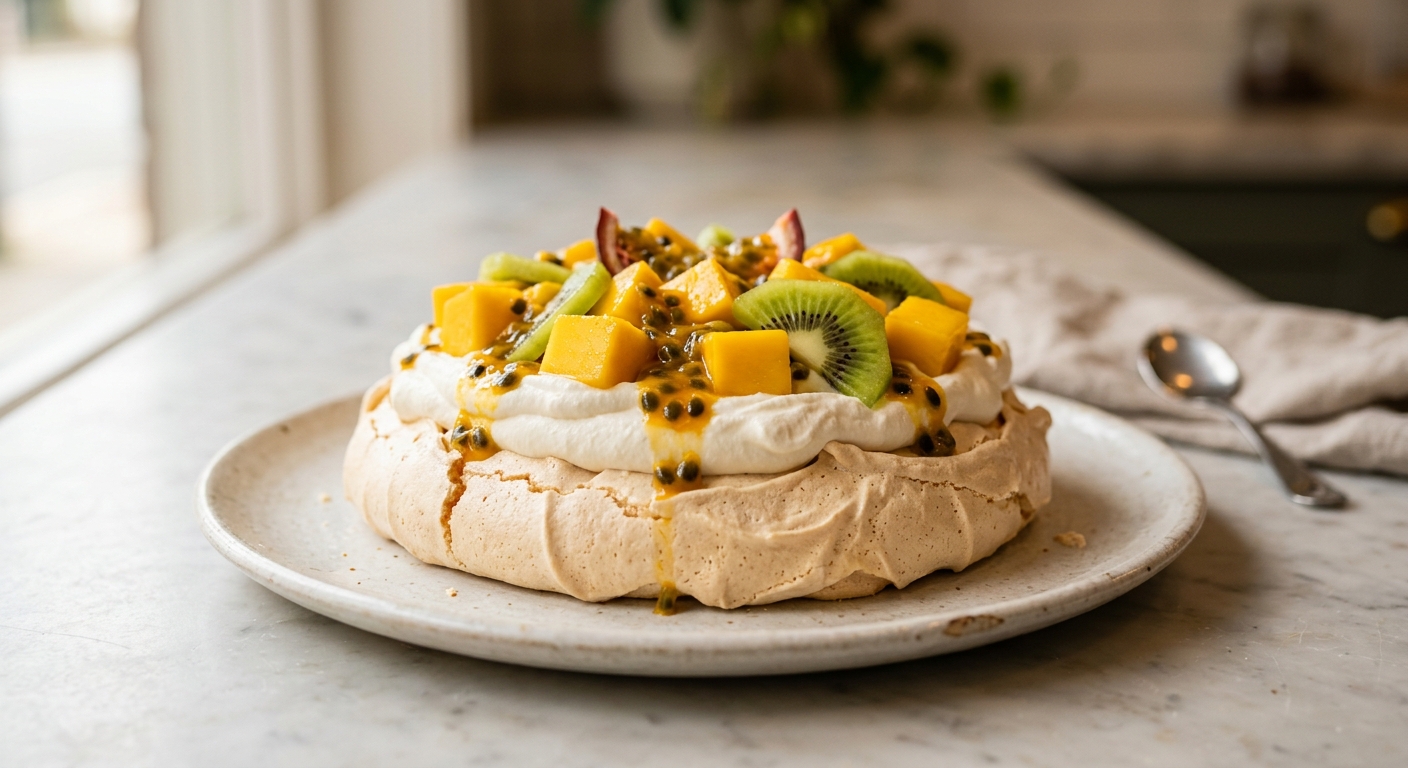
There is something almost magical about pulling a pavlova from the oven. What begins as a glossy white mound of beaten egg whites emerges hours later as a billowing, crackled dome, ivory at the edges and marshmallow-soft within. Pile it high with clouds of whipped cream and then heap on slices of golden mango, tart passionfruit pulp, and bright green kiwi, and you have a dessert that looks like it belongs on the cover of a magazine, tastes like a summer holiday, and costs surprisingly little to make.
What sets this version apart is the addition of a small amount of cornstarch and white vinegar to the meringue, a technique borrowed from the original Australian and New Zealand tradition. The cornstarch stabilizes the egg white foam and helps the interior stay gloriously chewy and marshmallow-like rather than drying all the way through. The vinegar reacts with the egg whites to strengthen the protein network, giving you a shell that holds its shape without collapsing. The coconut whipped cream, made simply by whipping cold heavy cream with a spoonful of toasted coconut flakes and a splash of coconut extract, ties the whole tropical theme together without overwhelming the delicate meringue beneath.
Despite looking dramatic, pavlova sits firmly in the medium-difficulty category. There are a few important rules to follow (dry bowl, room-temperature whites, patient folding), but none of them are beyond a careful home baker. This recipe is perfect for anyone who wants to impress guests at a dinner party, celebrate a special occasion during warmer months, or simply try their hand at one of the great classic meringue desserts of the Southern Hemisphere.
Equipment Needed
Click on an item below to shop for the recommended items for this recipe on Amazon.
As an Amazon Associate, we earn from qualifying purchases.
10
Ingredients
- Cream
- 6 largeegg whites, at room temperature (about 210g)
- 300 gcaster sugar (superfine sugar, about 1.5 cups)
- 2 tspcornstarch (cornflour)
- 1 tspwhite wine vinegar or white vinegar
- 1 tsppure vanilla extract
- —Pinch of Colima Sea SaltMicroplastic Free Salt
- 480 mlheavy whipping cream, very cold (about 2 cups)
- 2 tbspicing sugar (powdered sugar), sifted
- 0.5 tsppure coconut extract
- 2 tbsptoasted shredded coconut
- 1 largeripe mango, peeled and thinly sliced (about 200g fruit)
- 3 mediumkiwi fruit, peeled and sliced into rounds
- 4 mediumripe passionfruit, pulp scooped out
- Garnish (about 3 Tbsp)
- 30 gtoasted shredded coconut
- Garnish (optional)
- —Fresh mint leaves
Ingredient Substitutions
Instructions
- Position a rack in the lower third of your oven and preheat to 250°F (120°C). Line a large baking sheet with parchment paper. Using a 9-inch round cake pan or plate as a guide, trace a circle on the parchment, then flip the paper over so the pencil mark faces down. You will be able to see it through the paper.
- Make sure your bowl and whisk attachment are completely clean and grease-free. Even a trace of fat will prevent the egg whites from whipping properly. Wipe them down with a little white vinegar on a paper towel to be safe. Add the room-temperature egg whites and a pinch of fine sea salt to the bowl of a stand mixer. Whip on medium speed until the whites form soft, foamy peaks, about 2 to 3 minutes.
- Increase the speed to medium-high. Begin adding the caster sugar one heaped tablespoon at a time, waiting about 20 seconds between each addition. This slow addition is critical: it allows the sugar to fully dissolve into the egg white foam rather than sitting on top of it. Once all the sugar is added, continue whipping on high speed for 5 to 7 minutes until the meringue is very thick, glossy, and bright white. To test if the sugar has dissolved, rub a small amount between your fingers. It should feel completely smooth, with no gritty sugar crystals.
- Remove the bowl from the mixer. Sift the cornstarch over the meringue and add the vinegar and vanilla extract. Using a large spatula, fold these in gently with 8 to 10 deliberate strokes. You want to incorporate them without deflating the foam. A few streaks are fine.
- Pile the meringue onto the prepared parchment within the traced circle. Use the back of a large spoon to shape it into a thick disc with slightly raised edges and a slight well in the center. The raised edges will help hold the cream and fruit later. Do not worry about making it perfectly smooth. A rustic, textured surface is beautiful and characteristic of pavlova.
- Bake in the preheated oven for 1 hour and 15 minutes. The pavlova should look dry and set at the surface and feel firm (not wet or sticky) when you lightly touch the top. It will have taken on a very pale ivory color. Turn the oven off, leave the door closed, and let the pavlova cool completely inside the oven for at least 2 hours, or ideally overnight. This slow cooling prevents cracking from a sudden temperature change. Some cracking on the surface is completely normal and adds to the charm.
- When ready to serve, whip the cold heavy cream, icing sugar, and coconut extract together in a chilled bowl using a hand mixer or stand mixer, starting on medium and increasing to high. Whip to medium-stiff peaks, about 2 to 3 minutes. Fold in the toasted coconut. Carefully transfer the cooled pavlova shell to a serving plate or cake stand. Spoon the coconut whipped cream into the center well, spreading it gently. Arrange the mango slices, kiwi rounds, and passionfruit pulp over the cream. Scatter with toasted coconut flakes and mint leaves if using. Serve immediately once assembled.
- Purchase 8 to 10 individual store-bought meringue nests (approximately 200g total). Place them in a large zip-lock bag and crush them gently with your hands or a rolling pin into a mix of large chunks and fine crumbles. You want a variety of textures, not a fine powder.
- In a large chilled bowl, combine the cold heavy cream (480ml), 2 tbsp sifted icing sugar, and the coconut extract. Whip with a hand mixer on medium-high speed to medium-stiff peaks, about 2 to 3 minutes. Fold in the toasted coconut.
- Prepare all the fruit: slice the mango, peel and slice the kiwi into rounds, and scoop out the passionfruit pulp. In a small bowl, gently toss the mango and kiwi with the passionfruit pulp to create a simple tropical fruit salad.
- To assemble individual glasses (a beautiful option for dinner parties): layer crushed meringue pieces in the bottom of each glass or bowl, spoon in a generous amount of coconut whipped cream, and top with a heap of the tropical fruit mixture. Add another small scattering of meringue pieces on top for crunch, then a final drizzle of any passionfruit juice from the bowl. Scatter with toasted coconut and mint.
- Alternatively, spread the whipped cream onto a large platter, scatter over the meringue pieces, pile on the tropical fruit, and serve family-style for a showstopping centrepiece. Serve immediately as the meringue pieces will begin to soften within 30 minutes of assembly.
Nutrition Per Serving
Per 1 serving (makes one 9-inch pavlova, serving 8 to 10)
Why This Recipe Works
The magic of pavlova depends entirely on understanding what happens to egg whites when you whip them. As the whisk forces air into the liquid whites, the proteins (primarily ovomucin and ovalbumin) unfold and re-form around the air bubbles, creating a stable foam. Adding sugar gradually, one spoonful at a time, allows the sugar to dissolve into the aqueous film surrounding each bubble, creating a thick, syrupy matrix that makes the foam incredibly stable and gives the finished meringue its characteristic gloss. If you add all the sugar at once, the crystals weigh down the foam before it has a chance to develop structure, and you risk a grainy or weeping meringue.
The cornstarch and vinegar are the two ingredients that transform a standard meringue into a true pavlova. Cornstarch coats the egg white proteins and slows down their bonding during baking, which prevents the interior from setting all the way through. The result is that chewy, almost sticky marshmallow center that distinguishes pavlova from a dry, crisp meringue. The vinegar (or any acid) strengthens the protein bonds that form the cell walls of the foam, giving the meringue greater stability and helping the shell hold its dome shape without collapsing inward. The low oven temperature (250°F / 120°C) is equally important: you are not really baking the meringue so much as gently drying it out. High heat would cause the sugar to caramelize, weaken the protein structure, and cause the meringue to weep liquid sugar.
If your pavlova weeps beads of liquid sugar from the surface during or after baking, the most likely culprit is undissolved sugar. Always test the meringue between your fingers before shaping. If you bake on a humid day, the meringue may absorb moisture from the air and become sticky on the outside. This does not affect the flavor at all, and once it is covered in cream and fruit, no one will notice. A gentle crack across the top during the cooling phase is completely normal and is caused by the slight contraction of the outer shell as it cools. Embrace it as part of the character of a handmade pavlova.
Baker’s Tips
- Separate your eggs while they are cold (the yolk is firmer and less likely to break), but let the whites come to room temperature for 30 minutes before whipping. Room-temperature whites whip to a greater volume than cold ones.
- Even a single drop of egg yolk in your whites will prevent them from whipping properly, as fat breaks down the foam. If a yolk breaks, fish it out with a clean piece of shell or start fresh.
- Humidity is the enemy of meringue. Avoid making pavlova on rainy or very humid days if possible. A dry day gives you the crispest shell.
- Do not skip the step of wiping your bowl and whisk with white vinegar. Any trace of grease from previous use will deflate your egg whites before they have a chance to foam.
- Shape the meringue with slightly higher, thicker edges than the center, like a shallow volcano. This creates a natural well that holds the cream and fruit without it spilling over the sides.
- Always assemble the pavlova just before serving. The moment cream touches the meringue, the shell begins to soften. The contrast of crisp shell against soft interior and cool cream is the whole point.
Variations
- Passionfruit curd base: Instead of plain whipped cream, spread a thin layer of homemade or store-bought passionfruit curd across the base of the pavlova before adding the whipped cream. It adds a concentrated burst of tropical tartness.
- Berry pavlova: Replace all the tropical fruit with 400g of mixed berries (strawberries, raspberries, blueberries) and swap the coconut extract for 1 tsp of vanilla. Omit the toasted coconut and use a little lemon zest in the cream instead.
- Mini individual pavlovas: Divide the meringue mixture into 10 equal mounds on parchment-lined baking sheets, shaping each one into a small nest with a well in the center. Reduce the bake time to 45 to 55 minutes at the same temperature. These are perfect for dinner parties as no slicing is required.
- Chocolate swirl pavlova: Sift 2 tbsp of good-quality cocoa powder and gently marble it through the finished meringue with a skewer just before shaping. The bitterness of the cocoa pairs beautifully with the tropical fruit.
Troubleshooting & FAQ
My meringue is weeping or beading liquid sugar on the surface. What went wrong?
My pavlova collapsed completely after coming out of the oven. What happened?
The inside of my pavlova is completely dry and crisp, not chewy and marshmallow-like. How do I get that soft center?
My egg whites are not whipping up properly and look flat and grainy. What went wrong?
My pavlova cracked badly on top. Is it ruined?
Storage & Make-Ahead
- Storage: Store the undecorated meringue shell in an airtight container or a large bowl covered tightly with plastic wrap at room temperature for up to 2 days. Do not refrigerate the bare shell, as humidity will cause it to become soft and sticky. Once assembled with cream and fruit, pavlova must be served immediately and does not store well. Leftovers can be refrigerated for up to 1 day but the meringue will soften significantly.
- Make-Ahead: The meringue shell is an ideal make-ahead component. Bake it the day before, cool it in the oven overnight, and store it at room temperature in an airtight container. The coconut whipped cream can be whipped up to 4 hours ahead and kept refrigerated, covered. The fruit can be prepped and sliced up to 2 hours ahead, kept covered in the refrigerator. Assemble just before serving for the best texture contrast.