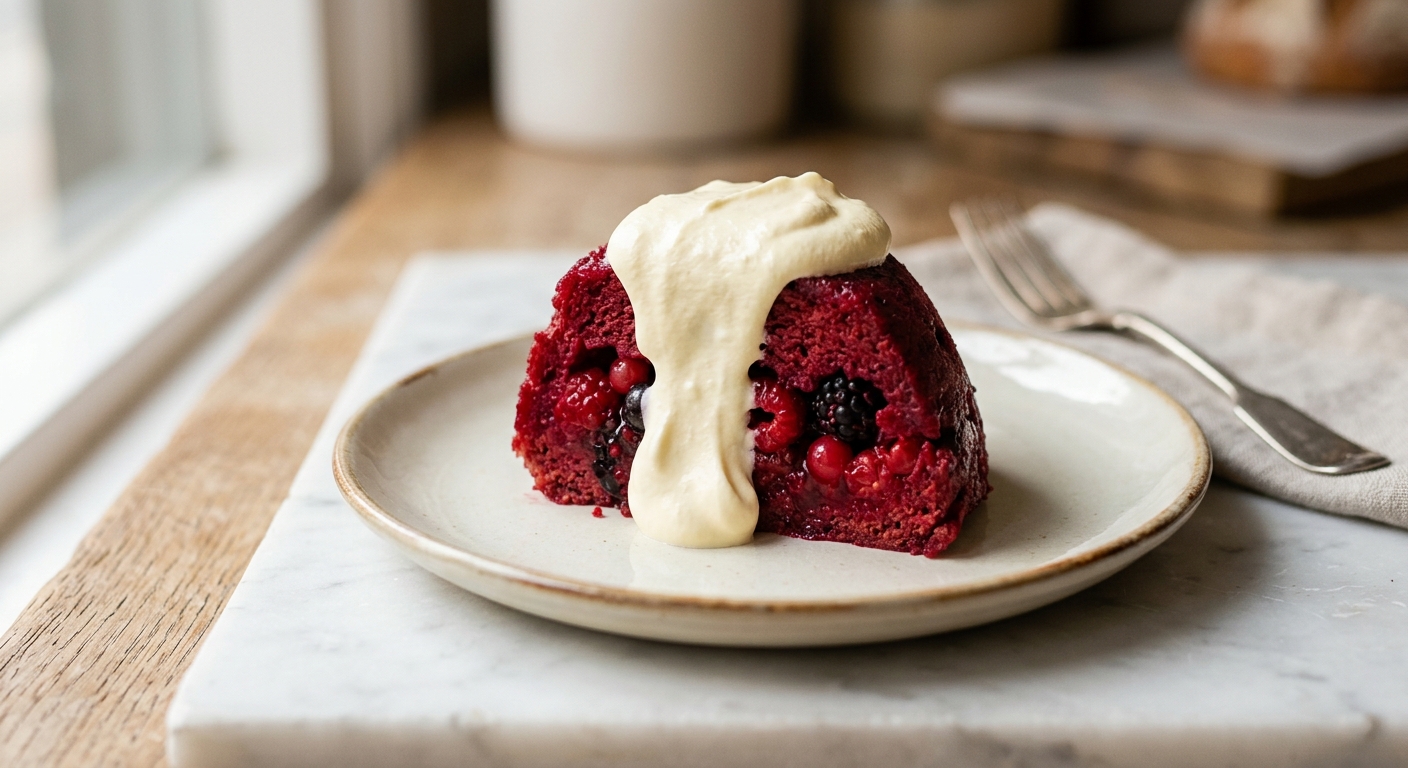
There is something almost magical about summer pudding. You take the most humble of ingredients, a loaf of white bread and a glut of ripe summer berries, press them together in a pudding basin, and leave them overnight. Come the next morning, what you unmould onto the plate looks like it belongs in the window of a Mayfair patisserie: a deep crimson dome glistening with berry juices, not a scrap of pale bread visible beneath its stained, jewelled surface. It is one of the great acts of kitchen alchemy, and it has been a beloved fixture of the British summer table since at least the late nineteenth century.
What sets this version apart is a careful balance of berries and a brief, gentle cook that draws out maximum flavour and colour without turning the fruit to mush. We use a combination of raspberries, redcurrants, blackcurrants, and strawberries. The redcurrants and blackcurrants are non-negotiable: their high pectin content gives the pudding enough body to hold a clean slice, and their sharpness cuts through the sweetness of the raspberries and strawberries beautifully. A splash of crème de cassis deepens the colour to an almost inky red and adds a sophisticated, winelike richness that you would never quite be able to identify but would always miss if it were absent.
This is a medium-difficulty recipe in the sense that it requires patience rather than technical skill. There is no baking, no custard-making, no thermometers. The hardest part is waiting. It is perfect for confident beginners who want to impress, for keen bakers looking for a break from the oven in hot weather, and for anyone hosting a summer lunch or dinner party who wants a centrepiece dessert that is entirely prepared the day before and requires nothing more than a confident unmoulding at the table.
Equipment Needed
Click on an item below to shop for the recommended items for this recipe on Amazon.
As an Amazon Associate, we earn from qualifying purchases.
8
Ingredients
- 900 gmixed summer berries: raspberries, redcurrants, blackcurrants, and hulled strawberries (fresh or frozen; see note on frozen below)
- 150 gcaster sugar (about 3/4 cup), plus more to taste
- 3 tbspcrème de cassis (blackcurrant liqueur) or blackcurrant cordial for an alcohol-free version
- 2 tbspwater
- 10 slicesgood-quality white sandwich bread, crusts removed (about 400g / 14 oz), ideally one day old
- —Lightly whipped double cream or crème fraîche, to serve
Ingredient Substitutions
Instructions
- Separate your berries by type. Place the blackcurrants, redcurrants, and halved strawberries in a medium saucepan with the caster sugar and 2 tablespoons of water. Set over a medium-low heat and stir gently for 3 to 4 minutes, just until the sugar dissolves and the berries begin to release their juices. Do not allow the mixture to boil vigorously. Add the raspberries and crème de cassis, stir gently for 1 more minute, then remove from the heat immediately. Taste and add a little more sugar if needed. The mixture should be sharply fruity with a good balance of sweetness. Pour into a bowl and leave to cool for 15 minutes.
- While the berry mixture cools, line a 1.2-litre pudding basin with two overlapping layers of cling film, leaving at least 10cm of overhang all around the rim. This overhang will be used to cover and press the pudding. The cling film lining is essential for clean unmoulding.
- Trim your bread slices to fit the basin. Cut one round from a slice to fit the base of the basin precisely. Cut the remaining slices into fingers roughly 6 to 7cm wide. Dip each piece briefly into the juice in the berry bowl, just long enough to colour the bread on both sides, then use them to line the basin, overlapping slightly and pressing the edges together firmly so there are no gaps. Reserve enough bread for the lid.
- Spoon the berry mixture into the lined basin, pressing it down lightly to eliminate air pockets. Spoon over any remaining juices from the bowl. Reserve 3 to 4 tablespoons of the juice in a small bowl and refrigerate it separately. You will use this to patch any pale spots after unmoulding. Place the remaining bread slices on top to form a lid, trimming to fit snugly. Fold the cling film overhang over the top.
- Set a small plate or saucer that fits just inside the rim of the basin directly on top of the cling film-covered bread lid. Place a 400g tin or similar weight on top of the plate. This even pressure is what compacts the pudding and ensures the bread becomes fully saturated. Refrigerate for a minimum of 8 hours, and up to 24 hours.
- To unmould, remove the weight and plate. Unfold the cling film from the top. Place a large flat serving plate face-down over the basin, then, holding both plate and basin firmly together, invert in one confident motion. Lift the basin away and peel off the cling film. If any pale bread patches are visible, dab with the reserved juice using a pastry brush or spoon. Serve immediately, sliced into wedges at the table, with generous pours of lightly whipped double cream or spoonfuls of crème fraîche.
- Combine the blackcurrants, redcurrants, halved strawberries, caster sugar, and 2 tablespoons of water in a large microwave-safe bowl. Cover loosely with a microwave-safe plate or cling film pierced with a few holes. Microwave on High (100%) for 3 minutes. Remove, stir gently, then add the raspberries and crème de cassis.
- Return to the microwave and cook on High for a further 1 minute. The berries should be softened and swimming in vivid juice. The redcurrants should have burst and collapsed. Taste carefully (the mixture will be very hot) and adjust sweetness. Leave to cool for 20 minutes, stirring once or twice.
- Line your 1.2-litre pudding basin with two overlapping layers of cling film, leaving at least 10cm of overhang all around the rim. Trim your bread slices: one round for the base and fingers for the sides, dipping each briefly in the berry juices before pressing into the basin. Ensure there are no gaps between the bread pieces.
- Fill the basin with the berry mixture, pressing down gently. Spoon over any remaining juice from the bowl. Reserve 3 to 4 tablespoons of the juice in a small container and refrigerate. Cover with the bread lid and fold over the cling film overhang.
- Place a small saucer and a 400g weight on top. Refrigerate for a minimum of 8 hours. Unmould onto a serving plate, patch any pale spots with the reserved juice, and serve in wedges with cold cream or crème fraîche.
- Cook the berry mixture using either the stovetop or microwave method described above. Allow to cool for 15 minutes. Line eight 150ml ramekins or dariole moulds with cling film, leaving overhang on all sides.
- Using a round cutter or the rim of a glass, stamp out circles of bread to fit the base of each mould. Cut additional strips to line the sides, dipping each piece in the berry juice before pressing into place. Overlap the strips slightly and press the seams firmly so there are no gaps.
- Divide the berry mixture evenly among the lined moulds, pressing down gently. Spoon over extra juice to ensure the bread is well saturated. Cut circles to fit the top of each mould as a lid. Fold the cling film overhang over each lid.
- Set a small flat tray over the moulds and place a weight such as a heavy baking dish on top to apply even pressure across all eight. Alternatively, press each mould individually with a small weight. Refrigerate for a minimum of 4 hours.
- To serve, unfold the cling film, invert each ramekin onto an individual plate, and peel away the cling film. Dab any pale patches with reserved juice. Garnish with a few fresh berries and a small sprig of mint, and serve immediately with cream or crème fraîche poured at the table.
Nutrition Per Serving
Per 1 serving (makes one 1.2-litre pudding basin, serving 8)
Why This Recipe Works
The genius of summer pudding lies in osmosis and staling. Day-old bread (rather than fresh) has lost some of its internal moisture, which means it acts like a sponge: when pressed against the warm, juice-laden berries, it draws the liquid in eagerly and deeply. The juice replaces the air and moisture in the bread’s gluten network, and as the pudding chills overnight, the structure sets around the fruit in a way that fresh bread, still full of its own moisture, simply cannot replicate. This is why the recipe insists on bread that is at least a day old and why overnight pressing is non-negotiable.
The inclusion of redcurrants and blackcurrants is not just about flavour. Both fruits are exceptionally high in pectin, the naturally occurring polysaccharide found in fruit cell walls that causes jams and jellies to set. When the berries are briefly heated with sugar, pectin is released into the juice. As the pudding cools and rests under pressure, this pectin-rich liquid gels slightly, binding the bread into a cohesive, sliceable mass. If you use only low-pectin fruits like strawberries or raspberries, the pudding will be soft, wet, and difficult to unmould without it collapsing. The rule of thumb is to ensure that at least a third of your berry weight comes from currants.
If your pudding does not unmould cleanly, resist the urge to panic. Pale patches of bread are easily concealed with the reserved juice. If the pudding has not set firmly enough to hold its shape, it was likely not pressed for long enough, the bread was too fresh, or the currant ratio was too low. It will still taste wonderful served in deep bowls with extra cream. Conversely, if the pudding is very dense and dry in the centre, the berry mixture was not juicy enough: next time, add an extra tablespoon of water during cooking and be more generous when dipping the bread.
Baker’s Tips
- Do not skip the step of lining the basin with cling film. Without it, unmoulding is a genuinely stressful exercise and the risk of the pudding sticking or tearing is high.
- Press the bread pieces against the sides of the basin firmly and overlap the edges generously. Any gap, however small, is a weak point where the berry filling can escape during unmoulding.
- Reserve your juice. Always set aside 3 to 4 tablespoons of berry juice in a small bowl before assembling. It is your insurance policy against any pale bread patches on the finished pudding.
- Use a confident, decisive flip when unmoulding. Hesitation causes the pudding to shift inside the basin. Place the plate firmly on top, grip the plate and basin together with both hands, and invert in one smooth motion.
- The pudding will look more vivid and dramatic if you ensure the bread pieces dipped in juice are arranged so the coloured side faces outward against the cling film, as that is what the diner sees when it is unmoulded.
- Serve the cream cold and only lightly whipped or simply poured. The contrast between the cold, sharp, intensely fruity pudding and cool cream is the whole point. Over-sweetened or heavily whipped cream will compete rather than complement.
Variations
- Autumnal version: Replace the summer berries with 500g blackberries, 250g plums (stoned and quartered), and 150g elderberries for a deeply flavoured late-season pudding. Increase the stovetop cooking time by 3 to 4 minutes to soften the plums.
- Boozy adult version: Replace the crème de cassis with 3 tbsp ruby port or sloe gin for a richer, more complex flavour suited to a dinner party setting.
- Honey and rose variation: Substitute half the caster sugar with light floral honey and add 1 tsp rosewater to the berry mixture off the heat. Pair with thick Greek yogurt instead of cream.
Troubleshooting & FAQ
My pudding fell apart when I unmoulded it. What went wrong?
There are pale, uncoloured patches of bread on my finished pudding. How do I fix this?
The inside of my pudding is still pale and dry even though the outside looks fine. Why?
Can I make this with only strawberries and raspberries? I cannot find currants.
My berry mixture tastes very sharp and acidic. Is that normal?
Storage & Make-Ahead
- Storage: Cover the unmoulded pudding loosely with cling film and refrigerate for up to 2 days. The texture softens further as it sits, which many people prefer. Do not freeze a fully assembled and set pudding, as the bread becomes waterlogged and loses all structure on thawing. You can, however, freeze the cooked berry mixture alone for up to 3 months and assemble fresh.
- Make-Ahead: This dessert is designed to be made ahead and actually improves with time. Assemble up to 24 hours before serving for the best flavour and firmest set. The cooked berry mixture can be prepared up to 2 days in advance and stored, covered, in the refrigerator before assembly.