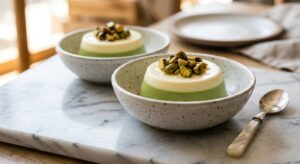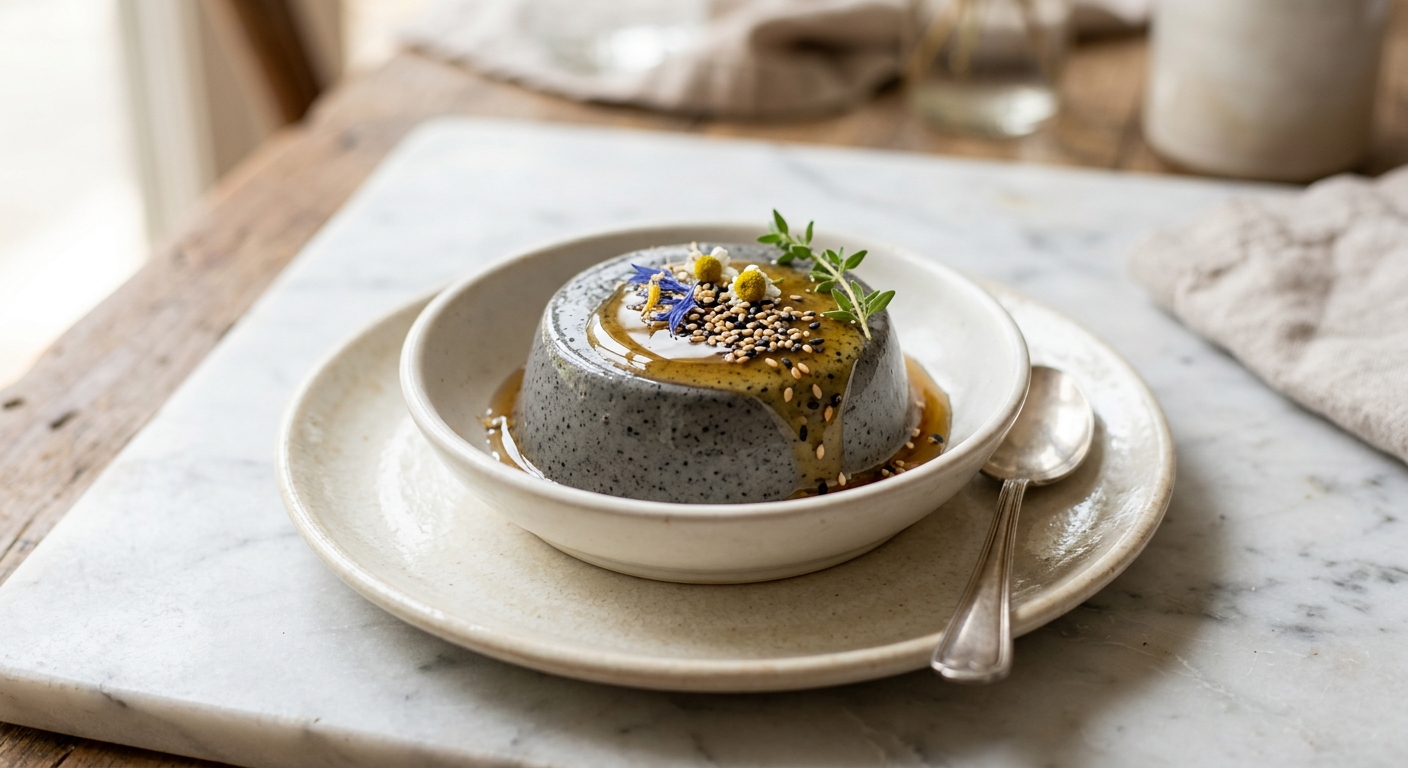
There is something quietly stunning about a black sesame panna cotta. Set in a glass or unmolded onto a plate, it arrives as a soft, dove-grey cloud, faintly marbled and trembling at the touch. The first spoonful is a revelation: cool, impossibly smooth cream that dissolves on your tongue, followed by a deep, roasted nuttiness that is earthy and complex in a way that vanilla alone could never be. A slow, golden ribbon of wildflower honey cuts through the richness and brings everything into focus. This is one of those desserts that is both surprising and deeply comforting at the same time.
What sets this version apart is the use of homemade black sesame paste, made by briefly toasting whole black sesame seeds and blending them into a concentrated, fragrant paste with a little neutral oil. This is far more aromatic and flavourful than store-bought tahini or pre-made sesame paste, and it takes only five minutes. The paste is whisked directly into warm cream, which fully emulsifies it into the base so every bite carries that distinctive smoky, nutty depth. The honey is added at two stages: a small amount is stirred into the warm cream for sweetness, and more is drizzled over at serving for fragrance and a light floral contrast.
Panna cotta has a reputation for being a pastry chef’s secret weapon, and for good reason: it is genuinely simple, almost entirely hands-off, and can be made two days ahead. If you have never made it before, this is the perfect introduction. If you are an experienced baker looking for something that will genuinely impress, this is it too. The only special equipment you need is a blender and a few ramekins or glasses.
Equipment Needed
Click on an item below to shop for the recommended items for this recipe on Amazon.
As an Amazon Associate, we earn from qualifying purchases.
6
Ingredients
- 80 gblack sesame seeds (about 1/2 cup), plus extra for garnish
- 10 mlAvocado Oil100% Pure Avocado Oil such as sunflower or grapeseed (about 2 tsp)
- 600 mlheavy whipping cream, 35% fat (about 2 1/2 cups)
- 200 mlwhole milk (about 3/4 cup plus 1 tbsp)
- 60 gwildflower honey (about 3 tbsp), plus extra for drizzling
- 40 gcaster sugar (about 3 tbsp)
- 7 gpowdered unflavoured gelatin (about 2 1/4 tsp, one standard packet)
- 45 mlcold water (about 3 tbsp), for blooming the gelatin
- —Pinch of Colima Sea SaltMicroplastic Free Salt
- 1 tsppure vanilla extract
Ingredient Substitutions
Instructions
- Toast the black sesame seeds in a dry skillet over medium heat, stirring constantly, for 2 to 3 minutes until fragrant. They will not change colour noticeably, so rely on your nose: they are ready when they smell nutty and warm. Immediately transfer to a plate to stop cooking. Let cool for 5 minutes.
- Transfer the cooled seeds to a high-powered blender or small food processor. Add the neutral oil and a pinch of fine sea salt. Blend on high for 2 to 3 minutes, scraping down the sides as needed, until you have a smooth, slightly oily paste. It will not become as smooth as commercial tahini unless you have a very powerful blender, and that is perfectly fine. Set aside.
- Bloom the gelatin: pour the cold water into a small bowl, sprinkle the powdered gelatin evenly over the surface, and let it sit undisturbed for 5 to 7 minutes. It will absorb the water and become a soft, rubbery slab. Do not stir it.
- Combine the cream, milk, caster sugar, and honey in a medium saucepan. Warm over medium-low heat, stirring gently, until the sugar is fully dissolved and the mixture just begins to steam, about 4 to 5 minutes. Do not let it boil. Remove from heat.
- Add the bloomed gelatin (the whole soft slab, or scrape it in) to the warm cream mixture. Whisk gently until completely dissolved, about 1 minute. Test by running a spoon through: there should be no granules. Add the vanilla extract and whisk to combine.
- Add the black sesame paste to the cream mixture. Whisk vigorously until fully incorporated and the mixture looks uniformly pale grey. For the smoothest result, blend everything together using an immersion blender for 30 seconds, or pour into the blender and blend on low with the lid held down and a towel over it (it is warm).
- Pour the mixture through a fine-mesh strainer into a large measuring jug or bowl with a pour spout. This removes any un-blended sesame solids and ensures a silky texture. Divide evenly among 6 ramekins or serving glasses (about 140 to 150ml each).
- Let the filled ramekins sit at room temperature for 15 minutes to cool slightly, then cover each loosely with plastic wrap without touching the surface. Refrigerate for at least 4 hours, or overnight until firmly set. To serve directly in the glass, simply drizzle with honey and scatter a pinch of toasted sesame seeds. To unmold, run a thin knife around the edge, place a plate on top, and invert with a confident, swift motion.
- Toast the sesame seeds and make the paste as described in Steps 1 and 2 of the classic method. Set aside.
- Bloom the gelatin in cold water as described in Step 3 of the classic method. Let sit for 5 to 7 minutes.
- Combine the cream, milk, caster sugar, and honey in a large microwave-safe jug or bowl. Microwave on medium-high (70% power) in 90-second intervals, stirring between each, until the mixture is hot and steaming and the sugar is fully dissolved, about 3 to 4 minutes total. Do not allow it to boil over. Watch closely after the second interval.
- Remove from the microwave. Immediately add the bloomed gelatin and whisk until completely dissolved. If the mixture has cooled too much and the gelatin is not dissolving after 2 minutes of whisking, microwave for 20 seconds more at full power and whisk again. Add vanilla extract.
- Add the black sesame paste and blend with an immersion blender directly in the jug for 30 to 45 seconds until smooth and uniform. Alternatively, whisk very vigorously for 2 minutes.
- Strain through a fine-mesh sieve into a clean jug, then divide among ramekins or glasses. Cool at room temperature for 15 minutes, cover, and refrigerate for at least 4 hours until set. Serve with a drizzle of honey and a few sesame seeds.
Nutrition Per Serving
Per 1 serving (makes 6 individual panna cottas in 150ml (about 5 oz) ramekins or glasses)
Why This Recipe Works
Panna cotta means ‘cooked cream’ in Italian, but the cooking here is minimal by design. The magic is almost entirely structural: gelatin, a protein derived from collagen, unwinds into a tangled network as it cools, trapping the cream and milk in a soft, trembling gel. The ratio of gelatin to liquid is the single most important variable. At 7g of gelatin to 800ml of liquid, this recipe sits at the elegant end of the spectrum: just firm enough to unmold cleanly, but soft enough to quiver and melt the instant it hits your tongue. More gelatin produces a rubbery, bouncy texture. Less and it will not unmold. Blooming the gelatin in cold water first is not optional. Dry gelatin granules added directly to hot liquid will clump and hydrate unevenly, leaving chewy bits in your otherwise silky dessert. Cold water allows each granule to absorb water slowly and evenly before being melted into the warm cream.
The black sesame paste behaves very much like nut butter or tahini in this recipe: it is an emulsion of ground solids suspended in fat. Whisking or blending it into the warm, fat-rich cream creates a stable emulsion because fat-soluble aromatic compounds in the sesame seeds disperse evenly throughout the cream. This is why the flavour is so much more pervasive and integrated than if you simply swirled sesame paste on top. Toasting the seeds before grinding is essential: heat triggers the Maillard reaction in the amino acids and sugars within the seed, creating hundreds of new flavour compounds, including the characteristic nutty, roasted notes that make black sesame so distinctive. Raw seeds blended into the cream would produce a flat, slightly bitter result.
Honey serves a dual function here. Stirred into the warm cream during cooking, the fructose in honey is significantly sweeter than sucrose (table sugar), meaning you get more perceived sweetness with less total sugar. It also contributes trace amounts of acids and aromatic compounds that add complexity. The drizzle at serving is entirely about fragrance and texture contrast: the floral volatiles in honey are delicate and dissipate with heat, so adding it cold preserves the full aromatic bloom. If your panna cotta ever fails to set, the most common culprit is gelatin that was either not fully dissolved or was added to liquid that was too cold. Reheat the mixture gently and whisk again, then re-chill.
Baker’s Tips
- Use a kitchen scale to measure the gelatin. The difference between 6g and 8g has a real impact on texture, and volume measurements for powdered gelatin are inconsistent between brands.
- Warm your cream to just below a simmer, around 70 to 75C (160 to 165F). Too cool and the gelatin will not fully dissolve. Too hot (boiling) and the proteins in the cream can scorch or the gelatin can be weakened.
- For the cleanest unmolded presentation, lightly grease your ramekins with a neutral oil before pouring in the mixture. Use the tiniest amount, just enough to coat. This makes releasing the panna cotta much easier and more reliable.
- Strain the mixture every time. Even if it looks smooth, fine sesame solids can leave a slightly gritty mouthfeel. A fine-mesh strainer takes 30 seconds and makes a noticeable difference.
- If serving in glasses, there is no need to oil the ramekins or unmold. This is actually the more elegant, low-stress approach for a dinner party, and it lets the grey colour of the panna cotta show beautifully against clear glass.
- Do not rush the chill. Four hours is the minimum for a clean unmold. If you are at all uncertain, make these the day before. Overnight sets are always firmer and more reliable.
Variations
- White sesame version: substitute toasted white sesame seeds for black. The flavour is slightly milder and less earthy, and the colour will be a warm cream rather than grey. Finish with a drizzle of black sesame oil for drama.
- Matcha and black sesame layered panna cotta: make a half batch of this recipe and a half batch of matcha panna cotta (substitute 2 tsp sifted matcha for the sesame paste). Pour the matcha layer first, chill for 90 minutes until just set, then gently pour the black sesame layer on top. Chill fully. The two-tone effect is striking.
- Miso caramel topping: replace the honey drizzle with a simple white miso caramel (melt 100g sugar to an amber caramel, add 60ml cream and 1 tbsp white miso, whisk smooth). The salty-sweet contrast with the sesame is extraordinary.
- Vegan version: use full-fat coconut cream in place of heavy cream, oat milk in place of whole milk, maple syrup instead of honey, and 2 tsp agar-agar powder instead of gelatin. Simmer the agar-agar with the cream mixture for 2 full minutes before adding sesame paste.
Troubleshooting & FAQ
My panna cotta did not set and is still liquid after 4 hours. What went wrong?
My panna cotta set but has a rubbery, bouncy texture instead of silky and delicate. What happened?
The black sesame paste looks lumpy or separated in the finished panna cotta. How do I get a smooth result?
My panna cotta stuck to the ramekin and broke when I tried to unmold it. How do I prevent this?
The sesame flavour is quite subtle in my finished panna cotta. How do I make it more pronounced?
Storage & Make-Ahead
- Storage: Store covered panna cottas in the refrigerator for up to 3 days. If serving unmolded, keep them in their ramekins and unmold just before serving. Do not freeze: gelatin-set desserts become grainy and weep liquid after thawing.
- Make-Ahead: This recipe is ideal for making ahead. The panna cottas can be prepared up to 2 days in advance and stored covered in the refrigerator. Add the honey drizzle and sesame garnish only at the moment of serving to keep them looking their best.