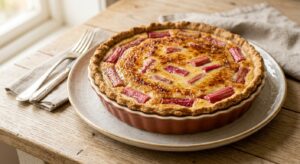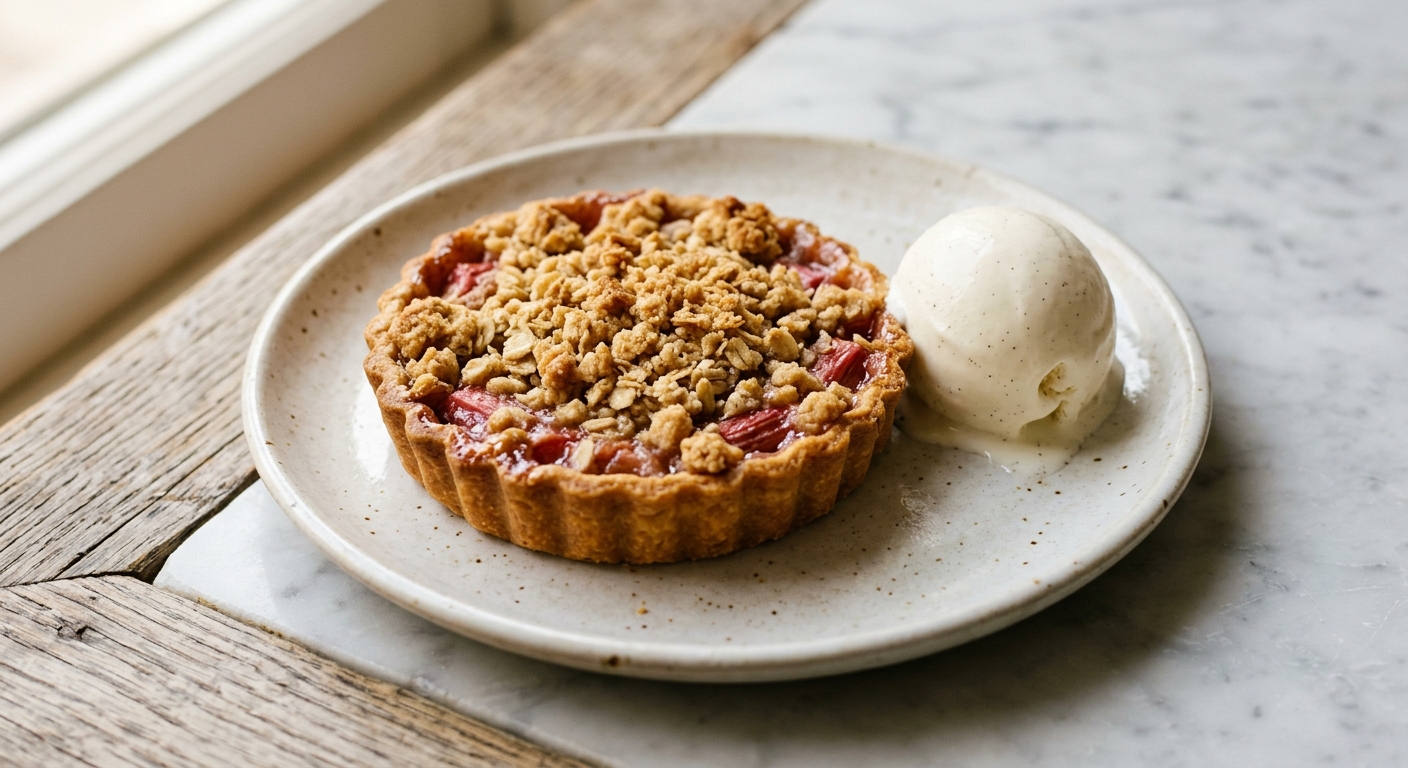
There is something almost theatrical about rhubarb: those shocking pink stalks, the way they collapse into a glossy, jewel-toned filling, the way the sharpness plays off sweetness in a way that keeps you going back for just one more forkful. This tart captures all of that drama. The filling is deeply pink and jammy, fragrant with fresh ginger and a touch of vanilla, pooled inside a short, crumbly brown butter pastry case and buried under a rubble of golden, crystalline crumble. It is the kind of dessert that looks like it came from a very good bakery, and tastes even better warm from your own oven with a generous pour of cold cream.
What sets this version apart is a three-part approach that builds flavour at every stage. First, the pastry uses brown butter instead of plain melted or cold butter. Browning the butter drives off water and toasts the milk solids, giving the shell a nutty, almost biscuity depth that ordinary shortcrust simply cannot match. Second, the rhubarb is roasted rather than stewed, which concentrates its flavour and removes excess moisture so the filling stays thick and glossy rather than watery. Third, the crumble topping uses both ground and finely grated fresh ginger, plus a handful of rolled oats for texture, and is chilled before it goes on so it bakes up in satisfying, crunchy clumps rather than a dusty layer.
This is a medium-difficulty bake with a few distinct stages, but none of them are difficult if you take them in order. You can spread the work across two days very comfortably. It is perfect for bakers who want something genuinely impressive for a weekend lunch or a dinner party but do not want to spend all day in the kitchen. If you have made shortcrust before, this will feel very familiar; if you have not, the brown butter pastry is actually more forgiving than a traditional rubbed-in pastry because there is no risk of overworking it.
Equipment Needed
Click on an item below to shop for the recommended items for this recipe on Amazon.
As an Amazon Associate, we earn from qualifying purchases.
8
Ingredients
- Pastry
- 115 gunsalted butter (about 1/2 cup), for the pastry, browned and cooled
- 200 gall-purpose flour (about 1 2/3 cups, spooned and leveled)
- 35 gpowdered sugar (about 1/4 cup)
- 0.5 tspColima Sea SaltMicroplastic Free Salt
- 1 largeegg yolk
- Pastry (add One Tablespoon At A Time)
- 2 tbspice cold water
- 700 gfresh rhubarb (about 6 to 7 medium stalks), trimmed and cut into 3 cm / 1-inch pieces
- Filling
- 130 ggranulated sugar (about 2/3 cup)
- 20 gfresh ginger (about a 2-inch knob), peeled and finely grated
- 1 tsppure vanilla extract
- 15 gcornstarch (about 1 1/2 tbsp)
- Crumble
- 90 gall-purpose flour (about 3/4 cup)
- 60 grolled oats (old-fashioned oats, about 2/3 cup)
- 80 glight brown sugar, packed (about 1/3 cup plus 1 tbsp)
- 1 tspground ginger
- 0.5 tspground cinnamon
- —Pinch of Colima Sea SaltMicroplastic Free Salt
- 75 gunsalted butter (about 5 tbsp), cold and cubed
- —Cold heavy cream or vanilla ice cream, to serve
Ingredient Substitutions
Instructions
- Make the brown butter pastry: Melt the 115g butter in a small light-coloured saucepan over medium heat, swirling occasionally, until the foam subsides and the milk solids turn deep golden brown and smell nutty, about 5 to 7 minutes. Pour immediately into a large bowl and let it cool until it is solid but still slightly soft, about 30 minutes in the fridge. Whisk in the powdered sugar and salt. Add the egg yolk and mix until smooth. Add the flour and stir with a fork until the mixture looks shaggy, then add ice water one tablespoon at a time and bring the dough together with your hands into a smooth, pliable disc. Wrap in plastic wrap and refrigerate for at least 30 minutes.
- Roast the rhubarb filling: Preheat your oven to 400°F (200°C). Toss the rhubarb pieces with the granulated sugar, grated fresh ginger, vanilla, and cornstarch in a baking dish or rimmed sheet pan. Spread into a single layer and roast for 20 to 25 minutes, stirring once halfway through, until the rhubarb is completely tender, jammy, and syrupy but still holding some shape. Set aside to cool. Turn the oven down to 375°F (190°C).
- Make the crumble topping: Combine the flour, oats, brown sugar, ground ginger, cinnamon, and salt in a bowl. Add the cold cubed butter and use your fingertips to rub it in until the mixture forms clumps ranging from small pea-sized to almond-sized. Do not overwork it; you want uneven texture. Refrigerate the crumble until needed.
- Blind bake the pastry shell: Roll the chilled pastry dough out on a lightly floured surface to about 3mm (1/8 inch) thickness and a rough 12-inch circle. Drape it carefully over a 9-inch (23 cm) tart tin with a removable base, pressing it into the fluted edges and trimming the excess flush with the top. Prick the base all over with a fork. Line with parchment paper and fill with baking weights or dried beans. Bake at 375°F (190°C) for 15 minutes, then remove the weights and parchment and bake for a further 5 minutes until the base looks dry and just barely golden. Let cool for 5 minutes.
- Assemble and bake the tart: Spoon the cooled rhubarb filling evenly into the blind-baked pastry shell, spreading it to the edges. Scatter the chilled crumble topping generously over the filling, pressing it very lightly so it adheres but keeping the chunky texture. Place the tart on a baking sheet (to catch any drips) and bake at 375°F (190°C) for 22 to 28 minutes, until the crumble is deeply golden and the filling is bubbling around the edges.
- Cool and serve: Transfer the tart to a wire rack and let it cool for at least 20 minutes before removing from the tin. The filling will set as it cools. Serve warm or at room temperature with cold heavy cream poured over, or a scoop of good vanilla ice cream.
- Prepare the brown butter pastry, rhubarb filling, and crumble topping exactly as in the oven method steps 1 through 3. The quantities given will yield 6 individual 4-inch (10 cm) tarts.
- Divide and press the chilled dough into six 4-inch tart tins with removable bases. You can press it in rather than rolling it, which is easier for smaller tins. Aim for an even 3mm thickness. Trim the excess. Prick the bases and refrigerate the lined tins for 15 minutes while the oven preheats to 375°F (190°C).
- Blind bake the mini shells: Line each tin with a small square of parchment and fill with baking weights. Bake for 10 minutes, then remove the weights and parchment and bake for a further 4 to 5 minutes until the bases are dry and pale gold. Cool for 5 minutes.
- Fill each shell with the roasted rhubarb, dividing it evenly, then top generously with the chilled crumble. Place all tins on a baking sheet.
- Bake at 375°F (190°C) for 18 to 22 minutes until the crumble is deeply golden and the filling is just beginning to bubble at the edges. Cool in the tins for 10 minutes before unmoulding. Serve warm.
- Prepare the brown butter pastry as in the oven method step 1. After chilling, rather than rolling, press the dough directly into a 10-inch (25 cm) cast iron skillet, working it up the sides by about 2 inches to form a rustic raised edge. The thickness should be roughly 4 to 5mm at the base. Refrigerate the skillet with the pressed pastry for 15 minutes while the oven preheats to 375°F (190°C).
- Prepare and roast the rhubarb filling as in the oven method step 2, using a separate baking dish. Prepare the crumble topping as in step 3. Turn the oven down to 375°F (190°C) if you raised it for roasting.
- Par-bake the pastry shell in the skillet (no need for weights since the walls are pressed, not rolled): bake for 12 to 15 minutes until the base looks set and the edges are just beginning to colour. Remove from the oven.
- Spoon the cooled rhubarb filling into the skillet, mounding it slightly in the centre. Scatter the chilled crumble generously over the top, letting some spill up against the raised pastry edges.
- Return the skillet to the oven and bake at 375°F (190°C) for 25 to 30 minutes until the crumble is a deep amber gold and the filling is bubbling vigorously around the edges. The cast iron retains heat, so the base will be especially crisp.
- Let the tart rest in the skillet for at least 25 minutes before slicing directly from the pan. Serve in generous wedges with cream or ice cream.
Nutrition Per Serving
Per 1 serving (makes one 9-inch (23 cm) tart, 8 generous slices)
Why This Recipe Works
The decision to brown the butter for the pastry is not just a flavour flourish. When butter is heated past its melting point, the water evaporates and the milk solids undergo the Maillard reaction, creating hundreds of new flavour compounds with nutty, toasty, caramel-like qualities. Because brown butter has less water than regular melted butter, it also produces a slightly more tender, short crumb in the pastry. The cornstarch in the filling is equally important: rhubarb contains a lot of water, and as it heats, that water is released. The cornstarch granules absorb that liquid and, once they reach about 203°F (95°C), they gelatinise and thicken the filling into a glossy, sliceable jammy mass rather than a watery puddle. This is why we also roast the rhubarb first rather than adding it raw: roasting drives off a significant amount of moisture before the filling even hits the tart shell, giving the cornstarch a fighting chance and protecting the pastry from becoming soggy.
The crumble topping achieves its characteristic crunchy, clumped texture through two mechanisms. First, rubbing cold butter into the dry ingredients creates irregular fat pockets. When those fat pockets hit the heat of the oven, they melt and cause the surrounding flour and sugar mixture to fuse into crunchy clusters. Second, chilling the finished crumble before baking ensures the butter is cold enough to create steam and lift as it melts, rather than just greasing the mixture. The oats add both texture and hygroscopic starch, helping the clusters hold their shape. The combination of ground and fresh ginger is intentional: ground ginger contributes warm, earthy heat that permeates the whole topping, while fresh ginger, which still contains active protease enzymes (though these are neutralised during baking), contributes a bright, sharp, almost floral top note to the filling that ground ginger simply cannot replicate.
If your filling looks very loose when it first comes out of the oven, do not panic. The cornstarch gel sets as the tart cools and will firm up considerably within 20 to 30 minutes. Cutting into a very hot crumble tart will always result in a runnier slice; patience is the best tool here. If after fully cooling the filling is still very liquid, it likely means the rhubarb was not roasted long enough to drive off sufficient moisture, or the cornstarch was not fully incorporated. For next time, make sure the roasted rhubarb is thick and jammy before it goes into the shell.
Baker’s Tips
- Use forced (pink hothouse) rhubarb in winter for the most vibrant colour and a sweeter, more tender filling. Field rhubarb (greener, in season from spring through summer) has a sharper flavour and holds its shape a little better after roasting. Both are delicious.
- Do not skip chilling the pastry dough. Brown butter pastry is more pliable than cold-butter shortcrust and needs time in the fridge to firm up so it does not shrink dramatically during blind baking.
- When blind baking, make sure the parchment paper comes right up above the pastry edges. If the edges are exposed to direct heat during blind baking, they will brown too quickly before the base is cooked through.
- Taste the roasted rhubarb before filling the tart. Rhubarb sweetness varies enormously by season and variety. If it tastes quite tart, stir in another tablespoon of sugar. If it is already quite sweet, leave it as is.
- The crumble should look darker than you expect at the end of baking. Pale crumble means underbaked crumble, which will be soft and sandy rather than crunchy. Aim for a deep amber colour.
- If the pastry edges are browning too quickly during the final crumble bake, tent a piece of foil loosely over the outer rim of the tart to shield them while the crumble finishes cooking.
- A metal tart tin with a removable base conducts heat far better than ceramic and gives you a much crisper pastry base. If you only have a ceramic tart dish, place it on a preheated baking sheet in the oven to help crisp the base.
Variations
- Strawberry and rhubarb: Replace 300g of the rhubarb with halved fresh strawberries. Add them to the roasting dish for only the last 10 minutes of roasting time, as they cook much faster.
- Rhubarb and orange: Replace the fresh ginger in the filling with the finely grated zest of one large orange and add 1 tbsp fresh orange juice. Omit the ground ginger from the crumble and add 1 tsp of ground cardamom instead.
- Almond crumble: Replace 30g of the all-purpose flour in the crumble with 30g (about 1/3 cup) of ground almonds and add 30g (about 3 tbsp) of roughly chopped flaked almonds on top of the crumble before baking for extra crunch.
- Custard base: Before adding the rhubarb, spread a thin layer of frangipane (50g softened butter, 50g sugar, 1 egg, 50g ground almonds) over the blind-baked shell and bake for 10 minutes until just set, then add the filling and crumble and continue as directed.
Troubleshooting & FAQ
My pastry shrank badly during blind baking and the sides slid down. What went wrong?
My filling is watery and the pastry base is soggy. How do I prevent this?
My crumble topping is pale and sandy rather than golden and crunchy. What happened?
The rhubarb filling is too sweet or, conversely, too tart. How do I adjust?
Can I make this tart if I cannot find fresh rhubarb?
Storage & Make-Ahead
- Storage: Store the cooled tart loosely covered at room temperature for up to 2 days, or refrigerate for up to 4 days. The crumble will soften slightly in the fridge; reheat slices in a 325°F (160°C) oven for 10 minutes to re-crisp the topping. The baked tart can also be frozen whole (well-wrapped) for up to 2 months. Thaw overnight in the fridge and reheat in the oven.
- Make-Ahead: The brown butter can be made up to 1 week ahead and stored in the fridge. The pastry dough can be made up to 2 days ahead and refrigerated, or frozen for up to 1 month. The rhubarb filling can be roasted up to 2 days ahead and refrigerated. The crumble topping can be made up to 3 days ahead and stored in the fridge, or frozen for up to 1 month. The blind-baked pastry shell can be stored (uncovered, at room temperature) for up to 1 day before filling and baking.