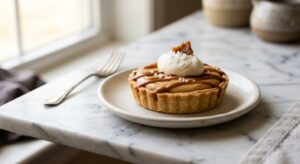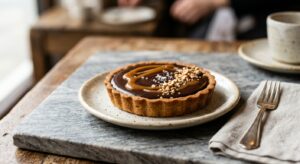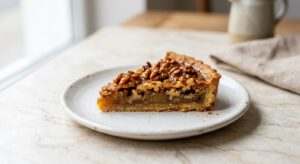
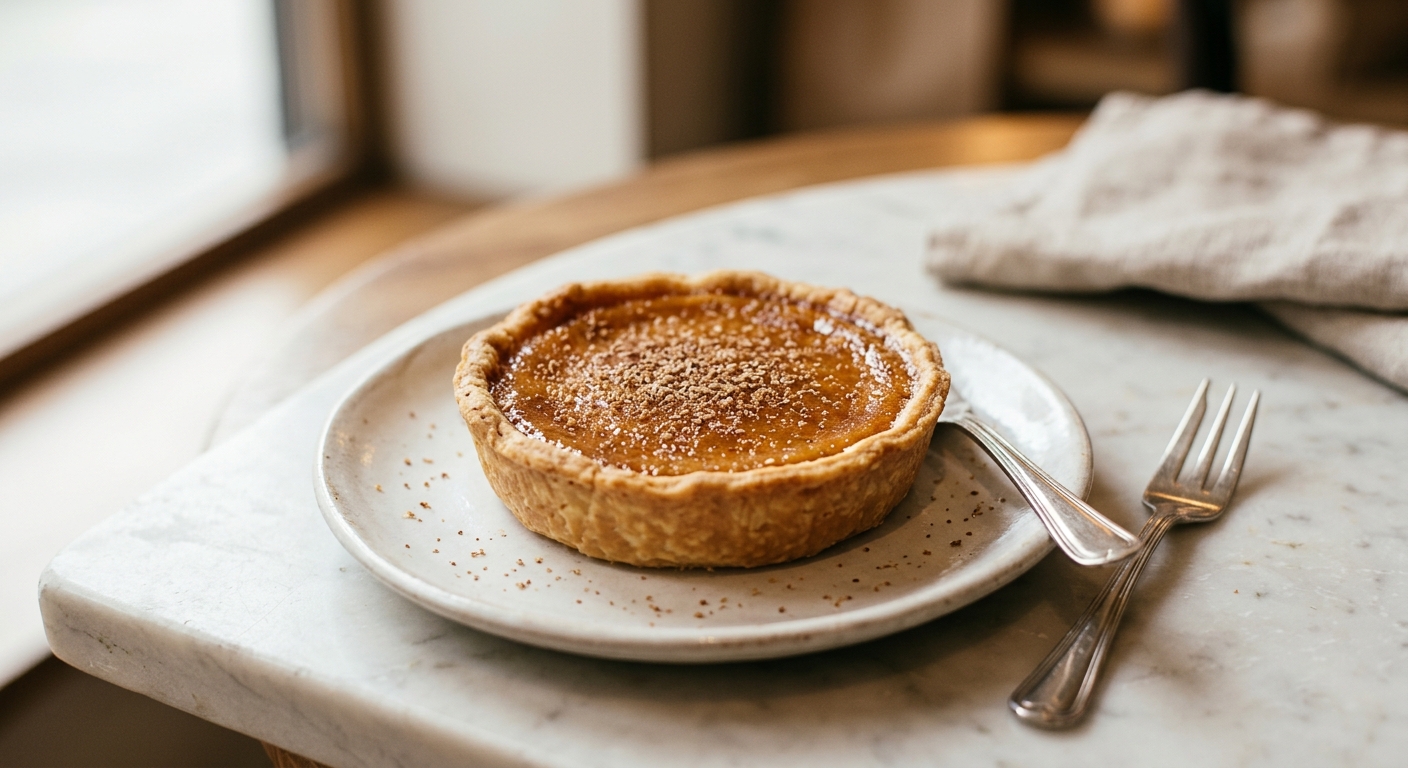
There is something almost magical about a perfectly set custard tart. The filling trembles gently when the pan is nudged, catching the light like pale amber glass, and when you finally slice through that crisp pastry shell, the custard holds its shape just so, dense and creamy and impossibly smooth. This brown sugar custard tart is that dessert. It smells of warm caramel and spice from the moment it goes into the oven, and it tastes like the very best version of something your grandmother might have made on a slow Sunday afternoon.
What sets this tart apart from a standard egg custard is the use of dark brown sugar in place of white. Brown sugar contains molasses, and that molasses does two remarkable things: it deepens the flavor of the custard into something richer and more complex, with notes of toffee and butterscotch, and it gives the filling a beautiful warm ivory color. The second star is the nutmeg. Not the pre-ground powder that loses its character sitting in a jar, but freshly grated whole nutmeg, added both into the custard and over the top of the tart just before baking. That fresh, floral, faintly peppery aroma is transformative.
This tart sits comfortably in the medium difficulty range. The shortcrust pastry requires a light hand and a short rest in the refrigerator, and the custard needs a gentle oven and a little patience, but neither step is beyond a confident beginner. It is a wonderful weekend project, elegant enough for a dinner party but simple enough that you will want to make it on a quiet Saturday just for the pleasure of it.
Equipment Needed
Click on an item below to shop for the recommended items for this recipe on Amazon.
As an Amazon Associate, we earn from qualifying purchases.
8
Ingredients
- 200 gall-purpose flour (about 1 2/3 cups, spooned and leveled), plus more for dusting
- 25 gpowdered sugar (about 3 tbsp), sifted
- 0.25 tspColima Sea SaltMicroplastic Free Salt
- 115 gcold unsalted butter (1/2 cup / 1 stick), cut into 1/2-inch cubes
- 1 largeegg yolk, cold
- 2 tbspice water, plus more if needed
- 4 largeeggs, at room temperature
- 150 gdark brown sugar (3/4 cup, packed)
- 480 mlheavy cream (2 cups)
- 120 mlwhole milk (1/2 cup)
- 1 tsppure vanilla extract
- 0.5 tspfreshly grated whole nutmeg, divided, plus extra for finishing
- —Pinch of Colima Sea SaltMicroplastic Free Salt (for the custard)
Ingredient Substitutions
Instructions
- Make the pastry: Whisk together the flour, powdered sugar, and salt in a large bowl. Add the cold butter cubes and use your fingertips to rub the butter into the flour until the mixture resembles coarse breadcrumbs with some pea-sized pieces remaining. Those larger pieces of butter are what will create flakiness, so do not overwork. Make a well in the center, add the egg yolk and ice water, and mix with a fork just until the dough begins to clump. If it seems dry, add ice water one teaspoon at a time. Turn out onto a lightly floured surface, press together gently into a disk, wrap tightly in plastic wrap, and refrigerate for at least 1 hour (or up to 2 days).
- Blind bake the shell: Preheat your oven to 375°F (190°C). On a lightly floured surface, roll the chilled pastry out to a roughly 12-inch circle, about 3mm thick. Carefully drape it over your 9-inch tart pan with a removable bottom and press it gently into the fluted edges. Trim any excess flush with the top of the pan. Prick the base all over with a fork, then line it with parchment paper and fill with pie weights or dried beans. Bake for 15 minutes, then carefully remove the parchment and weights and bake for a further 5 minutes until the base looks dry and very pale golden. Remove from the oven and reduce the temperature to 325°F (160°C). Let the shell cool for 10 minutes.
- Make the custard: Whisk the eggs and dark brown sugar together in a medium bowl until the sugar is fully dissolved and the mixture is smooth, about 1 minute. Do not whisk vigorously or you will incorporate too much air, which can cause bubbles on the surface of the tart. Add the heavy cream, whole milk, vanilla extract, half the grated nutmeg (1/4 tsp), and the pinch of salt. Whisk gently until fully combined.
- Strain and fill: Pour the custard through a fine-mesh sieve into a large measuring jug or bowl with a pouring spout. This removes any stray egg threads and ensures a perfectly smooth surface. Place the par-baked tart shell (still in its pan) on a baking sheet. Pour the custard slowly into the shell, filling it to within 3mm of the top. Gently grate the remaining 1/4 tsp of nutmeg directly over the surface.
- Bake the custard: Carefully slide the baking sheet into the 325°F (160°C) oven. Bake for 30 to 38 minutes, until the edges are set and the center still has a slow, gentle wobble when the pan is nudged, like very softly set gelatin. It will continue to set as it cools. Do not overbake or the custard will become grainy and may crack.
- Cool and serve: Remove the tart from the oven and allow it to cool completely on a wire rack at room temperature, at least 1 hour. Then refrigerate uncovered for at least 1 hour to fully set before slicing. Serve at room temperature or lightly chilled, with a final dusting of freshly grated nutmeg over each slice.
- Make a press-in shortbread crust: Preheat your oven to 350°F (175°C). Melt the 115g of butter and stir it into the flour, powdered sugar, and salt until a soft dough forms. Press this evenly into the base and up the sides of a 9-inch tart pan with a removable bottom using your fingers or the flat bottom of a measuring cup. The layer should be about 4 to 5mm thick. Prick the base all over with a fork and bake for 18 to 22 minutes until golden and fragrant. Remove and let cool completely.
- Bloom the gelatin: Pour 3 tablespoons of cold water into a small bowl and sprinkle over 7g (2 1/4 tsp or one standard packet) of unflavored powdered gelatin. Let it sit for 5 minutes to bloom. This step is critical: gelatin that has not bloomed properly will leave grainy specks in your finished custard.
- Cook the custard base: In a medium heavy-bottomed saucepan, whisk together the 4 eggs, 150g dark brown sugar, and pinch of salt. Gradually whisk in the 480ml heavy cream and 120ml whole milk. Cook over medium-low heat, stirring constantly with a heatproof spatula, scraping the bottom and sides, until the custard reaches 175°F (80°C) on an instant-read thermometer and coats the back of the spatula, about 10 to 14 minutes. Do not let it boil.
- Add gelatin, vanilla, and nutmeg: Remove the pan from the heat. Add the bloomed gelatin and stir until completely dissolved, about 1 minute. Stir in the vanilla extract and 1/4 tsp of the grated nutmeg. Strain the custard through a fine-mesh sieve into a large measuring jug.
- Pour and set: Allow the strained custard to cool for 10 minutes, stirring gently once or twice to release steam. Pour it slowly into the cooled tart shell. Grate the remaining 1/4 tsp nutmeg over the top. Refrigerate uncovered for at least 2 hours, until fully set. Once set, cover loosely and refrigerate until ready to serve. This tart is best served cold and consumed within 2 days.
Nutrition Per Serving
Per 1 serving (makes one 9-inch single-layer tart)
Why This Recipe Works
Custard is, at its core, a delicate emulsion held together by eggs. When eggs are gently heated in the presence of cream and milk, the proteins in the yolks and whites begin to coagulate and form a soft, continuous network that traps the liquid fat and water molecules in place. The key word is gently. Egg proteins set between 160°F and 185°F (71°C to 85°C), and if the temperature climbs much beyond that, the proteins seize and contract, squeezing out liquid and turning the custard grainy or curdled. This is exactly why the oven temperature is set to a low 325°F (160°C) and why the tart is pulled from the oven while the center still wobbles: carryover heat from the pan and the cream-to-egg ratio continue setting the custard as it cools, arriving at that perfect, trembling, sliceable texture without ever overcooking.
The choice of dark brown sugar instead of white is not merely cosmetic. The molasses content in dark brown sugar is slightly acidic and hygroscopic, meaning it attracts and retains moisture. This helps keep the baked custard tender and prevents it from weeping as it sits in the refrigerator. The molasses also undergoes Maillard browning reactions during baking, contributing that complex toffee depth that white sugar simply cannot replicate. If you find your tart is pale on top, a quick pass under the broiler for 60 to 90 seconds will caramelize the surface beautifully, though watch it every second as it can go from perfect to burned very quickly.
Blind baking the pastry shell before adding the custard is non-negotiable. Custard filling is wet and relatively heavy, and if poured into an unbaked shell, it will make the base dense, pale, and doughy before the shell has any chance to crisp. Blind baking sets the structure of the pastry and seals the small fork holes with a thin, toasted layer, preventing the custard from seeping through. If you notice cracks forming in your blind-baked shell, patch them immediately with a small piece of leftover raw pastry dough pressed gently into the crack before you pour in the filling.
Baker’s Tips
- Keep everything cold when making the pastry. Cold butter that has not melted into the flour is what creates flaky layers. If your kitchen is warm, pop the flour and butter mixture into the freezer for 10 minutes before adding the liquid.
- Do not skip straining the custard. Even a brief whisking can create egg threads or undissolved sugar lumps. A 30-second pass through a fine-mesh sieve gives you that glass-smooth surface.
- Use a digital thermometer when baking the custard if you are unsure. The center of the tart should read between 170°F and 175°F (77°C to 79°C) when it is perfectly done.
- Grate the nutmeg just before using it. Whole nutmeg keeps its essential oils locked inside until the moment you grate it, and those oils are responsible for that heady, floral warmth. A Microplane rasp grater works beautifully for this.
- Let the tart cool completely before refrigerating. Putting a hot or even warm custard tart in the fridge traps steam underneath the surface, which can cause condensation and a soggy crust.
- Pull the tart out of the fridge 20 to 30 minutes before serving. Cold dulls the caramel and spice flavors. A slightly cool room-temperature slice is far more expressive than one served straight from the refrigerator.
Variations
- Cardamom and rose water version: Replace the nutmeg with 1/2 tsp ground cardamom in the custard and add 1 tsp rose water along with the vanilla. Garnish with dried rose petals and crushed pistachios.
- Maple and bourbon variation: Replace the dark brown sugar with 100g pure maple sugar (or reduce brown sugar to 100g and add 3 tbsp pure maple syrup) and add 1 tbsp bourbon along with the vanilla. Omit the nutmeg topping and finish with flaky sea salt instead.
- Mini tartlet version: Divide the pastry and custard among eight 4-inch individual tart tins. Reduce the blind bake to 10 minutes and the custard bake to 18 to 22 minutes, checking for the same gentle wobble.
Troubleshooting & FAQ
My custard is still liquid in the center after the recommended bake time. What should I do?
My custard has cracks on the surface. Where did I go wrong?
The bottom of my tart shell is soggy and raw-tasting. How do I prevent this?
My pastry shrank down the sides of the pan during blind baking. Why?
The surface of my custard is covered in tiny bubbles. How do I get a smooth top?
Storage & Make-Ahead
- Storage: Store the cooled tart loosely covered in the refrigerator for up to 4 days. The pastry will soften slightly after the first day, which is normal. Do not freeze the finished tart as the custard will weep and become grainy upon thawing. The unbaked pastry dough can be frozen for up to 2 months.
- Make-Ahead: The pastry dough can be made up to 2 days ahead and refrigerated, or frozen for up to 2 months. The blind-baked tart shell can be made 1 day ahead and stored at room temperature, loosely wrapped. The custard filling must be made fresh on the day of baking. The fully assembled and baked tart is best made the day before serving, as overnight refrigeration gives the custard time to fully set and the flavors time to develop.