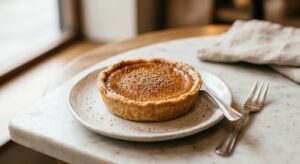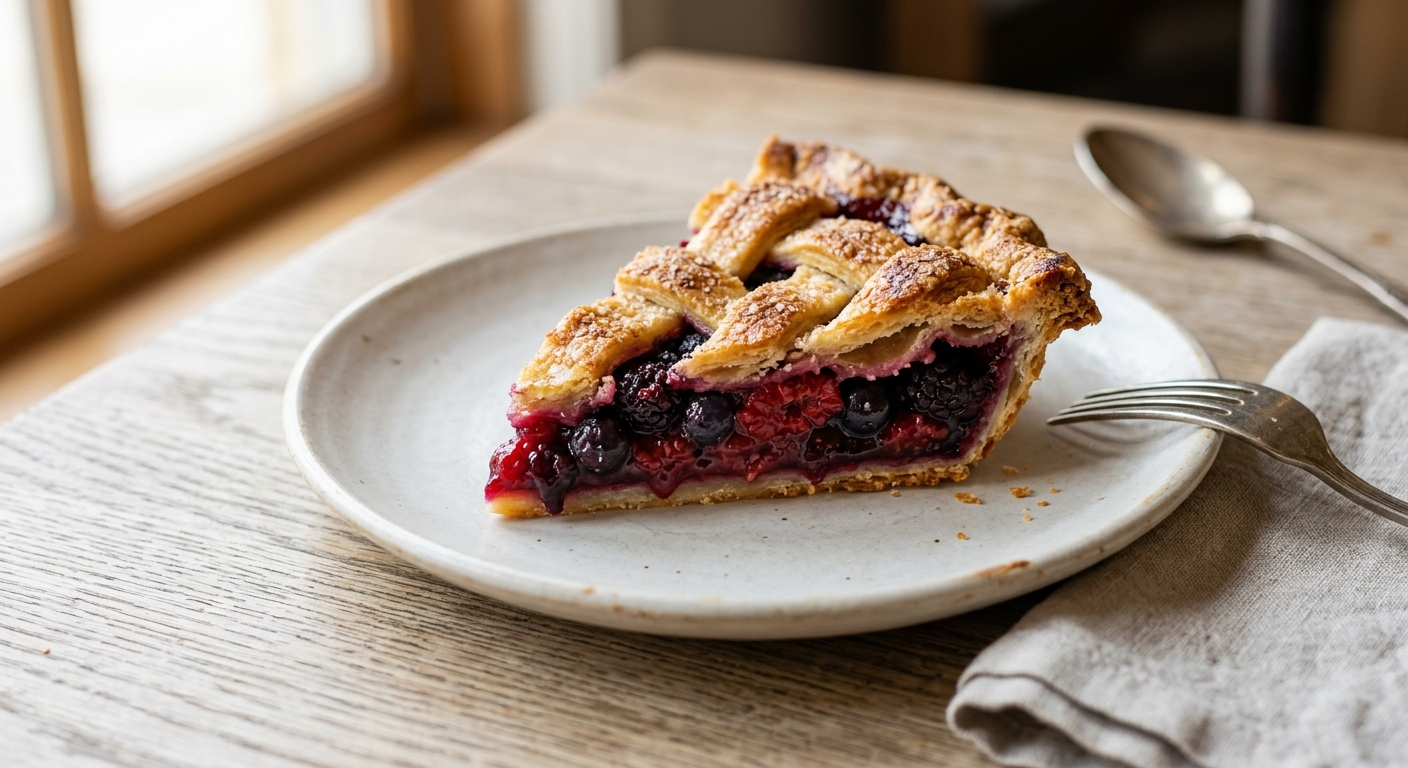
There is a moment, just as a berry pie comes out of the oven, when the kitchen smells of caramelized sugar and warm fruit and browned butter pastry all at once, and everything feels exactly right. The filling bubbles up through the vents in the top crust, glossy and deeply colored, and the edges have gone a perfect toasty gold. This is that pie. The one that sits in the center of the table and gets very quiet, admiring looks before it is cut, and zero leftovers after.
What sets this version apart is the all-butter pastry made with ice-cold water and a brief rest in the refrigerator, which creates those beautiful flaky layers without any shortening or lard. The filling uses a combination of four berries for complexity, a measured amount of cornstarch thickened at exactly the right ratio so the slices hold their shape without turning gluey, and a bright hit of lemon zest that keeps the whole thing from tasting flat. A sprinkle of coarse sugar on top gives the crust an irresistible crunch.
This pie sits at a comfortable medium difficulty. The pastry requires a little patience and cold hands, but the process is straightforward and deeply satisfying. It is ideal for confident beginner bakers looking to level up, seasoned home bakers who want a reliable go-to recipe, and anyone who believes that a homemade pie is one of the kindest things you can put on a table.
Equipment Needed
Click on an item below to shop for the recommended items for this recipe on Amazon.
As an Amazon Associate, we earn from qualifying purchases.
8
Ingredients
- Pastry
- 360 gall-purpose flour (about 3 cups, spooned and leveled), divided, plus more for dusting
- 1 tspColima Sea SaltMicroplastic Free Salt
- 15 ggranulated sugar (1 tbsp)
- 225 gunsalted butter, very cold, cut into 1.5 cm (half-inch) cubes
- 90 mlice water (about 6 tbsp), plus more as needed
- 1 tspapple cider vinegar
- 300 gfresh or frozen strawberries (about 2 cups), hulled and halved if large
- 200 gfresh or frozen blueberries (about 1.5 cups)
- 150 gfresh or frozen raspberries (about 1.25 cups)
- 150 gfresh or frozen blackberries (about 1.25 cups)
- Filling
- 150 ggranulated sugar (three-quarters cup)
- 45 gcornstarch (5 tbsp)
- 1 tspfinely grated lemon zest (from 1 lemon)
- 15 mlfresh lemon juice (1 tbsp)
- 1 tsppure vanilla extract
- 0.25 tspground cinnamon
- —Pinch of Colima Sea SaltMicroplastic Free Salt
- 1 largeegg, beaten with 1 tbsp water (egg wash)
- Sprinkling
- 15 gcoarse or turbinado sugar (1 tbsp)
Ingredient Substitutions
Instructions
- Make the pastry: In a large bowl, whisk together the flour, salt, and sugar. Add the cold butter cubes. Using your fingertips, a pastry cutter, or a box grater (grate frozen butter directly in), work the butter into the flour until you have a shaggy mixture with butter pieces ranging from the size of small peas to the size of a hazelnut. These uneven pieces are exactly what you want for a flaky crust. Stir the apple cider vinegar into the ice water. Drizzle half the liquid over the flour mixture and toss with a fork. Continue adding the liquid one tablespoon at a time, tossing after each addition, until the dough just holds together when you squeeze a small handful. You may not need all the water. Do not overwork.
- Divide the dough into two equal portions (about 295g each). Shape each into a flat disc, wrap tightly in plastic wrap, and refrigerate for at least 1 hour or up to 2 days. This rest allows the gluten to relax and the butter to firm up, which is essential for a tender, flaky result.
- Make the filling: In a large bowl, combine all four berries, the granulated sugar, cornstarch, lemon zest, lemon juice, vanilla extract, cinnamon, and salt. Toss gently to combine. Set aside while you roll the pastry (no longer than 20 minutes, or the berries will release too much juice and the filling will become wet).
- Preheat your oven to 425°F (220°C) and position a rack in the lower third. Place a rimmed baking sheet on the rack below to catch any drips. Remove one disc of dough from the refrigerator. On a lightly floured surface, roll it into a circle about 32 cm (12.5 inches) in diameter and roughly 3mm (one-eighth inch) thick. Transfer to a 9-inch pie pan by rolling the pastry loosely around your rolling pin and unrolling it over the pan. Gently press the dough into the bottom and sides without stretching it. Leave any overhang in place. Refrigerate while you roll the top crust.
- Roll the second disc into a circle about 30 cm (12 inches) in diameter. Pour the berry filling into the prepared pie shell, mounding it slightly in the center. Dot the filling with 15g (1 tbsp) of cold unsalted butter cut into small pieces if desired for extra richness. Drape the top crust over the filling. Trim both crusts to leave about 2.5 cm (1 inch) of overhang all around. Fold the overhanging dough under itself to form a thick edge, then crimp decoratively. Cut 5 to 6 vents in the top crust using a sharp knife or scissors. Brush the crust with egg wash and sprinkle generously with coarse sugar.
- Bake at 425°F (220°C) for 20 minutes until the pastry begins to set and turn golden at the edges. Reduce the oven temperature to 375°F (190°C) and continue baking for 35 to 40 minutes more, until the crust is deep golden brown and the filling is actively bubbling through the vents. If the edges are browning too quickly, shield them with a strip of foil or a pie shield after the first 25 minutes.
- Remove the pie from the oven and transfer to a wire cooling rack. Allow to cool for a minimum of 3 hours before slicing. This resting time is not optional: the filling needs time to set so slices hold their shape. If you cut into a warm pie the filling will be runny, though it will still taste wonderful.
- If baking your own crust, prepare one disc of the butter pastry as in the main recipe. Roll it out, press it into a 9-inch pie pan or cut into individual rounds using a 12 cm (5-inch) cutter for personal servings. Prick the base all over with a fork, line with parchment, and fill with pie weights or dried beans. Blind bake at 400°F (200°C) for 15 minutes, then remove the weights and bake for a further 5 minutes until the base is golden and dry. Cool completely.
- Combine all the berries, sugar, cornstarch, lemon zest, lemon juice, vanilla, cinnamon, and salt in a medium heavy-bottomed saucepan. Stir well to coat the berries. Place over medium heat.
- Cook, stirring gently but frequently, for 10 to 15 minutes. The berries will release their juices, the mixture will come to a gentle boil, and the filling will thicken noticeably. You will know it is ready when the filling holds a trail briefly when you drag a spoon through it and the color deepens from bright red to a rich jeweled purple-red. Remove from heat and stir in 15g (1 tbsp) butter for gloss and richness.
- Allow the filling to cool for 20 to 30 minutes until warm but no longer steaming, then spoon into the pre-baked pastry shell. The filling will continue to set as it cools. Serve warm or at room temperature. Top with a scoop of vanilla ice cream or a spoonful of clotted cream.
- Prepare the full butter pastry recipe as written. After chilling, divide the dough into 4 equal portions rather than 2. Roll each portion into a circle approximately 18 cm (7 inches) in diameter. Use half the circles (two portions) to line four 10 cm (4-inch) individual pie tins or ramekins, pressing the dough into the base and sides. Reserve the other two circles for the tops, keeping them refrigerated.
- Prepare the berry filling as written, reducing the total berry quantity to 600g and the cornstarch to 30g (3.5 tbsp) to account for the smaller volume. Divide the filling evenly among the lined tins, filling each one about three-quarters full.
- Cut the top pastry circles to fit, place them over the filling, crimp the edges by pressing with a fork, and cut two or three small vents in each top crust. Brush with egg wash and sprinkle with coarse sugar. Refrigerate the assembled pies for 15 minutes to firm up.
- Preheat your air fryer to 320°F (160°C) for 3 minutes. Place the pie tins in the basket, working in batches if needed and leaving space between them for air circulation. Bake for 18 to 22 minutes until the crusts are deeply golden and the filling is bubbling through the vents. Check at 15 minutes: if the tops are browning faster than expected, lay a small piece of foil loosely over each pie.
- Remove carefully using tongs and allow to cool on a wire rack for at least 45 minutes before eating. The filling will be very hot immediately after baking.
Nutrition Per Serving
Per 1 serving (makes one 9-inch double-crust pie)
Why This Recipe Works
The all-butter pastry relies on keeping fat cold at every stage. When butter is worked into flour but not fully incorporated, it remains in distinct flat layers. In the oven’s heat, the water in the butter converts to steam, pushing those layers apart and creating the flaky, shatter-crisp texture that makes a great pie crust so satisfying. This is why ice water, cold butter, and a rested, cold dough are non-negotiable. Warm butter simply melts into the flour and produces a crumbly, mealy crust instead of a flaky one. The small addition of apple cider vinegar slightly inhibits gluten formation, which keeps the crust tender rather than tough after rolling.
The two-temperature baking method (starting hot at 425°F and reducing to 375°F) is deliberate and important. The initial high heat sets the pastry structure quickly, ensuring the base cooks through before the fruit releases too much steam, and gives the crust its golden color. Dropping the temperature for the remainder of the bake allows the filling to cook gently and thoroughly all the way to the center without scorching the crust. The pie is done when the filling bubbles actively through the vents, not just at the edges: this means the entire filling has reached a temperature high enough to activate the cornstarch fully and cook the raw starch flavor out.
Cornstarch is the thickener of choice here because it produces a clear, glossy filling that showcases the jewel colors of the berries, sets firmly enough for clean slices, yet melts on the tongue rather than feeling gummy. The ratio of 45g cornstarch to 800g fruit is calibrated so the filling is set but still luscious. If your berries are very ripe and juicy (especially if using frozen), add an extra tablespoon of cornstarch. The three-hour cooling window is genuine: cornstarch gels as it cools, and cutting the pie too soon means the still-liquid filling will pour out of the slice rather than holding its shape.
Baker’s Tips
- Keep everything cold. If your kitchen is warm or your hands run hot, chill the bowl and flour in the freezer for 15 minutes before you start, and work quickly. You can also grate frozen butter directly into the flour on a box grater for very consistent, cold fat distribution.
- Do not stretch the pastry when lining the pan. Lift and drape it gently into the corners. Stretched pastry shrinks back during baking and can pull away from the sides.
- If using frozen berries, do not thaw them first. Thawed berries are wet and can make your filling soupy. Use them straight from frozen and increase the cornstarch by one tablespoon.
- The filling should mound above the rim of the pie dish before baking. Berries collapse and release liquid as they cook, and a generous fill means a satisfying, full-looking pie after baking.
- Place your pie on a preheated baking sheet (or at minimum, line the rack below with foil). Berry pies bubble over. This is a feature, not a flaw, but it is much easier to deal with on a baking sheet than on the oven floor.
- Brush the crimped edge with egg wash using a light hand and a pastry brush. Getting egg wash pooled in the crimps can cause the decorative edge to stick together and puff in unexpected ways.
- Patience with cooling is the single most important tip: a pie that has cooled for three hours will slice cleanly. A pie that has cooled for 30 minutes will taste just as wonderful but the filling will run. Plan ahead if presentation matters.
Variations
- Lattice top: Cut the second pastry disc into 2.5 cm (1-inch) strips and weave them over the filling for a classic lattice. Brush with egg wash and coarse sugar as usual. The open lattice allows more moisture to escape, resulting in a slightly more concentrated filling.
- Almond frangipane base: Spread a thin layer of almond frangipane (60g softened butter, 60g sugar, 1 egg, 60g almond flour) over the bottom of the unbaked pastry shell before adding the berry filling. The almond layer creates a moisture barrier that keeps the base crisp and adds wonderful flavor.
- Spiced version: Add half a teaspoon of ground cardamom and a quarter teaspoon of ground ginger to the filling along with the cinnamon. Especially beautiful with blackberries and blueberries in autumn.
- Crumble top: Replace the top pastry crust with a streusel made from 120g flour, 90g rolled oats, 100g brown sugar, 0.5 tsp cinnamon, and 85g cold cubed butter rubbed together until crumbly. Press gently over the filling and bake as directed.
Troubleshooting & FAQ
My pastry shrinks away from the sides of the pan when baking. What went wrong?
The bottom crust is soggy and undercooked even though the top looks done. How do I fix this?
My filling is runny when I cut the pie, even after cooling. What happened?
My butter pastry is crumbling and falling apart when I try to roll it. What should I do?
The edges of my pie are getting very dark before the filling is cooked through. What do I do?
Storage & Make-Ahead
- Storage: Store the baked pie loosely covered at room temperature for up to 2 days. For longer storage, cover and refrigerate for up to 5 days. The crust softens slightly in the refrigerator but can be crisped in a 325°F (165°C) oven for 10 minutes. Freeze baked pie whole or in slices, well wrapped, for up to 3 months. Reheat from frozen in a 350°F (175°C) oven for 25 to 30 minutes.
- Make-Ahead: The pastry discs can be made up to 2 days ahead and refrigerated, or frozen for up to 3 months (thaw overnight in the refrigerator before rolling). The berry filling can be mixed and held (without the cornstarch) in the refrigerator for up to 24 hours; stir in the cornstarch just before assembling. The fully assembled unbaked pie can be wrapped and frozen for up to 2 months and baked directly from frozen, adding 15 to 20 minutes to the bake time.