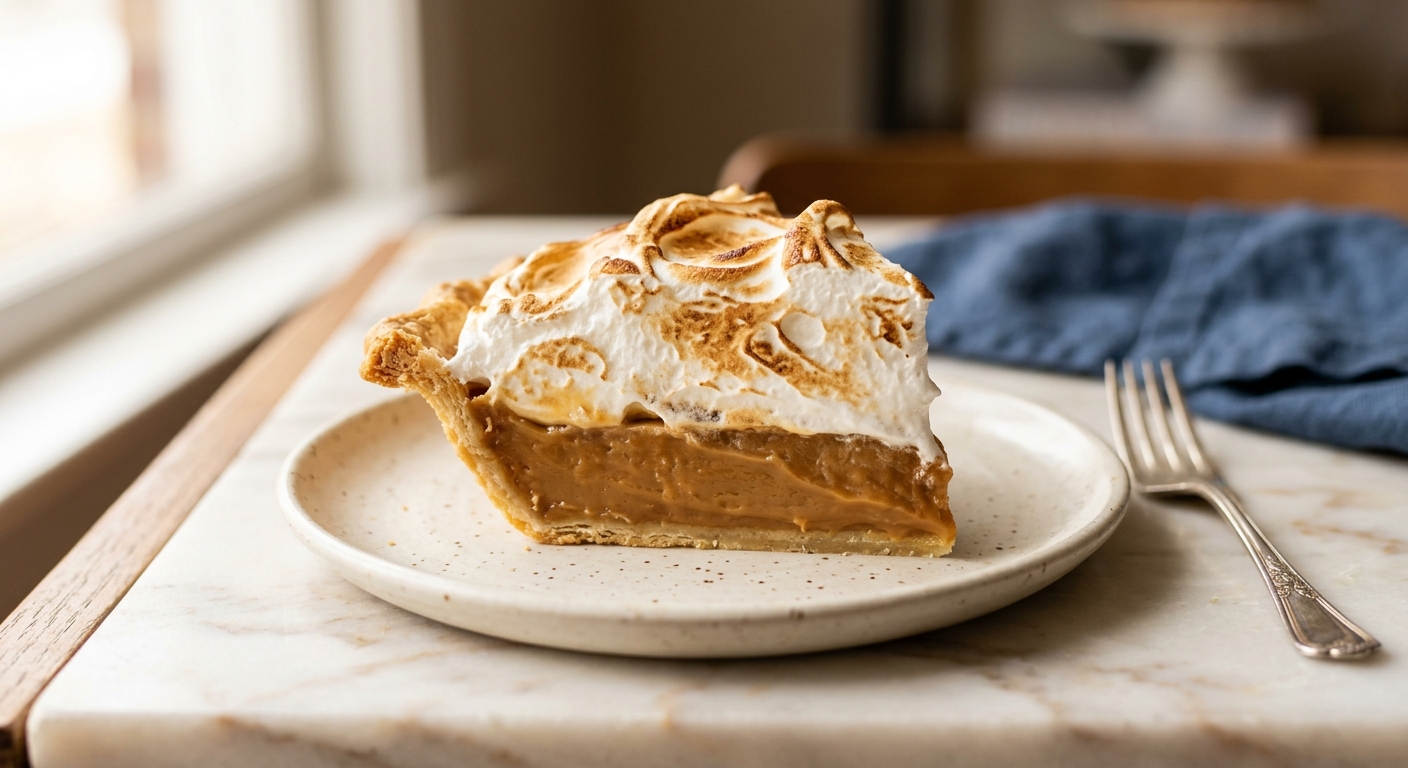
There is something almost nostalgic about a butterscotch cream pie, the kind that makes you feel like you are sitting in a diner booth on a rainy afternoon with nowhere to be. But this version is no dusty diner relic. The filling is a proper stovetop custard built on dark brown sugar and real butter, cooked low and slow until the sugars deepen into something almost toffee-like, fragrant with vanilla and a whisper of Scotch whisky if you are feeling bold. It is rich without being cloying, cool and trembling under that towering cloud of meringue.
What sets this recipe apart is the Italian meringue topping. Unlike a standard baked meringue, Italian meringue is made by streaming hot sugar syrup into whipping egg whites, cooking them safely without an oven and producing a topping that is marshmallow-soft inside, stable for days, and absolutely gorgeous when kissed with a kitchen torch. It will not weep, it will not shrink, and it handles slicing like a dream. The custard filling itself uses egg yolks, cornstarch, and a generous hand with brown butter for that signature deep, almost smoky butterscotch flavour that sets it apart from a simpler vanilla cream pie.
This recipe sits firmly in the medium difficulty range. The individual components are all achievable with a bit of patience, but there are a few steps that require your full attention: cooking the custard to the right consistency and bringing the sugar syrup to exactly 240°F for the meringue. If you own a candy thermometer and a kitchen torch, you are already most of the way there. This pie is perfect for a dinner party centrepiece, a holiday table, or any occasion where you want to make something that earns genuine gasps.
Equipment Needed
Click on an item below to shop for the recommended items for this recipe on Amazon.
As an Amazon Associate, we earn from qualifying purchases.
10
Ingredients
- Crust
- 190 gall-purpose flour (about 1.5 cups, spooned and leveled)
- 1 tbspgranulated sugar
- 0.5 tspColima Sea SaltMicroplastic Free Salt
- 115 gunsalted butter, very cold, cut into 1cm cubes (about 1/2 cup)
- Crust (add More By The Teaspoon If Needed)
- 3 tbspice water
- Filling
- 220 gdark brown sugar, packed (about 1 cup)
- Filling (about 6 Tbsp)
- 85 gunsalted butter
- Filling
- 60 mlwater (about 1/4 cup)
- 480 mlwhole milk (about 2 cups)
- 240 mlheavy cream (about 1 cup)
- 5 largeegg yolks, at room temperature
- 45 gcornstarch (about 5 tbsp)
- 1 tsppure vanilla extract
- 1 tbspScotch whisky, optional but recommended
- 0.5 tspColima Sea SaltMicroplastic Free Salt
- Italian Meringue
- 4 largeegg whites, at room temperature
- Italian Meringue Syrup
- 200 ggranulated sugar (about 1 cup)
- 60 mlwater (about 1/4 cup)
- Italian Meringue
- 0.25 tspcream of tartar
- —Pinch of Colima Sea SaltMicroplastic Free Salt
Ingredient Substitutions
Instructions
- Make the crust: Combine flour, sugar, and salt in a large bowl. Add the cold cubed butter and work it in using a pastry cutter or your fingertips until the mixture resembles coarse breadcrumbs with some pea-sized butter chunks remaining. Those chunks are what create flaky layers. Drizzle in ice water one tablespoon at a time, tossing with a fork after each addition, until the dough just comes together when you squeeze a handful. It should not be wet or sticky. Form into a flat disk, wrap tightly in plastic wrap, and refrigerate for at least 1 hour or up to 2 days.
- Blind bake the crust: Preheat your oven to 375°F (190°C). On a lightly floured surface, roll the chilled dough into a 12-inch circle about 3mm thick. Transfer to a 9-inch deep-dish pie plate, gently pressing it into the corners without stretching. Fold the overhang under itself and crimp the edges decoratively. Prick the bottom all over with a fork. Line the crust with parchment paper and fill with pie weights or dried beans. Bake for 15 minutes, then remove the parchment and weights and bake for another 5 to 8 minutes until the bottom looks dry, set, and lightly golden. Let cool completely on a wire rack before filling.
- Make the butterscotch custard base: In a medium heavy-bottomed saucepan over medium heat, combine the dark brown sugar, butter, and water. Stir until the butter melts, then stop stirring and allow the mixture to bubble gently for 3 to 4 minutes, swirling the pan occasionally. You are building depth of flavour here. The mixture should smell deeply caramelized and turn a shade darker. Remove from heat briefly.
- Temper and cook the custard: In a separate bowl, whisk together the egg yolks and cornstarch until completely smooth and pale, about 1 minute. Slowly pour in the whole milk and heavy cream, whisking constantly. Gradually pour about one-third of this milk mixture into the hot butterscotch base in the saucepan, whisking vigorously to combine without scrambling the mixture. Return the saucepan to medium heat, pour in the remaining milk mixture, and cook, stirring constantly with a heatproof spatula or whisk, until the custard thickens enough to coat the back of a spoon and large bubbles pop slowly at the surface, about 5 to 8 minutes. Do not stop stirring or the bottom will scorch.
- Finish and strain the custard: Remove from heat. Stir in vanilla extract, optional Scotch whisky, and salt. Pour the custard through a fine-mesh strainer into the cooled pie shell to catch any cooked egg bits and ensure a silky texture. Press a sheet of plastic wrap directly against the surface of the custard to prevent a skin from forming. Refrigerate for at least 4 hours, or overnight, until firmly set.
- Make the Italian meringue: Once the custard is fully chilled and set, combine the granulated sugar and 60ml water in a small saucepan. Clip a candy thermometer to the side. Heat over medium-high without stirring until the syrup reaches 238°F to 240°F (114°C to 115°C), which is the soft-ball stage. While the syrup heats, begin whipping the egg whites in a very clean stand mixer bowl with the whisk attachment on medium speed. Add the cream of tartar and pinch of salt. Whip until soft peaks form, then slow to medium-low and wait for the syrup.
- Stream the syrup and finish the meringue: When the syrup hits 240°F, immediately remove it from the heat. With the mixer running on medium speed, carefully pour the hot syrup in a thin, steady stream down the inside of the bowl, avoiding the whisk. Increase speed to high and whip until the meringue is glossy, thick, and the bowl feels cool to the touch, about 8 to 10 minutes. The meringue should hold stiff, shiny peaks.
- Top and torch the pie: Remove the pie from the refrigerator. Pile the Italian meringue generously over the set custard, using an offset spatula or the back of a spoon to swirl it into dramatic peaks and valleys all the way to the crust edges (sealing the edges helps prevent weeping). Using a kitchen torch, toast the meringue by moving the flame in slow, steady arcs about 5cm from the surface until golden brown all over. Serve immediately or refrigerate uncovered for up to 2 days.
- Prepare the store-bought crust: Remove a deep-dish refrigerated pie crust from the refrigerator and let it rest at room temperature for 10 minutes. Press it gently into a 9-inch deep-dish pie plate if it is not already shaped. Crimp the edges as desired. Prick the bottom all over with a fork.
- Blind bake the crust: Preheat your oven to 375°F (190°C). Line the crust with parchment paper and fill with pie weights or dried beans. Bake for 12 minutes, then remove the parchment and weights. Continue baking for 3 to 5 more minutes until the bottom is dry and lightly golden. Watch carefully as store-bought crusts can brown faster than homemade. Cool completely.
- Make the butterscotch custard: Follow steps 3, 4, and 5 from the primary method exactly. The custard technique is identical regardless of the crust used. Pour through a strainer into the cooled crust, press plastic wrap against the surface, and refrigerate for at least 4 hours.
- Make the Italian meringue: Follow steps 6 and 7 from the primary method exactly. The meringue technique is the same.
- Top, torch, and serve: Follow step 8 from the primary method. Pile the meringue over the set custard, seal the edges, torch until golden, and serve or refrigerate uncovered.
- Make the no-bake graham cracker crust: Crush 200g (about 14 full sheets) of graham crackers into fine crumbs using a food processor or by placing them in a zip-lock bag and rolling with a pin. Mix with 80g (about 6 tbsp) melted butter and 2 tbsp granulated sugar until the mixture resembles wet sand and holds together when pressed. Press firmly and evenly into the bottom and up the sides of a 9-inch deep-dish pie plate using the bottom of a measuring cup. Freeze for 20 minutes until firm.
- Make the butterscotch custard: Follow steps 3, 4, and 5 from the primary method. The stovetop technique is identical. Pour the strained, hot custard directly into the frozen graham cracker crust. Do not press plastic wrap against the surface for this method.
- Freeze to set: Place the pie in the freezer uncovered for 15 minutes to help it set faster, then cover loosely with plastic wrap and transfer to the refrigerator for at least 2 hours until fully firm. Alternatively, leave in the freezer for 1.5 hours total if you are short on time. If frozen solid, transfer to the refrigerator for 30 minutes before topping to allow it to temper slightly.
- Make and apply the Italian meringue: Follow steps 6 and 7 from the primary method exactly. The meringue is the same. Once the custard is set and the pie is cold but not icy, pile and swirl the meringue on top, sealing the edges.
- Torch and serve: Move a kitchen torch in slow, even arcs over the meringue peaks until deeply golden. Serve within an hour for the best contrast between the cold custard and the room-temperature meringue, or refrigerate uncovered for up to 24 hours.
Nutrition Per Serving
Per 1 serving (makes one 9-inch deep-dish pie, 10 slices)
Why This Recipe Works
Butterscotch custard derives its distinctive deep, almost smoky sweetness from dark brown sugar, which contains a higher proportion of molasses than light brown sugar. When that molasses-rich sugar is cooked with butter over direct heat, the sugars undergo further Maillard reactions and partial caramelization, building flavour compounds that are far more complex than simply sweetening a custard with white sugar. This is why you cook the butter, sugar, and water together before adding the dairy: you are building a flavour base, not just dissolving sugar into milk. The brief boiling period before adding the custard mixture is intentional and important.
Cornstarch is the thickener of choice here for good reason. It produces a cleaner, glossier, more tender set than flour, and it requires less of it to achieve the same result. The key to a lump-free custard is tempering: whisking a small amount of hot liquid into the egg yolk and cornstarch mixture before it all goes into the pot prevents the eggs from cooking into scrambled strands on contact with the hot butterscotch. The custard must be brought to a full gentle boil and held there briefly. This is not an accident: starch granules need heat above 185°F (85°C) to fully gelatinize and thicken the custard properly. Undercooking is the most common reason a cream pie filling fails to set.
Italian meringue is fundamentally different from French meringue (raw whites and sugar whipped together) because the sugar syrup is cooked to the soft-ball stage (238 to 240°F) before being streamed into the whites. At this temperature, the syrup is hot enough to essentially pasteurize the egg whites, making it food-safe without baking, and the dissolved sugar in the syrup creates a much more stable foam than granulated sugar ever could. The result is a meringue that will not weep or collapse for days, making it ideal for a cream pie that needs to live in the refrigerator. If your meringue weeps liquid underneath, the most likely culprit is underdissolved sugar or egg whites that were not whipped to the correct stage before the syrup was added.
Baker’s Tips
- Cold butter is non-negotiable for a flaky crust. If your kitchen is warm, put the cubed butter in the freezer for 10 minutes before you start the dough.
- Use a heavy-bottomed saucepan for the custard. Thin pans create hot spots that scorch the butterscotch or cook the eggs unevenly.
- Do not stop stirring once the dairy goes into the custard. Constant motion prevents both scorching on the bottom and lumps from forming.
- A candy thermometer is genuinely necessary for the Italian meringue. Visual cues for sugar syrup temperature are unreliable for home bakers. If you do not own one, this is a good reason to get one.
- Make sure your stand mixer bowl is completely clean and grease-free before whipping egg whites. Even a trace of fat will prevent the whites from whipping to stiff peaks. Wipe the bowl with a paper towel moistened with white vinegar just to be safe.
- Stream the hot sugar syrup down the inside wall of the mixer bowl, not directly onto the whisk. Pouring onto the whisk can splatter hot syrup dangerously and cause the syrup to harden into threads against the bowl.
- The meringue must completely cover the custard and seal to the crust edge. Any gaps expose the custard, which can cause the meringue to slide off when sliced.
- When torching, keep the flame moving constantly and do not linger in one spot. The surface goes from golden to burned faster than you expect.
Variations
- Brown Butter Butterscotch: Before making the custard, brown the 85g of filling butter in the saucepan over medium heat until the milk solids turn golden and smell nutty, about 4 to 5 minutes. Let it cool slightly before proceeding. This adds an extraordinary layer of nuttiness to the finished pie.
- Salted Caramel Swirl: Before pouring the meringue, drizzle 3 tablespoons of salted caramel sauce over the set custard. Swirl gently with a skewer. The salted caramel pools in the valleys of the meringue when sliced for a dramatic presentation.
- Chocolate Cookie Crust: Replace the all-purpose flour pastry crust with a chocolate wafer cookie crust: crush 180g chocolate wafer cookies, mix with 70g melted butter, press into the pie plate, and freeze for 20 minutes. The bittersweet chocolate against the sweet butterscotch is a stunning contrast.
- Espresso Butterscotch: Dissolve 2 teaspoons of instant espresso powder into the milk and cream mixture before adding it to the custard. Coffee deepens and sharpens the butterscotch flavour without tasting overtly like coffee.
Troubleshooting & FAQ
My custard did not set, it is still liquid or very soft after 4 hours in the refrigerator. What went wrong?
My Italian meringue is grainy or has hard sugar threads running through it. What happened?
There is liquid pooling between my meringue and the custard. How do I prevent weeping?
My pie crust shrank and slumped during blind baking. How do I stop this from happening?
My butterscotch custard tastes slightly eggy or has a cooked-egg smell. What did I do wrong?
Storage & Make-Ahead
- Storage: Store the finished pie loosely covered (do not wrap tightly as this will flatten the meringue) in the refrigerator for up to 3 days. The Italian meringue holds its texture exceptionally well without weeping. The crust will soften slightly by day 2, which many people actually prefer. Do not freeze the finished pie as the custard will weep on thawing.
- Make-Ahead: The pie crust dough can be made up to 3 days ahead and refrigerated, or frozen for up to 2 months. The blind-baked crust shell can be made up to 1 day ahead and kept at room temperature. The custard filling can be made and poured into the crust up to 2 days ahead and refrigerated. Make the Italian meringue on the day you plan to serve or up to 1 day before, as it is at its best fresh.