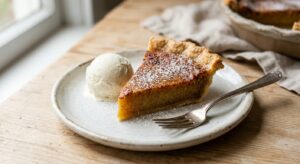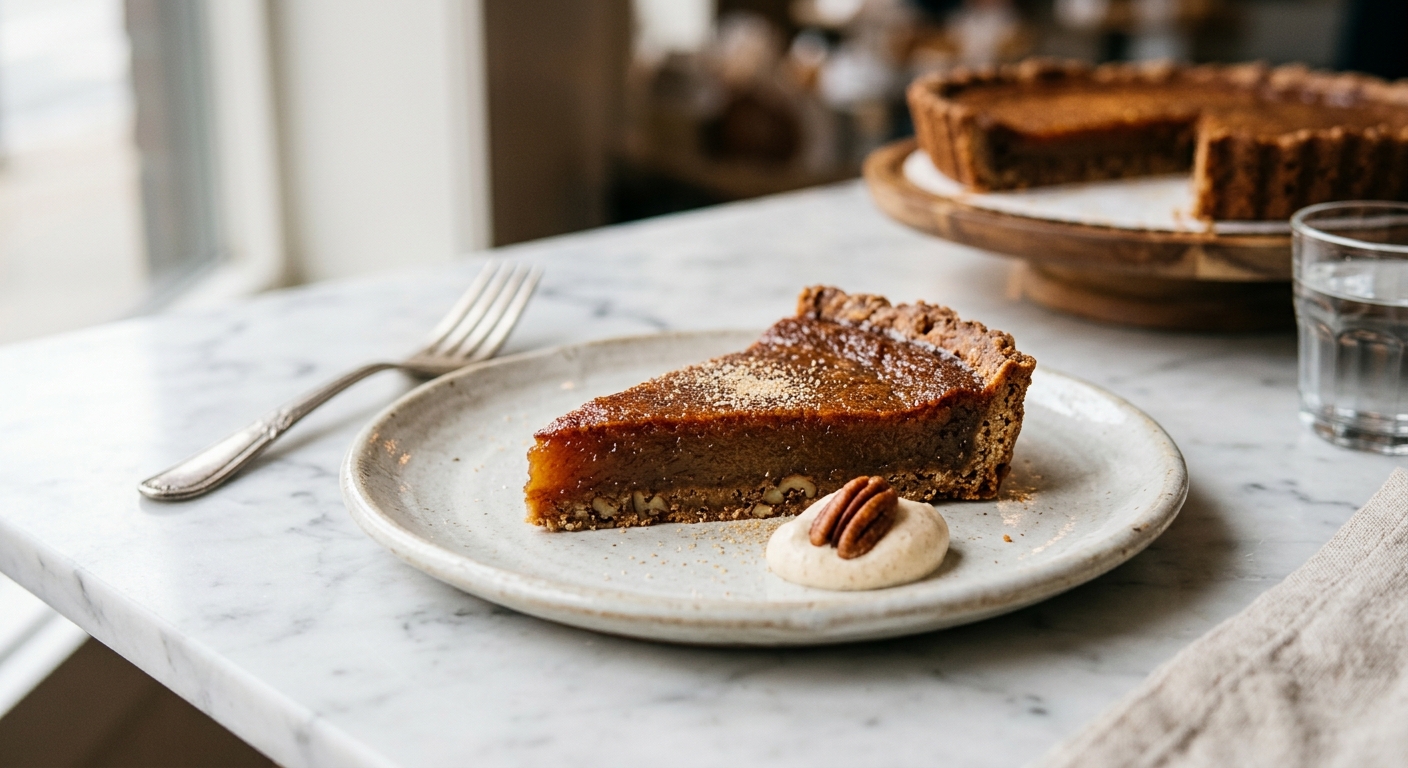
There is a particular kind of magic that happens when maple syrup meets brown butter in a hot pan. The nutty, caramelized depth of the butter mingles with the woodsy sweetness of the maple until you have something that smells like a Saturday morning in a Vermont farmhouse kitchen. That is exactly the foundation of this tart: a glossy, trembling custard with layered flavour that lingers long after the last bite. Set inside a crisp, golden pecan-flecked shortbread shell, it is the kind of dessert that makes a table go quiet.
What sets this tart apart from a standard maple custard is the technique of browning the butter before incorporating it into the filling. Browning drives off the water in butter and toasts the milk solids to a deep amber, developing dozens of new flavour compounds including nuttiness, toffee, and a subtle hint of hazelnut. That complexity, layered against pure maple syrup (not pancake syrup – real, Grade A or Grade B dark maple syrup), creates a custard with genuine depth rather than one-note sweetness. The pecan crust reinforces the toasted notes and adds a satisfying snap beneath the creamy filling.
This is a medium-difficulty recipe, but every step is approachable. If you have blind-baked a tart shell before, you will feel right at home. If you have not, the instructions walk you through it carefully. This tart is ideal for holiday gatherings, dinner parties, or any autumn weekend when you want something genuinely special on the table. It is also a wonderful make-ahead dessert, since it actually improves after a night in the refrigerator.
Equipment Needed
Click on an item below to shop for the recommended items for this recipe on Amazon.
As an Amazon Associate, we earn from qualifying purchases.
10
Ingredients
- Crust
- 130 graw pecans (about 1 cup), toasted and cooled
- 180 gall-purpose flour (about 1.5 cups, spooned and leveled)
- 40 gpowdered sugar (about 1/3 cup), sifted
- 0.5 tspColima Sea SaltMicroplastic Free Salt, divided
- 113 gunsalted butter (1 stick / 8 tbsp), cold and cut into cubes
- 1 largeegg yolk
- Filling
- 2 tbspice water, added one tablespoon at a time
- 113 gunsalted butter (1 stick / 8 tbsp)
- 240 mlpure maple syrup, Grade A Dark or Grade B (about 3/4 cup plus 2 tbsp), at room temperature
- 180 mlheavy cream (about 3/4 cup), at room temperature
- 3 largeeggs, at room temperature
- 2 largeegg yolks, at room temperature
- 1 tsppure vanilla extract
- 0.25 tspColima Sea SaltMicroplastic Free Salt
- —Colima Sea SaltMicroplastic Free Salt
- —Lightly whipped cream or creme fraiche, to serve
Ingredient Substitutions
Instructions
- Make the pecan crust: pulse the toasted pecans in a food processor until they resemble coarse sand, about 12 to 15 pulses. Do not over-process into nut butter. Add the flour, powdered sugar, and 1/4 tsp of the sea salt and pulse 4 to 5 times to combine. Add the cold cubed butter and pulse until the mixture resembles damp, pebbly sand with no large butter chunks visible, about 10 to 12 pulses. Add the egg yolk and 1 tablespoon of ice water and pulse until the dough just barely comes together. It should hold when pinched. Add the second tablespoon of ice water only if needed.
- Turn the dough out onto a lightly floured surface and press it into a flat disc. Do not knead. Wrap in plastic wrap and refrigerate for at least 30 minutes or up to 2 days. Meanwhile, preheat your oven to 375°F (190°C).
- Roll the chilled dough out on a lightly floured surface to about 12 inches in diameter and 3mm thick. Transfer carefully to a 9-inch fluted tart pan with a removable bottom, pressing the dough gently into the flutes. Trim the overhang flush with the top of the pan. Freeze the lined tart shell for 15 minutes.
- Blind-bake the crust: line the frozen tart shell with parchment paper and fill with pie weights or dried beans. Bake at 375°F (190°C) for 18 to 20 minutes, until the edges are set and lightly golden. Remove the weights and parchment and bake for another 5 minutes until the base looks dry and pale golden. Set aside. Reduce oven temperature to 325°F (165°C).
- Make the brown butter: in a light-coloured saucepan over medium heat, melt the 113g of butter for the filling. Swirl the pan occasionally and cook until the butter foams, then the foam subsides, and the milk solids at the bottom turn deep golden brown and smell nutty and toasty, about 6 to 8 minutes. Pour immediately into a heatproof bowl or measuring cup (scraping in all the browned bits) to stop cooking. Let cool for 10 minutes.
- Make the filling: in a large bowl, whisk together the maple syrup, heavy cream, whole eggs, egg yolks, vanilla extract, and 1/4 tsp fine sea salt until smooth and fully combined. Slowly drizzle in the cooled brown butter while whisking constantly. Strain the custard through a fine mesh sieve into a large measuring cup or pitcher with a spout.
- Place the par-baked tart shell (still in its pan) on a rimmed baking sheet. Slide it into the oven, then carefully pour the custard filling into the shell until it reaches just below the rim. (Pouring the filling after placing the shell in the oven prevents spills when transporting.) Bake at 325°F (165°C) for 28 to 32 minutes, until the edges are fully set and the centre has a gentle wobble about 2 inches wide, like a soft-set gelatin. Do not overbake.
- Remove from the oven and let the tart cool completely at room temperature for at least 1 hour, then refrigerate for a minimum of 2 hours (preferably overnight) before slicing. Sprinkle with flaky sea salt just before serving. Serve with lightly whipped cream or creme fraiche.
- Make the no-bake pecan crust: pulse the toasted pecans in a food processor until finely ground. Add 160g of graham cracker crumbs (or digestive biscuit crumbs), 40g of powdered sugar, and 1/4 tsp fine sea salt. Pulse to combine. Add 85g of melted unsalted butter and pulse until the mixture is evenly moistened and holds when pressed. Press firmly and evenly into the bottom and up the sides of a 9-inch fluted tart pan with a removable bottom. Freeze for 20 minutes until solid.
- Bloom the gelatin: sprinkle 2.25 tsp (one standard 7g packet) of unflavored powdered gelatin over 3 tablespoons of cold water in a small bowl. Let sit for 5 minutes without stirring until the gelatin absorbs the water and looks spongy.
- Brown the butter using the same method as the oven version: melt 113g unsalted butter in a light-coloured saucepan over medium heat, swirling occasionally, until the milk solids turn deep golden brown and smell nutty, about 6 to 8 minutes. Pour immediately into a heatproof bowl with all the browned bits.
- Make the stovetop custard: in a medium saucepan, whisk together the maple syrup, heavy cream, 3 whole eggs, 2 egg yolks, vanilla, and 1/4 tsp fine sea salt. Cook over medium-low heat, stirring constantly with a wooden spoon or heatproof spatula, until the custard thickens enough to coat the back of the spoon and reaches 170 to 175°F (77 to 80°C) on an instant-read thermometer, about 8 to 12 minutes. Do not let it boil or the eggs will scramble.
- Remove the custard from the heat and immediately whisk in the bloomed gelatin until completely dissolved, about 1 minute. Then slowly whisk in the brown butter in a thin stream. Strain the custard through a fine mesh sieve into a large measuring cup. Let cool at room temperature for 20 minutes, stirring occasionally, until the mixture is still pourable but no longer hot to the touch.
- Pour the cooled custard into the frozen tart shell. Refrigerate uncovered for at least 3.5 hours, or overnight, until fully set and sliceable. Finish with flaky sea salt and serve cold with whipped cream.
Nutrition Per Serving
Per 1 serving (makes one 9-inch round tart)
Why This Recipe Works
The custard in this tart is a classic baked egg custard, which relies on the proteins in eggs coagulating when heated to create a smooth, sliceable gel. Whole eggs provide structure through both the whites and yolks, while the additional egg yolks add richness and a more velvety texture because yolks contain fat and lecithin, which acts as an emulsifier. Baking at the relatively low temperature of 325°F (165°C) is intentional: high heat causes egg proteins to contract violently, resulting in a curdled, weepy custard. Low and slow allows the proteins to set gently and evenly from the outside in, which is why that central wobble is your doneness cue rather than a fully solid filling.
Browning the butter is not just a flavour choice, it is a form of flavour engineering. When butter is heated past the point where water evaporates, the milk solids undergo the Maillard reaction, the same family of browning reactions responsible for the crust on bread or the sear on steak. This creates hundreds of new aromatic compounds. In brown butter, the dominant notes are diacetyl (buttery, nutty) and furanones (caramel, toffee). These compounds harmonize with the volatile esters and aldehydes in real maple syrup to create a filling that tastes far more complex than the sum of its parts. This is also why the quality of your maple syrup matters so much: imitation syrup is almost entirely high-fructose corn syrup with artificial flavoring and will not provide the same aromatic complexity.
If your custard filling cracks on top, it was overbaked or the oven was too hot. A thin surface crack can be disguised with flaky salt and a dollop of cream, but a deeply cracked, sunken filling means the proteins have over-set. For next time, trust the wobble test and consider using an oven thermometer, as home ovens frequently run 15 to 25 degrees hotter than the dial suggests. If your crust slumps during blind-baking, it was not cold enough when it went into the oven. Freezing the lined shell for 15 minutes keeps the fat solid and the structure intact long enough for the proteins in the flour to set before the fat melts.
Baker’s Tips
- Use a light-coloured stainless steel or enameled saucepan to brown the butter. In a dark non-stick pan you cannot see the colour of the milk solids and it is very easy to burn.
- Bring your eggs and cream to room temperature before making the filling. Cold ingredients mixed together can cause the warm brown butter to seize or create an uneven emulsion.
- Do not skip straining the custard through a fine mesh sieve. This catches any accidentally scrambled egg bits and removes the chalazae (the white stringy bits), resulting in a perfectly smooth filling.
- Pouring the filling after the tart shell is already on the oven rack prevents the risk of spilling a full cup of liquid custard while walking across the kitchen.
- Let the tart cool fully before refrigerating. Putting a hot custard in the fridge creates condensation on the surface and can cause uneven setting.
- A sharp, thin-bladed knife dipped in hot water and wiped dry between cuts gives you clean, professional slices.
Variations
- Bourbon Maple Tart: Add 2 tablespoons of good bourbon to the custard filling along with the vanilla. It deepens the caramel notes significantly.
- Spiced version: whisk 1/2 tsp ground cinnamon, 1/4 tsp ground ginger, and a pinch of freshly grated nutmeg into the custard for a warmly spiced filling reminiscent of pumpkin pie.
- Chocolate swirl: melt 60g of dark chocolate (70%) and drizzle it over the poured but unbaked custard, then swirl gently with a toothpick before baking.
- Mini tarts: use six 4-inch individual tart pans. Reduce the filling bake time to 18 to 22 minutes at 325°F (165°C).
Troubleshooting & FAQ
My filling is still liquid in the centre after the suggested bake time. What went wrong?
My brown butter smells burnt and looks very dark. Can I still use it?
The crust shrank significantly down the sides during blind-baking. How do I prevent this?
There are small bubbles or a foamy surface on my baked custard. Is it ruined?
My crust is soggy on the bottom even after blind-baking. What can I do differently?
Storage & Make-Ahead
- Storage: Store the tart loosely covered in the refrigerator for up to 4 days. The crust will soften slightly after day 2 but the flavour deepens beautifully. Do not store at room temperature for more than 2 hours, as this is an egg custard tart. Freeze individual slices wrapped tightly in plastic wrap and then foil for up to 1 month; thaw overnight in the refrigerator.
- Make-Ahead: This tart is an excellent make-ahead dessert. The tart shell can be blind-baked up to 2 days ahead and stored at room temperature, loosely wrapped. The fully assembled and baked tart can be made up to 2 days in advance and refrigerated; the flavour is noticeably better on day 2. For the no-bake version, the crust can be pressed and frozen up to 3 days ahead.