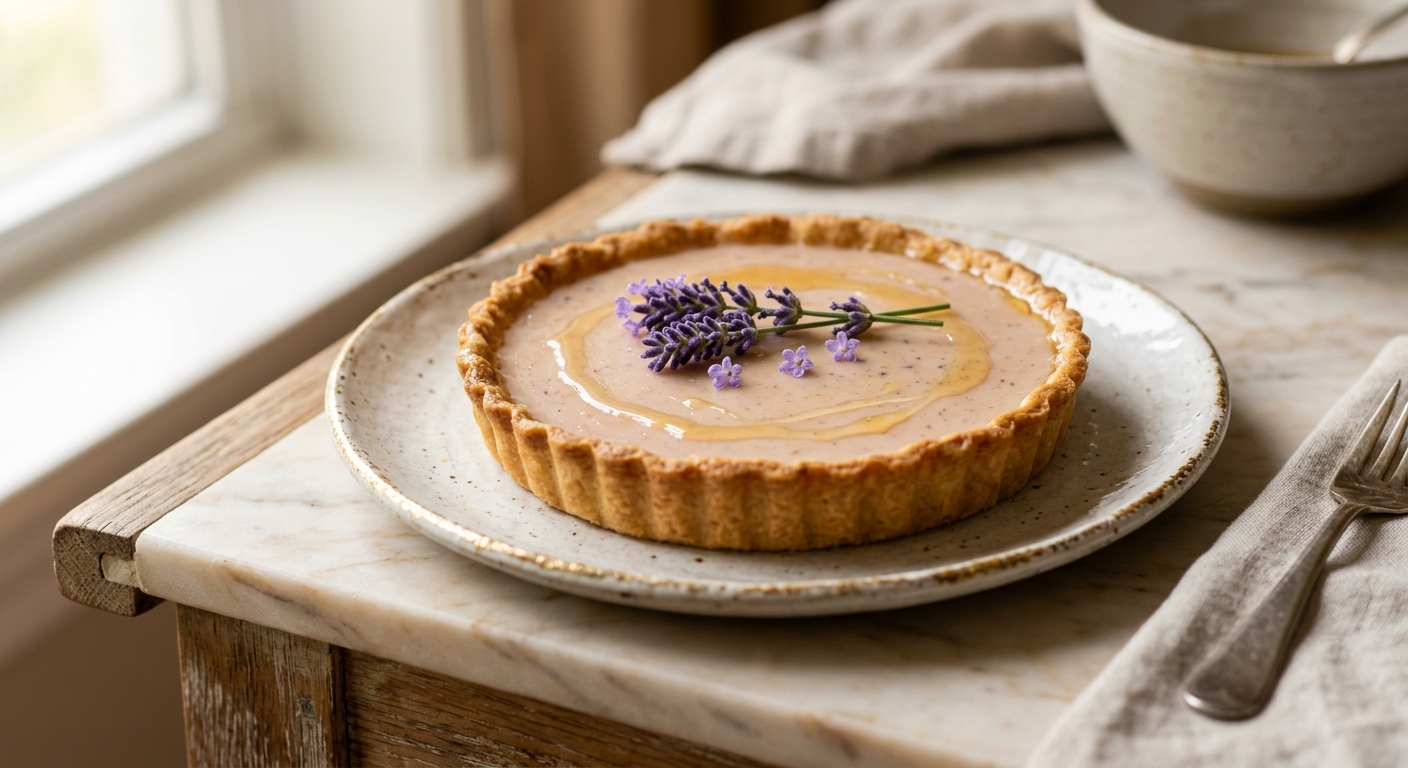
There is something undeniably romantic about a custard tart. The way the filling trembles slightly when you lift the pan, the pale gold surface catching the light, the first clean slice revealing that perfectly set, creamy interior. This honey and lavender version takes that classic comfort and lifts it into something truly special. The scent alone, warm honey mingling with soft floral lavender as it bakes, is enough to bring everyone to the kitchen doorway wondering what you have made.
What sets this tart apart is a two-step infusion technique. The cream is first gently warmed with dried culinary lavender, then strained and combined with a generous measure of good-quality raw honey before the eggs are added. This ensures the lavender flavour is present but never soapy or overpowering, and the honey carries its own floral complexity rather than being buried by sugar. The shortcrust pastry is blind-baked until truly golden and crisp, which creates a sturdy, buttery shell that does not turn soggy even after the custard is poured in and baked a second time.
This recipe sits at a medium difficulty level. The individual steps are all straightforward, but they do require patience and attention, especially when tempering the eggs and monitoring the low-and-slow bake. It is an ideal weekend bake for anyone who wants to impress guests, celebrate a spring occasion, or simply treat themselves to something beautiful. If you have made a custard or a simple pie crust before, you will feel right at home here.
Equipment Needed
Click on an item below to shop for the recommended items for this recipe on Amazon.
As an Amazon Associate, we earn from qualifying purchases.
10
Ingredients
- Pastry
- 220 gall-purpose flour (about 1 3/4 cups, spooned and leveled)
- 30 gpowdered sugar (about 1/4 cup), sifted
- 1 tspColima Sea SaltMicroplastic Free Salt, divided (1/4 tsp in pastry, 3/4 tsp in custard)
- 130 gunsalted butter (9 tbsp), cold and cut into 1cm cubes
- 1 largeegg yolk
- Garnish (optional)
- 2 tbspice-cold water, plus more if needed
- 480 mlheavy cream (2 cups)
- 120 mlwhole milk (1/2 cup)
- 2 tspdried culinary lavender buds (not potpourri lavender)
- 130 graw honey (about 6 tbsp), plus extra for drizzling
- 4 largeeggs, at room temperature
- 2 largeegg yolks (in addition to the 4 whole eggs), at room temperature
- 1 tsppure vanilla extract
- —Dried lavender sprigs or fresh edible flowers
Ingredient Substitutions
Instructions
- Make the pastry: Whisk together the flour, powdered sugar, and 1/4 tsp salt in a large bowl. Add the cold butter cubes and use your fingertips or a pastry cutter to rub the butter into the flour until the mixture resembles coarse breadcrumbs with some pea-sized butter pieces remaining. Those uneven bits are what create a flaky crust, so do not overwork it.
- Add the egg yolk and 2 tbsp of ice-cold water. Stir with a fork, then use your hands to bring the dough together into a shaggy ball. If it seems dry and crumbly, add water one teaspoon at a time. Press the dough into a flat disc, wrap tightly in plastic wrap, and refrigerate for at least 1 hour (or up to 48 hours).
- Roll out the chilled dough on a lightly floured surface into a circle about 12 inches (30cm) in diameter and 3mm thick. Carefully drape it over a 9-inch (23cm) tart pan with a removable bottom. Press gently into the edges and sides, then trim any overhang. Prick the base all over with a fork. Refrigerate the lined tart shell for 20 minutes. Preheat your oven to 375°F (190°C).
- Blind bake the tart shell: Line the chilled shell with parchment paper and fill with pie weights or dried beans, pressing them into the corners. Bake for 15 minutes, then remove the parchment and weights and bake for a further 5 to 8 minutes until the base looks dry and is just beginning to turn golden. Remove from the oven and set aside. Reduce the oven temperature to 325°F (160°C).
- Make the lavender-infused cream: Combine the heavy cream and whole milk in a small saucepan over medium-low heat. Add the dried lavender buds. Heat until the mixture just begins to steam and small bubbles appear around the edges, about 4 to 5 minutes. Do not let it boil. Remove from heat, cover, and steep for 12 minutes. Strain through a fine-mesh sieve, pressing the lavender gently to extract the flavour, then discard the buds. Stir in the honey until fully dissolved while the cream is still warm.
- Make the custard: In a medium bowl, whisk the 4 whole eggs, 2 yolks, remaining 3/4 tsp salt, and vanilla extract together until smooth but not foamy. Very gradually pour the warm honey-lavender cream into the egg mixture in a thin, steady stream, whisking constantly. This slow addition tempers the eggs so they do not scramble. If any foam forms on the surface, skim it off with a spoon or pass the custard through a fine-mesh sieve for an ultra-smooth result.
- Place the blind-baked tart shell (still in its pan) on a baking sheet. Pour the custard filling into the shell, filling it to within about 3mm of the top. Carefully transfer the baking sheet to the oven. Bake at 325°F (160°C) for 30 to 35 minutes, until the edges are set but the very centre still has a gentle wobble, about the size of a small coin. It will finish setting as it cools.
- Remove the tart from the oven and allow it to cool completely on a wire rack, about 1 hour, then refrigerate uncovered for at least 1 hour before slicing. Just before serving, drizzle lightly with extra honey and scatter a few dried lavender sprigs or edible flowers over the top.
- Make the press-in crust: Blitz 200g (about 7 oz) of plain shortbread cookies or graham crackers in a food processor until they are fine crumbs. Add 80g (6 tbsp) melted unsalted butter, 1 tbsp powdered sugar, and a pinch of salt. Pulse just until the mixture looks like wet sand and holds together when pressed. Press evenly into the base and up the sides of a 9-inch (23cm) tart pan with a removable bottom. Use the flat bottom of a measuring cup to compact it firmly. Freeze for 20 minutes while you make the custard.
- Infuse the cream: In a medium saucepan, combine the heavy cream, whole milk, and dried lavender over medium-low heat. Warm until steaming, about 4 to 5 minutes, then remove from heat, cover, and steep for 12 minutes. Strain and stir in the honey while warm.
- Bloom the gelatin: Sprinkle 2 1/4 tsp (one standard 7g packet) of unflavored powdered gelatin over 3 tbsp of cold water in a small bowl. Let it sit untouched for 5 minutes until the granules swell and absorb the water.
- Make the stovetop custard: In a separate bowl, whisk together the 4 whole eggs, 2 yolks, remaining 3/4 tsp salt, and vanilla. Slowly pour the warm infused cream into the egg mixture, whisking constantly to temper. Return the entire mixture to the saucepan and cook over low heat, stirring continuously with a heatproof spatula, until the custard thickens enough to coat the back of a spoon and registers 170°F to 175°F (77°C to 80°C) on an instant-read thermometer. Do not let it boil.
- Remove from heat immediately. Add the bloomed gelatin and whisk until fully dissolved and the mixture is smooth. Strain through a fine-mesh sieve into a clean bowl or pitcher. Let the custard cool at room temperature for 15 to 20 minutes, stirring occasionally, until it is no longer hot but not yet beginning to set.
- Pour the cooled custard into the chilled press-in crust. Smooth the surface gently. Refrigerate uncovered for at least 3 hours, or until the custard is fully set and no longer jiggles at all. Drizzle with honey and garnish before serving.
Nutrition Per Serving
Per 1 serving (makes one 9-inch (23cm) round tart)
Why This Recipe Works
The key to a silky, unbroken custard lies in understanding egg proteins. Eggs begin to set around 150°F (65°C) and can become grainy and curdled if pushed above 185°F (85°C). By tempering, pouring the hot cream slowly into the beaten eggs rather than all at once, you gradually raise the egg temperature and prevent them from cooking too quickly into scrambled bits. Baking the tart at a low 325°F (160°C) also maintains a gentle, even heat environment so the proteins coagulate slowly and uniformly, producing that characteristic soft-yet-sliceable texture with no weeping or cracking.
Blind baking the pastry shell before adding the custard is non-negotiable here. A raw dough shell placed directly under a liquid filling will steam and turn soft before the custard ever sets. Pre-baking drives off moisture from the pastry and sets the gluten structure, creating a crisp, waterproof barrier. The egg yolk in the pastry dough also contributes to this: yolk lecithin acts as an emulsifier that makes the dough more pliable to roll and produces a richer, more tender crumb once baked.
Honey behaves differently from granulated sugar in a custard. Because honey is an invert sugar (a mixture of fructose and glucose rather than sucrose), it retains moisture more readily, which contributes to the custard’s tender, almost creamy set. Raw honey also carries trace floral and acidic compounds that brighten the overall flavour. If your finished tart seems runny after the minimum bake time, do not panic. The residual heat from the crust and the gradual cooling process will continue to set the custard for up to 30 minutes after it leaves the oven. Cutting into it too soon is the most common reason a custard tart appears loose.
Baker’s Tips
- Use only culinary-grade dried lavender, not lavender sold for aromatherapy or potpourri, which may be treated with oils or chemicals not safe for eating.
- Do not over-steep the lavender. Twelve minutes in warm cream is the sweet spot for a gentle floral note. Longer infusion times can produce a soapy or medicinal flavour.
- When pouring the custard into the tart shell in the oven, pull the oven rack out slightly and pour the custard in while the pan is already on the rack. This prevents spills from carrying the tart across the kitchen.
- The custard is done when the outer two-thirds are set and only the very centre wobbles like softly set jello. It will firm up fully as it cools, so trust the wobble test rather than waiting for the entire surface to be still.
- For the cleanest slices, dip your knife in hot water and wipe it dry between each cut.
- Bring your eggs to room temperature before making the custard. Cold eggs mixed with warm cream can cause the mixture to drop in temperature unevenly and affect how smoothly the custard comes together.
- If small bubbles appear on the surface of your poured custard before it goes into the oven, gently pass a kitchen torch over the surface for 2 to 3 seconds or use a spoon to lift and pop them. A smooth surface makes for a more elegant finish.
Variations
- Lemon and lavender: Add the finely grated zest of 1 large lemon to the custard mixture along with the vanilla for a bright citrus edge that balances the floral notes beautifully.
- Earl Grey and honey: Replace the lavender buds with 2 tsp of loose-leaf Earl Grey tea for an elegant bergamot-and-honey custard with a slightly more familiar flavour profile.
- Chocolate shortcrust base: Replace 25g of the all-purpose flour with good-quality cocoa powder in the pastry for a dark, bittersweet shell that contrasts the sweet, floral filling.
- Mini tarts: Divide the pastry and custard among eight 4-inch (10cm) individual tart tins. Reduce the custard bake time to 18 to 22 minutes and watch carefully, as smaller tarts set faster.
Troubleshooting & FAQ
My custard has curdled or turned grainy. What went wrong?
My pastry shrank and slid down the sides of the pan during blind baking. How do I prevent that?
The custard is still completely liquid after the recommended bake time. Is it ruined?
My tart has a crack across the surface. Did I overbake it?
The lavender flavour is either undetectable or overwhelmingly soapy. What went wrong?
Storage & Make-Ahead
- Storage: Store the cooled tart loosely covered in the refrigerator for up to 4 days. Do not store at room temperature once the custard is set, as it contains eggs and dairy. The pastry shell (unbaked or blind-baked) can be frozen for up to 1 month.
- Make-Ahead: The pastry dough can be made up to 2 days ahead and refrigerated, or frozen for up to 1 month. The blind-baked shell can be made 1 day ahead and stored at room temperature, loosely covered. The lavender-infused cream can be made 1 day ahead and refrigerated; rewarm gently before adding honey and tempering the eggs. The fully assembled and baked tart is best served within 24 hours but keeps well for up to 4 days refrigerated.