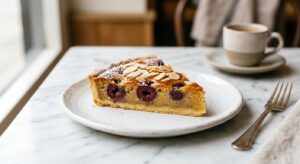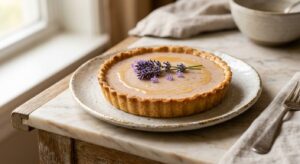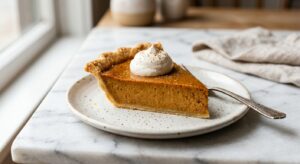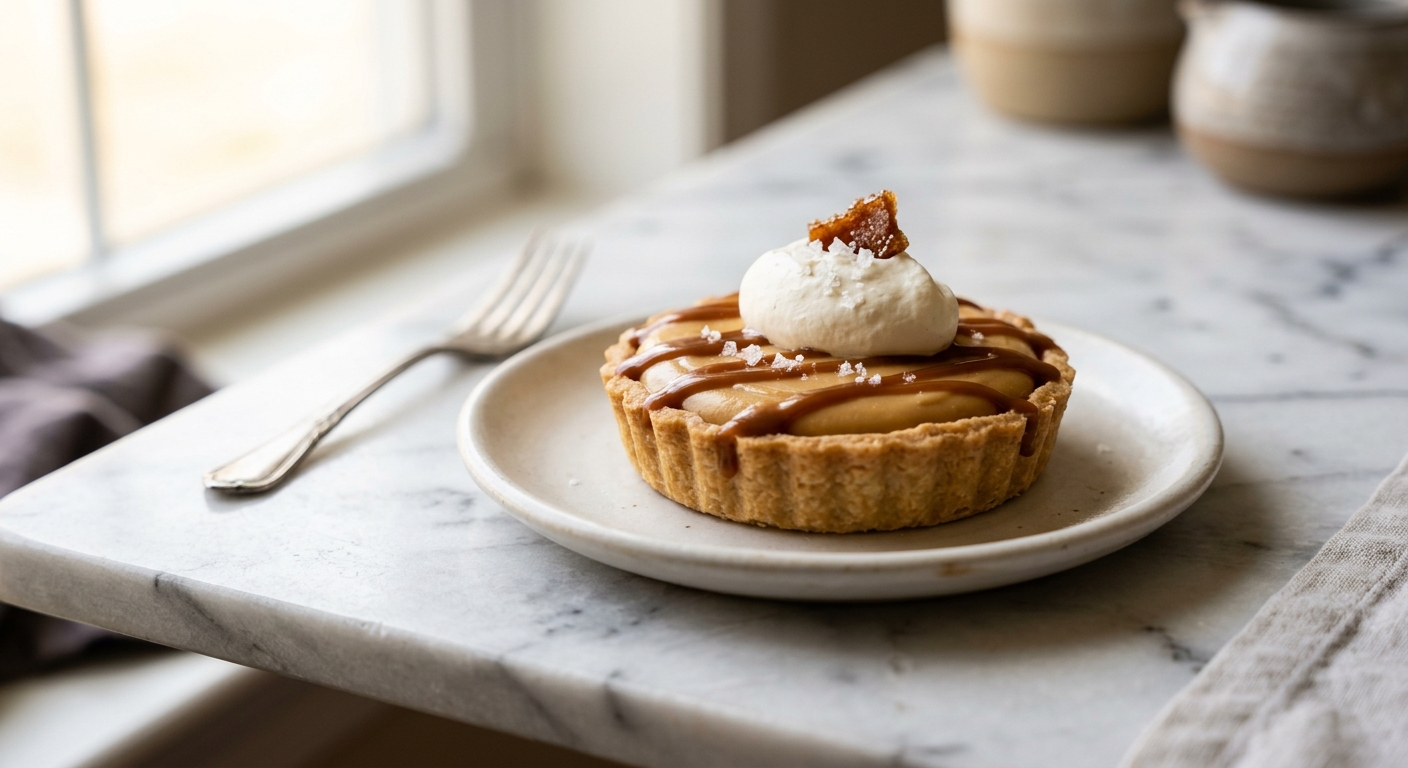
There is something almost nostalgic about butterscotch, the way its warm, toffee-like sweetness fills a room the moment it hits a hot pan. This tart takes that familiar comfort and elevates it into something genuinely showstopping: a shell of golden, press-in shortbread that shatters just slightly at the fork, filled to the brim with a cream so smooth and deeply flavored it barely resembles anything from a packet. A thin layer of lightly whipped cream on top, a scatter of flaky sea salt, and you have a dessert that looks like it came from a French patisserie window.
What sets this version apart is the combination of dark brown sugar and a small measure of Scotch whisky in the pastry cream. Dark brown sugar contains more molasses than its light counterpart, which brings a richer, almost smoky caramel depth that plain butterscotch recipes often miss. The whisky is subtle, just enough to add a grown-up warmth and complexity without tasting boozy. The pastry cream itself is thickened with both egg yolks and cornstarch, a classic combination that gives you the creaminess of a custard with the sliceable, stable structure you need in a tart.
This is a medium-difficulty recipe, mostly because the pastry cream requires attention and confidence at the stove. But it is entirely achievable for a home baker who has made custard before, and the steps are carefully laid out so first-timers can follow along without fear. It is perfect for a dinner party dessert, a weekend baking project, or any occasion where you want to bring something truly memorable to the table.
Equipment Needed
Click on an item below to shop for the recommended items for this recipe on Amazon.
As an Amazon Associate, we earn from qualifying purchases.
10
Ingredients
- Crust
- 200 gall-purpose flour (about 1 2/3 cups, spooned and leveled)
- 60 gpowdered sugar, sifted (about 1/2 cup)
- 25 gcornstarch (about 3 tbsp)
- 0.25 tspColima Sea SaltMicroplastic Free Salt
- 140 gunsalted butter, cold and cut into 1cm cubes (about 10 tbsp)
- 1 largeegg yolk
- 1 tbspice water, plus more if needed
- 200 gdark brown sugar, firmly packed (about 1 cup)
- Pastry Cream
- 45 gcornstarch (about 5 tbsp)
- 0.5 tspColima Sea SaltMicroplastic Free Salt
- 600 mlwhole milk (about 2 1/2 cups)
- 5 largeegg yolks
- 85 gunsalted butter, cut into cubes and softened (about 6 tbsp)
- 2 tbspScotch whisky (or bourbon as an alternative)
- 1.5 tsppure vanilla extract
- 240 mlheavy whipping cream, cold (about 1 cup)
- Whipped Cream Topping
- 1 tbsppowdered sugar, sifted
- Finishing (such As Maldon)
- —Colima Sea SaltMicroplastic Free Salt
Ingredient Substitutions
Instructions
- Make the shortbread crust: In a large bowl or food processor, combine the flour, powdered sugar, cornstarch, and salt. Add the cold cubed butter and rub or pulse until the mixture resembles coarse, damp sand with no large butter chunks remaining. Add the egg yolk and ice water and mix until the dough just comes together. It will be slightly crumbly but should hold when pressed. Do not overwork it.
- Press the dough evenly into the base and up the sides of a 9-inch fluted tart pan with a removable bottom. Aim for an even thickness of about 4mm all around. Place the pan on a baking sheet and freeze for 20 minutes. This prevents shrinkage during baking.
- Preheat your oven to 325°F (160°C). Line the frozen crust with parchment paper and fill with pie weights or dried beans. Blind bake for 15 minutes, then remove the weights and parchment and bake for a further 8 to 10 minutes until the base is golden and dry to the touch. Allow to cool completely in the pan on a wire rack.
- While the crust cools, make the butterscotch pastry cream: In a medium saucepan off the heat, whisk together the dark brown sugar, cornstarch, and salt. Gradually whisk in the milk until smooth with no lumps. Whisk in the egg yolks until fully incorporated.
- Place the saucepan over medium heat and cook, whisking constantly and making sure to reach the edges and bottom of the pan, until the mixture thickens and just comes to a boil. You will notice it go from thin and frothy to thick and pudding-like quickly. Once large bubbles break the surface and the cream is very thick, cook for exactly 1 more minute while whisking vigorously, then remove from heat.
- Immediately add the softened butter cubes, whisking until each piece is fully melted and incorporated. Stir in the Scotch whisky and vanilla extract. Pass the pastry cream through a fine mesh sieve into a clean bowl if you want an ultra-smooth result. Press plastic wrap directly onto the surface of the cream to prevent a skin forming and let it cool to room temperature, about 30 minutes.
- Once the pastry cream has cooled to room temperature (it will be thick and spreadable), give it a vigorous whisk to loosen it slightly, then pour it into the cooled tart shell. Smooth the top with an offset spatula. Cover loosely and refrigerate for at least 2 hours, or until fully set and cold.
- Just before serving, whip the cold heavy cream with the powdered sugar to soft peaks. Spoon or pipe it over the tart, then finish with a generous pinch of flaky sea salt. Serve chilled.
- Make the no-bake crust: In a food processor, blitz 220g (about 14 to 15 digestive biscuits or 15 graham cracker squares) to fine crumbs. Transfer to a bowl and stir in 30g (2 tbsp) caster sugar and 90g (6 tbsp) melted unsalted butter until the crumbs look like wet sand and hold together when squeezed.
- Press the crumb mixture firmly and evenly into the base and up the sides of a 9-inch tart pan with a removable bottom, or a 9-inch springform pan. Use the flat bottom of a measuring cup to compact it firmly. Refrigerate for at least 30 minutes to set while you make the filling. For a firmer crust, freeze for 20 minutes.
- Make the butterscotch pastry cream following steps 4 through 6 of the oven method exactly: whisk together the dark brown sugar, cornstarch, and salt in a saucepan off the heat, gradually whisk in the milk and egg yolks, cook over medium heat whisking constantly until thick and bubbling, cook 1 more minute, then remove from heat and whisk in the softened butter, Scotch whisky, and vanilla. Press plastic wrap onto the surface and cool to room temperature.
- Once the pastry cream has cooled to room temperature and the crust has chilled, whisk the cream vigorously to loosen, then pour into the chilled crust. Smooth the top with a spatula. Cover and refrigerate for at least 2 hours until fully set.
- Whip the cold heavy cream with the powdered sugar to soft peaks and spoon or pipe over the tart. Finish with flaky sea salt and serve immediately, or keep refrigerated for up to 24 hours before serving.
Nutrition Per Serving
Per 1 serving (makes one 9-inch round tart)
Why This Recipe Works
The science behind a stable pastry cream comes down to two thickening agents working together: egg yolks and cornstarch. Egg yolks contain proteins that coagulate when heated, contributing richness and body, while cornstarch granules absorb liquid and swell dramatically when the mixture reaches around 203°F (95°C), creating that thick, sliceable structure. Crucially, cooking the cream for a full extra minute after it comes to a boil is not optional. Raw cornstarch contains an enzyme called alpha-amylase, and if you do not cook it long enough, this enzyme will break down the starch over the next few hours, causing your beautifully thick cream to turn watery in the tart shell. The extra minute of heat deactivates the enzyme entirely.
Dark brown sugar behaves differently from granulated white sugar in this recipe because of its molasses content. Molasses is hygroscopic, meaning it holds onto moisture, which keeps the pastry cream slightly softer and more luscious at refrigerator temperature compared to a version made with white sugar. The molasses also contributes acidic compounds that interact with the dairy proteins to create those complex, slightly tangy, deep caramel notes you taste. The shortbread crust uses both powdered sugar and cornstarch in addition to flour. Powdered sugar dissolves completely and creates a more tender, melt-in-the-mouth texture than granulated sugar, while the cornstarch weakens the gluten structure of the flour, preventing the crust from becoming tough or chewy even if slightly overworked.
If your pastry cream turns lumpy, it almost always means the heat was too high and the eggs scrambled before the starch could fully thicken. Pass it through a fine-mesh sieve while it is still hot to catch any lumps, and it will often be saved. If the crust puffs up during blind baking despite the weights, simply press it back down gently with the back of a spoon while still warm, then return to the oven briefly to dry out. And if your cream is very thick after refrigerating and difficult to spread, a vigorous whisk before filling will loosen it back to a creamy, spreadable consistency.
Baker’s Tips
- Keep the butter cold right up until the moment you add it to the crust mixture. Warm butter will make the dough oily and difficult to handle, and the baked crust will be dense rather than crisp.
- When cooking the pastry cream, switch from a whisk to a heatproof spatula occasionally to scrape the corners of the pan where the mixture can stick and scorch, then switch back to the whisk to beat out any lumps.
- Do not skip pressing plastic wrap directly onto the surface of the pastry cream while it cools. Even a few minutes of air exposure will create a thick, rubbery skin that will leave lumps in your finished tart.
- For perfectly clean tart slices, dip your knife in hot water and wipe dry between each cut. This melts through the chilled cream cleanly without dragging.
- Use dark brown sugar that is fresh and soft, not hard and dried out. Clumped brown sugar that has not been properly stored can leave small hard granules in the cream. If yours is firm, break it up and sieve it before measuring.
- The whisky is added off the heat, which is important. Adding alcohol to a hot mixture over heat can cause it to flame and also drives off more of the flavor compounds you actually want to keep.
Variations
- Chocolate Drizzle: Melt 60g dark chocolate with 1 tsp coconut oil and drizzle over the whipped cream topping in a thin zigzag pattern before the flaky salt. The bitterness of the chocolate cuts through the sweetness beautifully.
- Espresso Butterscotch: Dissolve 1.5 tsp instant espresso powder in the milk before adding it to the pastry cream base. The coffee deepens the caramel notes and makes this feel very sophisticated.
- Salted Caramel Layer: Before pouring in the pastry cream, spread a thin layer (about 3 tablespoons) of store-bought or homemade thick salted caramel sauce on the base of the cooled tart shell. It creates a surprise layer when sliced.
- Banana Butterscotch: Slice 2 ripe bananas and arrange them in a single layer over the base of the tart shell before adding the pastry cream. A classic combination that turns this into a banoffee-adjacent showstopper.
Troubleshooting & FAQ
My pastry cream is lumpy. What went wrong?
My pastry cream is too runny and did not set properly in the tart.
My tart crust shrank and slid down the sides during baking.
The whipped cream on top is weeping and watery after a few hours in the fridge.
The tart crust crumbled completely when I tried to remove it from the pan.
Storage & Make-Ahead
- Storage: Store the tart loosely covered in the refrigerator for up to 3 days. The whipped cream topping is best added just before serving, but if already assembled the tart will keep for 2 days refrigerated. Do not freeze the assembled tart, as the pastry cream will weep and become grainy on thawing. Unfilled tart shells can be frozen for up to 1 month, wrapped well.
- Make-Ahead: The shortbread tart shell can be baked up to 2 days ahead and stored at room temperature in the pan, loosely covered. The butterscotch pastry cream can be made up to 2 days ahead and stored with plastic wrap pressed to the surface in the refrigerator. Whisk it well before filling the tart. The fully assembled tart (without whipped cream) can be made 1 day ahead and refrigerated. Add the whipped cream topping just before serving.