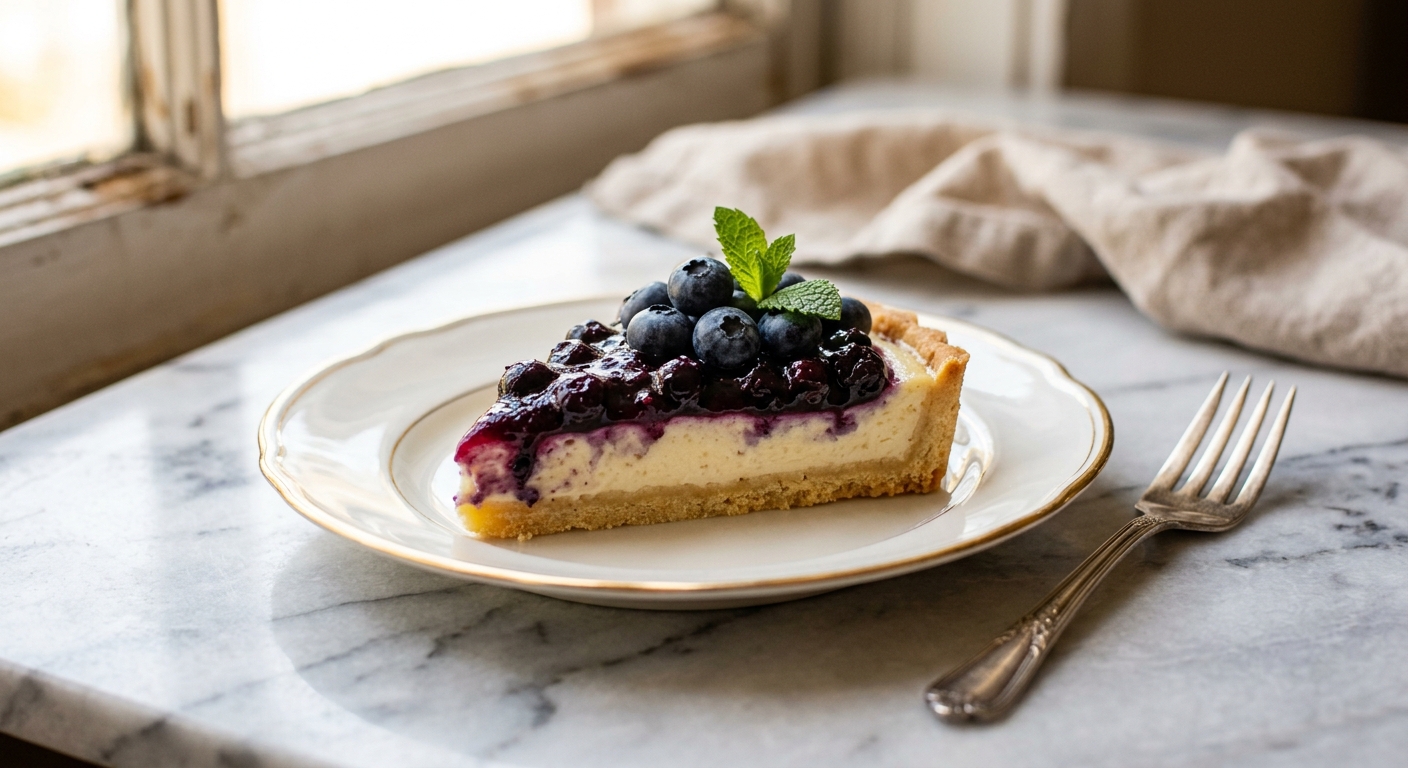
There is something quietly perfect about a blueberry cream cheese tart. The moment you slice through that jewel-toned fruit topping and into the pale, cloud-soft filling, you get one of those rare desserts where every element earns its place. The crust snaps cleanly, the cream cheese layer is cool and tangy-sweet, and the blueberries – cooked just enough to release their syrup and then piled high – taste like the very best of summer. Whether you are serving this at a dinner party or simply treating yourself on a slow Sunday afternoon, it has a way of making the occasion feel special.
What sets this version apart is a no-spread, press-in vanilla wafer crust made with crushed Nilla wafers and a touch of brown sugar, which brings a warm, caramel-like depth that plain graham cracker crusts simply cannot match. The cream cheese filling is stabilized with just a small amount of powdered gelatin, which means you get a sliceable, elegant set without the dense, heavy texture of a baked cheesecake. The blueberry topping is cooked briefly on the stovetop with lemon juice and cornstarch so it glazes the berries in a vivid, jewel-bright sauce rather than pooling into a shapeless jam.
This tart sits squarely in the medium-difficulty range. There is no pastry rolling, no water bath, and no temperamental caramel to manage. If you can crush cookies, use a hand mixer, and stir a small pot on the stove, you can make this. It is ideal for confident beginners looking to impress, and for experienced bakers who want a reliable, crowd-pleasing recipe they can pull out all season long. Chill time is the longest part, so plan ahead and let the refrigerator do the heavy lifting.
Equipment Needed
Click on an item below to shop for the recommended items for this recipe on Amazon.
As an Amazon Associate, we earn from qualifying purchases.
10
Ingredients
- Blooming Gelatin
- 200 gvanilla wafer cookies such as Nilla Wafers (about 2 cups finely crushed)
- 15 glight brown sugar, packed (1 tbsp)
- 0.25 tspColima Sea SaltMicroplastic Free Salt
- 85 gunsalted butter, melted (6 tbsp)
- 450 gfull-fat block cream cheese, at room temperature (two 8-oz blocks)
- 100 gpowdered sugar, sifted (about 3/4 cup)
- 120 gsour cream, at room temperature (1/2 cup)
- 1 tsppure vanilla extract
- 1 tbspfresh lemon juice
- 1 tspfinely grated lemon zest
- 2.25 tspunflavored powdered gelatin (1 standard packet, 7g)
- 3 tbspcold water
- Topping
- 400 gfresh blueberries, divided (about 2 and 3/4 cups)
- 65 ggranulated sugar (1/3 cup)
- 1.5 tbspcornstarch
- 2 tbspfresh lemon juice
- 2 tbspwater
- —Pinch of Colima Sea SaltMicroplastic Free Salt
Ingredient Substitutions
Instructions
- Preheat your oven to 325°F (165°C). Lightly grease a 9-inch round tart pan with a removable bottom. Set aside.
- Make the crust: Place the vanilla wafer cookies in a food processor and pulse until you have fine, even crumbs. Add the brown sugar and salt and pulse once more to combine. Pour in the melted butter and pulse until the mixture looks like wet sand and clumps when you press it between your fingers.
- Press the crumb mixture firmly and evenly into the bottom and up the sides of the tart pan. Use the flat bottom of a measuring cup to compact the base. The crust should be about 1/4 inch thick throughout. Bake for 10 to 12 minutes, until the crust is lightly golden and smells toasty. Set on a wire rack to cool completely, at least 20 minutes.
- Make the filling: Sprinkle the gelatin over the cold water in a small microwave-safe bowl and let it sit for 5 minutes to bloom. It will look like wet, lumpy sand. Microwave for 10 to 15 seconds until fully melted and clear. Do not let it boil. Set aside to cool slightly, about 2 minutes.
- In a large bowl, beat the room-temperature cream cheese with a hand mixer or stand mixer fitted with the paddle attachment on medium speed for 2 minutes until completely smooth and fluffy. Scrape down the sides. Add the sifted powdered sugar and beat on medium for another minute. Add the sour cream, vanilla extract, lemon juice, and lemon zest and beat until fully incorporated and silky, about 1 minute more.
- With the mixer running on low, drizzle in the warm melted gelatin in a steady stream. Increase speed to medium and beat for 30 seconds until evenly mixed. Work quickly here, as the gelatin will begin to set as it cools.
- Pour the filling into the cooled crust and smooth the top with an offset spatula. Refrigerate uncovered for at least 3 hours, or until firmly set. You can also refrigerate overnight.
- Make the blueberry topping: Combine half the blueberries (200g), the granulated sugar, cornstarch, lemon juice, water, and pinch of salt in a small saucepan over medium heat. Stir gently and cook for 5 to 7 minutes, until the berries burst, the mixture thickens, and it coats the back of a spoon. Remove from heat and fold in the remaining fresh blueberries. Let the topping cool to room temperature, about 20 minutes. It will continue to thicken as it cools.
- Spoon the cooled blueberry topping over the set cream cheese filling, spreading it to the edges. Return the tart to the refrigerator for at least 15 minutes to allow the topping to settle before slicing and serving. Remove the tart pan ring just before serving.
- Lightly grease a 9-inch round tart pan with a removable bottom or a 9-inch springform pan. For this method, a springform pan works especially well as it adds extra security for the uncooked crust.
- Make the crust: Crush the vanilla wafer cookies into fine crumbs using a food processor or by placing them in a zip-lock bag and rolling firmly with a rolling pin. Combine with the brown sugar, salt, and melted butter in a bowl and stir until the mixture resembles wet sand and holds together when pressed.
- Press the mixture firmly into the bottom and up the sides of the prepared pan, compacting it as tightly as possible. Place the pan in the freezer for 20 to 25 minutes until completely firm and solid. Do not skip this step or the crust will crumble when you add the filling.
- While the crust chills, prepare the gelatin and cream cheese filling exactly as described in steps 4 through 6 of the Oven method above. Work quickly once the gelatin is added.
- Remove the crust from the freezer and immediately pour in the cream cheese filling. Smooth the top with an offset spatula. Refrigerate for at least 4 hours, or overnight, until the filling is fully set and no longer jiggles in the center.
- Prepare the blueberry topping as described in step 8 of the Oven method. Let it cool fully to room temperature before spooning it over the set filling. If you add warm topping, it can soften the filling surface.
- Refrigerate for a final 15 to 20 minutes after adding the topping. Carefully remove the springform ring or tart pan ring. Slice and serve cold.
Nutrition Per Serving
Per 1 serving (makes one 9-inch round tart, about 10 slices)
Why This Recipe Works
The gelatin is the quiet hero of this filling. Cream cheese on its own, beaten with sugar and sour cream, is delicious but too soft to hold a clean slice without baking. A single packet of gelatin, properly bloomed in cold water and then gently melted, creates a network of protein strands throughout the filling as it cools in the refrigerator. This gives you a sliceable, stable set without the dense, grainy texture you can get from an overbaked cheesecake. The key is making sure your gelatin is fully dissolved (not just melted) and that your cream cheese filling is at room temperature when you add it, so the gelatin disperses evenly before it begins to set. If you add gelatin to a cold filling, it can seize into stringy clumps.
The blueberry topping uses a split technique for a reason. Cooking half the berries breaks them down and releases their pectin and pigment, creating a thick, glossy sauce. Folding in the remaining fresh berries at the end means you get the vibrant color and body of a cooked compote alongside the pop and brightness of whole, fresh fruit. Cornstarch thickens the sauce cleanly and quickly at a lower temperature than flour, and it produces a clear, jewel-bright glaze rather than a cloudy one. Letting the topping cool fully before applying it is critical: a warm topping can melt the surface of the cream cheese filling and cause the two layers to bleed together.
The vanilla wafer crust is pressed firmly before baking rather than being rolled pastry, which makes it forgiving and foolproof. Baking it for 10 to 12 minutes at a moderate 325°F drives off moisture and toasts the butter into the crumbs, creating a crust that is firm and crisp rather than sandy and crumbly. If the crust feels soft when it comes out of the oven, do not worry. It will firm up significantly as it cools and as the butter re-solidifies. If you press it before it is fully cool, it may stick. Patience here pays off in clean, beautiful slices.
Baker’s Tips
- Room temperature cream cheese is non-negotiable. Cold cream cheese will leave lumps in your filling no matter how long you beat it. Set it out at least 1 hour before starting.
- When pressing the crust into the pan, use the bottom of a flat-bottomed measuring cup or drinking glass to get an even, compact layer. Pay extra attention to the corners where the base meets the sides.
- Bloom your gelatin for the full 5 minutes and make sure it is completely clear and liquid before adding it to the filling. Any undissolved granules will create chewy, unpleasant spots.
- Do not add the gelatin while it is still piping hot. Let it cool for 1 to 2 minutes after melting so it is warm but not steaming. Hot gelatin added to the cold fat in cream cheese can cause greasiness.
- For the cleanest slices, dip your knife in hot water and wipe it dry between each cut. This prevents dragging and keeps the layers distinct.
- If your blueberry topping has thickened too much in the refrigerator before you are ready to use it, stir in 1 to 2 teaspoons of warm water to loosen it to a spoonable consistency.
Variations
- Lemon curd layer: Spread a thin layer (about 80g) of store-bought or homemade lemon curd over the cooled crust before adding the cream cheese filling for an extra citrus punch.
- Mixed berry version: Replace the blueberry topping with an equal weight of mixed strawberries, raspberries, and blackberries, prepared with the same cornstarch and lemon method.
- Chocolate crust: Replace the vanilla wafers with chocolate sandwich cookies (filling removed) for a mocha-berry contrast that is stunning for a dinner party.
- Individual tartlets: Press the crust into 8 to 10 individual 4-inch tartlet pans, reduce the bake time to 8 minutes, and portion the filling accordingly. Great for elegant entertaining without the need to slice.
Troubleshooting & FAQ
My cream cheese filling did not set and is still soft after 3 hours. What went wrong?
My crust is crumbling and falling apart when I try to slice the tart. How do I prevent this?
There are lumps in my cream cheese filling. Can I fix it?
My blueberry topping is too runny and is sliding off the tart. What happened?
Can I remove the tart from the pan without it breaking?
Storage & Make-Ahead
- Storage: Store the tart covered loosely with plastic wrap or in an airtight container in the refrigerator for up to 4 days. The crust will soften slightly after day 2 but the flavor remains excellent. Do not store at room temperature for more than 2 hours due to the cream cheese filling.
- Make-Ahead: The baked crust can be made up to 2 days ahead and stored at room temperature, tightly wrapped. The cream cheese filling can be made and poured into the crust up to 1 day ahead and refrigerated overnight. Add the blueberry topping no more than a few hours before serving for the best appearance and texture. The blueberry topping itself can be made 2 days ahead and stored in a sealed jar in the refrigerator. Bring it to cool room temperature before spooning over the tart.