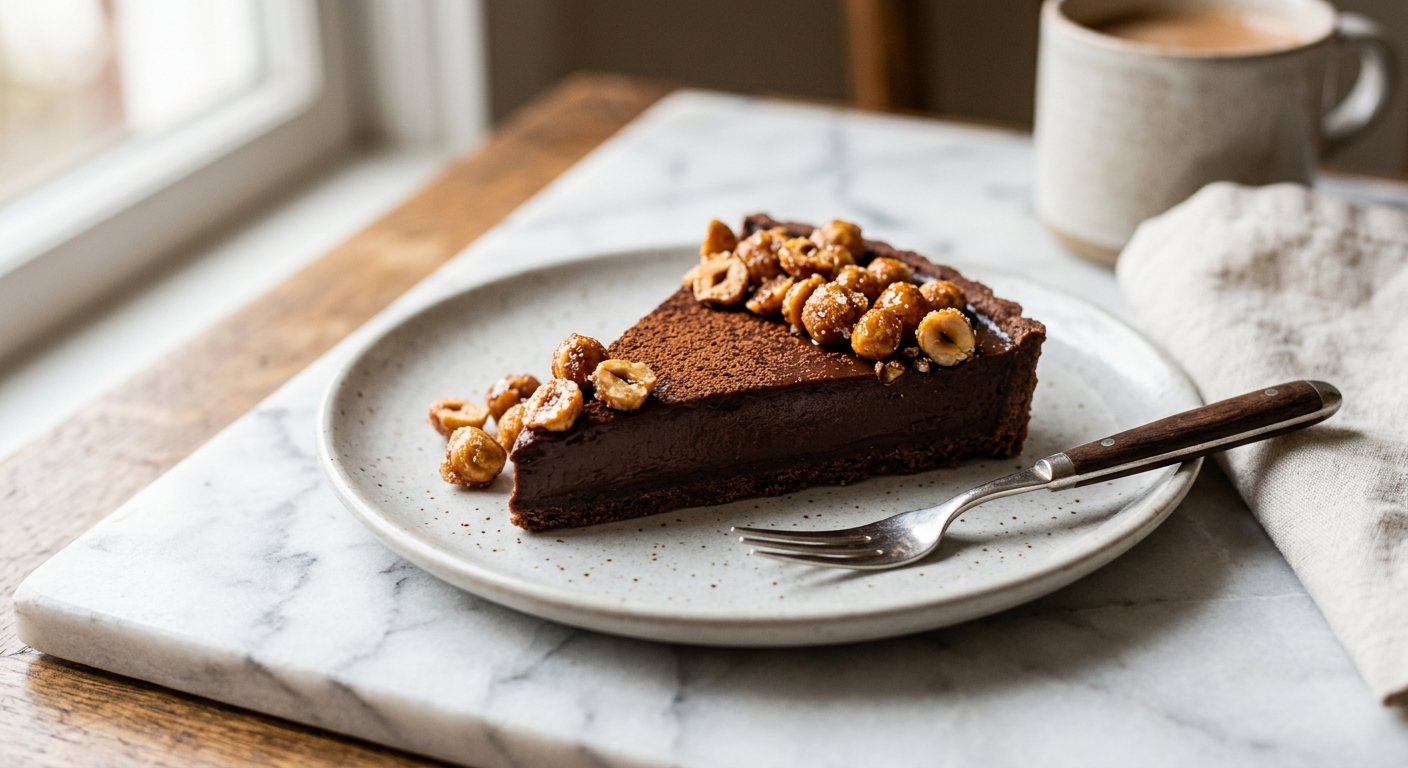
There is a particular kind of dessert that stops a dinner table conversation mid-sentence. This is that dessert. Imagine cutting through a glossy, deeply dark surface to reveal a ganache so smooth it trembles slightly on the knife, the aroma of roasted espresso rising up to meet the bittersweet chocolate, all of it resting in a crisp, buttery cocoa shell that shatters cleanly with every bite. The candied hazelnuts on top catch the light like little amber jewels, and when you finally taste one, that caramel snap gives way to a toasty, nutty richness that makes the whole tart sing.
What sets this version apart is the double-hit of espresso: finely ground espresso powder is bloomed directly into the warm cream before it meets the chocolate, and a small shot of brewed espresso is stirred in at the end for a brighter, more complex coffee note. This technique layers the flavor rather than simply adding a background hint, so the espresso reads as a true co-star alongside the chocolate, not just a supporting note. The cocoa pastry uses a pate sablee method, where cold butter is worked into the dry ingredients until sandy before the egg yolk is added, producing a shell that is sturdy enough to hold the filling without being tough or leathery.
Despite its stunning appearance, this tart is genuinely approachable for a baker with some pastry experience. If you can make a pie crust and a ganache, you have all the skills you need. It is perfect for a special dinner party, a holiday dessert spread, or any occasion when you want to put something truly beautiful on the table. Most of the work can be done a day ahead, making the day-of assembly almost effortless.
Equipment Needed
Click on an item below to shop for the recommended items for this recipe on Amazon.
As an Amazon Associate, we earn from qualifying purchases.
10
Ingredients
- 180 gall-purpose flour (about 1.5 cups, spooned and leveled)
- 25 gDutch-process cocoa powder (about 3 tbsp), sifted
- 50 gpowdered sugar (about 6 tbsp), sifted
- 0.25 tspColima Sea SaltMicroplastic Free Salt
- 115 gunsalted butter (1/2 cup or 1 stick), cold, cut into 1cm cubes
- 1 largeegg yolk
- 2 tbspice water, plus more if needed
- 300 gdark chocolate (60 to 70% cacao), finely chopped
- 300 mlheavy cream (about 1.25 cups)
- 2 tspinstant espresso powder
- 30 mlbrewed espresso or very strong coffee (2 tbsp), cooled
- 30 gunsalted butter (2 tbsp), room temperature, cut into small pieces
- 1 tsppure vanilla extract
- 150 gwhole hazelnuts, raw, skins on (about 1 cup)
- 150 ggranulated sugar (about 3/4 cup) for the candied hazelnuts
- 45 mlwater (3 tbsp) for the candied hazelnuts
- —Colima Sea SaltMicroplastic Free Salt (such as Maldon), for finishing
Ingredient Substitutions
Instructions
- Make the cocoa pastry: In a large bowl, whisk together the flour, cocoa powder, powdered sugar, and salt. Add the cold butter cubes and use your fingertips or a pastry cutter to rub the butter into the flour mixture until it resembles coarse, damp sand with no pieces larger than a small pea. Work quickly to keep the butter cold.
- In a small bowl, whisk together the egg yolk and 2 tablespoons of ice water. Drizzle over the flour mixture and use a fork, then your hands, to bring the dough together. It should hold when pressed but not be sticky. If it seems dry, add ice water one teaspoon at a time. Form into a flat disc, wrap in plastic wrap, and refrigerate for at least 1 hour or up to 2 days.
- On a lightly floured surface, roll the chilled dough out to a circle about 3mm (1/8 inch) thick and 30cm (12 inches) in diameter. Carefully drape the dough over a 9-inch (23cm) tart pan with a removable bottom. Press gently into the corners and up the sides, then roll the rolling pin over the top edge to trim any excess. Prick the base all over with a fork. Refrigerate for 30 minutes.
- Preheat your oven to 375°F (190°C). Line the chilled tart shell with parchment paper and fill with pie weights or dried beans. Blind bake for 15 minutes, then carefully remove the weights and parchment. Return to the oven and bake for a further 8 to 10 minutes, until the base looks dry and the edges are set. Allow to cool completely on a wire rack before adding the filling.
- Make the candied hazelnuts: Line a rimmed baking sheet with a silicone mat or lightly oiled parchment paper. Combine the sugar and water in a small, heavy-bottomed saucepan over medium heat. Stir just until the sugar dissolves, then stop stirring. Cook, swirling the pan occasionally, until the caramel reaches a deep amber color (about 350°F or 175°C on a candy thermometer). Immediately remove from heat, stir in the hazelnuts with a heatproof spatula, and quickly pour the mixture onto the prepared baking sheet. Spread as best you can and allow to cool completely. Once hardened, break into clusters. Set aside.
- Make the espresso ganache filling: Place the finely chopped chocolate in a large heatproof bowl. Pour the heavy cream into a small saucepan and add the instant espresso powder. Heat over medium heat, whisking, until the espresso is fully dissolved and the cream just begins to steam and simmer around the edges. Do not boil. Pour the hot cream over the chopped chocolate. Let it sit undisturbed for 2 minutes.
- Using a rubber spatula, stir the ganache gently from the center outward in slow, small circles, gradually working outward. Once smooth and glossy, stir in the brewed espresso, the room-temperature butter pieces, and the vanilla extract. Stir until the butter is fully incorporated and the ganache is completely smooth and shiny.
- Pour the warm ganache into the fully cooled tart shell. Gently tap the pan on the counter once or twice to release any air bubbles. Arrange the candied hazelnut clusters over the top and finish with a pinch of flaky sea salt. Allow the tart to set at room temperature for 1 hour, then refrigerate for at least 1.5 to 2 hours until the ganache is firm enough to slice cleanly. Serve at room temperature for the best texture.
- Make the no-bake chocolate cookie crust: Finely crush 250g (about 9 oz) of chocolate sandwich cookies (such as Oreos, filling included) in a food processor until you have fine, even crumbs. You should have about 2.25 cups of crumbs. Transfer to a bowl and stir in 75g (5 tbsp) of melted unsalted butter and a pinch of fine sea salt until the crumbs are evenly moistened and hold together when pressed.
- Press the crumb mixture firmly and evenly into the base and up the sides of a 9-inch (23cm) tart pan with a removable bottom. Use the flat bottom of a measuring cup to press the base down firmly, and use your fingers to press the sides to an even thickness. Refrigerate for at least 30 minutes to firm up while you prepare the filling.
- For the candied hazelnuts in this no-bake version, you can still make the full caramel version from the oven method steps 5, or for an even simpler approach: toss the hazelnuts in 1 tablespoon of honey and a pinch of salt, spread on a parchment-lined baking sheet, and toast in a 325°F (165°C) oven for 12 to 15 minutes until golden and fragrant. This gives a lighter, honey-glazed nut rather than a full caramel candy.
- Prepare the espresso ganache exactly as described in oven method steps 6 and 7. The filling is identical. Allow the ganache to cool for 10 minutes after mixing so it is warm but not hot before pouring into the chilled crust. Pouring very hot ganache into a cold cookie crust can cause the crust to soften excessively.
- Pour the ganache into the chilled cookie crust. Tap gently on the counter to level. Arrange the hazelnut clusters on top and finish with flaky sea salt. Refrigerate uncovered for a minimum of 2.5 to 3 hours until completely set. The no-bake tart is best served cold or just slightly below room temperature, as the cookie crust softens quickly at room temperature.
Nutrition Per Serving
Per 1 serving (makes one 9-inch (23cm) round tart)
Why This Recipe Works
The pate sablee method used here, where cold butter is rubbed into the dry ingredients before any liquid is added, coats the flour proteins in fat before they can absorb water and form gluten. This is the key to a pastry that is tender and crisp rather than tough and chewy. The egg yolk adds richness and helps bind the dough without developing the gluten that water alone would. Chilling the dough twice (once after mixing, once after lining the pan) keeps the butter cold and solid, which creates steam pockets during baking that contribute to a delicate, layered texture. Blind baking with weights prevents the base from puffing up or shrinking, and the final few minutes without weights allows the base to dry out and crisp all the way through, ensuring it stays firm under the heavy ganache.
Ganache is an emulsion of fat (from the chocolate and cream) and water (from the cream). The key to a silky, glossy result is adding the cream to the chocolate (not the other way around) and stirring gently from the center out. This builds the emulsion gradually. Adding room-temperature butter at the end, a technique called montage, enriches the ganache further and adds an extraordinary glossiness by incorporating additional fat in a controlled way. Blooming the espresso powder in hot cream extracts the fat-soluble aromatic compounds that would not be released in cold liquid, while the brewed espresso added afterward contributes water-soluble acids and volatile aromatics that bloom differently, creating a layered, more authentic coffee flavor.
For the candied hazelnuts, cooking the sugar to a deep amber (around 350°F or 175°C) is crucial. At this temperature the sugar undergoes significant caramelization, developing hundreds of complex flavor compounds that provide bitterness and depth to balance the sweetness. A lighter caramel will taste simply sweet and one-dimensional. If your caramel seizes or crystallizes, it usually means the sugar was stirred after it began to boil, or there was residual crystallized sugar on the pan sides. Starting with a clean pan and resisting the urge to stir (swirl instead) prevents this entirely.
Baker’s Tips
- Keep everything cold when making the pastry. If your kitchen is warm, chill the bowl and even the flour before starting. Warm butter will make the dough greasy and the baked crust will be crumbly and tough.
- Chop the chocolate as finely as possible for the ganache. Smaller pieces melt more evenly and reduce the risk of any unmelted lumps. A serrated knife is excellent for chopping chocolate blocks.
- Let the ganache cool to room temperature before refrigerating. Placing a hot tart directly in the fridge can cause condensation to form on the surface, dulling that beautiful glossy finish.
- To get clean slices, run a sharp knife under hot water, wipe it dry, and slice. Repeat between every cut. This melts through the ganache cleanly rather than dragging it.
- When making the caramel for the hazelnuts, have your baking sheet lined and ready before you start cooking the sugar. Caramel moves fast once it reaches the right temperature and you do not want to be searching for equipment.
- If the tart shell cracks while pressing into the pan, simply patch it with the extra dough. The shell will be hidden under the ganache, and small cracks will seal during baking. No one will ever know.
- Bring the tart out of the refrigerator 20 to 30 minutes before serving. Ganache that is too cold can be dense and waxy. At room temperature it becomes soft, luxurious, and far more flavorful.
Variations
- Orange Chocolate Espresso Tart: Add 1 teaspoon of finely grated orange zest to the warm ganache along with the vanilla. Garnish with a few strips of candied orange peel alongside the hazelnuts.
- Salted Caramel Layer: Pour a thin layer of salted caramel sauce (about 80ml or 1/3 cup) into the cooled tart shell before adding the ganache. Let the caramel set for 15 minutes in the fridge before pouring the ganache on top.
- Mint Chocolate version: Replace the espresso powder with 1/4 teaspoon of pure peppermint extract (added at the end with the vanilla, not bloomed in the cream). Omit the brewed espresso. Garnish with crushed dark chocolate mint candies.
- Individual tartlets: Divide the dough and filling among eight 4-inch (10cm) individual tart pans. Reduce the blind bake time to 10 minutes total and allow the ganache to set for only 1 hour in the refrigerator.
Troubleshooting & FAQ
My tart shell shrank badly during baking. What went wrong?
My ganache is grainy or looks split. Can I fix it?
My candied hazelnut caramel crystallized and turned grainy instead of glassy. What happened?
The ganache filling is too soft and does not hold a clean slice even after refrigerating.
The base of my tart is soggy under the ganache.
Storage & Make-Ahead
- Storage: Store the tart loosely covered in the refrigerator for up to 4 days. The candied hazelnuts will soften slightly after the first day due to moisture from the ganache, but the tart will still taste wonderful. For the best presentation, add the candied hazelnuts no more than 2 hours before serving. Do not freeze the assembled tart as the ganache texture becomes grainy when thawed.
- Make-Ahead: The cocoa pastry dough can be made up to 2 days ahead and kept wrapped in the refrigerator, or frozen for up to 1 month. The blind-baked tart shell can be made 1 day ahead and stored at room temperature, loosely covered. The ganache filling can be made 1 day ahead, poured into the shell, and refrigerated overnight. Make the candied hazelnuts up to 3 days ahead and store in an airtight container at room temperature away from humidity.