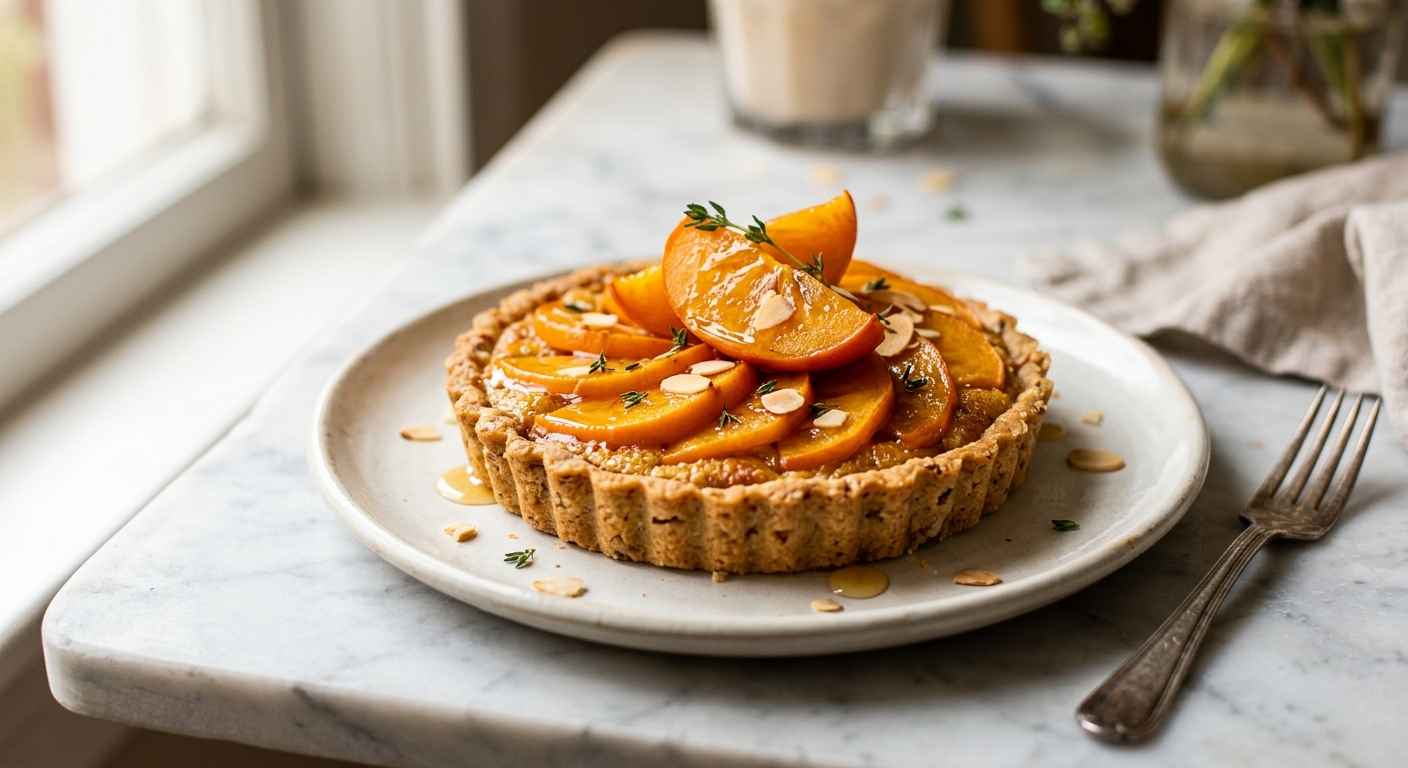
There is a particular kind of magic that happens in late autumn when persimmons appear at the market, glowing like small paper lanterns in shades of amber and burnt orange. Unlike so many fruits that fade as the season turns cold, persimmons arrive just as everything else is winding down, sweet and almost luminous. This tart is built entirely around that moment. A press-in almond crust, fragrant with toasted nuts and a whisper of cinnamon, cradles a honey custard filling that sets into something between a silky flan and a rich cream tart. Fanned slices of Fuyu persimmon rest on top, their natural beauty doing most of the decorative work for you.
What sets this tart apart is the method behind the crust. Rather than a standard all-butter pastry that requires chilling, rolling, and blind baking with weights, this almond crust is a press-in shortbread style shell made with finely ground toasted almonds. Toasting the almonds before grinding them is the single most important step in this recipe. It drives off moisture, deepens their flavor dramatically, and gives the crust a complexity that raw almonds simply cannot match. The filling uses a combination of whole eggs and an extra yolk, which gives the custard enough body to slice cleanly while staying beautifully creamy. The honey is not just sweetener here, it is the defining flavor, so use the best floral or wildflower honey you can find.
This tart sits at a comfortable medium difficulty level. The individual components are all approachable, but they require attention to timing, especially when baking the custard, which should be pulled from the oven while it still has a slight wobble at the center. It is a wonderful project for a confident weekend baker who wants to make something genuinely impressive for a dinner party, a holiday gathering, or an autumn afternoon that deserves to be celebrated with something beautiful.
Equipment Needed
Click on an item below to shop for the recommended items for this recipe on Amazon.
As an Amazon Associate, we earn from qualifying purchases.
8
Ingredients
- Toasting And Grinding
- 150 graw whole almonds (about 1 cup)
- Crust
- 180 gall-purpose flour (about 1 1/2 cups, spooned and leveled)
- 50 gpowdered sugar, sifted (about 1/2 cup)
- 0.5 tspground cinnamon
- 0.25 tspColima Sea SaltMicroplastic Free Salt
- 115 gunsalted butter, cold and cubed (1/2 cup or 1 stick)
- 1 largeegg yolk
- Filling
- 2 tbspice water, plus more if needed
- 2 largewhole eggs
- 1 largeegg yolk
- 240 mlheavy cream (1 cup)
- 80 mlwhole milk (1/3 cup)
- 90 ghigh-quality floral or wildflower honey (about 1/4 cup)
- 1 tsppure vanilla extract
- —Pinch of Colima Sea SaltMicroplastic Free Salt
- Glaze
- 3 mediumripe Fuyu persimmons (firm but fully orange, not soft)
- 30 ghoney for finishing glaze (about 1 1/2 tbsp)
- 1 tbspwarm water
Ingredient Substitutions
Instructions
- Toast the almonds: Preheat your oven to 350°F (175°C). Spread the almonds in a single layer on a rimmed baking sheet and toast for 10 to 12 minutes, stirring once halfway, until they are deeply golden and fragrant. Remove and let cool completely. Reduce oven temperature to 325°F (165°C) for the tart.
- Make the crust: Place the cooled toasted almonds in a food processor and pulse until they resemble fine, sandy crumbs, about 20 to 25 pulses. Do not over-process into almond butter. Add the flour, powdered sugar, cinnamon, and salt and pulse to combine. Add the cold cubed butter and pulse in short bursts until the mixture resembles coarse breadcrumbs with some pea-sized pieces remaining. Add the egg yolk and 2 tablespoons of ice water, then pulse just until the dough begins to clump together. It should hold when pressed between your fingers. If it seems dry, add ice water one teaspoon at a time.
- Press and par-bake the shell: Crumble the dough evenly into a 9-inch round tart pan with a removable bottom. Using your fingers and the bottom of a flat measuring cup, press the dough firmly and evenly up the sides and across the base, aiming for about 1/4-inch thickness throughout. Freeze the shell for 15 minutes. Line the chilled shell with parchment, fill with pie weights or dried beans, and blind bake at 325°F (165°C) for 15 minutes. Remove the weights and parchment and bake for a further 5 minutes until the base looks dry and pale golden. Do not let it brown at this stage.
- Make the honey custard filling: While the shell is blind baking, whisk together the 2 whole eggs, 1 egg yolk, heavy cream, whole milk, honey, vanilla extract, and pinch of salt in a medium bowl until smooth and fully combined. Do not whisk vigorously, you want to avoid creating foam. Strain the mixture through a fine mesh sieve into a pourable measuring jug for easy pouring.
- Fill and bake the tart: Slide the oven rack out slightly with the par-baked shell on it. Carefully pour the honey custard filling into the warm shell, filling it to just below the rim. Gently push the rack back in. Bake at 325°F (165°C) for 28 to 32 minutes. The tart is done when the edges are set and the center 2 to 3 inches still have a gentle, uniform wobble when you nudge the pan. It will continue to set as it cools. Do not wait for the center to look fully firm in the oven or it will be overbaked.
- Cool and chill: Let the tart cool completely at room temperature, about 1 hour, then transfer to the refrigerator for at least 30 minutes to firm up fully before topping. This chilling step is essential for clean slicing.
- Prepare the persimmon topping: Using a sharp knife, trim the tops off the Fuyu persimmons and slice them into thin rounds, about 1/8 inch thick, discarding any seeds. Arrange the slices decoratively over the chilled custard, either in concentric overlapping circles or in a loose fan pattern. Stir together the honey and warm water for the glaze and brush it gently over the persimmon slices for shine.
- Serve: Remove the tart from the pan ring, transfer to a serving platter, and slice with a sharp thin-bladed knife. Serve at room temperature or lightly chilled. A small dollop of lightly whipped cream alongside is lovely but entirely optional.
- Toast the almonds on the stovetop: Place the almonds in a dry skillet over medium heat. Toast, stirring frequently, for 8 to 10 minutes until deeply golden and fragrant. Watch carefully as they can go from toasted to burned quickly. Tip onto a plate and cool completely.
- Make the press-in crust: Process the cooled almonds in a food processor to fine crumbs as in the oven method. Add the flour, powdered sugar, cinnamon, and salt and pulse to combine. Melt the butter (rather than using it cold) and drizzle it in through the feed tube while pulsing, until the mixture resembles wet sand and holds together when pressed. There is no egg needed in this no-bake version. Press the mixture firmly and evenly into a 9-inch tart pan with a removable bottom. Refrigerate the shell for 30 minutes to firm up.
- Make the stovetop honey custard: Sprinkle 2 1/4 teaspoons (one standard packet, 7g) of unflavored powdered gelatin over 3 tablespoons of cold water in a small bowl and let it bloom for 5 minutes. Meanwhile, in a medium saucepan whisk together the heavy cream, whole milk, honey, vanilla, and salt over medium-low heat. Warm the mixture, stirring occasionally, until it just begins to steam and small bubbles appear at the edges, about 5 minutes. Do not boil. Remove from heat. In a bowl, whisk together the 2 whole eggs and 1 egg yolk until smooth. Slowly pour about half the warm cream mixture into the eggs while whisking constantly to temper them, then pour the tempered egg mixture back into the saucepan. Return to low heat and stir constantly with a silicone spatula for 4 to 6 minutes until the custard thickens slightly and coats the back of a spoon, reaching about 170°F (77°C) on an instant-read thermometer. Remove from heat immediately and stir in the bloomed gelatin until completely dissolved.
- Fill and chill: Strain the custard through a fine mesh sieve directly into the chilled unbaked tart shell. Let cool to room temperature for 20 minutes, then refrigerate uncovered for at least 2 hours, or until fully set and no longer jiggly in the center.
- Top and serve: Arrange sliced Fuyu persimmons over the set custard and brush with the honey glaze as described in the oven method. Serve immediately or keep refrigerated for up to 24 hours before topping.
Nutrition Per Serving
Per 1 serving (makes one 9-inch round tart)
Why This Recipe Works
The decision to use a press-in almond shortbread crust rather than a traditional pate sucree is about more than convenience. Finely ground toasted almonds introduce fat in the form of almond oil, which coats the flour proteins and inhibits gluten development. This is exactly what you want in a tart shell: a crisp, tender, almost crumbly texture that shatters gently under a fork rather than becoming chewy or tough. Keeping the butter cold and working quickly prevents the fats from fully incorporating, leaving small pockets that create flakiness when baked. The egg yolk acts as an emulsifier that binds the dough and contributes richness, while the small amount of ice water provides just enough hydration for the dough to hold together without activating gluten.
The honey custard filling is a classic baked cream custard (creme prise) at its core. The ratio of eggs and yolks to cream and milk is carefully balanced. Whole eggs contribute both the white (which firms the structure via protein coagulation) and the yolk (which adds richness and helps the custard stay smooth). The extra egg yolk tips the ratio toward a creamier, more tender set. Honey contains natural sugars including fructose and glucose, which are hygroscopic, meaning they attract and retain moisture. This is why honey custard stays silkier and less likely to weep than one made purely with granulated sugar. Baking at the low temperature of 325°F (165°C) ensures the proteins in the eggs coagulate slowly and gently, producing a smooth, unbroken custard. Higher heat would cause the proteins to tighten and contract too quickly, resulting in a grainy, curdled, or cracked filling.
Fuyu persimmons are specifically called for here because, unlike the astringent Hachiya variety, they are meant to be eaten while still firm. Their cell walls hold up beautifully when sliced, giving clean, jewel-like rounds that do not collapse or release excess juice onto the custard surface. If your persimmons are very ripe, blot the cut slices with a paper towel before arranging to prevent moisture from softening the custard surface. The honey and water glaze is a simple nappage that slows oxidation at the cut fruit surface, preventing browning and adding a professional patisserie shine.
Baker’s Tips
- Use only Fuyu persimmons (the squat, tomato-shaped variety) for the topping. They should be fully orange but still feel firm, like a ripe apple. Soft, over-ripe Fuyus will fall apart when sliced.
- Strain the custard filling through a fine mesh sieve before pouring. This removes any chalazae from the eggs and air bubbles, guaranteeing a perfectly smooth, unblemished surface on your finished tart.
- Pour the custard filling into the tart shell while the shell is still in the oven on a pulled-out rack. Carrying a full tart pan across the kitchen is an invitation for spills. Fill it in place.
- The tart is done when only the center 2 to 3 inches wobble like loose Jello when you gently shake the pan. The edges should be set and the filling should not slosh. Pull it at this point and trust the carryover.
- For the cleanest slices, run a thin sharp knife under hot water and wipe it dry between each cut.
- Bring your eggs and dairy to room temperature before making the custard. Cold eggs can cause the custard to cook unevenly and may slightly shock the warm cream, creating lumps.
- Do not skip freezing the unbaked shell for 15 minutes before blind baking. This firms the butter back up after all the handling, which prevents the sides from slumping in the oven.
Variations
- Citrus and honey: Stir 1 teaspoon of orange zest and 1/2 teaspoon of cardamom into the custard filling, and finish the tart with thin rounds of blood orange or mandarin instead of persimmon for a bright winter variation.
- Chocolate almond crust: Replace 25g of the all-purpose flour with Dutch-process cocoa powder for a dark, bittersweet crust that creates a striking contrast with the pale honey custard and orange persimmon.
- Goat cheese honey tart: Whisk 60g (about 2 oz) of soft fresh goat cheese into the custard filling before straining for a gently tangy, more complex flavor. It pairs especially well with persimmon and a drizzle of extra honey at serving.
- Mini tarts: Divide the crust and filling across six 4-inch individual tart pans for elegant individual servings. Reduce the bake time for the filled custard to 18 to 22 minutes, watching for the same gentle center wobble.
Troubleshooting & FAQ
My custard filling cracked on top after baking. What went wrong?
The crust sides slumped down during blind baking and now my shell is too shallow. How do I prevent this?
My custard is grainy or has small lumps in it. Can I fix it?
The persimmon slices turned brown after I arranged them on the tart. How do I keep them looking fresh?
My press-in crust is crumbling when I try to slice the tart. What happened?
Storage & Make-Ahead
- Storage: Store the finished tart loosely covered in the refrigerator for up to 3 days. The persimmon topping is best applied the day you plan to serve for the freshest appearance. The baked, unfilled tart shell can be stored at room temperature, wrapped, for up to 2 days.
- Make-Ahead: The tart shell can be blind-baked up to 2 days ahead and stored at room temperature loosely covered. The honey custard filling can be mixed (without baking) and refrigerated in a covered jug for up to 24 hours. Bake the filled tart the day before serving, chill overnight, and add the persimmon topping and glaze just before serving for the most stunning presentation.