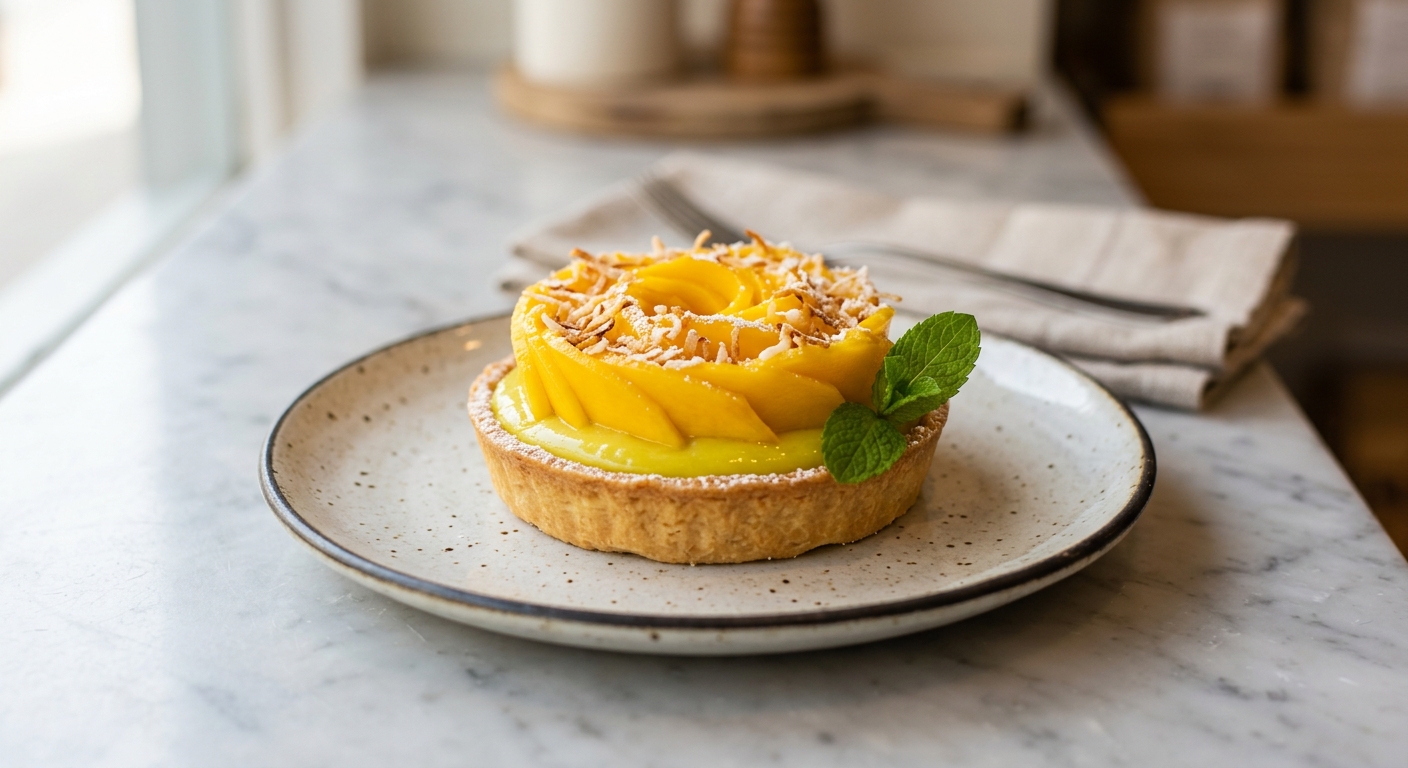
Close your eyes and imagine a dessert table somewhere warm and breezy, where the air smells faintly of toasted coconut and citrus. That is exactly the feeling this tart delivers, no plane ticket required. The shell shatters gently at the fork, giving way to a lime curd so silky and bright it almost glows, all crowned with ribbons of ripe mango that are sweet, floral, and just a little tropical. It is the kind of dessert that makes people put down their forks and ask, quietly and hopefully, if there is a second slice.
What sets this tart apart is a double layer of coconut: desiccated coconut is pressed directly into the pastry dough before baking, and a thin spread of coconut cream is stirred into the curd base to soften its edge and add a whisper of richness that plain lime curd does not have. The lime curd itself is cooked low and slow on the stovetop before being poured into the blind-baked shell, giving you precise control over the texture. The result is a curd that is firm enough to slice cleanly but still trembles slightly in the center, the way a truly great curd should.
This tart sits comfortably at a medium difficulty level. The pastry requires a short chill, and the curd needs your attention at the stove, but neither step is difficult once you understand what you are looking for. It is ideal for confident beginner bakers who want to stretch their skills, or for experienced bakers who want an impressive, make-ahead dessert for a dinner party, a summer celebration, or honestly, any afternoon that deserves something beautiful.
Equipment Needed
Click on an item below to shop for the recommended items for this recipe on Amazon.
As an Amazon Associate, we earn from qualifying purchases.
10
Ingredients
- 180 gall-purpose flour (about 1.5 cups, spooned and leveled)
- 40 gdesiccated coconut, unsweetened (about 1/2 cup)
- 30 gpowdered sugar, sifted (about 1/4 cup)
- 0.25 tspColima Sea SaltMicroplastic Free Salt
- 115 gunsalted butter, cold and cubed (about 1/2 cup / 1 stick)
- 1 large egg yolk
- 30 mlice cold water (2 tbsp), plus more as needed
- 4 large eggs, room temperature
- 2 large egg yolks, room temperature
- 150 ggranulated sugar (about 3/4 cup)
- 120 mlfresh lime juice (from about 6 to 7 limes)
- 2 tspfinely grated lime zest (from about 3 limes)
- 80 mlfull-fat coconut cream (about 1/3 cup)
- 115 gunsalted butter, cubed, room temperature (about 1/2 cup / 1 stick)
- 2 ripe mangoes (Ataulfo or Kent variety preferred), peeled and thinly sliced
- 30 mlneutral glaze or warmed apricot jam for brushing (2 tbsp), optional
- —Toasted coconut flakes, for garnish
- —Lime zest curls, for garnish
Ingredient Substitutions
Instructions
- Make the pastry: In a large bowl or food processor, combine the flour, desiccated coconut, powdered sugar, and salt. Add the cold cubed butter and rub or pulse until the mixture resembles coarse breadcrumbs with a few pea-sized butter pieces remaining. Add the egg yolk and 2 tablespoons of ice water. Mix gently with a fork or pulse in 3-second bursts until the dough just begins to clump. If it is still dry, add ice water one teaspoon at a time. Do not overwork. Turn out onto a lightly floured surface, press into a flat disc, wrap tightly in plastic wrap, and refrigerate for at least 1 hour or up to 24 hours.
- Blind-bake the shell: Preheat your oven to 375°F (190°C). On a lightly floured surface, roll the chilled dough into a circle about 12 inches (30cm) in diameter and about 3mm thick. Drape it over your 9-inch (23cm) tart pan with a removable base and gently press it into the fluted edges without stretching. Trim the excess flush with the rim. Prick the base all over with a fork. Place the tart shell in the freezer for 15 minutes (this is important; it prevents shrinking). Line the frozen shell with parchment paper, fill with pie weights or dried beans, and bake for 20 minutes. Remove the weights and parchment carefully and bake for a further 8 to 10 minutes, until the base is golden and looks dry. Let cool completely on a wire rack before filling.
- Make the lime curd: Combine the 4 whole eggs, 2 egg yolks, granulated sugar, lime juice, and lime zest in a medium heavy-bottomed saucepan. Whisk until smooth. Set the pan over low to medium-low heat. Add the coconut cream and stir to combine. Cook, stirring constantly with a silicone spatula or wooden spoon, for 10 to 14 minutes, until the mixture thickens enough to coat the back of a spoon and holds a line when you drag your finger across it. Do not let it boil. The target temperature is 170°F to 175°F (77°C to 80°C) if you are using an instant-read thermometer.
- Finish and strain the curd: Remove the pan from the heat and strain the curd through a fine-mesh sieve into a clean bowl to remove the zest and any cooked egg bits. Add the room-temperature butter cubes a few at a time, stirring after each addition until fully melted and incorporated. The curd will be glossy and smooth. Let it cool for 10 minutes, stirring occasionally.
- Fill and chill: Pour the warm curd into the fully cooled tart shell. Smooth the top with an offset spatula. Place the tart (still in its pan) on a flat surface in the refrigerator, uncovered, for at least 2 hours or until the curd is fully set and no longer jiggles.
- Decorate and serve: Once the curd is set, arrange the mango slices over the top in overlapping fans or a simple layered pattern. If using, warm the apricot jam with a teaspoon of water until runny and brush it lightly over the mango for a glossy finish. Scatter a small handful of toasted coconut flakes over the edges and add a few curls of lime zest. Remove the tart from the pan, slice with a sharp knife wiped clean between cuts, and serve.
- Make the no-bake shell: In a food processor, blitz 160g digestive biscuits or graham crackers into fine crumbs. Add 50g desiccated coconut (lightly toasted in a dry skillet until golden, then cooled) and a pinch of salt, and pulse to combine. Add 80g melted unsalted butter and pulse until the mixture holds together when pressed. Tip into a 9-inch (23cm) tart pan with a removable base. Use the bottom of a measuring cup to press the crumbs firmly and evenly across the base and up the sides. Refrigerate for at least 30 minutes until firm.
- Bloom the gelatin: Measure 1.5 teaspoons (about 5g) of powdered gelatin into a small bowl. Pour over 2 tablespoons (30ml) of cold water and let it sit for 5 minutes to bloom. It will look lumpy and spongy. This is correct.
- Make the curd: Combine the 4 whole eggs, 2 egg yolks, granulated sugar, lime juice, lime zest, and coconut cream in a heavy-bottomed saucepan as described in the oven method. Cook over low to medium-low heat, stirring constantly, until thickened to 170°F to 175°F (77°C to 80°C). Remove from heat and strain through a fine-mesh sieve into a clean bowl.
- Add gelatin and butter: While the curd is still hot (above 140°F / 60°C), add the bloomed gelatin and stir vigorously until it completely dissolves, about 1 minute. Then add the room-temperature butter cubes, a few at a time, stirring until incorporated. The gelatin ensures the curd sets firmly at refrigerator temperature without needing a pastry shell to support it.
- Fill and set: Let the curd cool for 10 minutes, stirring occasionally to release heat. Pour into the chilled crumb shell and smooth the top. Refrigerate for a minimum of 3 hours, or overnight, until completely firm. Decorate with mango slices, toasted coconut flakes, and lime zest curls just before serving.
Nutrition Per Serving
Per 1 serving (makes one 9-inch round tart)
Why This Recipe Works
The key to a lime curd that slices cleanly rather than oozing is understanding what makes it set. Egg proteins begin to denature and tighten around 160°F (71°C), and by the time you reach 175°F (80°C), the curd has thickened to the point where the proteins form a stable gel that holds its shape when cold. Cooking too fast or too hot scrambles the eggs into tiny curds, which is why a heavy-bottomed pan over gentle heat, and constant stirring, are non-negotiable. The coconut cream adds fat and a small amount of starch that further stabilize the emulsion and give the curd a slightly softer, creamier texture than a pure citrus curd.
The pastry technique here is a classic pate sablee approach: cold butter rubbed into flour creates small pockets of fat that, when the dough bakes, melt and create flaky, tender layers. Crucially, this dough also contains an egg yolk, which adds richness and helps bind the gluten-poor fat-heavy mixture into a cohesive dough that is less prone to cracking when rolled. The desiccated coconut in the dough contributes both flavour and texture, but it also absorbs moisture, which is why a touch of ice water is needed even though the egg yolk adds liquid. Chilling the dough before rolling and then again after lining the pan (the freezer step) relaxes the gluten and firms the butter, both of which are critical to preventing the shell from shrinking or slumping during baking.
If your curd is grainy or lumpy, it has overheated and some egg has scrambled. Do not panic: strain it immediately through a fine-mesh sieve while it is still hot and continue adding the butter off heat. The butter enrichment happens after cooking, precisely because adding cold fat at that stage drops the temperature quickly, arrests any further cooking, and creates a beautifully glossy emulsified curd. If after straining you still have an unpleasant texture, a quick 10-second blast with an immersion blender can rescue it entirely.
Baker’s Tips
- Weigh your flour rather than using cups. Coconut pastry dough is more delicate than plain shortcrust, and even a small amount of excess flour can make it crumbly and difficult to roll.
- The freezer step before blind-baking is not optional. Putting a fully chilled (frozen) shell into a hot oven is what prevents it from sliding down the sides. Fifteen minutes in the freezer makes a real difference.
- Use a microplane or fine zester for the lime zest and press firmly. You want the bright green outer layer only, not the bitter white pith underneath. Zest your limes before juicing them, never after.
- Let the curd cool for 10 minutes before pouring into the shell. Pouring boiling-hot curd into a pastry shell can soften and even crack it. A brief rest off the heat is worth it.
- For the cleanest mango presentation, use a vegetable peeler or mandoline to slice the mango into thin, even ribbons. Ataulfo (honey) mangoes are the best choice here since they are fiberless, sweet, and easy to slice.
- Always use room-temperature butter when making the curd. Cold butter takes too long to melt and can cause the emulsion to break or the temperature to drop too quickly, preventing proper thickening.
Variations
- Raspberry and lime version: Replace the mango topping with fresh raspberries pressed gently into the set curd in a single layer. The tartness of the raspberries amplifies the lime beautifully.
- Passion fruit curd variation: Replace half the lime juice (60ml) with strained fresh passion fruit pulp for a more intensely tropical curd with a deeper golden colour.
- Mini tart shells: Divide the pastry among a 12-cup mini tart tin for individual portions. Reduce blind-bake time to 12 minutes with weights and 5 to 6 minutes uncovered. Ideal for parties.
- Kaffir lime version: Replace the regular lime juice with a mix of regular lime juice and 1 tablespoon of finely sliced kaffir lime leaves steeped in the juice for 30 minutes (then strained out). The flavour is floral, herbal, and deeply complex.
Troubleshooting & FAQ
My tart shell shrank during blind-baking. What went wrong?
My lime curd turned out lumpy or grainy. Can I save it?
The curd set but it is too soft and does not hold its shape when sliced.
My pastry dough is crumbling and will not come together.
The mango topping released a lot of liquid and made the curd surface wet. How do I avoid this?
Storage & Make-Ahead
- Storage: Store the finished tart loosely covered in the refrigerator for up to 3 days. The mango is best added within 24 hours of serving as it can weep and soften the curd surface over time. The baked, unfilled tart shell can be stored at room temperature in an airtight container for up to 2 days. The curd alone keeps refrigerated for up to 1 week.
- Make-Ahead: This tart is an excellent make-ahead dessert. The pastry dough can be made up to 2 days ahead and refrigerated, or frozen for up to 1 month. The blind-baked shell can be made 2 days ahead and stored at room temperature. The lime curd can be made up to 5 days ahead and refrigerated, covered with plastic wrap pressed directly against its surface. Assemble the tart (curd into shell) up to 24 hours before serving and add the mango no more than 3 to 4 hours before serving for the best appearance.