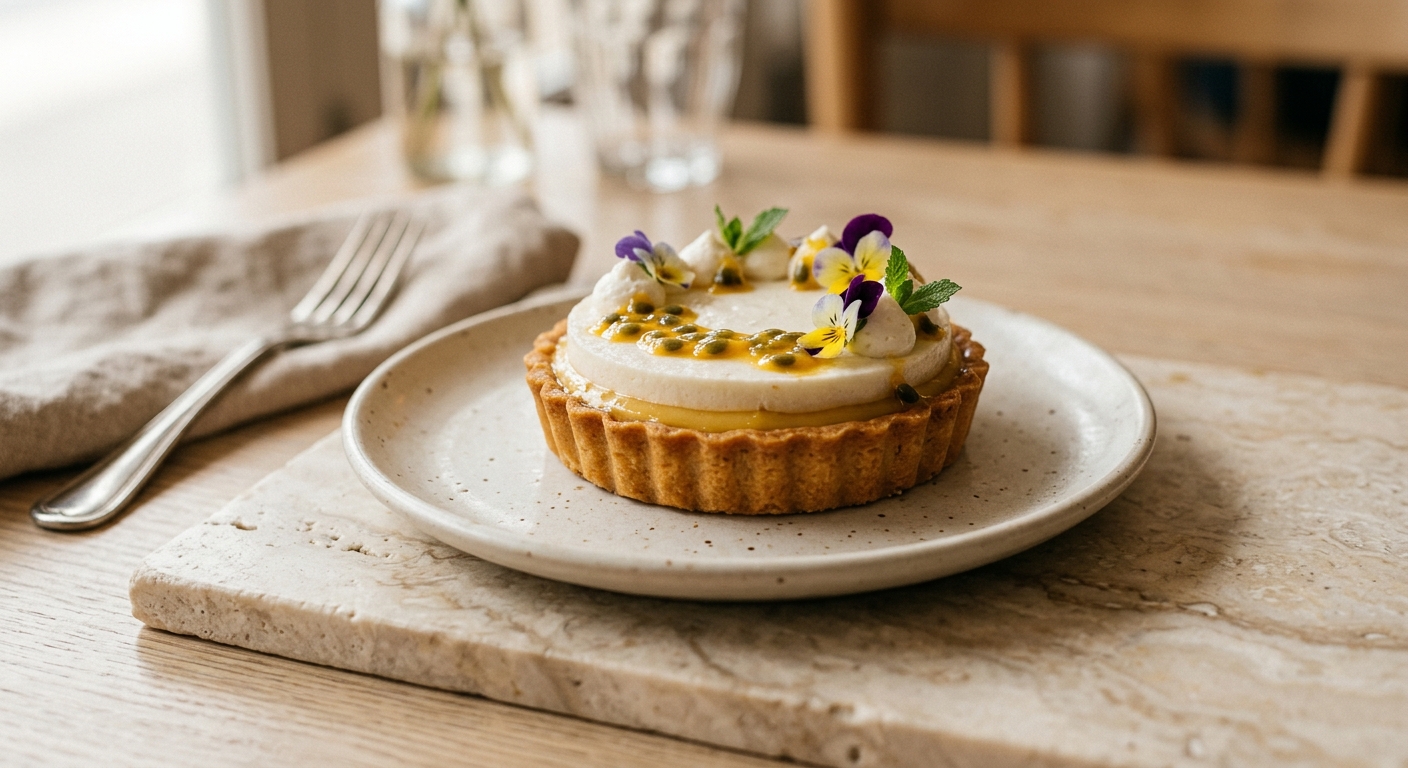
There is something almost impossibly tropical about the first bite of this tart. The filling is cool and creamy, deeply coconutty with that unmistakable richness of full-fat coconut milk, and then the passionfruit hits, all bright acidity and floral sweetness, cutting through like a ray of afternoon light. The shell underneath has a fine, sandy crunch from ground almonds that makes every forkful feel considered and complete. This is the kind of dessert that makes a table go quiet for a moment before everyone reaches for seconds.
What sets this recipe apart is the almond pastry, a variation on classic pâte sablée where a portion of the flour is replaced with finely ground blanched almonds. This does two things: it gives the shell a delicate, slightly chewy crumb rather than a hard snap, and it adds a subtle marzipan-like warmth that plays beautifully against both the coconut and the passionfruit. The coconut custard filling is a baked ganache-style set, using egg yolks and coconut cream to create a texture that slices cleanly but melts the moment it touches your tongue. The passionfruit layer is a bright, barely-set curd poured on last, setting to a glossy, jewel-like finish in the refrigerator.
This tart sits comfortably in the medium difficulty range. The pastry requires a light, confident hand and a little patience with chilling, but there is nothing here that a baker who has made a shortcrust before cannot handle. It is the ideal weekend bake, a make-ahead showstopper perfect for dinner parties, summer gatherings, or any occasion where you want to serve something that looks genuinely impressive but does not require a pastry diploma to pull off.
Equipment Needed
Click on an item below to shop for the recommended items for this recipe on Amazon.
As an Amazon Associate, we earn from qualifying purchases.
10
Ingredients
- 150 gall-purpose flour (about 1 cup plus 2 tbsp, spooned and leveled)
- 80 gblanched almond flour, finely ground (about 3/4 cup)
- 30 gpowdered sugar, sifted (about 1/4 cup)
- 0.25 tspColima Sea SaltMicroplastic Free Salt
- 115 gunsalted butter, cold and cubed into 1cm pieces (1/2 cup, 1 stick)
- 1 largeegg yolk
- 2 tbspice-cold water, plus more if needed
- 0.5 tsppure vanilla extract
- 400 mlfull-fat coconut milk (one 13.5 oz can), well shaken
- 120 mlcoconut cream (about 1/2 cup)
- 4 largeegg yolks
- 60 gcaster sugar (about 1/4 cup plus 1 tsp)
- 1 tbspcornstarch
- 30 gunsweetened desiccated coconut, lightly toasted (about 1/3 cup)
- 0.5 tsppure vanilla extract
- 125 mlfresh passionfruit pulp (from 6 to 8 large passionfruit, about 1/2 cup)
- 80 gcaster sugar (about 1/3 cup)
- 3 largeegg yolks
- 60 gunsalted butter, cubed (about 4 tbsp)
- 1 tbspcornstarch
- —Toasted coconut flakes and halved fresh passionfruit, to garnish
Ingredient Substitutions
Instructions
- Make the almond pastry: Combine the all-purpose flour, almond flour, sifted powdered sugar, and salt in a large bowl or food processor. Add the cold cubed butter and rub in with your fingertips (or pulse 10 to 12 times) until the mixture resembles coarse breadcrumbs with a few pea-sized pieces of butter remaining. Whisk together the egg yolk, ice water, and vanilla extract. Drizzle over the flour mixture and stir or pulse just until the dough begins to clump together. Squeeze a small piece: if it holds, it is ready. If it crumbles, add ice water one teaspoon at a time. Turn out onto the bench, press into a disc, wrap tightly in plastic wrap, and refrigerate for at least 1 hour (or up to 2 days).
- Roll and blind bake the shell: Preheat your oven to 375°F (190°C). On a lightly floured surface, roll the chilled pastry to a 12-inch (30cm) circle about 3mm thick, working quickly to keep it cold. Carefully drape it over a 9-inch (23cm) loose-bottomed tart tin and press it gently into the edges. Trim the overhang flush with the rim using a sharp knife. Prick the base all over with a fork. Refrigerate for 20 minutes (this prevents shrinkage). Line the shell with parchment paper, fill with baking weights or dried beans, and blind bake for 15 minutes. Remove the weights and parchment, then bake a further 5 to 7 minutes until the base looks dry and just golden at the edges. Reduce the oven temperature to 325°F (165°C).
- Make the coconut custard: Whisk together the egg yolks, caster sugar, and cornstarch in a medium bowl until pale and smooth, about 1 minute. Warm the coconut milk and coconut cream together in a small saucepan over medium heat until steaming but not boiling. Slowly pour the warm coconut liquid into the egg mixture while whisking constantly (this is tempering: it prevents the yolks from scrambling). Stir in the toasted desiccated coconut and vanilla extract.
- Bake the custard: Pour the coconut custard into the warm blind-baked shell. Bake at 325°F (165°C) for 22 to 25 minutes, until the custard is set around the edges but still has a gentle wobble in the centre, like a soft jelly. It will firm up as it cools. Do not overbake or the custard will crack and turn grainy. Remove from the oven and allow to cool completely to room temperature in the tin, about 1 hour.
- Make the passionfruit curd: Strain the passionfruit pulp through a fine-mesh sieve into a small saucepan, pressing firmly to extract all the juice. Return about half the seeds to the curd if you like the speckled look. Whisk in the egg yolks, caster sugar, and cornstarch. Cook over medium-low heat, stirring constantly with a silicone spatula or wooden spoon, until the mixture thickens noticeably and just begins to bubble, about 6 to 8 minutes. Remove from the heat and stir in the cold cubed butter one piece at a time until fully melted and glossy. Pass through a sieve for a smooth finish, or leave as-is for a more rustic curd.
- Assemble and set: Allow the passionfruit curd to cool for 10 minutes, stirring occasionally to prevent a skin forming. Pour it evenly over the cooled coconut custard layer. Refrigerate the tart, uncovered, for at least 1.5 hours until the curd is fully set and glossy. Before serving, scatter with toasted coconut flakes and arrange halved fresh passionfruit around the top. Remove the tart from the tin, slice with a warm sharp knife, and serve chilled.
- Make the no-bake almond crust: Preheat a dry skillet over medium heat and toast 80g (3/4 cup) of almond flour and 30g (1/3 cup) desiccated coconut together, stirring constantly, for 3 to 4 minutes until golden and fragrant. Combine 180g (6 oz) digestive biscuits or graham crackers (finely crushed, about 1.5 cups crumbs), the toasted almond and coconut mixture, 30g (2 tbsp) powdered sugar, and a pinch of salt. Stir in 90g (6 tbsp) melted unsalted butter until the mixture resembles wet sand and holds when pressed. Press firmly and evenly into the base and up the sides of a 9-inch (23cm) loose-bottomed tart tin using the back of a spoon or a flat-bottomed glass. Refrigerate for 30 minutes until firm.
- Bloom the gelatin for the coconut filling: Pour 3 tbsp (45ml) cold water into a small bowl and sprinkle over 7g (2.5 tsp, one standard sachet) of powdered gelatin. Let it sit undisturbed for 5 minutes until it looks spongy and swollen. Gently melt by setting the bowl over a cup of hot water or microwaving in 10-second bursts, stirring until fully liquid and clear. Do not boil.
- Make the no-bake coconut filling: Whisk together the 400ml full-fat coconut milk, 120ml coconut cream, 60g (1/4 cup) caster sugar, and 0.5 tsp vanilla extract in a medium bowl until the sugar dissolves. Whisk in the bloomed gelatin in a slow, steady stream. Pour the mixture through a fine-mesh sieve into a jug for easy pouring. Pour the filling into the chilled crust. Refrigerate uncovered for at least 2 hours until fully set and no longer jiggly in the centre.
- Make and pour the passionfruit curd: Follow the passionfruit curd steps from the oven method exactly (Step 5 above), cooking the strained pulp with egg yolks, sugar, cornstarch, and butter until thickened. Allow the curd to cool to room temperature, about 20 minutes, before gently pouring over the fully set coconut layer. Tipping warm curd onto a not-yet-set filling will cause the layers to bleed together, so patience here is essential.
- Final chill and serve: Refrigerate the assembled tart for a further 1.5 to 2 hours until the curd layer is set and glossy. Garnish with toasted coconut flakes and fresh passionfruit halves just before serving. Run a warm knife around the edge before removing the tart from the tin for clean sides.
Nutrition Per Serving
Per 1 serving (makes one 9-inch (23cm) round tart)
Why This Recipe Works
The almond flour in this pastry serves a precise structural purpose. When you replace a portion of all-purpose flour with finely ground almonds, you are reducing the total gluten-forming proteins available in the dough. Less gluten means a more tender, crumblier bite rather than a chewy or tough shell. The fat in the almonds also coats the flour particles, further inhibiting gluten development, which is exactly what you want in a shortcrust. This is the same principle behind classic French pâte sucrée, taken a step further with nut flour for added flavour complexity. Keeping the butter cold throughout the mixing process is critical: cold fat creates steam pockets during baking that translate to flakiness, while warm fat simply incorporates and produces a tighter, denser crumb.
The coconut custard sets via two mechanisms working together: egg yolk proteins coagulating under gentle heat, and the cornstarch acting as a safety net that prevents the yolks from curdling even if the oven temperature varies slightly. This is why tempering (slowly adding the hot coconut milk to the beaten yolks rather than the reverse) matters. Adding the hot liquid too quickly raises the egg temperature too fast, causing scrambling before the starch can stabilise things. The custard is intentionally baked at the lower temperature of 325°F (165°C) to keep the proteins relaxed and produce a silky, not rubbery, set. If it bakes too hot or too long, the proteins will tighten excessively and the custard will crack and weep.
The passionfruit curd layer relies on a classic acid-set curd technique. The high natural acidity of passionfruit juice actually helps denature the egg proteins at a lower temperature than neutral custards require, which is why the curd thickens relatively quickly on the stovetop. The cornstarch added here gives extra insurance for a clean, sliceable layer rather than a pourable sauce consistency. Stirring in cold butter off the heat at the end of cooking, a process called mounting, emulsifies the curd into a glossy, stable mixture and slightly lowers its temperature, reducing the risk of overcooking residual heat from continuing to cook the eggs. If your curd looks greasy or broken at any point, vigorous whisking or a brief blitz with an immersion blender will usually bring it back together.
Baker’s Tips
- Keep everything cold when making the pastry. If your kitchen is warm, chill the mixing bowl in the freezer for 10 minutes before you start, and work fast once the butter goes in.
- Do not skip the second chill before blind baking. Resting the rolled, tin-lined pastry in the refrigerator for 20 minutes allows the gluten to relax and the butter to re-firm, which dramatically reduces shrinkage during baking.
- Press the parchment paper into every corner of the pastry shell when blind baking. Weights that sit too far from the edges will allow the sides to slump inward.
- Taste your passionfruit before making the curd. Some passionfruit are significantly more tart than others. If yours are very sour, add an extra 10g of sugar to the curd. If they are very sweet, add a small squeeze of fresh lime juice to sharpen the flavour.
- A warm knife is the secret to clean tart slices. Dip your knife in hot water and wipe it dry between each cut for bakery-neat portions.
- Toast the desiccated coconut in a dry pan before adding it to the custard. Even a few minutes of toasting removes excess moisture and concentrates the flavour dramatically.
- When rolling almond pastry, work on a lightly floured piece of parchment paper. The dough is softer than regular shortcrust and harder to transfer. You can simply flip the parchment over the tart tin and peel it away, rather than trying to lift the pastry directly.
Variations
- Mango and Coconut: Replace the passionfruit curd with a mango curd using 125ml of strained fresh mango puree in place of passionfruit, keeping all other curd ingredients the same. The result is sweeter and more floral.
- Lime and Coconut: Use 125ml fresh lime juice and 1 tbsp finely grated lime zest instead of passionfruit for the curd layer. Add an extra 20g sugar to balance the sharper acidity. Finish with candied lime zest.
- Chocolate Almond Shell: Add 20g (3 tbsp) unsweetened cocoa powder to the pastry, reducing the flour by the same amount. The bittersweet shell creates a mocha-coconut-passionfruit combination that is deeply sophisticated.
- Individual Mini Tarts: Divide the pastry among eight 4-inch (10cm) mini tart tins. Reduce the blind bake time to 10 minutes total and the custard bake to 15 to 18 minutes. Perfect for dinner parties where you want individual portions.
Troubleshooting & FAQ
My pastry cracked and broke when I tried to line the tart tin. What went wrong?
The coconut custard cracked across the top after baking. Is it ruined?
My passionfruit curd did not thicken, it is still runny after cooling. What happened?
The pastry shell shrank down the sides during blind baking. How do I prevent this?
The layers are bleeding into each other when I slice the tart. What went wrong?
Storage & Make-Ahead
- Storage: Store the finished tart loosely covered in the refrigerator for up to 3 days. The pastry will soften slightly after day one but the flavour remains excellent. Do not freeze the finished tart as the custard and curd layers will weep and separate on thawing. The baked, unfilled tart shell can be frozen for up to 1 month, wrapped tightly in plastic wrap.
- Make-Ahead: The almond pastry dough can be made up to 2 days ahead and kept wrapped in the refrigerator, or frozen for up to 1 month. The blind-baked shell can be made 1 day ahead and stored at room temperature. The passionfruit curd can be made up to 3 days ahead and refrigerated in a sealed jar. Assemble the tart the day before serving for the best texture and cleanest slices.