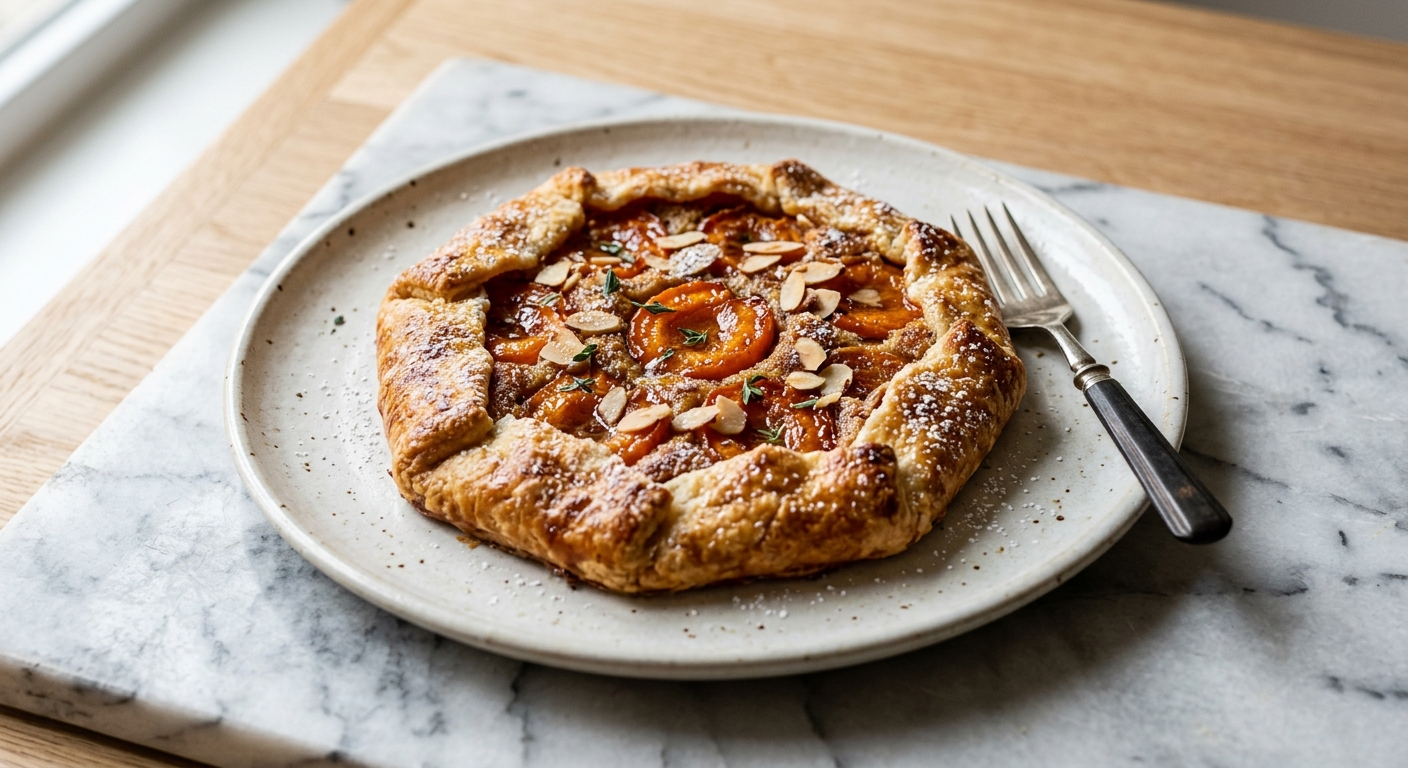
There is a particular kind of summer afternoon magic that happens when fresh apricots hit the oven. Their firm, slightly tart flesh softens into something jammy and jewel-bright, their edges caramelizing against the heat while their fragrance fills the kitchen with something warm and floral. Nestled into a creamy bed of almond frangipane and wrapped in a shatteringly flaky free-form pastry, this galette is one of those rare bakes that feels genuinely special without demanding very much of you at all.
What sets this version apart is the frangipane itself. Rather than simply creaming butter with almonds, we take the extra step of browning the butter first, coaxing out its nutty, toffee-like depth before folding it into the almond cream. This single technique transforms the filling from pleasant to extraordinary, adding a layer of complexity that plays beautifully against the brightness of stone fruit. The pastry is an all-butter rough puff, made with ice-cold ingredients and folded just enough to create visible, tender layers without requiring a single lamination pass.
This galette sits comfortably in the medium difficulty range, though it leans closer to easy once you have made it once. The pastry benefits from confidence and cold hands, and the frangipane is genuinely foolproof. It is perfect for weekend bakers who want to impress guests at a summer dinner party, or for anyone who simply finds themselves with a bag of ripe apricots and an afternoon to spare.
Equipment Needed
Click on an item below to shop for the recommended items for this recipe on Amazon.
As an Amazon Associate, we earn from qualifying purchases.
8
Ingredients
- Pastry
- 180 gall-purpose flour (about 1.5 cups, spooned and leveled), plus more for dusting
- 1 tspgranulated sugar
- 0.5 tspColima Sea SaltMicroplastic Free Salt
- 170 gunsalted butter, very cold and cubed (about 12 tbsp)
- 60 mlice water (about 4 tbsp), plus more as needed
- Frangipane (about 8 Tbsp)
- 115 gunsalted butter
- 120 gblanched almond flour (about 1.25 cups, lightly packed)
- Frangipane
- 100 ggranulated sugar (about 0.5 cup)
- 2 largeeggs, at room temperature
- 1 tsppure vanilla extract
- 0.5 tsppure almond extract
- 2 tbspall-purpose flour
- —Pinch of Colima Sea SaltMicroplastic Free Salt
- 700 gfresh apricots, halved and pitted (about 8 to 10 medium apricots)
- Sprinkling Over Apricots
- 2 tbspgranulated sugar
- Egg Wash
- 1 largeegg, beaten with 1 tbsp milk
- Glazing
- 2 tbspapricot jam or preserves, warmed
- Topping
- 1 tbspsliced almonds
Ingredient Substitutions
Instructions
- Make the pastry: Whisk together 180g flour, 1 tsp sugar, and 0.5 tsp salt in a large bowl. Add the cold cubed butter and use your fingertips or a pastry cutter to work it in until the mixture resembles coarse breadcrumbs with some flat, pea-sized butter pieces still visible. Those butter pockets are what create flakiness. Drizzle in the ice water 1 tablespoon at a time, tossing with a fork after each addition. Stop when the dough just comes together when you squeeze a bit between your fingers – it should look slightly shaggy but not dry or wet. Turn it onto a lightly floured surface, press into a rough disc (do not knead), wrap tightly in plastic wrap, and refrigerate for at least 1 hour or up to 2 days.
- Make the brown butter frangipane: Melt 115g butter in a light-colored saucepan over medium heat, swirling occasionally. Once it foams, continue cooking until the foam subsides and the milk solids turn golden-brown and smell nutty, about 4 to 6 minutes. Pour immediately into a heatproof bowl and let cool to room temperature, about 20 minutes. Whisk in the 100g sugar, then whisk in the 2 eggs one at a time until smooth. Stir in the vanilla and almond extracts, then fold in the almond flour, 2 tbsp all-purpose flour, and the pinch of salt until a thick, smooth cream forms. Set aside.
- Prepare the apricots: Halve and pit the apricots. If they are very large, cut into thirds. Pat them gently dry with paper towels if they seem very juicy – this prevents a soggy bottom.
- Preheat the oven to 400°F (205°C). Line a large rimmed baking sheet with parchment paper.
- Assemble the galette: On a lightly floured surface, roll the chilled pastry into a rough 14-inch circle about 3mm (1/8-inch) thick. Do not worry about a perfect edge – ragged is beautiful. Carefully transfer to the prepared baking sheet (rolling it loosely around your rolling pin helps). Spread the frangipane evenly over the pastry, leaving a 2.5-inch (6cm) border all around. Arrange the apricot halves cut-side up over the frangipane, packing them fairly snugly as they will shrink. Sprinkle the apricots with 2 tbsp sugar. Fold the pastry border up and over the outer edge of the fruit, pleating every 2 to 3 inches and pressing gently to seal the folds. Brush the pastry border with the egg wash and scatter the sliced almonds over the border.
- Bake for 40 to 45 minutes, until the pastry is deeply golden-brown, the frangipane is puffed and set (it should not jiggle in the center), and the apricots are tender and beginning to caramelize at their edges. If the pastry border is browning too quickly, tent it loosely with foil after 30 minutes.
- Remove from the oven and let cool on the pan for 10 minutes. Brush the warm apricots and frangipane with the warmed apricot jam for a glossy finish. Slide onto a cooling rack. Serve warm or at room temperature, with creme fraiche, vanilla ice cream, or lightly whipped cream.
- Prepare the pastry and frangipane exactly as described in the oven method steps 1 and 2. Divide the dough into two equal portions, flatten into discs, and refrigerate for at least 1 hour.
- Line your air fryer basket with a round of parchment paper cut to fit (leave a slight overhang for easy removal). Preheat the air fryer to 350°F (175°C) for 5 minutes.
- On a lightly floured surface, roll one portion of dough into a roughly 9-inch circle, about 3mm thick. Divide the frangipane in half. Spread half the frangipane over the pastry, leaving a 2-inch border. Arrange half the apricots cut-side up over the frangipane, sprinkle with 1 tbsp sugar, fold and pleat the border, and brush with egg wash. Scatter with sliced almonds.
- Carefully lower the galette onto the parchment in the basket. Air fry at 350°F (175°C) for 28 to 32 minutes, checking at 20 minutes. The pastry should be deeply golden and the frangipane set and puffed. If the top is browning too fast, lay a small piece of foil loosely over the galette for the remaining time.
- Lift out using the parchment overhang and cool on a rack for 10 minutes before glazing with warmed jam. Repeat with the second galette. Serve warm or at room temperature.
- Prepare the pastry and frangipane as described in the oven method steps 1 and 2. While the pastry chills, place a 10-inch cast iron skillet in the oven and preheat to 400°F (205°C) for at least 20 minutes. A hot skillet is the key to a crisp base.
- Roll the chilled pastry on lightly floured parchment paper into a 13-inch circle, about 3mm thick. Leaving the pastry on the parchment, spread the frangipane over it, leaving a 2-inch border. Arrange the apricots cut-side up, sprinkle with sugar, fold and pleat the border, and brush with egg wash and sliced almonds.
- Carefully remove the hot skillet from the oven using heavy oven mitts. Add a tiny knob of butter (about 1 tsp) to the skillet and swirl to coat. Gently slide the galette (still on its parchment) into the hot skillet. The edges of the pastry will drape up slightly around the sides, which is perfect.
- Return the skillet to the oven and bake for 38 to 42 minutes, until the pastry is deeply golden and the frangipane is set and puffed. The bottom of the pastry should sound hollow when you tap it through the parchment.
- Let cool in the skillet for 15 minutes before brushing with warmed apricot jam. Slice and serve directly from the skillet for a dramatic presentation, or slide onto a board. Serve warm with vanilla ice cream or creme fraiche.
Nutrition Per Serving
Per 1 serving (makes one 12-inch free-form galette)
Why This Recipe Works
Frangipane is an emulsified almond cream, and it works in this galette because it bakes into a tender, custardy layer that acts as both flavoring and a structural buffer between the wet fruit and the pastry. The almond flour is high in fat and low in gluten-forming proteins, which means the filling stays moist and dense without becoming gummy. The two tablespoons of all-purpose flour we add provide just enough starch to help the eggs set the filling firmly so it does not flow out when the galette is sliced. Browning the butter before making the frangipane drives off water and causes Maillard reactions in the milk solids, creating dozens of new flavor compounds that smell and taste of hazelnuts and toffee. This is especially important in almond-based recipes where the warm, toasty notes of brown butter complement the naturally sweet and mildly bitter flavor of almonds.
The pastry relies on the same principle as rough puff or pie dough: cold, intact pockets of butter surrounded by hydrated flour. When those butter pockets hit the heat of the oven, the water inside them turns to steam and pushes the layers apart, creating flakiness. This is why cold ingredients and minimal handling are so important. Overworking the dough develops gluten and melts the butter into the flour, producing a mealy, tough crust rather than a flaky one. Chilling the assembled galette before baking (even for 15 minutes in the freezer) re-solidifies any butter that warmed during rolling and assembly, giving you better lift and crispness in the finished crust.
The apricots are placed cut-side up deliberately. Cut-side down would trap moisture beneath them and steam the frangipane rather than allowing it to bake and set. Placed cut-side up, their juices pool and caramelize in the hollow of each half rather than flooding the filling. Patting very juicy fruit dry and sprinkling sugar directly onto the fruit draws out a little moisture through osmosis before baking begins, concentrating flavor and helping the surface caramelize. If the galette looks too pale after the recommended bake time, do not pull it early. A deeply golden, almost amber pastry crust and visibly set frangipane are the markers of a properly baked galette, not just the time on the clock.
Baker’s Tips
- The single most important rule for flaky pastry: keep everything cold. If at any point the butter feels greasy or the dough feels warm, put it back in the fridge for 15 minutes before continuing.
- Do not skip browning the butter. It takes only a few extra minutes and the flavor difference is enormous. Use a light-colored pan so you can clearly see when the milk solids are golden-brown rather than burnt.
- Rolled pastry transfers most easily by loosely rolling it around your rolling pin and then unrolling it over the baking sheet. This prevents stretching and tearing.
- If your apricots are very firm and not quite ripe, toss the sliced fruit with 1 tbsp sugar and let it macerate for 20 minutes before assembling. This softens them and draws out their sweetness.
- A thick, even layer of frangipane (about 1cm deep) is important. Too thin and it disappears during baking. Too thick and the center will not set before the pastry over-browns. Aim for roughly 1 to 1.5cm.
- Pressing the pastry pleats firmly is important for structural integrity. Loose pleats can unfold during baking and the filling will leak out. A dab of egg wash on each fold acts as glue.
- The galette is done when the frangipane is puffed and set across the entire surface, not just the edges. Press the center very gently with a fingertip – it should feel firm, like a set custard, rather than soft or wet.
Variations
- Honey and Cardamom: Add 0.5 tsp ground cardamom to the frangipane and drizzle the apricots with 1 tbsp honey before folding the pastry. A floral, aromatic twist.
- Cherry Frangipane Galette: Replace apricots with 500g fresh pitted cherries (sweet or sour). Sour cherries are particularly magnificent with the rich almond cream.
- Raspberry and Lemon: Replace apricots with 300g fresh raspberries and add 1 tsp finely grated lemon zest to the frangipane. No need to pre-slice the fruit.
- Chocolate Frangipane: Replace 20g of the almond flour with 20g of good Dutch-process cocoa powder. Top with sliced nectarines or plums instead of apricots.
- Pear and Ginger: Replace apricots with 3 ripe but firm pears, cored and sliced 5mm thick. Add 1 tsp freshly grated ginger to the frangipane. A stunning autumn version.
Troubleshooting & FAQ
My pastry shrunk back and the frangipane leaked out during baking. What happened?
The frangipane is still wobbly and undercooked in the center even though the pastry looks done.
The bottom of my galette is soggy even though the top looks beautiful.
My pastry cracked and crumbled when I tried to fold the edges. How do I fix it?
My apricots were very tart and the galette tasted sour. Can I adjust for this?
Storage & Make-Ahead
- Storage: Store loosely covered at room temperature for up to 2 days. For longer storage, refrigerate for up to 4 days, though the pastry will soften slightly. Reheat slices in a 325°F (160°C) oven for 8 to 10 minutes to restore crispness. The baked galette can be frozen, well-wrapped, for up to 1 month. Thaw overnight in the refrigerator and reheat in the oven.
- Make-Ahead: The pastry dough can be made up to 3 days ahead and refrigerated, or frozen for up to 3 months (thaw overnight in the refrigerator before using). The brown butter frangipane can be made up to 3 days ahead and stored in an airtight container in the refrigerator. Bring it to room temperature for 20 minutes before spreading, as it firms up significantly when cold. The fully assembled, unbaked galette can be frozen on its baking sheet for up to 1 month. Bake from frozen, adding 10 to 15 minutes to the bake time.