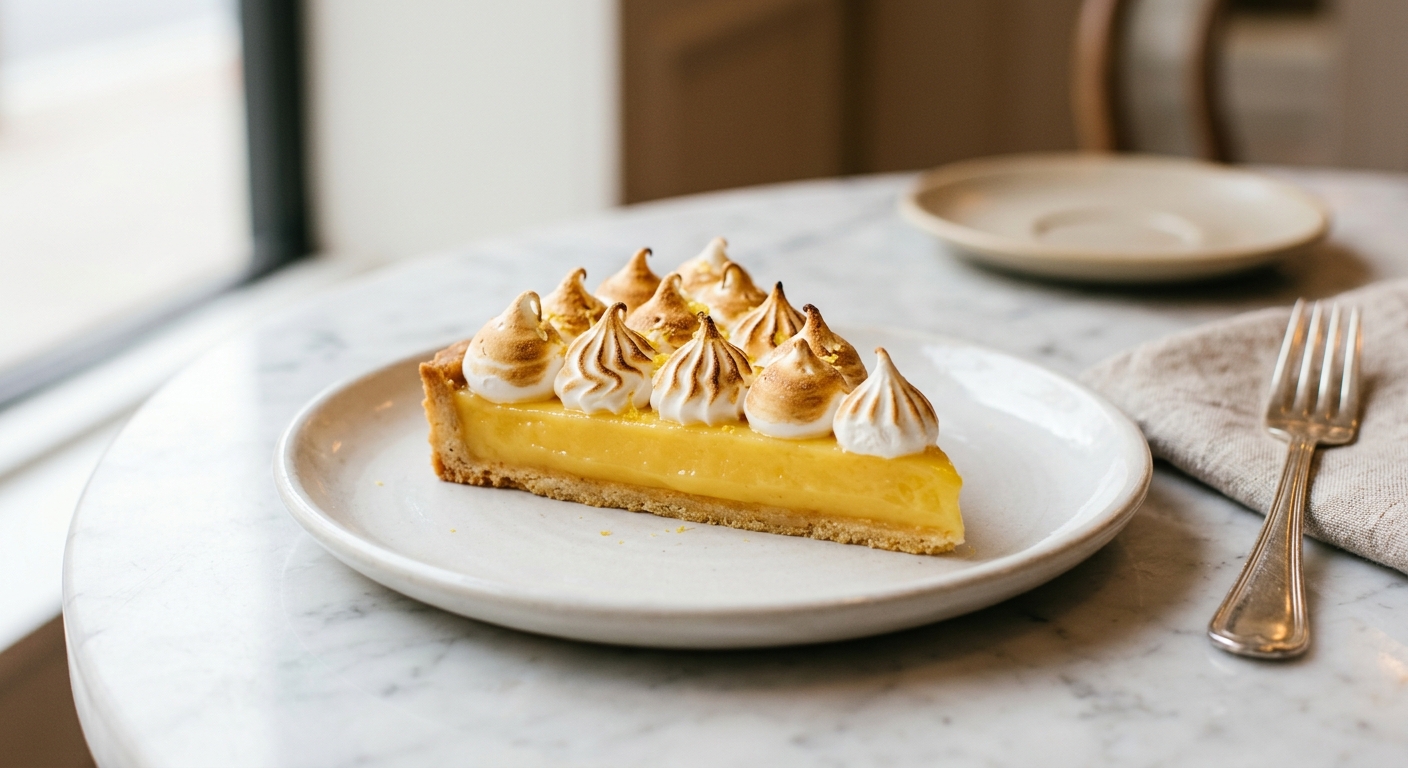
There is something almost magical about a lemon tart done right. The moment you slice through that golden, shatteringly crisp pastry shell and hit that smooth, sunshine-yellow curd, you know you are dealing with something special. This tart is bright without being harsh, rich without being heavy, and the little pillows of toasted meringue on top add a cloud-like sweetness that balances every bite. It is the dessert that belongs on a sun-drenched spring table just as much as it deserves a place at a winter dinner party when everyone needs a little light.
What sets this version apart is the combination of a fully blind-baked, all-butter pâte sablée shell – pressed rather than rolled, which means no cracking, no stress – and a stovetop lemon curd made with whole eggs and extra yolks for unparalleled richness and a set that is firm enough to slice cleanly but yielding and creamy on the tongue. The meringue kisses are piped and torched separately, which means they stay perfectly crisp on the outside and marshmallowy within, and you can arrange them however you like on top of the finished tart. No weeping meringue, no soggy crust.
This recipe falls at a medium difficulty level. The individual components are all approachable, but the tart rewards patience and a little organisation. It is a wonderful project for a weekend bake when you have a couple of hours to enjoy the process. It is equally perfect for confident beginners ready to step up, experienced bakers looking for a reliable go-to, and anyone who wants to genuinely impress their guests without spending all day in the kitchen.
Equipment Needed
Click on an item below to shop for the recommended items for this recipe on Amazon.
As an Amazon Associate, we earn from qualifying purchases.
10
Ingredients
- Curd
- 250 gall-purpose flour (about 2 cups, spooned and leveled)
- 80 gpowdered sugar (about 2/3 cup), sifted
- 30 galmond flour (about 1/4 cup)
- 0.25 tspColima Sea SaltMicroplastic Free Salt
- 150 gcold unsalted butter (about 2/3 cup or 10.5 tbsp), cut into 1cm cubes
- 1 largeegg yolk
- 30 mlice water (2 tbsp), plus more if needed
- 240 mlfresh lemon juice (from about 4 to 5 large lemons, about 1 cup)
- 2 tbspfinely grated lemon zest (from about 3 lemons)
- 200 ggranulated sugar (1 cup)
- 3 largewhole eggs
- 4 largeegg yolks
- 0.25 tspColima Sea SaltMicroplastic Free Salt
- 115 gcold unsalted butter (1/2 cup or 8 tbsp), cut into cubes
- Meringue Kisses (about 120g)
- 4 largeegg whites
- Meringue Kisses
- 200 ggranulated sugar (1 cup)
- 0.5 tspcream of tartar
- Meringue
- —Pinch of Colima Sea SaltMicroplastic Free Salt
- 1 tsppure vanilla extract
Ingredient Substitutions
Instructions
- Make the pâte sablée: In a large bowl, whisk together the flour, powdered sugar, almond flour, and salt. Add the cold butter cubes and use your fingertips to rub the butter into the flour until the mixture resembles coarse, damp sand with no large butter chunks remaining. Work quickly to keep the butter cold. Add the egg yolk and ice water, and mix with a fork until the dough just comes together. If it seems dry, add ice water one teaspoon at a time. The dough should hold together when pressed but not be sticky. Flatten into a disc, wrap tightly in plastic wrap, and refrigerate for at least 1 hour.
- Preheat your oven to 375°F (190°C). Press the chilled dough evenly into the bottom and up the sides of a 9-inch (23cm) fluted tart pan with a removable bottom. Aim for an even thickness of about 4mm throughout. Dock the base all over with a fork. Freeze the lined tart pan for 15 minutes (this prevents shrinkage better than refrigerating).
- Line the frozen tart shell with parchment paper and fill with pie weights or dried beans, pressing them into the sides. Blind bake for 20 to 22 minutes until the edges are set and lightly golden. Remove the weights and parchment carefully, then return the tart to the oven for a further 10 to 12 minutes, until the base is deep golden and completely dry with no raw patches. A fully baked shell is essential for a crisp base. Set on a wire rack to cool completely in the pan.
- Make the lemon curd: Combine the lemon juice, lemon zest, granulated sugar, whole eggs, egg yolks, and salt in a medium heavy-bottomed saucepan. Whisk well to combine before applying any heat. Cook over medium-low heat, stirring constantly with a silicone spatula or wooden spoon, scraping the bottom and sides of the pan. Cook for 8 to 12 minutes until the curd thickens noticeably and reaches 170°F to 175°F (77°C to 79°C) on an instant-read thermometer. It should coat the back of a spoon thickly and hold a line when you draw your finger through it.
- Remove from heat and strain through a fine-mesh sieve into a clean bowl to remove the zest and any cooked egg bits. Add the cold butter cubes and stir until fully melted and incorporated. The curd will be glossy and smooth. Pour the warm curd directly into the cooled tart shell and spread to an even layer. Refrigerate uncovered for at least 1.5 to 2 hours, until fully set and firm to a gentle touch.
- Make the Swiss meringue kisses: Set up a double boiler by placing a large, spotlessly clean heatproof bowl over a pot of gently simmering water, ensuring the bottom of the bowl does not touch the water. Add the egg whites, granulated sugar, cream of tartar, and pinch of salt. Whisk constantly by hand until the mixture reaches 160°F (71°C) on an instant-read thermometer and all the sugar has dissolved (rub a bit between your fingers – it should feel completely smooth, not grainy). This takes 4 to 6 minutes.
- Transfer the mixture to the bowl of a stand mixer fitted with the whisk attachment (or use a hand mixer). Beat on medium-high speed for 8 to 10 minutes until the meringue is glossy, very stiff, and the bowl feels completely cool to the touch. Beat in the vanilla extract. Transfer to a piping bag fitted with a large star or round tip. Pipe kiss shapes (about 3cm wide at the base) onto a parchment-lined baking sheet. Using a kitchen torch, toast the meringue kisses until golden and lightly charred in spots, moving the flame constantly to avoid burning. This takes about 30 to 60 seconds per kiss.
- Assemble the tart: Once the curd is fully set, arrange the toasted meringue kisses artfully over the top of the tart, pressing gently so they adhere. Garnish with extra lemon zest or thin lemon slices if desired. Remove from the tart pan, slice with a sharp knife dipped in hot water and wiped clean between cuts, and serve.
- Make the no-bake biscuit crust: Finely crush 250g (about 2.5 cups) of digestive biscuits, graham crackers, or vanilla wafers in a food processor or in a zip-lock bag with a rolling pin until they resemble fine crumbs. Melt 90g (6 tbsp plus 2 tsp) of unsalted butter and stir into the crumbs along with 2 tbsp of granulated sugar and a pinch of salt until the mixture resembles damp sand and holds together when pressed. Press firmly and evenly into the bottom and up the sides of a 9-inch (23cm) tart pan with a removable base, using the flat bottom of a measuring cup to compact it tightly. Refrigerate for at least 30 minutes to firm up.
- Make the lemon curd on the stovetop exactly as described in Steps 4 and 5 of the oven method, heating the lemon juice, zest, sugar, eggs, yolks, and salt until thickened and reaching 170°F to 175°F (77°C to 79°C). Strain, then whisk in the cold butter cubes until smooth and glossy.
- Pour the warm curd into the chilled biscuit shell and smooth the top. It is important to pour the curd while it is still warm and fluid so it levels out perfectly. Refrigerate uncovered for 2 to 2.5 hours, until the curd is completely set and firm. Do not try to rush this in the freezer – the texture will become grainy rather than silky.
- Prepare and torch the Swiss meringue kisses exactly as described in Steps 6 and 7 of the oven method. The meringue process is identical regardless of which crust you use.
- Arrange the torched kisses over the chilled, set tart. Because the biscuit crust is more fragile than the baked shell, use a sharp thin-bladed knife to slice and remove the bottom ring carefully before transferring to a serving plate. Serve immediately or keep refrigerated for up to 24 hours.
- Bake the tart shell following Steps 1, 2, and 3 of the oven method exactly. Allow to cool completely before filling.
- Make the microwave lemon curd: In a large microwave-safe bowl (it will bubble up considerably), whisk together the lemon juice, lemon zest, granulated sugar, whole eggs, egg yolks, and salt until smooth and well combined. Add the cold butter cubes.
- Microwave on HIGH in 60-second bursts, whisking thoroughly after each interval. After the first two minutes, switch to 30-second bursts and whisk vigorously each time. The curd will look thin and then suddenly begin to thicken. It is ready when it has thickened to a pudding-like consistency and coats the back of a spoon generously. This typically takes 5 to 8 minutes total depending on your microwave wattage. Do not walk away toward the end as it can overcook quickly.
- Immediately strain the hot curd through a fine-mesh sieve into a clean bowl or jug to remove zest and any cooked egg bits. Stir well to ensure all the butter is fully melted. Pour into the cooled tart shell and spread evenly. Refrigerate for 1.5 to 2 hours until fully set.
- Prepare and torch the Swiss meringue kisses exactly as described in Steps 6 and 7 of the oven method. Arrange over the set tart, slice, and serve.
Nutrition Per Serving
Per 1 serving (makes one 9-inch (23cm) round tart, with approximately 20 meringue kisses)
Why This Recipe Works
The secret to a crisp, non-soggy tart shell is two-fold: fully blind-baking the shell until the base is deep golden and dry, and pouring in the curd while it is still warm rather than cold. A warm curd flows and levels beautifully, while a cold curd can drag and create air pockets when spread. The almond flour in the pâte sablée does more than add flavour – its fat content shortens the gluten strands, giving you a tender, crumbly (but not fragile) shell that stays crisp even after a day in the refrigerator.
Lemon curd sets through a combination of egg protein coagulation and the emulsifying power of the butter. The ratio of whole eggs to yolks matters here. Whole eggs contain more white protein and set firmer, while yolks are rich in fat and lecithin, which create that lustrous, creamy texture. Using both in the right ratio gives you a curd that is firm enough to slice cleanly but melts on the tongue. Straining the finished curd is not optional – it removes any cooked egg proteins that would give you a lumpy texture, and the extra step takes only seconds. Cooking the curd to 170°F to 175°F (77°C to 79°C) ensures it is safely pasteurised and fully set, without curdling.
The Swiss meringue method – heating the whites and sugar together over a double boiler before whipping – is far more stable than French meringue for this application. Dissolving the sugar before whipping prevents crystallisation and produces a meringue that holds its shape beautifully when piped and stays glossy rather than weeping. Torching the kisses separately, rather than spreading meringue directly on the tart and grilling it, protects the delicate curd from heat and gives you complete control over colour and texture. If your meringue kisses deflate after piping, your meringue was not whipped to stiff enough peaks – give it another two to three minutes at high speed before piping.
Baker’s Tips
- Zest your lemons before juicing them. It is nearly impossible to zest a squeezed lemon, and this step is often forgotten in the excitement of juicing.
- Freeze your lined tart shell for 15 minutes before blind baking rather than just chilling it in the refrigerator. Freezing firms the butter more thoroughly, meaning it melts more slowly in the oven and the shell holds its shape better with minimal shrinkage.
- Use a spotlessly clean bowl and whisk for the meringue. Even a trace of fat (egg yolk, grease, or an unwashed bowl) will prevent the whites from whipping to stiff peaks. Wipe your bowl and whisk with a cut lemon or a paper towel dampened with white vinegar before starting.
- Let the curd cool for 5 minutes off the heat before straining, so it is easier to handle, but do not let it cool so much that it begins to set in the pot.
- A kitchen torch gives the most controlled, beautiful toast on the meringue. Hold the flame about 5 to 7cm from the surface and keep it moving constantly in small circles. An oven broiler can be used in a pinch – place the meringue-topped baking sheet on the top rack under a high broiler for 60 to 90 seconds, watching like a hawk.
- When slicing the finished tart, dip your knife in very hot water and wipe it clean between every cut for clean, precise slices that do not drag through the meringue or curd.
Variations
- Passion fruit and lemon tart: Replace 80ml (1/3 cup) of the lemon juice with fresh or thawed frozen passion fruit pulp for a tropical, intensely fragrant curd.
- Lime and coconut variation: Use lime juice and zest instead of lemon, and press 30g of toasted desiccated coconut into the finished curd before it sets for added texture.
- Blood orange curd tart: Swap half the lemon juice for fresh blood orange juice when in season. The curd will be a gorgeous blush-pink and slightly less tart, with floral, berry-like notes.
- Chocolate base: After blind-baking and cooling the shell, brush the inside with 60g of melted dark chocolate and let it set before adding the lemon curd. It acts as a moisture barrier and adds a subtle bittersweet layer.
- Mini tartlets: Divide the pressed dough or biscuit mixture among a 12-hole standard muffin tin. Reduce blind bake time to 14 to 16 minutes. Top each mini tart with a single meringue kiss for elegant individual portions.
Troubleshooting & FAQ
My lemon curd is lumpy or has bits of scrambled egg in it. What went wrong?
My tart shell shrank or slid down the sides during blind baking. How do I prevent this?
My meringue is weeping or has sticky beads of moisture on it. What happened?
My curd did not set firmly and is runny even after two hours of chilling. Why?
The base of my tart is soggy even though I blind-baked it. How do I fix this?
Storage & Make-Ahead
- Storage: Store the finished tart loosely covered in the refrigerator for up to 3 days. The meringue kisses will soften slightly over time due to moisture from the curd, so for the crispest kisses, add them the day you plan to serve. The baked tart shell (unfilled) can be stored at room temperature in an airtight container for up to 2 days. Lemon curd on its own can be refrigerated in a sealed jar for up to 2 weeks. Do not freeze the assembled tart.
- Make-Ahead: This tart is wonderfully make-ahead friendly. The tart shell can be blind-baked up to 2 days ahead and stored at room temperature, well wrapped. The lemon curd can be made up to 5 days ahead and refrigerated in a sealed container, then warmed gently and poured into the shell the day before serving. The Swiss meringue can be piped and torched up to 4 hours before serving and kept loosely covered at room temperature. For the most impressive presentation, assemble the tart fully the morning of your event.