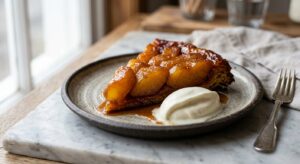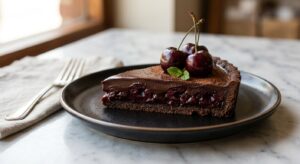
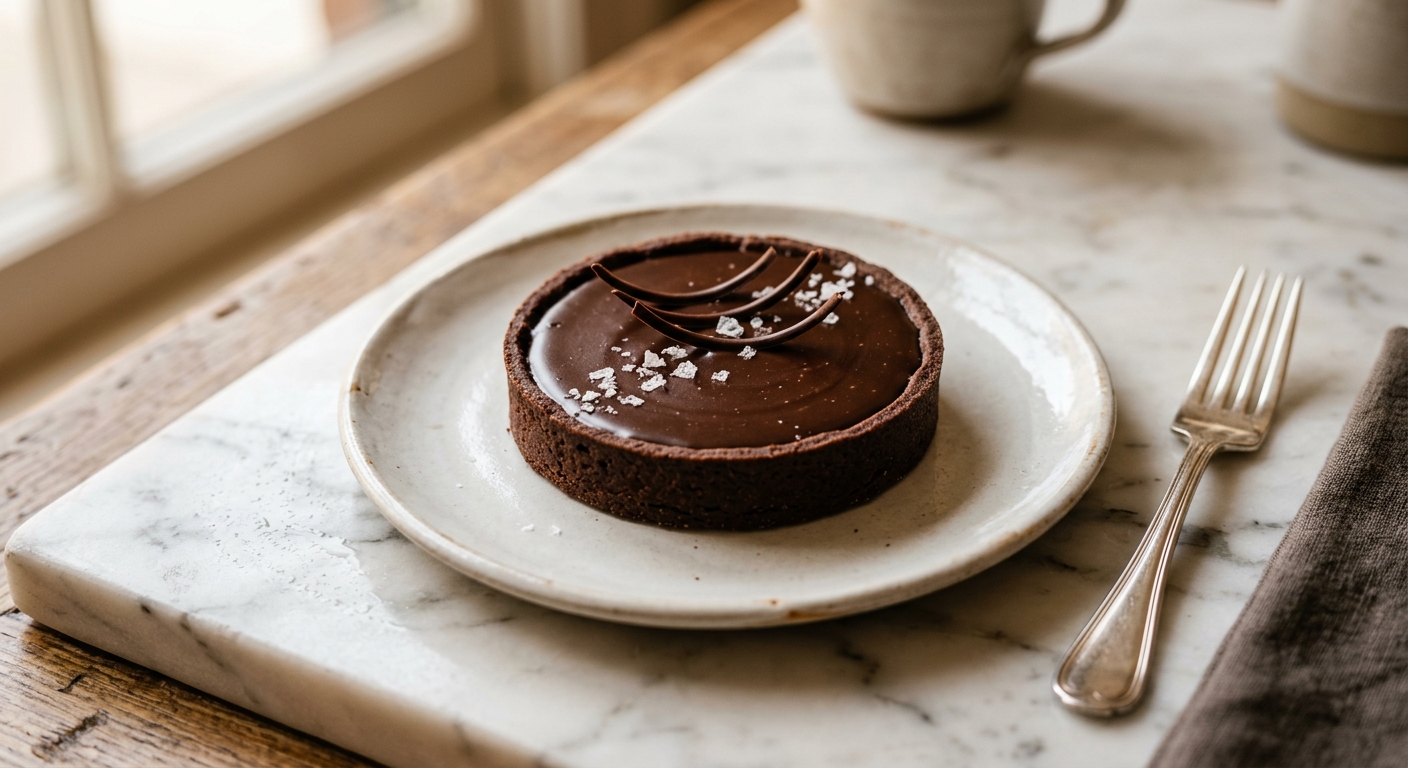
There is a particular kind of dessert that stops conversation the moment it hits the table. This dark chocolate ganache tart is exactly that. The filling is impossibly smooth, deeply chocolatey, and just barely set, with a texture somewhere between a firm truffle and a cool, creamy pudding. The shell is thin and crisp, with a subtle cocoa bitterness that echoes the filling. And then there is that final flourish: a scattering of flaky sea salt that catches the light and transforms every single bite, making the chocolate taste more intensely of itself than you thought possible.
What sets this version apart is the ganache ratio and the technique behind it. Rather than equal parts chocolate and cream, this recipe uses a higher chocolate ratio, which gives the filling enough body to slice cleanly at room temperature without ever turning rubbery or grainy. The cream is warmed gently with a small amount of glucose syrup, which isn’t glamorous but is genuinely important: it keeps the ganache glossy and prevents the chocolate from seizing or becoming dull over time. The cocoa shortcrust is made using the French sablé method, creaming the butter and sugar first for a shell that is tender and snappy rather than tough.
This tart sits at a medium difficulty level, mostly because the pastry requires a little patience and a light touch. But every step is straightforward and clearly explained, and the ganache itself is nearly foolproof. It is ideal for dinner party hosts who want a showstopper dessert they can prepare entirely the day before, and for anyone who believes, rightly, that dark chocolate and sea salt is one of the great flavor combinations in the world.
Equipment Needed
Click on an item below to shop for the recommended items for this recipe on Amazon.
As an Amazon Associate, we earn from qualifying purchases.
10
Ingredients
- Finishing
- 180 gall-purpose flour (about 1.5 cups, spooned and leveled)
- 25 gunsweetened Dutch-process cocoa powder (about 3 tablespoons)
- 40 gpowdered sugar, sifted (about 5 tablespoons)
- 0.25 tspColima Sea SaltMicroplastic Free Salt
- 115 gunsalted butter, cold and cut into small cubes (about 1/2 cup)
- 1 largeegg yolk
- 30 mlice water (2 tablespoons), plus more as needed
- 300 gdark chocolate, 70 to 72% cacao, finely chopped
- 300 mlheavy cream (about 1.25 cups)
- 20 gglucose syrup or light corn syrup (about 1 tablespoon)
- 30 gunsalted butter, at room temperature (about 2 tablespoons)
- —1 to 1.5 teaspoons Colima Sea SaltMicroplastic Free Salt (such as Maldon)
- Optional Dusting
- —Cocoa powder or edible gold dust
Ingredient Substitutions
Instructions
- Make the cocoa sablé crust: In a large bowl or the bowl of a stand mixer fitted with the paddle attachment, beat the cold butter and powdered sugar on medium-low speed for 2 to 3 minutes, until the mixture is just combined and looks like damp sand. Do not cream it to a fluffy stage. Add the egg yolk and mix briefly to incorporate.
- Sift the flour, cocoa powder, and fine sea salt directly into the bowl. Mix on low speed (or fold by hand) until the dough just comes together in clumps. Drizzle in the ice water one tablespoon at a time, mixing only until the dough holds together when you press a piece between your fingers. It should not be sticky. Turn the dough out, press it into a flat disk, wrap in plastic wrap, and refrigerate for at least 1 hour.
- Preheat your oven to 325°F (160°C). On a lightly floured surface, roll the chilled dough out to about 3mm thick (roughly 1/8 inch), working quickly to keep it cold. Carefully drape it into a 9-inch fluted tart pan with a removable bottom. Press it gently into the corners without stretching the dough. Trim the edges flush with the pan. Prick the base all over with a fork. Refrigerate the unbaked shell for another 20 minutes to relax the gluten and prevent shrinkage.
- Line the chilled tart shell with parchment paper and fill with baking weights or dried beans. Blind bake for 15 minutes. Remove the weights and parchment, and bake for a further 8 to 10 minutes, until the base looks dry and set and the edges are firm. The shell should feel dry to the touch with no raw patches. Set aside on a wire rack to cool completely before filling.
- Make the ganache filling: Place the finely chopped dark chocolate in a heatproof bowl. In a small saucepan over medium-low heat, combine the heavy cream and glucose syrup. Heat, stirring occasionally, until the mixture just begins to steam and small bubbles form around the edges. Do not let it boil. Pour the hot cream over the chocolate and let it sit undisturbed for 2 minutes so the chocolate melts.
- Starting from the center, stir the ganache slowly in small circles with a rubber spatula, gradually widening your motion. Do not whisk, which would incorporate air bubbles. Once the ganache is smooth and glossy, add the room-temperature butter and stir gently until fully incorporated. The butter adds richness, sheen, and a silky texture.
- Pour the warm ganache into the completely cooled tart shell. Gently tap the pan on the counter twice to release any air bubbles. Use a toothpick to pop any bubbles that rise to the surface. Leave the tart at room temperature for 20 minutes, then transfer it to the refrigerator and chill, uncovered, for at least 2 hours, until the ganache is fully set but still has a slight give when you gently press the center.
- Remove the tart from the refrigerator 15 to 20 minutes before serving to take the chill off slightly, which brings out the full chocolate flavor. Just before serving, scatter the flaky sea salt evenly over the surface. Slice with a thin, sharp knife wiped clean between each cut.
- Make the no-bake chocolate cookie crust: In a food processor, blitz 200g of chocolate sandwich cookies (such as Oreos, about 20 cookies) including the filling, until you have fine crumbs. Alternatively, place them in a zip-lock bag and crush with a rolling pin. You should have about 1.75 cups of crumbs.
- Melt 55g of unsalted butter. Pour it over the cookie crumbs and stir well until the crumbs look like wet sand and hold together when pressed. Press the mixture evenly into the bottom and up the sides of a 9-inch tart pan with a removable bottom or a 9-inch springform pan. Use the flat bottom of a measuring cup to compact it firmly. Refrigerate the crust for at least 30 minutes to firm up before filling.
- Make the ganache filling exactly as described in steps 5 and 6 of the Oven method: heat the cream with the glucose syrup until steaming (not boiling), pour over the chopped chocolate, rest 2 minutes, stir from the center outward until smooth, then stir in the room-temperature butter.
- Pour the ganache into the chilled cookie crust. Tap the pan gently to level the surface and pop any air bubbles with a toothpick. Do not add the sea salt yet.
- Refrigerate the tart, uncovered, for at least 3 hours or until the ganache is fully set and does not wobble when you move the pan. Once set, you can loosely cover it. Remove from the refrigerator 10 minutes before serving, scatter with flaky sea salt, and slice cleanly with a warm knife.
- Prepare and bake the cocoa sablé crust exactly as described in steps 1 through 4 of the Oven method. Allow the shell to cool completely before proceeding.
- Place the finely chopped dark chocolate and glucose syrup in a large microwave-safe bowl. Pour the heavy cream directly over the chocolate. Do not stir yet.
- Microwave the mixture on 50% power (medium) for 90 seconds. Remove and stir gently from the center. The mixture will look broken and uneven at this stage. That is normal. Return to the microwave on 50% power for 30-second bursts, stirring gently between each, until the cream is fully hot and the chocolate is nearly melted, about 2 to 3 more bursts. Using 50% power is essential: full power will scorch the chocolate and split the cream.
- Once the mixture is mostly melted with only a few small solid pieces remaining, stir continuously and gently from the center outward until the ganache is completely smooth and glossy. The residual heat will melt the remaining pieces. Add the room-temperature butter and stir until incorporated.
- Pour into the cooled tart shell, tap to release air bubbles, and refrigerate uncovered for at least 2 hours until set. Scatter with flaky sea salt just before serving.
Nutrition Per Serving
Per 1 serving (makes one 9-inch round tart)
Why This Recipe Works
The key to a ganache that slices cleanly, looks glossy for days, and tastes luxuriously smooth rather than greasy lies in the fat chemistry. Dark chocolate contains cocoa butter, which is a crystalline fat. When you pour hot cream over chopped chocolate and stir gently from the center, you are creating an emulsion: the cocoa butter and milk fat from the cream are dispersed into tiny, uniform droplets. Stirring from the center outward (rather than whisking vigorously) prevents air incorporation and gives the emulsion time to form properly. The glucose syrup interferes with cocoa butter crystallization, keeping the surface shiny and the texture supple rather than grainy or dull as the tart sits in the refrigerator over several days.
The cocoa sablé crust uses a technique called creaming the butter and sugar first before adding the flour. This coats the flour proteins in fat before any water-based liquid can activate them, meaning gluten development is minimal. The result is a shell that is genuinely short and crisp rather than chewy. Using cold butter and adding ice water keeps things from becoming greasy. Blind baking with weights is non-negotiable here: the filling is liquid and the shell must be fully cooked before it goes in, otherwise the base will be raw, soft, and unable to support the ganache cleanly.
If your ganache looks broken or greasy, do not panic. A broken ganache usually means the emulsion separated, often because the cream was too hot or the chocolate was not chopped finely enough. Fix it by adding one tablespoon of warm (not hot) cream and stirring gently from the center until it comes back together. If the ganache is not setting after 2 hours in the refrigerator, the cream-to-chocolate ratio may have been off. You can gently re-melt the filling in a double boiler, stir in an extra 30g of finely chopped dark chocolate, and re-pour.
Baker’s Tips
- Chop the chocolate as finely as possible before starting, ideally into pieces no larger than a pea. Smaller pieces melt faster and more evenly, giving you a smoother ganache with less stirring needed.
- The butter added to the ganache must be at true room temperature, soft enough to leave an indent when pressed. Cold butter will not emulsify properly and can cause the ganache to look greasy or split.
- Do not skip the second chill of the raw tart shell before blind baking. That 20-minute rest in the refrigerator relaxes the gluten developed during rolling and is the most effective way to prevent the sides from slumping in the oven.
- For perfectly clean slices, dip your knife in hot water, wipe it dry with a clean towel, and slice. Repeat between each cut. This takes an extra 30 seconds and makes a visible difference.
- Use the best chocolate you can reasonably access. With a recipe this simple, chocolate quality is the dominant flavor. Valrhona Guanaja, Callebaut 70-30-38, or Lindt Excellence 70% all work beautifully.
- Add the flaky sea salt at the very last moment before serving, not when you pour the ganache. Salt sitting on the surface for hours will partially dissolve, losing its visual drama and textural crunch.
- If your kitchen is warm (above 75°F or 24°C), the pastry dough may become soft and sticky during rolling. Work in short bursts, returning the dough to the refrigerator for 10 minutes whenever it starts to soften.
Variations
- Orange and dark chocolate: Add 1 tablespoon of finely grated orange zest to the cream as it heats. Strain it out before pouring over the chocolate. The citrus oil will infuse into the cream beautifully.
- Espresso ganache: Dissolve 2 teaspoons of instant espresso powder into the warm cream before pouring it over the chocolate. Coffee deepens and amplifies the chocolate flavor without tasting noticeably of coffee.
- Salted caramel layer: Spread a thin layer (about 3 tablespoons) of room-temperature salted caramel sauce over the baked, cooled crust before pouring in the ganache. The caramel sets against the chocolate as it chills, creating a hidden layer.
- Spiced version: Add 0.5 teaspoon of ground cinnamon, a pinch of cayenne, and a pinch of cardamom to the cream as it heats for a Mexican-inspired dark chocolate tart.
- White chocolate version: Replace the dark chocolate with 350g of good-quality white chocolate (white chocolate sets softer, so the higher amount compensates). Omit the glucose syrup and use only 200ml of cream.
Troubleshooting & FAQ
My ganache looks oily or grainy instead of smooth and glossy. What went wrong?
The sides of my tart shell shrank and slumped down during blind baking. How do I prevent this?
My ganache is still liquid and wobbly after 2 hours in the fridge. Will it set?
My cocoa pastry dough is crumbling and will not come together. What do I do?
There are air bubbles on the surface of my set ganache. How do I avoid them?
Storage & Make-Ahead
- Storage: Store the finished tart loosely covered in the refrigerator for up to 5 days. The ganache surface can absorb odors, so keep it away from strong-smelling foods. Bring individual slices to room temperature for 15 minutes before eating for the best texture and flavor. Do not freeze the filled tart, as the ganache can become grainy upon thawing. The unfilled baked shell can be frozen for up to 1 month, well-wrapped.
- Make-Ahead: This tart is an excellent make-ahead dessert. The baked tart shell can be made up to 2 days ahead and stored at room temperature, loosely wrapped. The ganache can be poured and the tart fully assembled up to 2 days ahead and refrigerated. Hold off on adding the flaky sea salt until 10 to 15 minutes before serving, as it will dissolve and lose its crunch if added too early.