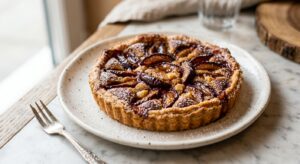
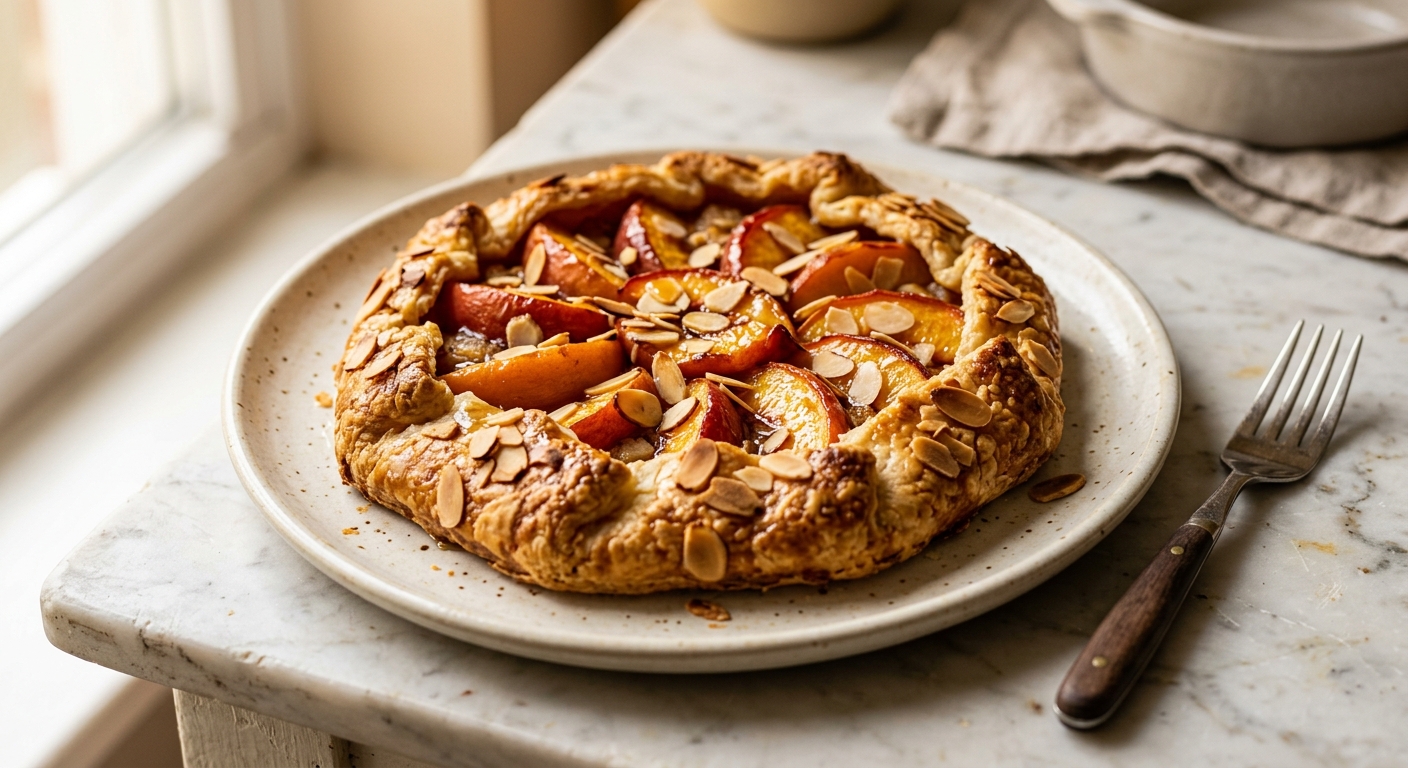
There is something deeply satisfying about a galette. The edges are purposefully imperfect, folded over in rough, rustic pleats, and the fruit bubbles up through the center in the most inviting way. This peach and almond version is the dessert I make every August when peaches are so ripe and fragrant that they barely need any help at all. The filling is generous, the pastry is shatteringly crisp, and the whole thing perfumes your kitchen with something that smells like the very best version of summer.
What sets this galette apart from a simple fruit fold-over is the layer of frangipane, a classic French almond cream, spread across the base of the pastry before the peaches go on. Frangipane is made from ground almonds, butter, sugar, and eggs, and it does something extraordinary in the oven: it puffs up around the fruit, absorbing the peach juices as it bakes and transforming into a soft, almost custardy almond layer. It acts as both a flavor base and a moisture barrier, keeping the pastry crisp underneath while adding a nutty richness that makes every bite feel complete. A honey glaze brushed on straight from the oven gives the peaches a gorgeous sheen and a floral sweetness that ties everything together.
This recipe sits comfortably in the medium difficulty range. The pastry requires a little attention and a cold kitchen, but there is no blind baking, no fussy crimping, and no tart tin to worry about. It is ideal for confident beginners who want to stretch their skills, or experienced bakers looking for a relaxed, show-stopping dessert for a summer dinner party. Serve it warm with a scoop of vanilla ice cream or a dollop of creme fraiche, and watch it disappear.
Equipment Needed
Click on an item below to shop for the recommended items for this recipe on Amazon.
As an Amazon Associate, we earn from qualifying purchases.
8
Ingredients
- Frangipane
- 190 gall-purpose flour (about 1.5 cups, spooned and leveled), plus extra for dusting
- 15 gicing sugar (about 2 tbsp), sifted
- 0.5 tspColima Sea SaltMicroplastic Free Salt
- 115 gunsalted butter, very cold, cut into 1 cm cubes (about 1/2 cup or 1 stick)
- 60 mlice water (about 4 tbsp), plus more as needed
- 100 gblanched almond flour (about 1 cup, lightly packed)
- 80 gunsalted butter, at room temperature (about 5.5 tbsp)
- 80 gcaster sugar (about 6 tbsp)
- 1 largeegg, at room temperature
- 1 tsppure almond extract
- 1 tsppure vanilla extract
- 15 gall-purpose flour (about 2 tbsp)
- 700 gripe but firm peaches (about 4 to 5 medium), pitted and sliced 5mm thick
- Tossing The Peaches
- 30 gcaster sugar (about 2.5 tbsp)
- 1 tspground cinnamon
- 0.25 tspground cardamom
- 15 mlfresh lemon juice (about 1 tbsp)
- Egg Wash
- 1 largeegg yolk mixed with 1 tbsp heavy cream
- Topping
- 20 gflaked almonds (about 3 tbsp)
- Glazing
- 30 mlrunny honey (about 2 tbsp)
- Sprinkling On The Pastry Crust
- —Demerara sugar
Ingredient Substitutions
Instructions
- Make the pastry: In a large bowl, whisk together 190g flour, 15g icing sugar, and 0.5 tsp salt. Add the cold butter cubes and use your fingertips to press and rub the butter into the flour until you have a shaggy mixture with some flat, pea-sized butter pieces remaining. These butter pieces are crucial for a flaky crust. Drizzle in the ice water one tablespoon at a time, tossing with a fork after each addition, until the dough just comes together when you press a handful. It should not be sticky or smooth. Tip onto a lightly floured surface, press into a flat disc, wrap in plastic wrap, and refrigerate for at least 1 hour (or up to 2 days).
- Make the frangipane: Beat 80g room-temperature butter and 80g caster sugar together in a bowl with a hand mixer or by hand until pale and fluffy, about 3 minutes. Beat in the egg until fully combined, then mix in the almond extract and vanilla extract. Fold in the almond flour and 15g plain flour until smooth. The frangipane should be thick and spreadable. Cover and refrigerate until needed (up to 3 days).
- Prepare the peaches: Toss the peach slices with 30g caster sugar, 1 tsp cinnamon, 0.25 tsp cardamom, and 15ml lemon juice in a bowl. Set aside for 10 minutes. The sugar draws out a little juice. Do not leave them much longer than this or they will become too wet.
- Assemble the galette: Preheat your oven to 400°F (200°C) and place a baking sheet inside to heat up. On a lightly floured sheet of parchment paper, roll the chilled pastry into a rough circle about 33 to 35cm (13 inches) in diameter and 3mm thick. Do not worry about perfect edges. Transfer the parchment and pastry to a second (cold) baking sheet for easier handling. Spread the frangipane evenly over the pastry, leaving a 5cm (2-inch) border all the way around. Arrange the peach slices over the frangipane in overlapping concentric circles or a casual fan pattern, leaving the border clear. Fold the pastry border up and over the edge of the fruit, making rough pleats every 5cm or so and pressing gently to seal. The frangipane will hold the pleats from the inside.
- Brush the folded pastry border all over with the egg wash. Scatter the flaked almonds over the crust and sprinkle generously with demerara sugar. Carefully slide the galette on its parchment paper onto the preheated baking sheet in the oven. Baking on a hot sheet is the single most important step for a crisp bottom crust.
- Bake for 40 to 45 minutes until the crust is a deep golden brown, the frangipane is puffed and set, and the peaches are tender and caramelized at the edges. The juices bubbling around the fruit should look syrupy, not watery. If the crust is browning too quickly after 30 minutes, tent loosely with foil.
- As soon as the galette comes out of the oven, warm the honey in a small saucepan or microwave until runny and brush it generously over the peaches and exposed frangipane. This glaze sets as the galette cools, giving a beautiful sheen. Allow to cool for at least 20 minutes before slicing. Serve warm or at room temperature.
- Prepare the pastry and frangipane following the same steps as the oven method. When rolling out the pastry, aim for a circle of about 25cm (10 inches) in diameter, knowing it will be folded down to roughly 18 to 20cm once the border is pleated. Use only about half the frangipane and about 350g of the peach filling to keep the galette compact enough for the basket.
- Cut a circle of parchment paper to fit your air fryer basket. Roll and assemble the galette directly on this parchment circle, spreading the frangipane with a 4cm border, layering the peaches, and pleating the edges as described in the oven method. Apply egg wash, flaked almonds, and demerara sugar. Chill the assembled galette for 10 minutes in the refrigerator before air frying. This firms up the butter and helps the pastry hold its shape.
- Preheat your air fryer at 375°F (190°C) for 3 minutes. Carefully lower the galette on its parchment into the basket. Air fry for 15 minutes, then check the color. If the crust edges are browning very quickly, cover them loosely with small strips of foil. Continue cooking for a further 13 to 17 minutes until the crust is deep golden brown and the frangipane is fully set and no longer jiggly in the center.
- Remove the basket and brush the hot galette immediately with warm honey. Allow to cool in the basket for 5 minutes before carefully lifting out on the parchment. Do not try to transfer it while it is too hot as the pastry is fragile. Cool for a further 15 minutes before slicing.
- Prepare the pastry and frangipane following the oven method steps. For a 10-inch skillet, roll the pastry to about 30cm (12 inches) in diameter. For a 12-inch skillet, roll to 35cm (14 inches). Assemble the galette on a sheet of parchment paper as described in the oven method, with frangipane, peaches, and pleated edges. Apply egg wash, almonds, and demerara sugar. Slide the assembled galette (on its parchment) onto a flat plate or cutting board and refrigerate for 15 minutes to firm up.
- Place your cast iron skillet on the stovetop over medium-high heat and let it preheat for 4 to 5 minutes until very hot. You should feel significant heat when you hold your hand 5cm above the surface. Do not add any oil or butter.
- Working quickly and carefully, slide the chilled galette (still on its parchment) from the plate directly into the hot cast iron skillet. You will hear a satisfying sizzle. Cook on the stovetop for 4 to 5 minutes without moving it. You are browning the base directly on the hot iron before the oven finishes the top. After 5 minutes, use a spatula to carefully lift one edge of the parchment and peek: the base should be golden and beginning to look set.
- Transfer the skillet to a preheated oven at 400°F (200°C) and bake for 30 to 35 minutes until the crust is deep golden all over, the frangipane is puffed and set, and the peaches are tender. Because the base got a head start on the stovetop, you may find the galette finishes closer to the 30-minute mark. Begin checking at 28 minutes.
- Remove from the oven and brush immediately with warm honey glaze. Allow to cool in the skillet for 20 minutes before slicing and serving directly from the pan for a wonderfully rustic presentation. Use a spatula to slide slices out carefully.
Nutrition Per Serving
Per 1 serving (makes one 11-inch galette)
Why This Recipe Works
The key to a galette that is crisp on the bottom and not soggy comes down to three things working together: cold butter in the pastry, a hot baking surface, and the frangipane acting as a moisture buffer. When cold butter hits a hot oven, the water inside the butter converts to steam rapidly, creating small pockets of air that separate the pastry layers and produce flakiness. If the butter is too warm before baking, it melts slowly into the dough rather than steaming, and you get a dense, tough crust. This is why chilling the assembled galette before baking is not optional: it re-firms the butter after all the handling during assembly.
Frangipane is doing more than adding flavor. Almond flour is high in fat and contains no gluten, which means it sets into a soft, rich layer rather than a bready one. The egg in the frangipane helps it firm up into a porous, custardy matrix that absorbs the peach juices as they release during baking. Without this layer, those juices would travel directly into the pastry and make it wet. The small amount of plain flour added to the frangipane gives it just enough structure to puff gently and hold its shape rather than spreading too thin. If you omit it, the frangipane tends to stay too dense and greasy.
Peaches release a significant amount of liquid when they bake, which is why the brief sugar maceration before assembly matters. Tossing the slices with sugar draws out a portion of that liquid before they go onto the galette, reducing the amount that steams into the pastry during baking. Using ripe but firm peaches (not overripe ones that are soft and mushy) also helps them hold their shape and release less juice overall. If your peaches seem very juicy after macerating, drain them briefly in a colander before arranging them, and your crust will thank you.
Baker’s Tips
- Keep everything cold. If your kitchen is warm, work quickly and do not hesitate to pop the pastry back in the fridge for 10 minutes if it starts to feel soft or greasy while you are rolling it.
- Do not skip the hot baking sheet. Sliding the galette onto a preheated surface is the single biggest thing you can do to guarantee a crisp, non-soggy base. Think of it like a pizza stone.
- The demerara sugar on the crust edges is not just decorative. Its coarse crystals stay crunchy through baking and add a satisfying snap and sweetness to every bite of crust.
- Taste your peaches before adding the full amount of sugar. Very ripe, sweet peaches may need only 20g of sugar. Underripe or tart ones may benefit from the full 30g.
- If the frangipane seems too stiff to spread, let it sit at room temperature for 10 minutes. If it is too soft, pop it in the fridge for 15 minutes. It should be the consistency of thick peanut butter.
- Brush the honey glaze on while the galette is still hot from the oven. The heat helps the glaze soak in slightly at the edges and set to a beautiful shine as it cools. If you wait until it is cold, the honey will just sit on the surface and feel sticky.
Variations
- Brown butter frangipane: Brown the 80g butter in a saucepan until nutty and golden before beating it into the sugar. It adds a deeper, more complex toasted almond flavor.
- Raspberry and peach: Scatter 80g fresh raspberries over the frangipane before adding the peach slices for a tart, fruity counterpoint to the sweet almond cream.
- Autumnal pear and ginger: Swap peaches for 3 firm Bosc pears, thinly sliced, replace cardamom with 0.5 tsp ground ginger, and add 1 tsp finely grated fresh ginger to the frangipane for a cozy cold-weather version.
- Savory herb crust: Add 1 tsp fresh thyme leaves to the pastry dough and reduce the icing sugar to 1 tsp for a subtly herbal, slightly savory crust that pairs beautifully with the sweet peach filling.
Troubleshooting & FAQ
My pastry cracked when I tried to fold the edges over the fruit. What went wrong?
The bottom of my galette was soggy even though it looked done on top. How do I fix this?
My frangipane puffed up and pushed the peaches off center during baking. Is that normal?
The galette released a lot of liquid during baking and the juices are burning on the pan. What should I do?
Can I use canned peaches? My fresh peaches were not ripe.
Storage & Make-Ahead
- Storage: Store loosely covered at room temperature for up to 1 day, or refrigerate in an airtight container for up to 3 days. The pastry will soften slightly in the fridge. Reheat slices in a 325°F (165°C) oven for 8 to 10 minutes to restore crispness. Freezing is not recommended once assembled and baked, as the peaches release moisture on thawing.
- Make-Ahead: The pastry disc can be made up to 2 days ahead and refrigerated, or frozen for up to 1 month (thaw overnight in the fridge before rolling). The frangipane can be made up to 3 days ahead and stored in an airtight container in the refrigerator. The assembled, unbaked galette can be covered and refrigerated for up to 4 hours before baking, which is convenient for dinner parties.