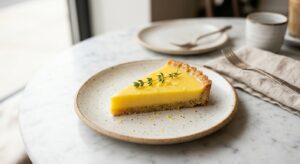
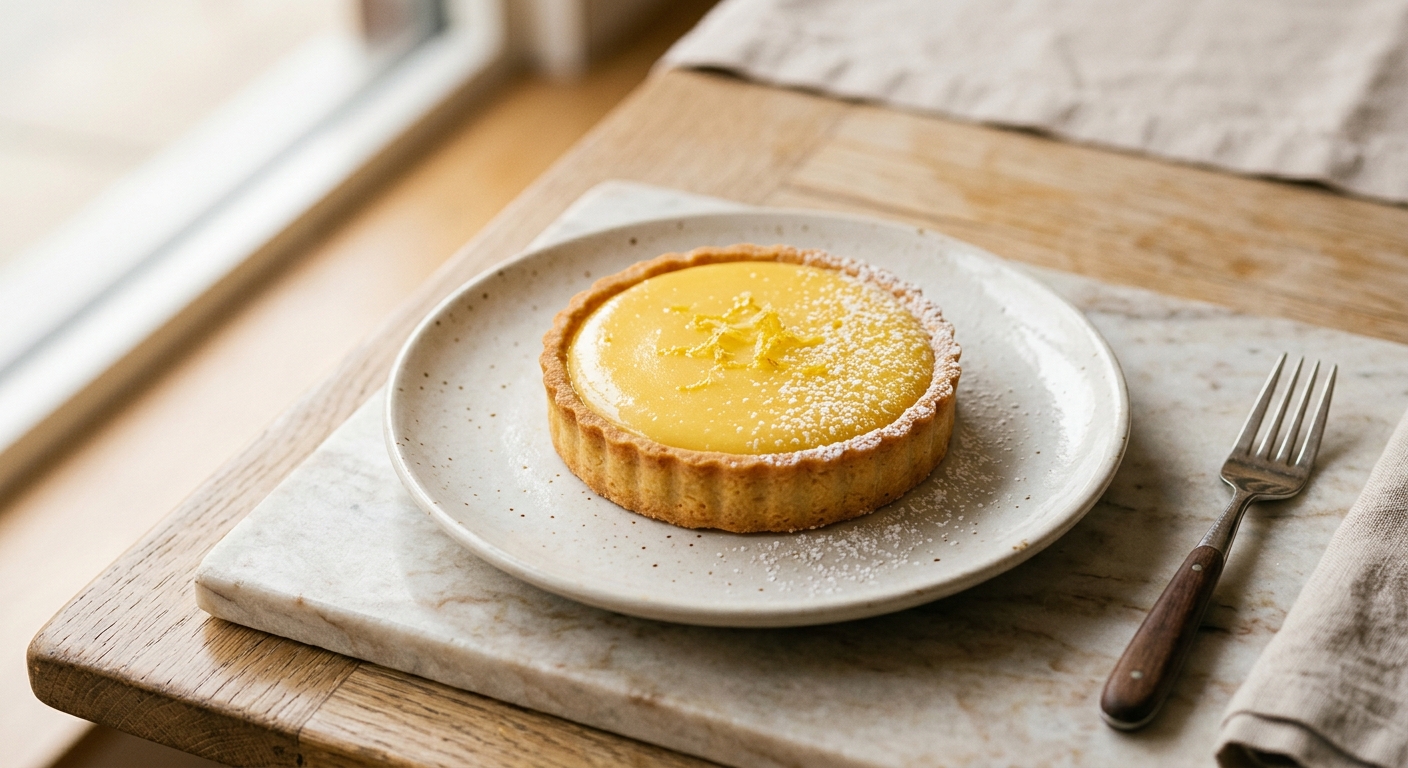
There is something deeply satisfying about a tart done well. The moment you slice through a perfectly crisp shell into a filling that holds its shape cleanly, catching the light with that pale lemon gloss, you know you have made something worth sharing. This lemon and almond cream tart is one of those recipes that feels quietly luxurious without demanding anything extraordinary from you. It smells of toasted almonds and warm pastry as it bakes, and the finished filling is soft and yielding, tart and creamy all at once, with a clean citrus finish that lingers pleasantly.
What sets this tart apart is the combination of two distinct components working in harmony. The shell is a classic pate sablee enriched with ground almonds, which adds a delicate crumb and a subtle nuttiness that plain shortcrust simply cannot offer. The filling is a French-style lemon cream, cooked gently on the stovetop rather than baked directly in the shell. Cooking it separately gives you complete control over the texture, resulting in a filling that is impossibly smooth and dense without any of the rubbery quality that can come from overbaked lemon curd. A final swirl of lightly whipped cream folded in at the end transforms it into something closer to a lemon mousse, light yet rich.
This recipe sits at a medium difficulty level. The pastry requires a light hand and some patience during blind baking, and the lemon cream needs attentive stirring at the stove. That said, every step is clearly explained and the techniques are foundational ones that will serve you across dozens of other recipes. It is ideal for the home baker who wants to stretch a little beyond the everyday and arrive at something genuinely impressive, whether for a weekend dinner party, a spring celebration, or simply because Tuesday deserves something beautiful.
Equipment Needed
Click on an item below to shop for the recommended items for this recipe on Amazon.
As an Amazon Associate, we earn from qualifying purchases.
10
Ingredients
- 180 gall-purpose flour (about 1 1/2 cups, spooned and leveled)
- 50 gground almonds (almond flour, about 1/2 cup)
- 60 gpowdered sugar (about 1/2 cup), sifted
- 0.25 tspColima Sea SaltMicroplastic Free Salt
- 115 gunsalted butter, cold and cut into 1cm cubes (about 1/2 cup)
- 1 largeegg yolk, cold
- 2 tbspcold water, plus more if needed
- 3 largeeggs, room temperature
- 2 largeegg yolks, room temperature
- 180 mlfresh lemon juice (from about 4 to 5 large lemons, approximately 3/4 cup)
- 200 ggranulated sugar (about 1 cup)
- 2 tbspfinely grated lemon zest (from about 3 lemons)
- 115 gunsalted butter, cut into cubes and softened to room temperature (about 1/2 cup)
- 120 mlheavy whipping cream, cold (about 1/2 cup)
- 1 tbsppowdered sugar, for whipping the cream
- —Powdered sugar or thin lemon slices, to garnish
Ingredient Substitutions
Instructions
- Make the almond pastry: Combine the flour, ground almonds, powdered sugar, and salt in a large bowl or food processor. Add the cold butter cubes and work in by hand using your fingertips, or pulse in the processor, until the mixture resembles coarse, damp sand with no large butter lumps remaining. Add the egg yolk and cold water, then mix just until the dough begins to clump together. If it seems dry, add water half a teaspoon at a time. Do not overwork the dough. Shape into a flat disc, wrap tightly in plastic wrap, and refrigerate for at least 1 hour or up to 2 days.
- Blind bake the shell: Preheat your oven to 375°F (190°C) with a rack in the lower third. On a lightly floured surface, roll the chilled dough into a circle about 3mm thick and roughly 30cm (12 inches) in diameter. Carefully drape it over a 9-inch (23cm) fluted tart pan with a removable base. Press gently into the edges without stretching, then trim the overhang flush with the top. Dock the base all over with a fork. Refrigerate for 20 minutes. Line the chilled shell with parchment paper and fill generously with pie weights or dried beans. Bake for 20 minutes until the edges are just golden.
- Remove the weights and parchment carefully, then return the shell to the oven for a further 12 to 15 minutes until the base is fully dry, golden, and smells of toasted almonds. Let it cool completely in the pan on a wire rack before filling.
- Make the lemon cream filling: While the shell cools, combine the eggs, egg yolks, granulated sugar, lemon juice, and lemon zest in a medium heavy-bottomed saucepan. Whisk together well. Cook over medium-low heat, stirring constantly with a heatproof spatula or wooden spoon, for 8 to 12 minutes until the mixture thickens noticeably and reads 170 to 175°F (77 to 80°C) on an instant-read thermometer. It should coat the back of the spoon and hold a clear line when you run your finger through it. Do not let it boil.
- Remove the pan from the heat and strain the lemon curd through a fine-mesh sieve into a clean bowl or large measuring jug. Discard any zest or cooked egg solids. Allow to cool to about 140°F (60°C), approximately 10 minutes. Add the softened butter pieces a few at a time, stirring after each addition until fully incorporated. Once all the butter is in, use an immersion blender or transfer to a stand blender and blend for 1 to 2 minutes until the cream is silky, glossy, and emulsified. Press plastic wrap directly onto the surface and refrigerate until fully cold, at least 2 hours.
- Fold in the whipped cream and assemble: Once the lemon cream is cold and set, whip the heavy cream and 1 tablespoon of powdered sugar together to soft peaks. Using a flexible spatula, gently fold the whipped cream into the cold lemon cream in two additions until just combined and smooth. Pour and scrape the filling into the cooled tart shell. Smooth the top with an offset spatula. Refrigerate for at least 30 minutes before slicing. Dust lightly with powdered sugar or garnish with thin lemon slices just before serving.
- Purchase a 9-inch pre-baked shortcrust or almond tart shell from a reputable bakery or the baking aisle. If it seems soft, crisp it up in a 350°F (175°C) oven for 8 to 10 minutes, then let it cool completely before filling.
- Make the lemon cream filling: Combine the eggs, egg yolks, granulated sugar, lemon juice, and lemon zest in a medium heavy-bottomed saucepan. Whisk well to combine. Cook over medium-low heat, stirring constantly with a heatproof spatula, for 8 to 12 minutes until thickened and the mixture reaches 170 to 175°F (77 to 80°C). It should coat the spoon and hold a line when you drag a finger across it. Remove from heat immediately.
- Strain the curd through a fine-mesh sieve into a clean bowl. Let cool to around 140°F (60°C), then add the softened butter piece by piece, stirring to incorporate each addition fully. Blend with an immersion blender for 1 to 2 minutes until very smooth and glossy. Press plastic wrap onto the surface and refrigerate for at least 2 hours until cold and set.
- Fold the cold lemon cream with the whipped cream (soft peaks, sweetened with 1 tablespoon powdered sugar) in two gentle additions. Spoon and spread into the cooled tart shell. Smooth the top and refrigerate for at least 30 minutes before serving. Garnish with a light dusting of powdered sugar or a few thin lemon rounds.
- Prepare the almond pastry as described in the oven method and chill for 1 hour. Prepare the lemon cream filling on the stovetop following the same steps, and refrigerate until cold.
- Preheat your oven to 375°F (190°C). Divide the chilled dough into 8 to 10 equal portions depending on your pan size. Roll each portion into a 3mm thick circle slightly larger than the cavity of each mini tart pan or muffin cup. Press gently into the pans, trim the edges, and dock the bases with a fork. Freeze the lined pans for 15 minutes (freezing rather than refrigerating helps small shells hold their shape during blind baking).
- Line each chilled mini shell with a small square of parchment and fill with pie weights or dried beans. Bake for 12 minutes until the edges are set. Remove weights and parchment and bake a further 8 to 10 minutes until the bases are golden and dry. Cool completely in the pans on a wire rack.
- Fold the cold lemon cream with the whipped cream as described. Transfer to a piping bag fitted with a large round or star tip. Pipe the filling generously into each cooled mini shell. Alternatively, spoon and smooth with the back of a small spoon. Refrigerate for at least 30 minutes.
- Just before serving, garnish each mini tart with a small slice of fresh lemon, a curl of lemon zest, or a single edible flower for an elegant finishing touch.
Nutrition Per Serving
Per 1 serving (makes one 9-inch (23cm) tart)
Why This Recipe Works
The secret to a crack-free, shrink-free tart shell lies in two things: cold butter and patience. Keeping the butter cold as you work the pastry ensures that small, solid fat particles coat the flour without fully blending into it. These pockets of fat melt in the oven, creating a tender, crumbly, almost cookie-like texture called pate sablee, quite different from the flaky layers you get with puff pastry. The ground almonds replace some of the flour, reducing gluten development further and adding fat of their own, which is why this shell has such a delicate, melt-in-the-mouth quality. Chilling the dough before rolling and again after lining the pan allows any developed gluten to relax and the butter to firm back up, both of which dramatically reduce shrinkage during blind baking.
The lemon cream filling is cooked on the stovetop rather than baked in the shell because direct oven heat is much harder to control for an egg-based custard at this scale. Stovetop cooking lets you watch the curd closely and pull it at exactly the right moment, around 170 to 175°F (77 to 80°C), where the egg proteins have set firmly enough to thicken the curd but have not curdled into scrambled egg. Straining immediately stops the cooking and removes any tiny cooked egg pieces before they affect the texture. Adding the butter below 140°F (60°C) and then blending creates an emulsion, where the fat molecules are broken into tiny droplets suspended in the lemon liquid, giving the cream its extraordinarily smooth, almost silky mouthfeel. This technique is borrowed directly from French patisserie and makes a noticeable difference compared to simply stirring the butter in.
Folding in lightly whipped cream at the end does two things. First, it lightens the density of the curd, making the filling feel airy on the palate rather than heavy. Second, the fat in the cream helps stabilize the filling so it slices cleanly and holds its shape at room temperature for a short period. If your filling seems loose after folding, it simply needs more time in the refrigerator. Do not be tempted to add more whipped cream to compensate, as this will dilute the lemon flavour.
Baker’s Tips
- Use a microplane or fine zester for the lemon zest and press firmly to get the aromatic oils from the outermost yellow layer only. Avoid the white pith directly beneath, which is bitter.
- Roll the pastry between two sheets of parchment paper if you find it sticks to the work surface. Almond pastry is more fragile than plain shortcrust and this method makes transferring it to the pan much easier.
- If your pastry cracks when you transfer it to the pan, simply press the pieces back together with your fingers. The shell will still blind bake perfectly and the crack will be invisible once filled.
- Do not rush the stovetop curd. Cooking over medium-low heat with constant stirring may feel slow, but high heat risks curdled eggs and a grainy texture. The extra 5 minutes are absolutely worth it.
- An instant-read thermometer takes all the guesswork out of the lemon cream. If you do not have one, use the spoon test: drag your finger across the back of the coated spoon and the line should hold completely clean without the curd running back together.
- Make sure the lemon cream is fully cold and set before folding in the whipped cream. Warm curd will deflate the cream immediately and the filling will not hold its shape in the shell.
Variations
- Blood orange and almond tart: Replace all lemon juice and zest with fresh blood orange juice and zest. Reduce the sugar by 20g as blood oranges are sweeter. The filling will be a stunning deep rose colour.
- Lemon and lavender: Add 1 teaspoon of dried culinary lavender to the lemon juice and sugar before cooking the curd. Strain it out with the zest for a delicately floral filling that is not overpowering.
- Chocolate almond shell: Add 20g of unsweetened cocoa powder to the pastry dough, reducing the flour by the same amount. The dark shell creates a striking contrast with the pale yellow filling.
- Dairy-free version: Use cold vegan block butter in the pastry and coconut cream butter (such as Miyoko’s) in the lemon cream. Whip chilled coconut cream to soft peaks in place of the heavy cream. The result is richly flavoured with a gentle coconut undertone.
Troubleshooting & FAQ
My tart shell shrank and slid down the sides during blind baking. What went wrong?
My lemon cream filling looks grainy or has small lumps in it. Can it be rescued?
The filling is not setting firmly enough. It looks too soft or runny in the shell.
The base of my tart shell is soggy even after blind baking. How do I fix this?
My pastry dough is crumbling apart and will not come together. What should I do?
Storage & Make-Ahead
- Storage: Store the filled tart loosely covered in the refrigerator for up to 3 days. The pastry will begin to soften slightly after the first day as it absorbs moisture from the filling, which many people enjoy. Do not freeze the assembled tart as the filling texture suffers. Unfilled baked tart shells can be stored at room temperature in an airtight container for up to 2 days or frozen for up to 1 month.
- Make-Ahead: The almond pastry dough can be made up to 2 days ahead and refrigerated, or frozen for up to 6 weeks. The baked tart shell can be prepared a day ahead and stored at room temperature. The lemon cream (before folding in the whipped cream) can be made up to 3 days ahead and kept refrigerated, covered with plastic wrap directly on the surface. Fold in the whipped cream and fill the shell on the day of serving for the best texture and presentation.