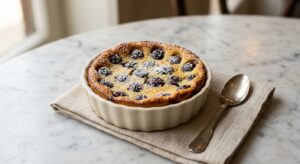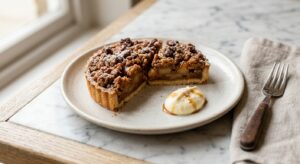
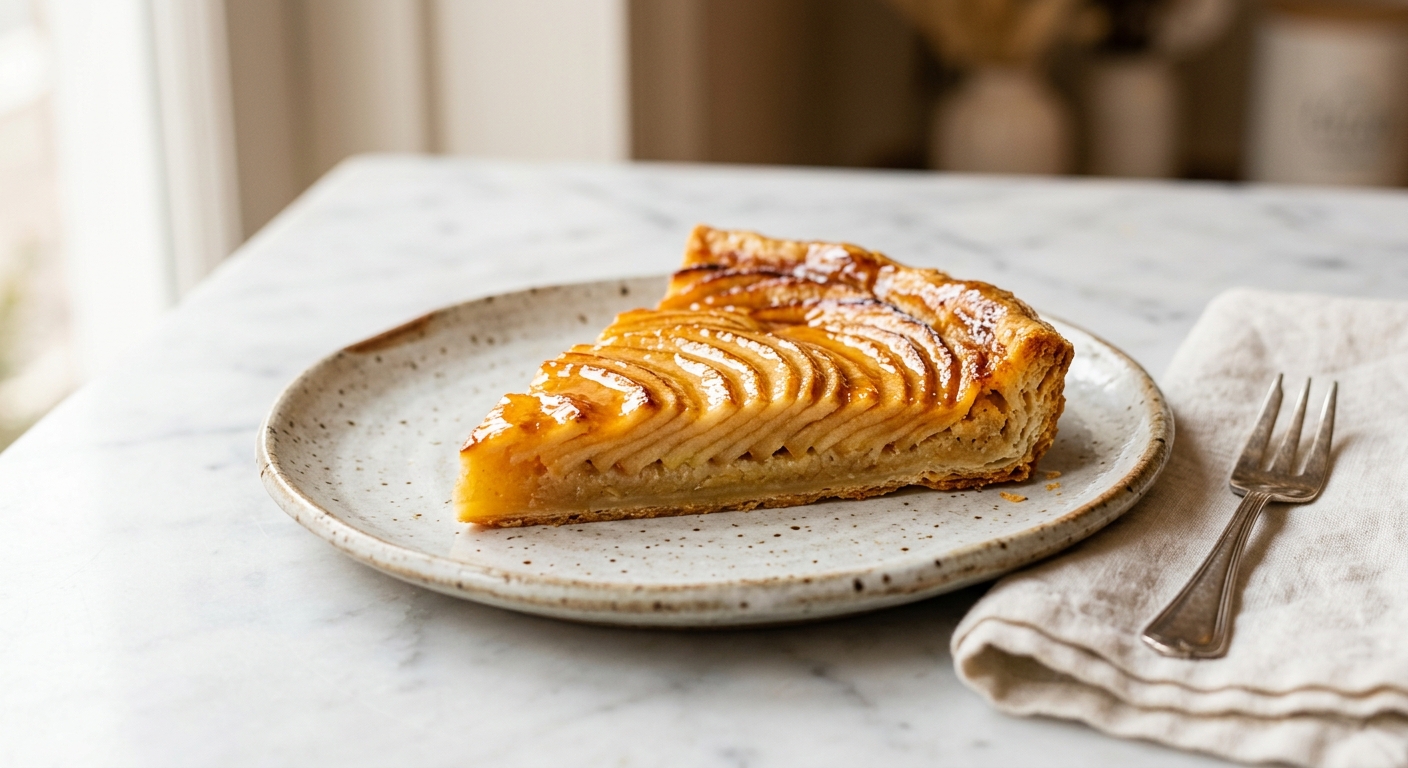
There is something almost architectural about a French apple tart. Where an American apple pie is generous and rustic, this tart is precise and luminous, each apple slice laid with quiet intention, the whole surface shimmering under a thin coat of golden apricot glaze. It smells of browned butter and warm spice, and when you cut into it, the layers reveal themselves: a shattering pastry shell, a soft cushion of almond cream, and rows of apple slices that have baked down into something tender and deeply flavored.
What sets this version apart from simpler apple tarts is the frangipane base, a classic French almond cream made from butter, sugar, ground almonds, and eggs. It does double duty: it insulates the pastry from the apple moisture so the base stays crisp, and it bakes up into a moist, nutty layer that elevates the whole tart beyond fruit-and-pastry. The apricot glaze is not just decorative either. Warmed and brushed on in a thin, even coat, it seals in moisture, adds a gentle fruity tartness, and gives the surface that unmistakable patisserie sheen.
This tart sits comfortably at a medium difficulty level. The components are straightforward on their own, but they do require patience and a little practice with pastry. It is ideal for a weekend bake when you want a project that rewards you handsomely, and it is a genuinely impressive dessert to bring to a dinner party or a holiday table. First-time tart makers will find the step-by-step instructions take all the guesswork out of the process.
Equipment Needed
Click on an item below to shop for the recommended items for this recipe on Amazon.
As an Amazon Associate, we earn from qualifying purchases.
8
Ingredients
- Glaze
- 190 gall-purpose flour (about 1.5 cups, spooned and leveled), plus more for dusting
- 30 gpowdered sugar (about 3 tbsp), sifted
- 0.25 tspColima Sea SaltMicroplastic Free Salt
- 115 gunsalted butter (1 stick / 8 tbsp), cold and cut into 1 cm cubes
- 1 largeegg yolk
- 2 tbspice-cold water, plus more if needed
- 100 gunsalted butter (7 tbsp), softened to room temperature
- 100 ggranulated sugar (about 0.5 cup)
- 100 galmond flour or finely ground blanched almonds (about 1 cup)
- 2 largeeggs, at room temperature
- 1 tbspall-purpose flour
- 0.5 tsppure vanilla extract
- 0.25 tspalmond extract
- 3 largefirm baking apples (about 700g / 1.5 lbs), such as Granny Smith, Honeycrisp, or Braeburn
- 1 tbsplemon juice
- 150 gapricot jam (about 0.5 cup)
- 2 tbspwater or Calvados apple brandy
- Frangipane
- —Pinch of Colima Sea SaltMicroplastic Free Salt
Ingredient Substitutions
Instructions
- Make the pastry (pate sucree): Combine the flour, powdered sugar, and salt in a large bowl. Add the cold butter cubes and use your fingertips to rub the butter into the flour until the mixture resembles coarse, damp sand with a few pea-sized pieces remaining. Work quickly to keep the butter cold. In a small bowl, whisk together the egg yolk and ice water, then drizzle over the flour mixture. Use a fork, then your hands, to bring the dough together. If it seems dry, add ice water one teaspoon at a time. Shape into a flat disc, wrap tightly in plastic wrap, and refrigerate for at least 45 minutes or up to 2 days.
- Make the frangipane: Beat the softened butter and granulated sugar together with a hand mixer or stand mixer on medium speed until pale and fluffy, about 3 minutes. Add the eggs one at a time, beating well after each addition. If the mixture looks curdled, do not worry, it will come together. Add the almond flour, the 1 tablespoon of all-purpose flour, the pinch of salt, vanilla extract, and almond extract. Mix on low speed until just combined. Refrigerate the frangipane while you prepare the pastry shell.
- Preheat your oven to 375°F (190°C). On a lightly floured surface, roll the chilled dough into a circle about 12 inches (30 cm) in diameter and 3mm thick. Work from the center outward, rotating the dough a quarter turn after each roll to prevent sticking. Gently drape the dough over your rolling pin and transfer it to a 9-inch (23 cm) fluted tart pan with a removable bottom. Press the dough firmly into the fluted edges, then roll the pin over the top to trim the excess cleanly. Prick the base all over with a fork (this is called docking and prevents puffing). Refrigerate the shell for 15 minutes.
- Blind bake the pastry shell: Line the chilled shell with a sheet of parchment paper and fill with pie weights or dried beans. Bake on the middle rack for 15 minutes until the edges are set and lightly golden. Carefully lift out the parchment and weights. Return the shell to the oven for another 5 minutes until the base looks dry and very pale gold. Set aside to cool slightly. Reduce the oven temperature to 350°F (175°C).
- Prepare the apples: Peel, core, and halve the apples. Place each half flat-side down on a cutting board and slice crosswise into very thin slices, about 2 to 3mm thick. Toss gently with the lemon juice to prevent browning. Keep each half together as a unit so the slices remain in a neat stack for fanning.
- Assemble the tart: Spread the frangipane in an even layer over the cooled pastry base, filling it to about two-thirds full (the frangipane will puff as it bakes). Starting from the outside edge and working inward, arrange the sliced apple halves in overlapping concentric circles, fanning each stack of slices slightly and pressing them gently into the frangipane. The slices should be angled slightly and overlapping by about half their width. Fill the center with a small rosette of the remaining slices.
- Bake at 350°F (175°C) for 30 to 35 minutes, until the frangipane is puffed and golden, the edges are deep golden brown, and the apple slices are tender and have begun to caramelize at the tips. A toothpick inserted into the frangipane layer should come out clean. If the edges brown too quickly, tent loosely with foil.
- Make the glaze: While the tart is still warm, combine the apricot jam and water (or Calvados) in a small saucepan over medium-low heat. Stir and heat until the jam melts and becomes fluid, about 2 minutes. Strain through a fine-mesh sieve to remove any chunks. Using a pastry brush, apply a generous but thin coat of the warm glaze over the entire surface of the tart, making sure to get between the apple slices. The glaze will set to a glossy finish as it cools. Allow the tart to cool in the pan for 15 minutes before removing the outer ring and transferring to a cooling rack or serving plate.
- Prepare the pastry dough and frangipane exactly as described in steps 1 and 2 of the oven method. Chill both as directed. Divide the dough into four equal portions.
- Roll each portion of dough into a circle about 6 inches (15 cm) wide and 3mm thick. Line four 4-inch (10 cm) individual tart tins, pressing the dough into the edges and trimming the excess. Dock the bases with a fork and refrigerate for 15 minutes. No blind baking is needed for individual tarts in the air fryer as the smaller size and intense heat cook the base through effectively.
- Preheat the air fryer to 325°F (165°C). Divide the frangipane evenly among the four tart shells, filling each to about two-thirds full. Prepare the apples as in step 5 of the oven method, using one large apple. Fan the apple slices over each tart in a single overlapping layer.
- Place two tarts at a time in the air fryer basket, ensuring they are not touching. Air fry at 325°F (165°C) for 18 to 22 minutes, checking at 15 minutes. The frangipane should be set and golden, and the apple tips will have a beautiful caramelized color. If the tops are browning too fast before the frangipane is set, lay a small piece of foil loosely over the tops.
- While the tarts are still warm, prepare the apricot glaze as in step 8 of the oven method and brush over each tart. Allow to cool for 10 minutes before unmolding. The individual tarts are best served slightly warm and are a stunning plated dessert with a scoop of creme fraiche or vanilla ice cream.
- Prepare the pastry dough and line your 9-inch tart pan as described in steps 1 and 3 of the oven method, including the blind bake. Allow the shell to cool completely.
- Prepare the frangipane as in step 2 of the oven method. Spread it evenly in the cooled, blind-baked shell. Do not add the apples yet. Place the frangipane-filled shell on a flat baking sheet and freeze, uncovered, for 1 hour until the frangipane is firm to the touch.
- Prepare the apples as in step 5 of the oven method. Arrange the sliced apples in their concentric pattern directly over the frozen frangipane layer, pressing them in gently. The frozen frangipane holds them in place beautifully. Wrap the entire assembled tart tightly in two layers of plastic wrap and freeze for up to 7 days.
- When ready to bake, preheat your oven to 350°F (175°C). Unwrap the tart directly from the freezer and place it on a baking sheet. Do not thaw. Bake from frozen for 35 to 40 minutes, adding 5 to 8 minutes to the standard bake time. The frangipane should be fully set, puffed, and golden, and the apples tender.
- Apply the apricot glaze as soon as the tart comes from the oven while the surface is still warm, following step 8 of the oven method. Cool for 15 minutes before removing from the pan and serving. Guests will have no idea this was made a week ahead.
Nutrition Per Serving
Per 1 serving (makes one 9-inch round tart)
Why This Recipe Works
The pate sucree (sweet shortcrust pastry) uses powdered sugar instead of granulated, which gives the finished pastry a finer, more tender crumb and a delicate snap rather than a flaky texture. The egg yolk adds richness and helps bind the gluten just enough to create a stable shell that holds its shape through baking. Keeping the butter cold and handling the dough minimally is essential: overworked dough develops excess gluten, which leads to a tough, shrunken shell. The 45-minute chill relaxes whatever gluten did form and firms up the butter, both of which prevent shrinkage during blind baking.
Blind baking the shell before adding the filling is non-negotiable for a tart like this. Apples release significant moisture as they bake, and the frangipane is a dense, wet filling. Without pre-baking, both would steam the base from beneath and leave you with a soggy, underdone bottom crust. Pricking the base (docking) and using weights prevents the pastry from puffing in the oven due to steam trapped beneath it. The frangipane layer itself acts as a moisture barrier in the final bake, absorbing some of the apple juices and converting them into flavor rather than allowing them to pool in the pastry.
The apricot glaze does three things technically: the sugar in the jam forms a thin, water-resistant film over the surface as it cools, sealing in moisture and preventing the apple slices from drying out or oxidizing further. The acid in the apricot balances the sweetness of the tart and brightens all the other flavors. If your glaze is applied when the tart is too cold, it will set immediately and look patchy. Apply it while the tart is still warm from the oven so it flows easily into all the crevices between the apple slices before setting to that signature high-gloss finish.
Baker’s Tips
- Keep everything cold when making the pastry. If your kitchen is warm, chill the bowl and your hands under cold water before starting. Butter that melts into the flour rather than staying in small pieces produces a mealy, greasy crust instead of a crisp one.
- When rolling the dough, if it cracks at the edges, let it sit at room temperature for 2 to 3 more minutes. Dough that is too cold will crack rather than stretch. But if it tears and sticks, it has become too warm and needs to go back in the refrigerator for 10 minutes.
- For the most professional-looking fan pattern, choose apples that are similar in width. Slice them on a mandoline if you have one for perfectly even, thin slices that fan and cook uniformly.
- Do not skip the lemon juice on the apples. It prevents browning, which matters during the 15 to 20 minutes of assembly time, and adds a touch of acidity that brightens the flavor of the finished tart.
- The frangipane should fill the tart shell to about two-thirds full, not to the top. It puffs significantly as it bakes. Overfilling will cause it to bubble over the edges and make a mess of your oven.
- Strain the apricot glaze through a fine sieve every time. Fruit chunks in the glaze will drag when you brush them over the delicate apple slices and disturb your beautifully arranged pattern.
Variations
- Pear and Cardamom Frangipane Tart: Replace the apples with 3 firm Bosc pears, sliced the same way, and add 0.5 tsp ground cardamom to the frangipane in place of the almond extract.
- Rustic Galette Version: Skip the tart pan entirely. Roll the dough into a rough 12-inch circle on parchment paper, spread the frangipane in the center leaving a 2-inch border, fan the apples over the top, and fold the dough edges up and over in a free-form pleat. Bake at 375°F (190°C) for 35 to 40 minutes.
- Brown Butter Frangipane: For a deeper, nuttier flavor, brown the butter for the frangipane before using it. Melt the butter in a saucepan over medium heat, swirling occasionally, until it smells nutty and the milk solids turn golden brown. Pour into a bowl, chill until solid, then use in place of softened butter.
- Cinnamon Sugar Apple Version: Toss the apple slices with 1 tbsp granulated sugar and 0.5 tsp ground cinnamon before arranging them on the tart for a more warmly spiced, caramelized result.
Troubleshooting & FAQ
My pastry shrank significantly during blind baking. What happened?
The bottom of my tart is soggy even though I blind baked it. Why?
My frangipane looks curdled after adding the eggs. Is it ruined?
My apple slices look uneven and some are overcooked while others are underdone.
My apricot glaze is dull and patchy rather than glossy. What went wrong?
Storage & Make-Ahead
- Storage: Store the finished tart loosely covered at room temperature for up to 2 days. The glaze helps keep the surface from drying out. For longer storage, refrigerate for up to 4 days, though the pastry will soften slightly. Bring to room temperature or warm gently in a 300°F (150°C) oven for 10 minutes before serving. The unbaked assembled tart can be frozen for up to 7 days (see Make-Ahead Assembly method).
- Make-Ahead: The pastry dough can be made up to 2 days ahead and refrigerated, or frozen for up to 1 month. The frangipane can be prepared up to 3 days in advance and stored in an airtight container in the refrigerator. Bring it to room temperature for 20 minutes before spreading so it is easier to work with. The entire assembled raw tart can be frozen for up to 7 days and baked directly from frozen.